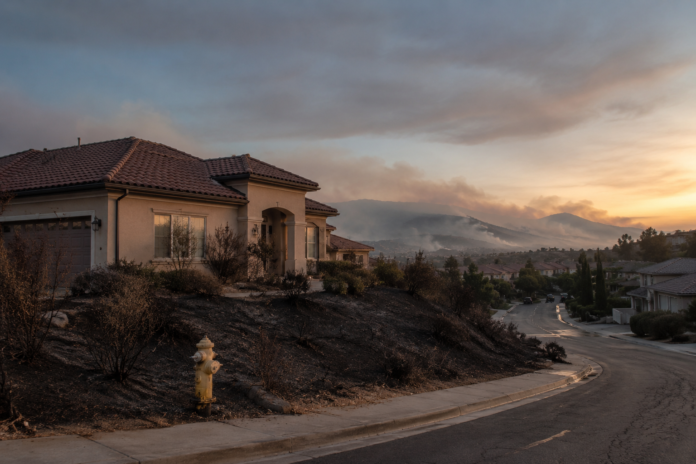
A homeowner in the hills above Los Angeles used to worry about her premium going up ten or fifteen percent a year. In the spring of 2025, she got a different kind of letter: a non-renewal notice, arriving six weeks after the Eaton Fire burned through a neighborhood two ridgelines away from her own untouched house. Her insurer wasn’t paying a claim on her home. It was leaving her ZIP code.
Quick Answer
The homeowners insurance availability crisis is the withdrawal of private insurers from wildfire-, hurricane-, and hail-exposed markets faster than regulators or state-run backstops can absorb the displaced homeowners. It shows up first as non-renewals, not just rate hikes: insurers in California, Florida, and Louisiana have shed hundreds of thousands of policies since 2022, pushing homeowners onto state “insurer of last resort” plans like the California FAIR Plan and Florida Citizens Property Insurance Corporation, which now carry far more concentrated risk than they were designed to hold. The trigger is usually a single catastrophe or a state’s rate regulations colliding with rising reinsurance costs, and the consequence for an individual homeowner is a lapsed policy, a mortgage-lender ultimatum, or a forced move to a costlier surplus-lines carrier.
Who Gets Hit First: The Anatomy of a Non-Renewal Notice
Insurance companies do not cancel policies in the middle of a covered term except in narrow circumstances like nonpayment or fraud. What they do instead, on a mass scale, is decline to renew. A non-renewal notice typically arrives 45 to 120 days before a policy’s expiration date, depending on the state, and it does not require the insurer to point to anything the homeowner did wrong. The trigger is almost never an individual claim. It is a portfolio-level decision made by an actuarial team that has re-run a catastrophe model and concluded that an entire ZIP code, county, or wildfire-hazard-severity zone no longer clears the company’s return threshold.
Four groups tend to receive these notices first, and the pattern has been remarkably consistent across states since 2022:
- Homes in a designated high hazard zone. California’s Department of Insurance maps “Very High” fire hazard severity zones down to the parcel level; a home just inside the line faces materially different treatment than one thirty yards outside it, even though the physical exposure is nearly identical.
- Homes with aging roofs or systems. Roofs older than 15-20 years, knob-and-tube wiring, polybutylene plumbing, and homes without updated electrical panels are flagged disproportionately in hail- and wind-exposed states such as Oklahoma and Colorado.
- Homes carrying replacement-cost gaps. If a policy’s dwelling coverage limit has not kept pace with reconstruction costs, insurers increasingly treat the mismatch itself as a risk signal, since underinsured claims produce disputes and litigation.
- Homes in counties where the insurer’s own reinsurance treaty got more expensive. This is the least visible trigger to the homeowner, and the most common one operationally. When a carrier’s catastrophe reinsurance renews at a materially higher rate, the carrier often responds by shrinking its footprint in the counties that reinsurer priced most punitively, regardless of any individual home’s condition.
The result is a market where creditworthiness of the insurer, not just the homeowner, has become the swing factor. A well-maintained, mid-value home with a spotless claims history can still lose coverage purely because of where it sits on a map.
Risk Factor One: Catastrophe Models Are Repricing Risk Faster Than Regulators Can Approve It
For most of the last three decades, insurers priced homeowners policies primarily off historical loss experience: what a given area had actually cost the company to insure over the prior 10 to 20 years. That approach broke down as wildfire and severe convective storm losses stopped following historical patterns. Insurers now lean on forward-looking catastrophe models built by firms like Verisk, CoreLogic, and Moody’s RMS, which simulate tens of thousands of synthetic storm and fire years to estimate a “probable maximum loss” for a given portfolio.
The friction comes from a regulatory mismatch. States such as California historically required insurers to set rates using only backward-looking data under Proposition 103, which meant a carrier could not charge today for a wildfire risk that models predicted for next year, only for wildfire losses that had already happened. California’s Sustainable Insurance Strategy, rolled out by the Department of Insurance starting in 2024, changed that trade: insurers can now use forward-looking catastrophe models and factor in reinsurance costs in their rate filings, in exchange for a commitment to write more policies in wildfire-distressed areas. The reform is still in its early years, and the state’s largest insurers have used the new rules to file for double-digit increases while only gradually restoring capacity.
The chart below shows how sharply non-renewal activity climbed between 2018 and 2023 across the states where catastrophe-model recalibration hit hardest, based on aggregated carrier filing data compiled by insurance analytics firms.
Growth in Homeowners Non-Renewal Rates, 2018-2023
Percent increase in policies non-renewed, by state
Bars scaled to Florida’s increase (280% = 100% bar width). Source: aggregated carrier non-renewal filing data, 2018 baseline vs. 2023.
Notice that California’s percentage increase looks comparatively modest next to Florida’s. That is deceptive. California started from a much smaller non-renewal base because Proposition 103’s rate suppression had kept more insurers writing business there for longer, which means the 82% increase represents a market that changed direction abruptly rather than one that had already adjusted. Montana and Wyoming, states with no obvious catastrophe narrative, still posted 67% increases each over the same period, a sign that reinsurance repricing is now bleeding into markets nobody would flag as high-risk from a homeowner’s chair.
Risk Factor Two: The Reinsurance Squeeze Behind Every Rate Filing
Homeowners rarely see the layer of the market that actually drives most non-renewal decisions: reinsurance, the insurance that primary carriers buy to protect their own balance sheets against catastrophic losses. When global reinsurers raised property-catastrophe rates by 30-50% at the January 2023 renewal, the largest single-year jump the market had seen since Hurricane Katrina, primary insurers faced a choice between absorbing the cost, passing it through in rate filings, or shrinking the book of business exposed to the priciest reinsurance layers.
Most carriers did some combination of all three. The California FAIR Plan illustrates the mechanics well because its finances are public. After the January 2025 Palisades and Eaton fires caused an estimated $4.1 billion in insured losses and pushed the FAIR Plan’s own claims past $1.2 billion by that April, the plan exhausted its available claims-paying capacity and levied a $1 billion assessment on every admitted insurer doing business in California. Under the state’s existing rules, insurers can pass through 50% of the first $1 billion of any FAIR Plan assessment directly to policyholders statewide as a surcharge, and 100% of any amount above that threshold. A homeowner in Sacramento who has never filed a claim and lives nowhere near a fire hazard zone still helped pay for the Eaton and Palisades losses through that mechanism.
This is the structural core of the availability crisis: losses that used to stay contained within a single insurer’s book, in a single state, are now being socialized across an entire state’s policyholder base, and increasingly across the reinsurance market’s global capital, which prices in California and Florida risk alongside European windstorm risk and Japanese earthquake risk. When any one of those exposures spikes, the repricing ripples into homeowners’ mailboxes everywhere reinsurance-dependent carriers operate.
Reinsurance Renewal Cycle: What Homeowners Should Watch
Reinsurance treaties for U.S. property catastrophe risk typically renew on January 1 and, for a smaller share of the market, June 1 ahead of hurricane season. Rate movement at those two renewal dates tends to show up in homeowners’ policies four to nine months later, once state insurance departments approve the resulting rate filings. A homeowner who tracks January reinsurance renewal headlines gets a rough early-warning system for what their own premium, or non-renewal risk, will look like by the following autumn.
Risk Factor Three: State-Run “Insurer of Last Resort” Plans Are Becoming the Primary Market
Every state maintains some version of a residual insurance market for homeowners who cannot find coverage from a private carrier: the California FAIR Plan, Florida’s Citizens Property Insurance Corporation, Louisiana Citizens, the Texas Windstorm Insurance Association, and similar entities elsewhere. These plans were built as backstops of genuinely last resort, expected to hold a small, stable share of the market. That design assumption has broken down in the two states most exposed to catastrophe risk.
Florida’s Citizens peaked at roughly 1.4 million policies in September 2023, at one point insuring close to one in six homes in the state. An aggressive, state-directed depopulation program, combined with tort and litigation reforms that reduced insurers’ legal-defense costs and a wave of new private carriers entering the market, cut that number to roughly 439,000 policies by late November 2025, with regulators projecting a further drop to around 385,000 by year-end, the lowest level in the company’s history. Under Florida’s “take-out” rules, a Citizens policyholder must generally accept a private offer if it comes in within 20% of their Citizens premium, which has accelerated the shift even for homeowners who would prefer to stay put.
California’s FAIR Plan moved in the opposite direction for most of the last decade. Its share of new California home-purchase mortgages rose from roughly 1.6% of the statewide residential market in 2015 to 3.7% in 2023, then spiked further after the January 2025 fires: FAIR Plan policies backed 8.1% of new California mortgage originations in the first quarter of 2025, before easing slightly to 5.6% by the first quarter of 2026 as some depopulation and private-market re-entry took hold. Roughly 40% of FAIR Plan policyholders also carry a separate “difference in conditions” policy to cover perils the FAIR Plan’s basic fire policy excludes, adding close to $2,000 a year in extra premium on top of the FAIR Plan cost itself.
The direction of travel matters more than the snapshot. Florida shows that a residual market can shrink again once litigation costs and reinsurance capacity normalize. California shows what happens when a wildfire season outruns the reforms meant to prevent exactly this outcome. Both plans share the same underlying fragility: they charge rates set by statute or regulatory formula rather than pure market pricing, they are usually not allowed to hold as much reinsurance and reserve capital as private carriers, and when a single catastrophic event exceeds their claims-paying resources, the assessment mechanism spreads the shortfall across the entire state’s insured population, private-market policyholders included.
The $4.1 Billion Wake-Up Call: How the Eaton and Palisades Fires Exposed the Whole System
The January 2025 wildfires in and around Los Angeles offer the clearest recent worked example of how the availability crisis moves from an abstract market trend into a specific homeowner’s bad week.
Before the fires, the FAIR Plan already carried an outsized concentration of homes in the Pacific Palisades and Altadena areas, precisely because private insurers had been non-renewing policies there for several years. When the fires burned through those neighborhoods, the FAIR Plan was left holding a disproportionate share of the total loss relative to its size: an estimated $4.1 billion in combined insured losses across both fires, against a claims-paying structure designed around routine, dispersed wildfire seasons rather than a single event of that magnitude concentrated in the plan’s own highest-risk geography.
By April 2025, the FAIR Plan had already paid out roughly $1.2 billion against nearly 5,000 claims and had exhausted the capital cushion it normally relies on before triggering an assessment. Regulators approved a $1 billion assessment against the state’s admitted insurers, structured so the companies could recover half of that amount from policyholders statewide through a surcharge, pending final sign-off from the Insurance Commissioner. One of the state’s largest homeowners insurers, covering roughly one-fifth of the California market, disclosed it expected to pay more than $7 billion in fire-related claims across its own book and separately received approval for a rate increase of about 17% effective mid-2025, on top of a request it had filed before the fires occurred.
Three downstream effects followed within months, and they illustrate exactly what “availability crisis” means in practice rather than in the abstract:
- Homeowners outside the burn area paid for it anyway. The statewide assessment surcharge meant a homeowner in Fresno or Bakersfield, with no wildfire exposure at all, saw a line-item increase tied to a fire hundreds of miles away.
- Mortgage servicers began flagging lapsed coverage faster. Lenders that hold the mortgage on a home are contractually required to maintain continuous hazard insurance on the collateral; when a FAIR Plan policyholder’s coverage lapsed during the post-fire scramble for replacement policies, several servicers moved to force-placed coverage within 30 to 45 days, a policy the lender buys on the homeowner’s behalf that typically costs two to four times a normal market rate and covers only the lender’s interest, not the homeowner’s contents or liability.
- The FAIR Plan’s underlying reinsurance program strained at the same moment its policy count was climbing. Its coverage tower is structured with a retention of roughly $900 million per wildfire event before reinsurance responds, above which it can draw on a program with an annual capacity of around $5.78 billion; a repeat event of similar or larger size within the same reinsurance treaty year would test that structure directly.
The episode did not create a new problem so much as compress a decade-long trend into a single fiscal year, showing regulators, insurers, and homeowners simultaneously what happens when a residual market designed for the exception becomes, in practice, the rule for an entire region.
Red Flags: Signs Your Coverage Is at Risk of Non-Renewal
Most homeowners do not find out their insurer is retreating from their area until the notice arrives. These signals tend to show up first, often a full renewal cycle or two before the actual non-renewal letter.
| Red Flag | What It Usually Means | Typical Lead Time |
|---|---|---|
| Insurer announces it has “paused new business” in your state or county | Renewals often continue for a period, but the carrier is signaling it wants to shrink its footprint and non-renewals in the same territory frequently follow | 6-18 months |
| Your renewal premium jumps more than 25% with no claims history | A territory-level rate action is underway; large jumps often precede a non-renewal wave for the same rating tier | 1-2 renewal cycles |
| Insurer requests a new roof, wildfire, or wind-mitigation inspection | The carrier is re-underwriting the individual risk, often ahead of deciding whether to keep the policy at all | 3-9 months |
| Neighboring homes report non-renewal letters | Non-renewals are almost always territory-based rather than individual; a cluster nearby is a strong leading indicator | 0-12 months |
| Your dwelling coverage limit has not increased in 3+ years | A widening gap between coverage and true reconstruction cost is itself a red flag insurers now screen for | Ongoing |
| Mortgage servicer sends a “insufficient coverage” notice | Your policy has lapsed, been canceled, or fallen below the lender’s required limit; force-placed coverage can follow within 30-45 days | 30-45 days |
How to Protect Your Coverage: A Practical Response Checklist
None of these steps guarantee a carrier will keep you, but each one measurably improves your odds of finding replacement coverage quickly and at a defensible price if a non-renewal notice does arrive.
Before a Non-Renewal Notice Arrives
- Get your dwelling coverage limit reviewed annually against actual local rebuild costs, not against the home’s market value; the two numbers diverge more every year that construction-material costs rise.
- Ask your current carrier directly whether it has filed to reduce its footprint in your county; agents can usually tell you this before it becomes public.
- Document mitigation work with photos, receipts, and permits, including roof replacement, defensible-space clearing, wind-rated garage doors, or impact-resistant windows; several states now require insurers to give credit for verified mitigation, but the homeowner has to produce the paperwork.
- Ask about a wildfire or wind-mitigation certification inspection before your insurer requests one; going in proactively signals lower risk and can support a rate or retention argument.
The Moment a Non-Renewal Notice Arrives
- Start shopping immediately, not at the deadline. Most states require 30-60 days of notice specifically so homeowners have time to find replacement coverage; treat that window as a hard deadline, not a suggestion.
- Contact an independent agent who writes with multiple carriers, including surplus-lines or excess-and-surplus (E&S) markets, rather than relying on a single captive agent who can only offer one company’s product.
- Check your state’s residual market eligibility rules before assuming you need it. Most FAIR Plans and Citizens-style entities require proof that at least one, sometimes two or three, admitted carriers declined the risk before they will issue a policy.
- Ask your mortgage servicer for a grace-period confirmation in writing once you have binder coverage lined up, so a processing delay does not trigger force-placed insurance in the interim.
If You End Up on a FAIR Plan or Citizens-Style Policy
- Assume the base policy is incomplete. Most residual-market fire policies exclude liability, theft, and water damage; pair it with a difference-in-conditions (DIC) policy from the private market to restore that coverage.
- Re-shop every renewal, not just the first year. Private capacity returns to distressed areas unevenly, and a homeowner who checks only once can miss a window when a standard carrier re-enters their territory at a lower price than the residual plan.
- Track assessment surcharges separately from your base premium so you can see whether a rate increase reflects your own risk or a statewide catastrophe cost-sharing mechanism unrelated to your home.
Key Takeaways
- Non-renewals, not premium increases alone, are the clearest signal of the availability crisis; insurers are shrinking their footprint by geography rather than pricing every risk individually.
- Reinsurance costs, which most homeowners never see directly, drive a large share of primary-carrier retreat decisions and now ripple through rate filings four to nine months after each renewal cycle.
- State residual markets such as the California FAIR Plan and Florida Citizens were designed as small backstops and have, at different points since 2023, functioned as the primary market for entire regions.
- A single catastrophic event, like the January 2025 Los Angeles fires, can trigger a statewide assessment that raises costs for homeowners who suffered no direct loss at all.
- Homeowners who track mitigation credits, rebuild-cost gaps, and carrier footprint announcements proactively find replacement coverage faster and at better terms than those who wait for the non-renewal letter.
Frequently Asked Questions
What is the homeowners insurance availability crisis?
It is the withdrawal of private insurers from wildfire-, hurricane-, and hail-exposed markets faster than regulators or state-run backstops can absorb the displaced homeowners, showing up primarily as non-renewals rather than simple rate increases.
Why are insurers leaving high-risk states like California and Florida?
Rising reinsurance costs, catastrophe models that predict higher future losses than historical data alone would suggest, and in some states, rate regulations that limited how quickly insurers could reflect that forward-looking risk in premiums, have combined to make some territories unprofitable for private carriers to continue covering at scale.
What is a FAIR Plan or state insurer of last resort?
It is a state-created insurance pool, funded and operated by the state’s licensed insurers, that provides basic property coverage to homeowners who cannot find a policy on the private market. Examples include the California FAIR Plan, Florida’s Citizens Property Insurance Corporation, and Louisiana Citizens. These plans typically offer narrower coverage than a standard homeowners policy and can charge policyholders, or all insurers statewide, an assessment if claims exceed the plan’s available capital.
Can my mortgage lender force-place insurance if my policy is canceled?
Yes. Mortgage contracts require continuous hazard insurance on the property, and if coverage lapses, the servicer can buy a force-placed policy on the homeowner’s behalf, often within 30 to 45 days of detecting the gap. Force-placed policies typically cost two to four times a standard market rate, cover only the lender’s financial interest in the home rather than the homeowner’s belongings or liability, and the cost is usually added directly to the mortgage payment.
Will home insurance become unavailable everywhere, or just in high-risk zones?
The most severe non-renewal activity remains concentrated in wildfire zones, hurricane-exposed coastlines, and hail-prone regions of the central United States. However, reinsurance repricing has already pushed non-renewal increases into states with no obvious catastrophe narrative, including Montana and Wyoming, suggesting the pressure is broader than headlines about California and Florida alone would imply.
How much have non-renewal rates actually increased?
Non-renewal rates rose 280% in Florida, 267% in Louisiana, 216% in Hawaii, 136% in South Carolina, and 103% in Oklahoma between 2018 and 2023, based on aggregated carrier filing data. California posted an 82% increase over the same period, a smaller percentage but from a market that had previously been comparatively stable.
References
- California Department of Insurance, “Fact Sheet: Summary on Residential Insurance Policies and the FAIR Plan,” January 2025.
- California Department of Insurance, “Sustainable Insurance Strategy” program overview and rate reform documentation.
- Insurify, “In Vulnerable Areas, Climate Risk Drives Home Insurance Non-Renewals, Not Just Rate Hikes,” 2025 analysis of state-level non-renewal trend data, 2018-2023.
- Citizens Property Insurance Corporation (Florida), policy-count and depopulation program reporting, November 2025.
- California FAIR Plan Association, public statements and mortgage-origination market-share data, Q1 2025 and Q1 2026.
- Kennedys Law, “Structure of the California FAIR Plan and the Financial Challenges,” 2025 analysis of the January 2025 Los Angeles wildfire claims and assessment mechanics.
- California Assembly Insurance Committee, oversight hearing background materials on the California FAIR Plan, May 2025.
- For a broader look at how climate exposure is reshaping valuations of real property beyond insurance premiums alone, see Pricing the Unpredictable: Factoring Physical Climate Risk into Real Asset Valuations.