Quick Answer
Build-to-rent (BTR) investing means putting capital into purpose-built detached or paired rental home communities that are designed, financed, and operated as a single rental asset rather than sold off house by house. Individual investors typically get exposure through publicly traded single-family rental REITs, private BTR funds and syndications, or Delaware Statutory Trusts, since ground-up development is dominated by builders and institutions writing eight- and nine-figure checks. Institutional BTR communities have generally traded at stabilized capitalization rates between roughly 5.0% and 6.0% through 2025 and into 2026, with yield-on-cost targets 50 to 150 basis points above that range needed to justify new construction.
Why Build-to-Rent Has Moved From Niche to Mainstream
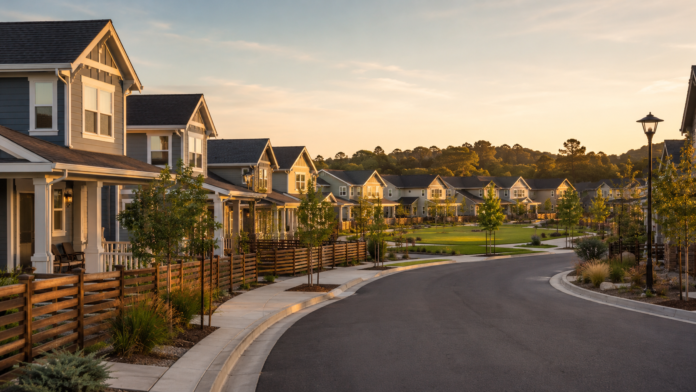
A decade ago, “single-family rental” mostly meant a landlord who bought a used house on a regular residential street, sometimes two or three streets over from where the family across the street had bought theirs. Build-to-rent flips that model. A developer buys a whole parcel, plats an entire subdivision, and builds every home with the explicit intention of renting it out under one ownership entity, with one property manager, one leasing office, and often one shared amenity core such as a dog park, pool, or clubhouse. Nobody in the community ever gets a “for sale” sign in the yard, because nothing in the community is for sale, at least not one house at a time.
The catalyst was affordability math that stopped working for a large share of would-be buyers. Mortgage rates that sat near 3% in 2021 climbed into the high 6% and 7% range through 2024 and 2025, and even with modest easing since, a median-priced home in most Sun Belt metros still requires a monthly payment well above what a comparable rental costs. Builders noticed this gap before most investors did. Large national homebuilders that once measured success purely in closings started carving off entire subdivisions and selling them, still under construction, to institutional landlords through forward-purchase agreements. That single financial innovation, locking in a buyer before the first foundation is poured, is what allowed build-to-rent to scale from a few thousand homes a year to tens of thousands.
By the mid-2020s, build-to-rent construction accounted for a meaningfully larger slice of single-family housing starts than it did a decade earlier, with concentration heaviest in Sun Belt metros such as Phoenix, Atlanta, Dallas-Fort Worth, Charlotte, and Tampa, where land is comparatively cheap, population growth is strong, and local governments have been willing to approve rental-specific subdivision plats. For an investor deciding where to allocate real estate dollars, this matters for a very practical reason: BTR is no longer a side experiment run by a handful of hedge funds. It is a recognized, financeable, and analyzable property type with its own data providers, its own cap rate benchmarks, and its own operating playbook, and readers who want the wider context of how rental real estate fits into a diversified portfolio may find it useful to review a broader comparison of long-term real estate investment options before narrowing in on this one property type.
What Actually Counts as Build-to-Rent (And What Doesn’t)
The label gets used loosely, so it helps to draw clean lines. Three distinct products often get lumped together under “single-family rental,” and they behave very differently as investments.
Build-to-rent communities are purpose-built from the ground up as rental housing. Every home in the plat is owned by the same entity, typically a joint venture between a homebuilder or developer and an institutional capital partner. Density tends to run higher than a typical for-sale subdivision (smaller lots, shared landscaping, sometimes attached duplex or triplex “cottage court” formats) because the economics reward efficient land use when nobody needs a driveway wide enough to sell to a picky buyer.
Scattered-site single-family rental is the older model: an operator (or an individual landlord) acquires existing homes one at a time, spread across many different subdivisions built originally for owner-occupants. Acquisition costs per home are often lower, but so is operating efficiency, since maintenance crews and leasing staff have to drive between dozens of disconnected addresses instead of walking a single community.
Horizontal multifamily / townhome rental sits between the two: attached or semi-attached units built at higher density than BTR detached product but still ground-up and single-ownership, often marketed to renters who want more space than a garden apartment without the price of a detached BTR home.
Only the first category is what this guide means by build-to-rent. The distinction matters for underwriting because BTR communities benefit from economies of scale that scattered-site portfolios cannot replicate, one leasing office instead of many, bulk landscaping and pest-control contracts, and centralized maintenance dispatch, while still delivering the private-yard, no-shared-walls product that a large share of renters, particularly families with children or pets, actively prefer over an apartment.
How Build-to-Rent Deals Get Financed and Underwritten
Two numbers drive almost every BTR investment decision: yield on cost and exit capitalization rate. Yield on cost, sometimes called the development yield, is simply the community’s projected stabilized net operating income divided by total project cost: land, hard construction costs, soft costs like architecture and permitting, and a contingency reserve. Exit cap rate is the capitalization rate a buyer is expected to pay for the stabilized, fully-leased asset once it trades, whether that buyer is a REIT, a pension fund, or a private equity real estate vehicle.
The gap between those two numbers is the development spread, and it is the entire reason anyone takes on construction risk instead of simply buying a finished, leased-up community. If a developer can build a project at a 6.2% yield on cost and reasonably expects it to trade at a 5.4% cap rate once stabilized, the 80-basis-point spread converts directly into value creation on day one of stabilized operations, independent of any further rent growth. When spreads compress, as they did through 2022 and 2023 when construction costs and interest rates both climbed while cap rates lagged, new BTR starts slow down almost immediately, because the arithmetic stops working for anyone except a builder willing to accept a thinner margin to keep crews employed.
Financing usually layers three sources. A construction loan, typically floating-rate and sized to 55–65% of cost, carries the project through vertical construction. A forward-purchase or forward-commitment agreement with an institutional buyer, often a non-traded REIT, a private real estate fund, or occasionally a publicly traded operator such as American Homes 4 Rent or Invitation Homes, locks in a takeout price before leasing even begins, which is what makes the construction loan bankable in the first place. And a general partner equity check, usually 10–20% of cost, comes from the developer or builder sponsoring the deal, aligning their incentives with the capital partner who is funding most of the cost.
For an individual investor, the forward-commitment structure is the reason direct participation in ground-up BTR development is rare outside of accredited-investor real estate funds and syndications with minimums that often start at $50,000 and run into six figures. Most retail exposure instead comes through three channels: shares of publicly traded single-family rental REITs, units in a private non-traded BTR-focused fund, or fractional ownership through a Delaware Statutory Trust used for 1031 exchange proceeds. Each channel trades liquidity for control in a different way: REIT shares trade daily but move with the broader stock market as much as with property fundamentals, while a DST or private fund locks up capital for years but offers a return stream that tracks the underlying real estate more directly.
What Actually Drives Net Operating Income Once the Community Is Leased
Stabilized BTR performance comes down to four levers, and the ones that matter most surprise people who assume this is just apartment investing with yards attached.
Resident turnover is the single biggest driver of long-run NOI, because every vacated home costs money in make-ready repairs, lost rent during the turn, and leasing commissions. BTR communities have consistently posted lower turnover than both scattered-site rentals and traditional garden apartments, largely because the tenant base skews toward families who value the private yard, the extra bedroom, and the school district enough to renew rather than move for a marginally cheaper unit across town. Lower turnover compounds: a community running 32% annual turnover instead of 50% needs roughly a third fewer make-ready cycles every year, and that saving flows almost straight to the bottom line.
Property tax treatment is the second lever, and it is easy to underestimate. Many states reassess property value at or near the point of sale, which means the exact moment a builder sells a finished, leased community to an institutional buyer can trigger a tax bill increase that was never in the original construction-phase pro forma. Sophisticated BTR investors model a post-transfer reassessment scenario explicitly rather than assuming the builder’s initial tax estimate holds after the ownership change.
Insurance cost is the third lever, and it has moved from a rounding error to a genuine underwriting variable in wind- and wildfire-exposed Sun Belt and Mountain West markets. Detached-home insurance for a rental portfolio behaves differently than a single apartment building’s master policy, because each structure carries its own roof, siding, and foundation exposure, and carriers have repriced that risk aggressively since 2023.
Amenity and HOA cost is the fourth lever. BTR communities market shared amenities, pools, dog parks, walking trails, to justify their rent premium over both older single-family rentals and nearby apartments, but those amenities carry ongoing maintenance costs that scattered-site rentals simply don’t have. The rent premium needs to more than offset that cost, and in well-run communities it typically does, with BTR rents commonly landing somewhere between 5% and 15% above a comparable nearby apartment unit of similar size.
A Worked Example: Underwriting a 128-Home Build-to-Rent Community
Numbers make the mechanics concrete. Consider a hypothetical 128-home BTR community in a secondary Sun Belt metro, built at an all-in cost (land, hard costs, soft costs, and a construction contingency) of $260,000 per home.
| Line Item | Amount |
| Total development cost (128 homes × $260,000) | $33,280,000 |
| Average market rent per home, per month | $2,250 |
| Gross potential rent (annualized) | $3,456,000 |
| Less vacancy and credit loss (5.5%) | -$190,080 |
| Plus other income (pet, admin, application fees) | $76,800 |
| Effective gross income | $3,342,720 |
| Less operating expenses (38% of EGI: taxes, insurance, management, R&M, HOA/landscaping) | -$1,270,234 |
| Stabilized net operating income | $2,072,486 |
| Yield on cost (NOI ÷ total development cost) | 6.23% |
| Assumed stabilized exit cap rate | 5.50% |
| Implied stabilized value (NOI ÷ exit cap rate) | $37,681,564 |
| Value creation over development cost | $4,401,564 (13.2%) |
The 73-basis-point spread between the 6.23% yield on cost and the 5.50% assumed exit cap rate is what generates that 13.2% value creation before a single dollar of rent growth or refinancing is factored in. Shrink that spread to 20 basis points, plausible if construction costs run over budget or cap rates drift higher while the project is under construction, and the value creation nearly disappears, which is exactly why sponsors stress-test both variables independently rather than treating the spread as fixed. It’s also why so many 2022- and 2023-vintage BTR deals underwrote conservatively on exit cap rate: nobody wanted to be the developer who assumed cap rate compression that never showed up.
Turnover, Cap Rates, and Rent Premiums: The Numbers Side by Side
Two comparisons come up in almost every BTR investment memo: how BTR turnover stacks up against other rental formats, and how BTR cap rates have moved over the last several years relative to the broader rate environment.
Average Annual Resident Turnover by Rental Housing Type
Dashed line marks the approximate blended U.S. rental-housing turnover rate (45%) as a reference point
The turnover gap is the clearest quantitative case for BTR as an operating model, not just a development play. A community that keeps residents for an average of roughly three years instead of two spends measurably less on make-ready costs, vacancy loss, and leasing commissions over any given holding period, even if its gross rent is similar to a nearby apartment.
| Property Type | Typical Ownership Structure | 2026 Stabilized Cap Rate Range | Rent Premium vs. Apartments | Retail Investor Access |
| Build-to-Rent Community | Single institutional owner, ground-up | 5.0% – 6.0% | +5% to +15% | REIT shares, private funds, DSTs |
| Scattered-Site SFR | Individual homes, mixed owners | 5.3% – 6.5% | Roughly comparable | Direct ownership, small syndications |
| Garden-Style Apartments | Single institutional owner, attached units | 5.2% – 6.2% | Baseline | REIT shares, private funds |
| Horizontal Townhome Rental | Single institutional owner, attached/paired | 5.1% – 6.1% | +2% to +8% | Private funds, some public REITs |
Cap rates across all four categories moved together on the way up, widening by roughly 100 to 150 basis points between 2021 and 2024 as financing costs rose, and have drifted modestly tighter since as capital returned to the sector looking for yield ahead of further rate cuts. BTR sits at the tight end of that range in most cycles precisely because of the turnover advantage described above: buyers are willing to pay a slightly lower cap rate, meaning a higher price, for an income stream that requires less ongoing capital expenditure to sustain.
Common Mistakes Investors Make With Build-to-Rent
The mistakes that show up most often in BTR deals are less about the concept and more about the details investors skip when the story sounds compelling.
Treating the sponsor’s pro forma rent growth as a floor rather than a projection. Many private BTR fund offerings show rent growth assumptions of 3% to 4% annually stretching five or more years into the future. Actual single-family rent growth has varied enormously by metro and by year: strong in 2021 and 2022, much flatter in several Sun Belt markets by 2023 and 2024 once a wave of new supply hit at the same time. Underwriting the deal at zero rent growth and seeing whether the numbers still work is a healthier exercise than trusting the sponsor’s base case.
Ignoring the post-transfer property tax reassessment. As covered above, several states reassess value at sale, and a builder’s initial tax line in a construction-phase pro forma often reflects raw land value, not the finished, leased community’s market value. Investors who buy into a fund after the community has already traded should ask specifically whether the current tax bill reflects a post-sale reassessment or an outdated, pre-transfer figure.
Underestimating regulatory and political risk. Several states and municipalities have introduced restrictions on institutional purchases of single-family homes, ranging from disclosure requirements to outright caps on the share of homes in a subdivision that can be rental-only, and a handful of local governments have added conditional-use hurdles specifically for rental-plat subdivisions. This risk is uneven across markets and worth checking at the specific city and county level, not just assumed away because a state as a whole is considered landlord-friendly.
Confusing a publicly traded SFR REIT’s stock price with the underlying real estate’s performance. REIT shares of companies like Invitation Homes or American Homes 4 Rent trade daily and often move with interest-rate expectations and broader equity market sentiment well before, or instead of, any change in the actual portfolio’s occupancy or rent roll. An investor buying REIT shares as “BTR exposure” is also buying equity-market volatility that a direct fund investor with a multi-year lockup does not experience in the same way.
Skipping the exit liquidity conversation. Private BTR funds and DSTs commonly carry five- to ten-year hold periods with limited or no secondary market. Investors sometimes commit capital they may need sooner, discover there is no clean exit ramp, and end up selling a fund interest at a steep discount on a thin secondary market if a redemption becomes necessary.
A Practical Due-Diligence Checklist Before You Commit Capital
- Confirm whether you are buying into a ground-up development deal (construction risk, higher target return) or a stabilized, already-leased acquisition (lower risk, lower target return).
- Ask for the sponsor’s assumed yield on cost and exit cap rate separately, and re-run the math at a 50-basis-point wider exit cap rate to see how much the projected value creation depends on cap rate compression.
- Check the specific metro and county for any institutional-ownership restrictions, rental-plat zoning conditions, or short-term-rental-adjacent ordinances that could affect a BTR subdivision.
- Ask whether property taxes in the pro forma reflect a post-transfer reassessment, and if not, request a revised estimate.
- Review historical turnover and occupancy for the sponsor’s existing communities, not just the specific deal being marketed, since operating discipline varies more by sponsor than by property type.
- Clarify the fund or DST’s hold period, distribution schedule, and any secondary-market or redemption mechanism before wiring funds.
- If using 1031 exchange proceeds into a DST, confirm the DST holds “real property” for tax purposes under the applicable revenue ruling framework and consult a qualified intermediary and tax advisor before the identification deadline.
- Compare the insurance line item against current wind, flood, and wildfire-zone pricing for the specific market, not a national average.
Key Takeaways
- Build-to-rent communities are single-ownership, purpose-built detached or paired rental subdivisions, distinct from scattered-site SFR and from attached multifamily.
- The development spread, yield on cost minus expected exit cap rate, is the core driver of value creation in ground-up BTR deals, and it has compressed and re-widened repeatedly as interest rates and construction costs shifted between 2021 and 2026.
- Individual investors most commonly access BTR through publicly traded SFR REIT shares, private real estate funds and syndications, or Delaware Statutory Trusts for 1031 exchange proceeds.
- Lower resident turnover, typically in the low 30% range annually versus higher rates for apartments and scattered-site rentals, is BTR’s clearest structural operating advantage.
- Property tax reassessment at transfer, regulatory restrictions on institutional ownership, and thin secondary-market liquidity are the risks most often missed in the initial pitch.
Frequently Asked Questions
What is build-to-rent investing?
Build-to-rent investing means putting capital into housing communities that are constructed specifically to be rented rather than sold, with every home in the subdivision owned by a single entity and managed as one rental asset. Investors typically gain exposure through REIT shares, private funds, or DSTs rather than by developing a community themselves.
Is build-to-rent profitable in 2026?
Stabilized BTR communities have generally traded at capitalization rates between 5.0% and 6.0% through 2025 and into 2026, with new development still penciling in markets where yield on cost can clear the exit cap rate by 50 to 150 basis points. Profitability varies significantly by metro, land cost, and how much new supply has recently hit that specific submarket.
How can I invest in build-to-rent without building a community myself?
The three most accessible routes are buying shares of publicly traded single-family rental REITs, investing in a private real estate fund or syndication focused on build-to-rent development or acquisition, or, for investors completing a 1031 exchange, purchasing a fractional interest through a Delaware Statutory Trust that holds BTR property.
What returns should I expect from a build-to-rent investment?
Returns depend heavily on whether you are entering at the development stage or buying a stabilized, already-leased asset, and on the specific spread between yield on cost and exit cap rate at the time of underwriting. A worked example with a 73-basis-point spread produced roughly 13% value creation over total development cost before any rent growth, which illustrates the mechanism rather than a guaranteed outcome.
Are there regulatory risks specific to build-to-rent?
Yes. A number of states and municipalities have introduced disclosure rules, ownership caps, or zoning conditions aimed specifically at institutional single-family rental ownership, and some of these rules apply directly to rental-plat BTR subdivisions. These restrictions vary by city and county and should be checked for the specific market of any deal under consideration.
What is the minimum investment for a build-to-rent fund or syndication?
Private BTR-focused funds and syndications commonly set minimums in the $25,000 to $100,000 range for accredited investors, though this varies widely by sponsor and vehicle. Publicly traded SFR REIT shares, by contrast, can be purchased for the price of a single share through any standard brokerage account.
References
National Rental Home Council. State of the Build-to-Rent Industry Report.
John Burns Research and Consulting. Build-to-Rent Market Analysis.
National Association of Home Builders. Single-Family Built-for-Rent Construction Data.
Yardi Matrix. Single-Family Rental and Build-to-Rent National Report.
CBRE Research. U.S. Single-Family Rental and Build-to-Rent Investment Trends.
Green Street. Single-Family Rental Sector Outlook.