Quick answer: Data center real estate investing means buying exposure to the buildings, land, and power infrastructure that house servers, not the servers or the software running on them. Value is set primarily by secured electrical capacity (megawatts), not square footage. In mid-2026, stabilized data center assets in primary U.S. markets trade at cap rates roughly a percentage point below the broader commercial average, vacancy in top hubs sits under 2%, and the binding constraint on new supply is utility interconnection queues that now stretch three to seven years in the most sought-after markets. Investors get exposure through publicly traded REITs such as Equinix and Digital Realty, private infrastructure funds, or direct development, and each path carries a different mix of liquidity, minimum check size, and development risk.
What Is Data Center Real Estate, Exactly?
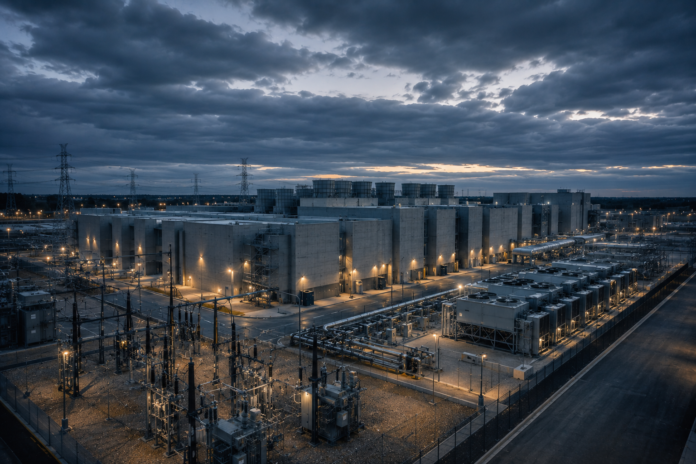
A data center is a purpose-built structure that supplies three things to computing hardware: continuous electrical power, controlled temperature and humidity, and physical security. Strip away the servers and the racks, and what remains is the real estate — concrete floor slabs engineered to carry loads far beyond a typical office building, redundant electrical switchgear, backup generators, chilled-water loops or direct-to-chip cooling plumbing, and enough fiber conduit to connect the building to the outside world several times over. That shell, not the computers inside it, is what a data center real estate investor actually owns.
This distinction matters because it decides who owns what. A hyperscale cloud provider like Amazon Web Services or Microsoft Azure typically owns and operates its own servers, storage arrays, and networking gear. The building around that equipment, along with the power and cooling systems built into its walls and roof, is frequently owned by a landlord — a REIT, a private developer, or an infrastructure fund — and leased back to the tenant under a long-term contract. The landlord’s return comes from rent on the shell and its embedded infrastructure, not from any claim on the computing capacity itself.
The legal basis for treating a data center as real property, rather than as equipment, traces back to a series of IRS private letter rulings issued in the late 2000s, most notably the 2007 ruling that allowed Digital Realty Trust to operate as a REIT. The rulings concluded that a data center’s structural components — its power distribution systems, cooling infrastructure, and raised floors — function like the plumbing, electrical, and HVAC systems of any commercial building, and therefore count as real property under the REIT asset tests. That single interpretation opened the door for the modern data center REIT sector, and it is the reason Digital Realty, Equinix, and their peers can pass through 90% of taxable income to shareholders under REIT rules while operating what is, functionally, a specialized industrial facility.
How Data Center Real Estate Actually Works
The Lease Structure: Triple-Net, Power-Metered, and Sticky
Most institutional-grade data center leases follow a triple-net (NNN) structure. The tenant pays base rent plus its pro-rata share of property taxes, insurance, and common-area maintenance, and it also pays directly for the electricity it consumes, metered at the rack or the room level. This shields the landlord from the single biggest variable cost in the building — power — while still letting the landlord earn a spread on the infrastructure that delivers that power reliably.
What makes these leases unusually durable is the switching cost baked into the tenant relationship. Moving a rack of production servers is not like moving office furniture. It means physically relocating hardware, re-establishing network peering relationships, re-testing failover systems, and accepting real downtime risk during the transition. Hyperscale tenants routinely sign 10-to-20-year leases, and even smaller colocation customers rarely leave once they are cabled in, because the operational risk of moving usually outweighs any rent savings on offer elsewhere.
Hyperscale vs. Colocation vs. Edge: Three Very Different Businesses
“Data center real estate” is really an umbrella over three distinct business models, and conflating them is one of the more common mistakes new investors make.
Hyperscale facilities are built for a single large tenant — often one of the major cloud platforms — under a build-to-suit or powered-shell arrangement. The landlord may deliver a bare structure with committed power and let the tenant fit out the interior, or it may deliver a fully finished facility. Either way, revenue is concentrated in one or two tenants, lease terms run long, and yields are lower because the credit risk is lower.
Colocation facilities house dozens or hundreds of smaller tenants — banks, healthcare systems, media companies, and mid-sized cloud resellers — each renting a cage, a cabinet, or a fraction of a rack. Colocation operators like Equinix earn additional revenue from “cross-connects,” the physical fiber jumpers that let one tenant’s servers talk directly to another’s, which is why colocation campuses cluster near major internet exchange points. Lease terms are shorter, typically three to five years, tenant diversification is much higher, and per-square-foot yields tend to run richer to compensate for the operational intensity of managing many customers.
Edge facilities are smaller, distributed sites placed close to population centers to shave milliseconds off response times for applications like content delivery, gaming, and increasingly AI inference. They trade scale for proximity, and their investment case rests less on megawatts and more on real estate fundamentals that would feel familiar to a retail or last-mile logistics investor: dense population nearby, available power, and a defensible local footprint.
How Investors Actually Get Exposure
Three practical entry points exist for anyone who wants exposure to this asset class rather than to the technology sitting inside it.
Publicly traded REITs remain the simplest route. Equinix and Digital Realty together control a large share of the global colocation and interconnection market, and both are accessible through an ordinary brokerage account with daily liquidity. Iron Mountain, historically a records-storage REIT, has diversified aggressively into data centers over the past several years, giving investors a third, more conservative-leaning option.
Private infrastructure and real estate funds sit one step further out on the risk-and-illiquidity spectrum. Blackstone’s roughly $10 billion take-private of QTS Realty Trust in 2021 and Global Infrastructure Partners’ approximately $15 billion acquisition of CyrusOne in 2022 both moved large data center portfolios out of public markets and into long-duration private vehicles. These funds typically require accredited or institutional investor status, lock up capital for five to ten years, and target returns built on development and repositioning rather than passive income.
Direct development is the highest-risk, highest-control path. It means acquiring land with a credible path to utility power, negotiating an interconnection agreement, securing an anchor tenant, and building to that tenant’s specification. Done well, it captures a development margin that REIT shareholders never see. Done poorly — with power that never materializes or a tenant that walks away mid-entitlement — it can strand capital in raw land for years.
Why Power, Not Land, Now Sets the Price
For most of commercial real estate’s history, location has been the dominant pricing variable — proximity to transit, to labor, to customers. Data centers have partially inverted that logic. A parcel of land with no committed electrical capacity is close to worthless in this sector, no matter how well it sits relative to fiber routes or highways, because the multi-year wait for a new utility interconnection has become the real bottleneck on growth.
Northern Virginia’s “Data Center Alley,” still the largest concentration of data center capacity on earth, has seen new-connection queues stretch past five years in parts of Loudoun County. Utilities across major hubs — Georgia Power, Dominion Energy, and grid operators serving Phoenix and Dallas among them — have all reported data center interconnection requests that dwarf anything they modeled a decade ago, driven by the sudden jump in per-rack power draw that generative AI training and inference workloads demand. A standard enterprise rack drew perhaps 5 to 10 kilowatts as recently as 2020. AI training clusters built around current-generation GPU architectures now routinely draw 50 to 120 kilowatts per rack, and some liquid-cooled deployments push higher still.
That power squeeze has pushed some of the largest tenants to secure electricity outside the traditional grid entirely. Microsoft’s 2024 agreement to restart a reactor at the former Three Mile Island nuclear plant, run in partnership with Constellation Energy, and Amazon’s purchase of a nuclear-powered data center campus from Talen Energy are both direct responses to the same underlying constraint: waiting in a standard interconnection queue is no longer fast enough for hyperscale growth plans. For real estate investors, the practical takeaway is that a facility with a signed, firm power agreement today is worth measurably more than an equivalent building still waiting on a utility study, independent of how attractive the physical site might otherwise be.
This dynamic has reshaped how appraisers and brokers think about the asset class more broadly, and it connects directly to the wider case investors have been making for treating data centers as a distinct property type rather than a niche inside industrial real estate — a shift covered in more detail in this look at why data centers have become one of the most sought-after commercial real estate niches of the decade. The common thread across that analysis and the power story here is the same: scarcity of a specific input, not general market sentiment, is what is setting price.
Stabilized Cap Rates by Property Type, First Half 2026
Institutional-quality, stabilized assets in primary U.S. markets
Illustrative ranges compiled from broker and appraisal survey data; individual deals vary by market and tenant credit.
Dashed line marks the approximate blended all-property average cap rate (~6.3%) for reference. Lower cap rate generally implies a higher price paid per dollar of net operating income.
Who Should Actually Care About This Asset Class
Institutional allocators care because data centers now offer a rare combination in commercial real estate: bond-like cash flow durability paired with a genuine secular growth driver. A REIT analyst covering the sector is effectively underwriting both a real estate credit and a bet on continued digital and AI infrastructure demand, which is a different exercise than underwriting an apartment building’s rent roll.
Retail investors who hold a total-market REIT index fund already have some incidental exposure, since Equinix and Digital Realty both sit inside major REIT benchmarks. Anyone who wants a larger, more deliberate allocation can buy those names directly or through a sector-specific ETF, accepting the stock-market volatility that comes with daily pricing in exchange for liquidity that private vehicles simply do not offer.
Accredited investors and family offices considering private infrastructure funds should care about a different set of trade-offs: longer lockups, less transparency into individual asset performance, and a return profile that depends heavily on the sponsor’s ability to actually deliver power and tenants on schedule, which is not guaranteed even for well-capitalized sponsors in today’s interconnection environment.
Developers, utilities, and municipal planners have a stake as well, even if they never buy a share of REIT stock. Data center campuses reshape local tax bases, put unusual strain on regional power grids, and increasingly draw organized community opposition over noise, water use for cooling, and visual impact — all factors that feed directly back into how an asset gets entitled, financed, and ultimately valued.
Hyperscale vs. Colocation vs. Edge: A Side-by-Side Comparison
| Attribute | Hyperscale | Colocation | Edge |
|---|---|---|---|
| Typical lease term | 10 to 20 years | 3 to 5 years | 1 to 3 years |
| Tenant concentration | Very high (1 to 2 tenants) | Low (dozens to hundreds) | Moderate |
| Typical rack density | 50 to 120+ kW (AI clusters) | 5 to 20 kW | 5 to 15 kW |
| Primary revenue driver | Committed power and shell rent | Per-cabinet rent plus cross-connect fees | Latency-sensitive local demand |
| Approximate stabilized cap rate | 4.5% to 5.5% | 5.5% to 6.5% | 6.5% to 8% |
| Key risk | Single-tenant concentration | Operational complexity, churn at renewal | Small scale limits institutional appeal |
Common Misconceptions About Data Center Real Estate Investing
“It’s just industrial real estate with computers in it.” Warehouses and data centers share a box-like footprint, but the cost structure has almost nothing in common. A distribution warehouse might cost $60 to $120 per square foot to build. A hyperscale-ready data center shell, once power infrastructure, generators, and cooling systems are included, frequently runs into the thousands of dollars per square foot. The capital intensity, not the floor plan, defines the asset class.
“Bigger buildings are always worth more.” A 300,000-square-foot facility with 20 megawatts of confirmed power is worth substantially less than a 100,000-square-foot facility with 80 megawatts of confirmed power and liquid cooling infrastructure. Investors who anchor on square footage instead of committed capacity routinely misprice these deals.
“Data centers are recession-proof.” Enterprise demand for cloud and colocation space has proven remarkably durable through past downturns, and long lease terms buffer near-term cash flow. That resilience is not unconditional, though — a sharp pullback in AI capital expenditure by a small handful of hyperscale tenants could leave certain purpose-built campuses with a concentrated vacancy problem that takes years to backfill.
“REITs and private funds offer basically the same exposure.” Public REIT shares reprice daily with the broader stock market and can swing on tech-sector sentiment that has little to do with the underlying real estate. Private infrastructure funds are shielded from that daily volatility but lock up capital for years and depend heavily on a specific sponsor’s execution.
“Green certifications are just marketing.” Lenders and institutional buyers increasingly price a discount into facilities running on carbon-intensive power, because major hyperscale tenants have their own sustainability commitments and will pay a premium for space that helps them meet those targets. A facility with a Power Usage Effectiveness ratio near 1.2 typically finances more cheaply than a legacy building above 1.6, all else equal.
A Practical Due-Diligence Checklist Before You Invest
- Confirm the power is real, not aspirational. Ask for the signed utility interconnection agreement, not a letter of intent, and check the delivery date against the tenant’s own timeline.
- Identify tenant concentration. A single-tenant hyperscale asset carries different risk than a diversified colocation campus; underwrite the credit of whoever is actually paying the rent.
- Check the cooling architecture against current, not historical, density needs. A facility built for 10 kW racks may need a costly retrofit before it can host modern AI workloads.
- Review lease escalators and who bears energy price risk. A true triple-net structure with tenant-paid power protects the landlord from utility rate volatility; some legacy leases do not fully pass this through.
- Assess fiber and network diversity. A building with power but only one carrier path is exposed to a single point of failure that can scare off major tenants.
- Look at local political and community dynamics. Several jurisdictions have introduced or tightened moratoriums and siting restrictions on new data center construction in response to grid strain and water use concerns.
- Match your investment vehicle to your liquidity needs. Public REIT shares suit investors who may need to exit on short notice; private funds suit those comfortable locking up capital for five-plus years in exchange for a different return profile.
- Stress-test the exit. Model what the asset is worth if the current anchor tenant does not renew, and confirm there is a realistic pool of replacement tenants for that specific power and cooling configuration.
Key Takeaways
- Data center real estate investing means owning the building, land, and power infrastructure — not the servers or software inside it.
- Secured electrical capacity, measured in megawatts, is now the primary driver of value, ahead of square footage or even location in the traditional sense.
- Hyperscale, colocation, and edge facilities are three distinct business models with different lease terms, tenant concentration, and risk profiles.
- Public REITs such as Equinix and Digital Realty offer liquid, lower-minimum access; private infrastructure funds offer potentially higher returns with far less liquidity.
- Utility interconnection queues of three to seven years, driven by AI-era power demand, are the binding constraint on new supply in most primary markets.
- Tenant concentration, power availability, and cooling architecture matter more to underwriting this asset class than they do in almost any other commercial property type.
Frequently Asked Questions
What exactly counts as “data center real estate” for investment purposes?
It refers to the building shell, land, and embedded infrastructure — electrical switchgear, backup generators, cooling systems, and raised flooring — that houses computing equipment. It does not include the servers, storage, or networking hardware, which the tenant typically owns and operates separately.
How is a data center investment different from buying a warehouse or office building?
The cost to build and the value drivers differ enormously. A warehouse is priced mainly on location and square footage; a data center is priced primarily on secured power capacity, cooling architecture, and network connectivity, with construction costs that can run many times higher per square foot than conventional industrial space.
What is a good cap rate for a data center in 2026?
Stabilized, institutional-quality hyperscale assets in primary U.S. markets have generally traded in the 4.5% to 5.5% range in 2026, with colocation assets running somewhat higher and smaller edge facilities higher still, reflecting differences in tenant concentration and lease duration.
Can retail investors invest in data centers without a private equity fund?
Yes. Publicly traded REITs such as Equinix, Digital Realty, and Iron Mountain can be bought through any standard brokerage account, offering daily liquidity and no accreditation requirement, though the shares will move with broader stock market sentiment in addition to real estate fundamentals.
What is the biggest risk in data center real estate right now?
Power availability and tenant concentration together pose the largest risk. A facility built for a single hyperscale tenant can face years of vacancy if that tenant does not renew, and any asset still waiting on a utility interconnection faces genuine uncertainty about when, or whether, it can be built out at all.
References
- Internal Revenue Service, Private Letter Ruling 200731017 (2007), regarding REIT treatment of data center structural components.
- CBRE Research, “North America Data Center Trends” (2026 edition).
- JLL Global Research, “Global Data Center Outlook” (2026).
- Uptime Institute, “Annual Global Data Center Survey” (2025).
- International Energy Agency, “Electricity 2026: Analysis and Forecast to 2028.”
- Lawrence Berkeley National Laboratory, “United States Data Center Energy Usage Report” (2024 update).
- Equinix, Inc., Annual Report on Form 10-K (fiscal year 2025).
- Digital Realty Trust, Inc., Annual Report on Form 10-K (fiscal year 2025).
- Federal Energy Regulatory Commission, “Report on Grid Interconnection Queues and Data Center Load Growth” (2025).