Quick Answer
Buying a token tied to a painting does not give you the painting. It gives you a claim, usually a membership interest in a single-purpose LLC or a similar vehicle, and the actual canvas sits in a bonded freeport or a climate-controlled fine art warehouse under a custody agreement that most token buyers never read. The real cost of that arrangement runs 1.2% to 2.0% of the artwork’s appraised value every year in storage, insurance, and audit fees, and it is usually deducted from token holders before any resale gain is calculated. The token can trade in seconds; the object it represents can only be verified by a physical inspector standing in front of it, and that mismatch is the actual storage problem this article is about.
A tokenized Basquiat does not stop being a piece of stretched canvas and pigment the moment a smart contract is deployed against it. Somebody still has to hang it, or more realistically, crate it, climate-control it, insure it, and periodically confirm to a set of strangers scattered across a dozen jurisdictions that it has not been swapped, damaged, or quietly sold out from under them. Blockchain rails solved the problem of moving fractional ownership between wallets in seconds. They did nothing to solve the much older problem of keeping a physical object safe, verifiable, and legally encumbered in a way courts will recognize if something goes wrong. That gap between the frictionless token and the stubbornly physical painting is where most of the real risk in art tokenization actually lives.
Why the custody question matters more in 2026 than it did three years ago
Fractional art platforms have been around since roughly 2017, but the early ones mostly sold shares in a single high-profile piece as a marketing exercise rather than a genuine access class. What changed by 2026 is scale and regulatory maturity. Reg A+ qualified offerings built around blue-chip contemporary and modern works have moved past novelty status, secondary trading venues for fractional art interests have opened, with predictably thin volume, and a handful of Swiss and Liechtenstein-based custody banks now offer dedicated tokenized-collectible vaulting as a standing product line rather than a bespoke arrangement negotiated deal by deal.
That growth has outpaced the plumbing. A stock exchange has a central securities depository, a transfer agent, and decades of case law about what happens when a broker fails. A tokenized art deal has an SPV operating agreement, a storage contract with a private warehouse, and an insurance policy that was underwritten for a single owner, not for two thousand fractional claimants who never signed anything with the insurer directly. When something goes wrong with a stock, regulators and clearinghouses have a playbook. When something goes wrong with a stored canvas backing a token, you are largely relying on contract law, bailment principles that predate the automobile, and whichever jurisdiction’s courts end up with venue.
None of this means tokenized art custody is reckless by design. It means the custody layer is doing far more legal and practical work than most buyers assume, and the quality of that layer varies enormously between issuers. For a broader look at how these fractional ownership structures are assembled in the first place, our real-world asset tokenization guide walks through the SPV and legal-wrapper mechanics that sit underneath deals like this one.
What “custody” actually means when the asset is a painting, not a security
In securities custody, the qualified custodian holds an electronic entry, not the underlying company. Art custody is the opposite: the custodian holds the only copy of the asset that exists. There is no dematerialized version of a Warhol. If the physical object is lost, damaged, stolen, or misattributed, the token has nothing left to represent, no matter how clean the blockchain record looks.
The single point of failure sits in the warehouse, not the ledger
Most due diligence on tokenized art deals focuses on smart contract audits, SPV formation documents, and secondary-market liquidity terms. Those matter, but they are downstream of a more basic question: who has physical control of the object, under what contract, and what happens to that contract if the custodian is acquired, goes insolvent, or simply mishandles a crate during a routine move between climate zones. A flawless smart contract cannot recover a painting that water-damaged in transit because a logistics subcontractor used an uninsulated truck for a three-hour leg of a longer journey. This happens more often than issuers like to advertise, and it is almost never disclosed in offering materials because it falls under ordinary operational risk rather than a reportable event.
Bailment law, not blockchain law, decides who is liable
When a warehouse holds your painting, the relationship is a bailment: you, or the SPV, on your behalf, remain the owner, and the custodian is a bailee with a duty of reasonable care. Article 7 of the Uniform Commercial Code governs the warehouse receipts that most reputable fine art storage facilities issue, and that receipt, not the token, is the document a court will look to first if the painting is damaged or lost. A token holder whose only relationship is with the SPV, and whose SPV’s only relationship is with the warehouse, sits two contractual layers removed from the instrument that actually protects the asset. That distance is fine in the ordinary case and becomes very expensive in a dispute, because each layer can carry its own liability caps, notice periods, and choice-of-law clauses that do not automatically flow through to the token holder.
Title, condition, and provenance are three separate custody problems
People tend to collapse “custody” into a single idea, but a fine art custodian is really managing three distinct risks at once. Title risk is whether the SPV genuinely owns clean title, free of liens, disputed heirship claims, or export restrictions. Condition risk is whether the physical object degrades, from humidity, light exposure, vibration during transport, or simple mishandling. Provenance risk is whether the documentary chain proving the work is what it claims to be stays intact and accessible. A custodian can be excellent at one of these and mediocre at another; a freeport with immaculate climate control can still have sloppy paperwork procedures, and a boutique fine art handler with meticulous condition reports can still be careless about verifying export licenses before a cross-border move.
Where the physical object actually lives: freeports, warehouses, and the specs that matter
Three storage models dominate the market, and the differences between them are not cosmetic.
Bonded freeports
Freeports, the best known sit in Geneva, Luxembourg, Singapore, and Delaware, are customs-bonded warehouses where goods can sit indefinitely without triggering import duties or, in some structures, capital gains recognition until the piece is sold or physically removed. They were built for high-net-worth collectors and dealers moving inventory between auctions, and tokenization platforms have largely adopted them wholesale because the tax deferral and jurisdictional neutrality make cross-border fractional ownership administratively simpler. A Geneva freeport vault typically runs climate control to roughly 68 to 72 degrees Fahrenheit with relative humidity held between 45% and 55%, filtered air to limit particulate and pollutant exposure, and UV-filtered or fully dark storage rooms depending on the medium.
Dedicated fine art logistics warehouses
Outside the freeport system, specialized fine art handlers, the kind that also manage museum loans and gallery shipping, offer comparable climate specifications without the customs-bonded status. These facilities are more common for domestically held, single-jurisdiction SPVs where the tax deferral of a freeport is not the deciding factor. They tend to run slightly cheaper on pure storage fees but do not offer the same duty-deferral or the reputational cachet some issuers lean on in marketing materials.
Bank vaults and general-purpose storage
A minority of smaller tokenized-collectibles deals, particularly for items below roughly $250,000 in appraised value, use bank safe-deposit facilities or general secure storage rather than true fine art vaulting. These spaces control for theft but rarely control for humidity, temperature stability, or light, and insurers frequently price fine art policies higher, or decline them outright, when the storage venue lacks climate documentation. This is the tier where the phrase “storage problem” is most literal: the token can be perfectly compliant while the underlying object is quietly deteriorating.
The handling details that separate adequate from excellent
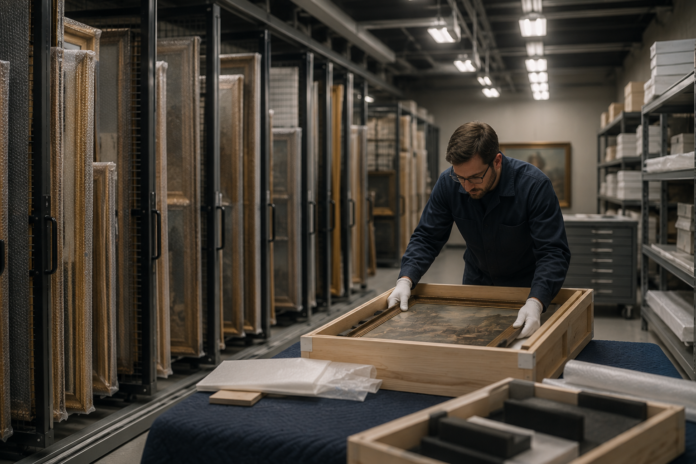
Climate control alone is not the whole spec sheet. Vibration damping during any move, a documented pest-control protocol, since paper, canvas, and organic frame materials are vulnerable, fire suppression systems that use inert gas rather than water sprinklers, and restricted access logs showing exactly who touched the crate and when are the details that separate a genuinely institutional-grade custodian from one that simply rents a climate-controlled room. Offering documents rarely spell these out in plain language; they usually sit buried in an appendix or become available only on request.
The verification problem: proving the token still matches the object
A bond issuer proves it still owes you money through audited financial statements. A tokenized art SPV has to prove something stranger: that the specific physical object backing your token still exists, is still in the condition described at issuance, and has not been quietly substituted, damaged, or double-pledged as collateral elsewhere. This is the fractional-art equivalent of proof of reserve, and it is far harder to automate than a crypto exchange’s on-chain reserve attestation, because a painting cannot be hashed and checked against a ledger. It has to be looked at, by a human, in person.
Physical audits and their actual frequency
Better-run programs commission an independent physical inspection and condition report on a fixed schedule, typically annually, with a full re-appraisal every two to three years or whenever a material market event, a major auction result for a comparable work, for instance, suggests the prior valuation has gone stale. Weaker programs rely on the custodian’s own attestation, with no independent third party ever laying eyes on the piece between the initial appraisal and a sale event. Token holders almost never see the underlying inspection reports directly; they see a summary line in an annual SPV report, if they see anything at all.
Insurance riders are a verification mechanism, not just a safety net
All-risk fine art insurance policies require periodic condition reporting as a condition of coverage, which means the insurer is, in effect, an independent check on the custodian’s claims, since a lapsed or invalidated policy is financially disastrous for the SPV. A serious due diligence question for any tokenized art deal is not just whether it is insured, but whether the policy names the SPV as the insured party with the token structure disclosed to the underwriter, or whether the policy was written years earlier for a single private owner and never properly updated. The latter is more common than it should be, and it can mean a claim gets denied on a technicality exactly when it matters most.
Chain of custody documentation
Every time a piece moves, even a few miles between two rooms in the same freeport for a museum loan, a chain-of-custody record should get generated: who authorized the move, who packed it, what condition it was in before and after, and who signed off. Gaps in this record are the first thing an insurer or a court will flag if a dispute arises later, and gaps are disturbingly easy to create when a piece goes out on loan for exhibition, a fairly common practice that also boosts the perceived prestige, and resale value, of the token.
A worked example: pricing the custody stack on a $2.4 million painting
Numbers make this concrete. Assume a mid-career contemporary painting carries an appraisal of $2,400,000 and sits inside a single-purpose LLC that issues 2,400 membership tokens at an initial price of $1,000 each. The sponsor selects a bonded freeport for storage rather than a standard warehouse, both for the tax-deferral benefit and the marketing value of the freeport’s reputation.
| Annual custody line item | Cost | % of appraised value |
|---|---|---|
| Freeport storage and climate control | $12,000 | 0.50% |
| All-risk fine art insurance | $8,400 | 0.35% |
| Independent condition audit (biennial, amortized) | $3,000 | 0.13% |
| SPV administration and reporting fee | $15,000 | 0.62% |
| Total annual carrying cost | $38,400 | 1.60% |
That $38,400 does not vanish into an accounting footnote. It gets charged against the SPV and, in most deal structures, deducted from token holders pro rata before any distribution or sale proceeds are calculated. Spread across 2,400 tokens, it works out to $16 per token per year, or roughly $1.33 a month for someone holding a single $1,000 token. On a painting that appreciates 6% in a given year, that custody drag quietly consumes more than a quarter of the paper gain before the token holder sees a cent. Investors who model tokenized art purely on expected price appreciation, the way they might model a stock, routinely miss this, because the custody cost line rarely appears anywhere near the marketing materials quoting historical price performance for the artist.
Visualizing the carrying-cost gap between storage tiers
The chart below compares typical all-in annual carrying cost, storage, insurance, and audit combined, as a percentage of appraised value across the four storage tiers described earlier. The dashed line marks the 1% threshold that most sponsors use internally as a rough underwriting boundary for what a fractional deal can absorb before returns start looking unattractive next to comparable asset classes.
Illustrative annual carrying cost as a percentage of appraised value. Private storage is cheapest and, for a tokenized fractional structure, generally the least appropriate.
Comparing the four custody models directly
| Custody model | Climate control | Insurability | Typical audit cadence | Best fit |
|---|---|---|---|---|
| Bonded freeport | Full ASHRAE-grade spec | Easiest; insurers favor documented facilities | Annual, plus move-triggered reports | Institutional multi-jurisdiction offerings |
| Fine art warehouse | Full spec, no bonded status | Easy | Annual | Single-jurisdiction domestic SPVs |
| Bank vault / general storage | Ambient only, no humidity control | Harder; some perils excluded | Rare, on request | Small, lower-value collectibles only |
| Private / DIY storage | None | Frequently voided or heavily capped | None | Not appropriate for tokenized structures |
Common mistakes buyers and sponsors make with tokenized art custody
- Assuming the insurance policy automatically covers the fractional structure. Many policies get written for a named individual owner and never formally endorsed to reflect an SPV or a token structure, which can give an insurer grounds to dispute a claim after the fact.
- Treating the warehouse receipt as boilerplate. The receipt issued under Article 7 of the UCC is the actual legal instrument that establishes the bailment and liability caps; buyers rarely ask to see it, and sponsors rarely volunteer it.
- Confusing “climate-controlled” with “specification-verified.” A facility can advertise climate control without publishing actual temperature and humidity logs; ask for the logs, not the marketing claim.
- Overlooking loan-out risk. Pieces sometimes go out on loan to museums or exhibitions to build provenance and marketing value, which introduces new custody chains, new insurance riders, and new transit risk that the original offering documents may not have anticipated.
- Ignoring what happens on custodian insolvency. If the storage facility itself goes bankrupt, a poorly drafted custody agreement can leave the SPV, and by extension every token holder, in a general creditor queue rather than asserting a clean bailor’s right to reclaim the specific object.
- Not budgeting for the carrying-cost drag. As the worked example above shows, custody costs of 1.5% to 2.0% annually meaningfully erode returns on an asset class that already lacks a dividend or coupon to offset holding costs.
- Assuming secondary-market liquidity solves the exit problem. Even where a token can technically trade, thin volume means a seller often has to accept a discount that has nothing to do with the underlying artwork’s value and everything to do with the custody and verification friction buyers price in.
Practical checklist before buying into a tokenized art or collectibles offering
- Request the actual name of the storage facility, not just “a bonded freeport” or “a fine art vault” in generic terms, and confirm it independently.
- Ask for the most recent condition report and appraisal date, and confirm the appraiser is independent of the sponsor.
- Confirm the insurance policy explicitly names the SPV and discloses the fractional or tokenized ownership structure to the underwriter.
- Get the audit cadence in writing: how often is the piece physically inspected, and by whom.
- Ask what happens contractually if the custodian is sold, merged, or becomes insolvent.
- Read the fee schedule line by line and calculate the all-in annual carrying cost as a percentage of appraised value, not just the headline management fee.
- Check whether the piece can be loaned out for exhibitions, and if so, who bears the transit and additional insurance cost when that happens.
- Look for a stated dispute-resolution and governing-law clause, and understand which jurisdiction you would actually be litigating in if something went wrong.
Key Takeaways
- A token backed by art is a claim on an SPV, not a claim on the physical object itself; custody of the object runs through bailment law and a warehouse receipt, not through the blockchain.
- Bonded freeports in Geneva, Luxembourg, Singapore, and Delaware dominate institutional-grade tokenized art custody because of their climate specifications and tax-deferral treatment, but they are not the only viable model.
- All-in annual carrying costs, storage, insurance, and audits combined, typically run 1.2% to 2.0% of appraised value for properly custodied fine art, and that cost is deducted from token holder returns.
- Verification that the token still matches the object depends on periodic physical inspection and properly endorsed insurance, neither of which can be automated the way on-chain proof of reserve works for financial assets.
- The biggest custody failures happen at the seams: insurance policies never updated for the fractional structure, warehouse receipts nobody reads, and loan-outs that create new transit risk outside the original custody plan.
Frequently asked questions
Who actually owns the physical painting when art is tokenized?
The physical painting is almost always titled to a single-purpose entity, typically an LLC or a similar structure, and token holders own a fractional membership or beneficial interest in that entity rather than a direct property right in the canvas itself. The distinction matters legally: a token holder generally cannot walk into the vault and demand the painting, and their recourse in a dispute runs through the entity’s operating agreement rather than through direct title claims.
What happens to my tokens if the storage facility holding the artwork goes bankrupt?
In a well-drafted arrangement, the artwork is held under a bailment, meaning it remains the property of the SPV and should not become part of the storage facility’s bankruptcy estate, since the facility never owned it. In practice, the outcome depends heavily on how clearly the custody agreement and warehouse receipt establish that bailment, and on how quickly the SPV’s manager acts to reclaim or relocate the piece once insolvency proceedings begin.
How often is a tokenized artwork physically inspected to confirm it still exists?
Programs with strong governance typically commission an independent physical inspection and condition report annually, with a full third-party re-appraisal every two to three years or after a significant market event affecting comparable works. Weaker programs may rely solely on the custodian’s own internal attestations, with no independent inspection between the initial acquisition and an eventual sale.
Can I take physical delivery of a fractionalized, tokenized artwork?
Almost never in practice. Most offering structures either prohibit physical delivery entirely or require a token holder to acquire effectively all outstanding tokens before triggering a redemption-for-delivery right, since the underlying object cannot be physically divided among fractional owners. The realistic exit path is selling the token, not claiming the object.
Is art held in a freeport actually safer than a bank vault?
For fine art specifically, yes, in most practical respects. Freeports are purpose-built for art and high-value objects, with climate and humidity specifications, fire suppression systems designed not to damage the contents, and handling protocols that general bank vaults, designed primarily for cash, documents, and small valuables, typically do not offer. The tradeoff is cost: freeport storage generally runs more expensive than general secure storage, which is part of why it stays reserved for higher-value pieces.
References
- Uniform Commercial Code, Article 7 (Documents of Title / Warehouse Receipts)
- U.S. Securities and Exchange Commission, Regulation A+ offering framework
- ASHRAE guidelines for museum, gallery, and fine art storage environments
- Industry practice standards published by major fine art logistics and freeport operators