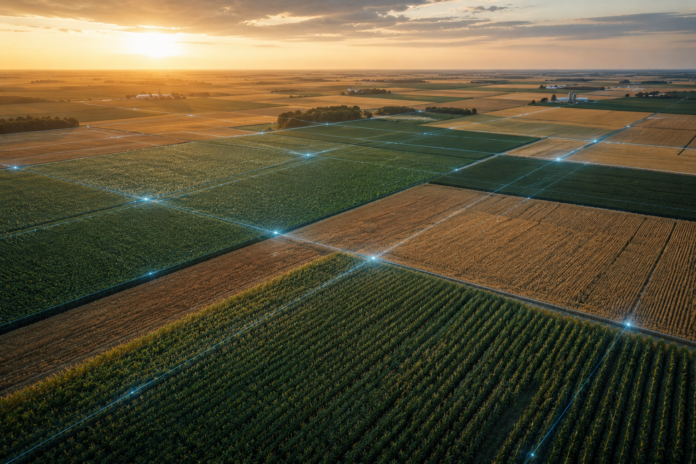
Land has always been the asset nobody could buy a little of. That is changing, slowly and with a lot of legal scaffolding most investors never see, as farmland ownership gets sliced into blockchain-recorded shares that trade for a few hundred dollars instead of a few hundred thousand.
Quick Answer
Tokenized farmland investing means buying digital units — typically security tokens tied to membership interests in a special purpose vehicle (SPV) that holds title to physical cropland — recorded and transferred on a blockchain. Returns come from two sources: cash rent or crop-share income paid out to token holders (usually 2% to 4% a year net of fees) and long-run land appreciation (historically averaging in the mid-single digits annually for U.S. row-crop ground). The tokens do not make the land liquid; they lower the entry ticket to $100–$5,000 and add a thin, often illiquid secondary market layered on top of a fundamentally slow-moving asset.
Why Farmland Tokenization Is Gaining Ground Right Now
Farmland has quietly been one of the best-performing, lowest-volatility asset classes in American finance for four decades, and almost nobody outside of farming families and a handful of institutional funds has been able to own a piece of it directly. U.S. farm real estate values have marched upward through most of the last twenty years, interrupted only briefly by the mid-1980s farm debt crisis and a short plateau after the 2014 commodity downturn. The USDA’s annual Land Values Summary has repeatedly shown cropland values compounding faster than general inflation over rolling ten-year windows, while the asset itself throws off a steady rental yield that barely correlates with the S&P 500 or the bond market.
That combination — low correlation, inflation sensitivity, and a physical yield stream — is exactly what family offices and pension funds have wanted more of since the 2022–2023 rate shock exposed how fragile a plain 60/40 portfolio can be. Farmland Partners Inc. and Gladstone Land Corporation built entire public companies around giving retail shareholders indirect exposure, and equity crowdfunding platforms such as AcreTrader, FarmTogether, and Harvest Returns spent the back half of the 2010s proving that individual investors would put five-figure checks into row-crop and permanent-crop deals sourced online. None of that required a blockchain. What tokenization adds is a further reduction in the minimum check, a standardized digital cap table that can, in principle, be transferred peer-to-peer, and — for operators willing to build the compliance layer — a path toward a real secondary market instead of the multi-year lockups typical of Reg D real estate syndications.
The agricultural commodity side of tokenization is also worth separating out, because it is easy to conflate the two. AgroToken, a platform operating out of Argentina and expanding into Brazil and the United States, issues tokens such as SOYA, CORA, and WHEA that represent warehouse-receipted grain rather than land itself — a farmer can tokenize stored soybeans and use the token as on-chain collateral for a loan without selling the physical crop at a depressed price. That is a genuinely useful piece of agricultural finance infrastructure, but it is a commodity-inventory token, not a farmland-ownership token, and this guide is concerned with the latter: digital claims on the dirt itself and the rental stream it produces.
Core Mechanics of a Tokenized Farmland Deal
Every legitimate farmland tokenization structure built for U.S. investors as of 2026 follows roughly the same three-layer architecture, borrowed almost verbatim from the broader real-world-asset (RWA) tokenization playbook that institutions like BlackRock and Franklin Templeton popularized for treasuries and private credit. Layer one is the legal entity that actually owns the land. Layer two is the token that represents a claim on that entity. Layer three is the compliance rail that decides who is allowed to hold, buy, or sell the token.
The SPV Wrapper and Land Title
You do not, in almost every structure on the market, hold direct title to a farm. A single-purpose LLC or similar SPV buys the parcel, takes title in its own name, and finances or holds it debt-free depending on the sponsor’s model. The blockchain token represents a membership interest, a preferred equity claim, or in some structures a beneficial interest in a Delaware statutory trust that in turn holds the LLC. This is not a technicality to skim past: if the SPV mismanages the property, fails to pay county property taxes, or gets tangled in a lawsuit with a neighboring landowner over drainage rights, the token’s value can fall even though the underlying blockchain ledger is functioning flawlessly. The chain proves who owns the token. It says nothing about how well the entity beneath it is run.
Token Standards and Investor Whitelisting
Most farmland security tokens are issued on permissioned rails using standards like ERC-3643 or comparable compliant-token frameworks that bake KYC and transfer restrictions directly into the smart contract. A wallet that has not completed identity verification and, where the offering relies on Regulation D 506(c), accreditation confirmation simply cannot receive the token — the transfer function reverts. This is the opposite of a typical crypto token, where anyone with a wallet address can receive a transfer. Farmland tokens are closer to a digitally native stock certificate with a bouncer built into the code.
Cash-Rent vs. Crop-Share Revenue Models
The economics token holders actually receive depend on which farm-operating agreement sits underneath the SPV. In a cash-rent model, a tenant farmer pays a fixed dollar amount per acre regardless of yield or commodity price that year, and the SPV distributes that fixed income to token holders — steady, predictable, but capped on the upside. In a crop-share model, the landowner entity takes a percentage of the harvest’s value instead of a flat fee, usually somewhere between one-quarter and one-half depending on region and whether the landowner also shares input costs. Crop-share deals pay more in a strong commodity year and less — sometimes nothing above break-even — in a weak one, so the distribution schedule token holders see is inherently lumpier and tied to USDA crop price and yield data released after harvest.
Where the Yield Actually Comes From
Total return on a tokenized farmland position breaks into two pieces that behave very differently, and conflating them is the single most common analytical mistake new investors make.
Cash Rent Income
Net operating cash yield on U.S. row-crop farmland has typically run in the 2.5% to 4% range annually relative to land value, after property taxes, insurance, and management fees are subtracted — figures broadly consistent across public REIT filings and the equity-crowdfunding platforms that publish historical distribution data. Permanent-crop ground such as almond orchards or wine grape vineyards can post higher cash yields in strong years but carries meaningfully more operational and weather risk, since a hailstorm or a late frost can wipe out an entire season’s crop in a way that row-crop insurance products only partially offset.
Land Appreciation
The larger and slower-moving piece of the return is the land itself getting more valuable, driven by a mix of population growth pressing against a fixed supply of arable acreage, productivity gains from precision agriculture, and — in years like 2021 through 2023 — general inflation pushing up the replacement value of hard assets. Appreciation is also the part of the return an investor cannot touch without selling, and on most tokenized platforms selling means either waiting for the sponsor’s redemption window or finding a buyer on a thin secondary marketplace.
Fee Drag You Need to Subtract
Sponsors typically charge an annual asset management fee in the 0.75% to 1.5% range, plus a disposition or carried-interest fee — often 10% to 20% of profit above a preferred return — when the farm is eventually sold. Tokenization platforms sometimes layer an additional small platform fee for custody, transfer agent services, and the compliance infrastructure that keeps the token whitelisted. None of this is unusual for real estate or private equity structures, but it means the headline “gross yield” advertised on a platform’s marketing page is rarely the number that lands in an investor’s wallet.
A Worked Example: Tokenizing a 500-Acre Iowa Row-Crop Farm
Numbers make this concrete faster than another paragraph of description, so walk through a plausible deal structure end to end.
A sponsor identifies a 500-acre corn and soybean farm in central Iowa appraised at $6,200 per acre, putting total land value at $3,100,000. The sponsor forms an SPV, buys the land debt-free using investor capital, and mints 31,000 tokens at $100 each, giving every token a 1/31,000th economic interest in the entity. The farm is leased to a local operator under a cash-rent agreement at $260 per acre per year, a figure in line with recent central Iowa cash rent surveys for high-quality corn ground.
- Gross annual rental income: 500 acres × $260/acre = $130,000
- Property taxes and insurance: roughly $28 per acre = $14,000
- Sponsor asset management fee (1.25% of land value): $38,750
- Net distributable income: $130,000 − $14,000 − $38,750 = $77,250
- Net cash yield to token holders: $77,250 ÷ $3,100,000 = 2.49%
- Per-token annual distribution: $77,250 ÷ 31,000 tokens = $2.49 per $100 token
Now layer in appreciation. If the land value grows at a conservative 4.5% annually — near the trailing long-run average for Midwest cropland — the position’s paper value after one year rises from $3,100,000 to $3,239,500, an unrealized gain of roughly $4.50 per token. Add that to the $2.49 cash distribution and the token’s total first-year return before disposition fees comes to approximately $6.99 per $100 token, or a 6.99% total return. That is a reasonable, unspectacular outcome for the asset class — nothing close to equity-market upside, but with a return stream that has historically moved with little regard for what stocks or bonds were doing that same year. It also assumes a clean year: no drought, no operator default, no unexpected tile-drainage repair, and no discount applied because a buyer wants out of the position before the sponsor’s five-to-seven-year target hold period ends.
Liquidity: The Metric Every Marketing Page Undersells
Tokenization is often pitched as solving farmland’s liquidity problem, and it does move the needle — but only partway, and the honest way to see that is to compare it against the full spectrum of access routes on a common scale.
Relative Liquidity Score by Access Route (0–10 scale)
10 = same-day exit at a visible market price, comparable to a listed common stock
1
2
4
8.5
10
A publicly traded REIT share settles in two business days at a visible, continuously quoted price because it trades on an exchange with real depth. A tokenized farmland unit, even on a platform that operates a functioning secondary marketplace, is being matched against a small pool of other accredited investors, often at a discount to the last appraised net asset value, and sometimes not at all for weeks at a time. Tokenization roughly doubles the liquidity score of a direct farm purchase or a plain equity-crowdfunding stake, which is a real improvement — it is just not the same thing as public-market liquidity, no matter how the marketing copy is phrased.
Comparing the Four Ways to Access Farmland Today
| Feature | Direct Ownership | Equity Crowdfunding | Tokenized Farmland | Farmland REIT |
|---|---|---|---|---|
| Typical minimum | $500,000+ | $10,000–$15,000 | $100–$5,000 | Price of one share |
| Typical hold period | Indefinite | 5–10 years | 5–7 years, secondary exit possible | None — sell anytime market is open |
| Net cash yield (approx.) | 2.5%–4% | 2%–3.5% | 2%–3.5% | 1.5%–3% dividend yield |
| Diversification per dollar | Low — one farm, one region | Low to moderate | Moderate — smaller checks span more deals | High — hundreds of farms in one share |
| Regulatory wrapper | Deed / title, no securities law | Reg D 506(c) or Reg A+ | Reg D, Reg A+, or Reg S security token | Exchange-listed public security |
| Management burden | High — you are the landlord | None — sponsor manages | None — sponsor manages | None — REIT manages |
Common Mistakes Investors Make With Tokenized Farmland
Most of the money lost or underperforming in this space traces back to a handful of recurring errors rather than outright fraud, though fraud has happened often enough in the broader RWA sector that skepticism is warranted.
- Mistaking token liquidity for cash liquidity. A secondary marketplace with three other willing buyers is not the same as a market. If nobody on the platform wants your acreage exposure the week your roof needs replacing, the token is not going to bail you out.
- Ignoring water rights and drainage easements. In much of the American West, the water right attached to a parcel can be worth more than the soil itself, and it is governed by state-specific prior-appropriation law that has nothing to do with the blockchain layer sitting on top of the deal. A sponsor’s summary memo glossing over water rights in one paragraph is a red flag, not a formality.
- Treating crop-share distributions as guaranteed income. A drought year or a commodity price collapse can send a crop-share payout to near zero, and investors who budgeted around a flat percentage learn the difference between cash rent and crop share the hard way.
- Overlooking concentration risk. Buying tokens in three different farms all growing corn within sixty miles of each other in the same county is not diversification; a single regional drought or hailstorm can hit all three simultaneously.
- Skipping the appraisal cadence question. Farmland is appraised infrequently — sometimes annually, sometimes less — which smooths reported valuations and can mask real-time price discovery. A token’s “net asset value” is only as current as the last appraisal, not a live market print.
- Confusing the SPV manager’s track record with the platform’s track record. A tokenization platform is a technology and compliance layer; the actual farm operator and asset manager underneath the SPV is a separate party with its own history of good or bad harvests, and that history matters more to your outcome than the platform’s user interface.
A Practical Due-Diligence Checklist Before You Buy Farmland Tokens
- Confirm the SPV holds clear title and request the actual deed or title insurance policy, not just a summary slide.
- Ask how often the land is independently appraised and by whom, and whether that appraiser is affiliated with the sponsor.
- Read the operating or lease agreement to determine whether income is cash rent, crop share, or a hybrid, and model both a strong and a weak harvest year.
- Verify the regulatory exemption the offering relies on — Reg D 506(c) requires accredited-investor verification, Reg A+ allows non-accredited participation up to certain limits — and confirm you meet the applicable requirements.
- Check whether a functioning secondary market actually exists on the platform, how many trades have historically cleared there, and at what discount or premium to stated net asset value.
- Look for crop insurance coverage and confirm whether the policy covers the specific crops and perils relevant to that parcel’s geography.
- Ask how the smart contract handling the token has been audited and by which security firm, and whether the audit report is public.
- Understand the tax reporting you will receive — a K-1 from a partnership is common and considerably more complex at filing time than a simple 1099-DIV.
- Determine the sponsor’s disposition fee and carried interest structure before assuming a headline return projection net of all costs.
- Spread capital across multiple crops and growing regions rather than concentrating in one county or one commodity.
Key Takeaways
- Tokenized farmland investing wraps physical cropland in an SPV and represents ownership through a blockchain-recorded, whitelisted security token rather than a freely tradable crypto asset.
- Returns split into cash income (roughly 2.5% to 4% net historically) and land appreciation (historically mid-single digits annually), and the two behave very differently in a bad year.
- Tokenization meaningfully lowers minimum investment, often to a few hundred dollars, but only partially solves liquidity — secondary markets remain thin compared with a listed REIT share.
- Cash-rent and crop-share lease structures produce materially different income volatility, and investors should know which one sits underneath any specific deal.
- Fee drag from asset management fees, disposition carries, and platform charges can meaningfully reduce the headline yield advertised on a marketing page.
- Real due diligence means reading the lease agreement, the title documents, and the smart contract audit — not just the platform’s return projection.
Frequently Asked Questions
What is tokenized farmland investing?
Tokenized farmland investing is the practice of buying digital security tokens that represent an ownership or membership interest in a special purpose vehicle that holds title to physical agricultural land. The blockchain records who owns each token, while a legal entity separate from the chain actually owns and operates the farm.
How much money do I need to start investing in tokenized farmland?
Minimums vary by platform, but tokenized offerings commonly start between $100 and $5,000, which is substantially lower than the five-figure minimums typical of equity crowdfunding platforms and far below the cost of buying a farm outright.
Is tokenized farmland actually liquid?
Only partially. Tokenization adds a secondary marketplace layer that does not exist for direct farm ownership, but that marketplace typically has few participants and can trade at a discount to appraised value, so it is far less liquid than shares of a publicly traded farmland REIT.
What is the difference between cash rent and crop share in a tokenized farmland deal?
Cash rent pays token holders a fixed amount per acre regardless of that year’s harvest or commodity prices, producing steady but capped income. Crop share ties the payout to a percentage of the harvest’s value, which can pay more in a strong year but drop sharply in a weak one.
What risks are specific to farmland tokenization beyond normal farmland risk?
Smart contract bugs, sponsor or platform insolvency, thin secondary-market liquidity, and regulatory uncertainty around how security tokens are treated across state lines are risks layered on top of the usual agricultural risks of weather, commodity prices, and operator performance.
How are tokenized farmland returns taxed?
Most structures pass income through as a partnership interest, meaning investors typically receive a Schedule K-1 rather than a simple 1099, and gains on eventual sale of the underlying farm are generally treated as capital gains at the SPV level before being distributed. Investors should consult a tax professional familiar with real estate partnerships before committing capital.
Investors weighing a tokenized farmland allocation often benefit from first understanding how the broader real-world-asset tokenization market works across real estate, commodities, and private credit — a foundation covered in more depth in this real-world asset tokenization guide, which walks through the SPV and token-standard mechanics that farmland deals borrow directly from.
References
- United States Department of Agriculture, National Agricultural Statistics Service — Land Values Summary, annual report series.
- USDA Economic Research Service — Farm Income and Wealth Statistics.
- Farmland Partners Inc. — public investor filings and annual reports.
- Gladstone Land Corporation — public investor filings and annual reports.
- Securities and Exchange Commission — Regulation D, Regulation A, and Regulation S offering frameworks.
- Federal Reserve Economic Data (FRED) — farmland value and agricultural credit conditions series.
- American Farmland Trust — research on farmland loss, access, and land tenure trends.
- AgroToken — public platform documentation on grain-backed commodity tokenization in Argentina and Brazil.