Financial Disclaimer: The information provided in this article is for educational and informational purposes only and does not constitute professional financial, investment, or legal advice. Real estate investments, particularly in specialized niches like data centers, carry significant risk. Always consult with a qualified financial advisor before making any investment decisions.
As of March 2026, the landscape of commercial real estate has undergone a fundamental shift. While traditional office spaces continue to navigate the complexities of hybrid work and retail adjusts to an e-commerce-first world, one asset class has risen to undisputed dominance: the data center. Often described as the “landlords of the internet,” data center owners provide the physical shells, power, and cooling required to house the servers that power our digital lives.
Key Takeaways
- The Power Constraint: In 2026, “location” is secondary to “power.” Facilities with secured grid connections are seeing record-breaking valuation premiums.
- The AI Catalyst: Generative AI and Large Language Models (LLMs) have tripled the power density requirements of standard racks, driving up rent.
- Sticky Tenants: Data centers boast some of the lowest vacancy rates and highest tenant retention in the real estate world due to the massive costs associated with moving server equipment.
- High Barriers to Entry: Capital intensity and technical expertise requirements limit competition, protecting the margins of early movers.
Who This Is For
This guide is designed for institutional investors, commercial real estate developers, and individual investors looking to diversify their portfolios through Real Estate Investment Trusts (REITs). Whether you are a seasoned property mogul or a curious newcomer, understanding the intersection of “bricks and mortar” and “bits and bytes” is essential for navigating the 2026 economy.
The Fundamental Shift: Why 2026 is Different
For years, data centers were considered a “fringe” or “alternative” investment. However, as of March 2026, they have moved to the core of institutional portfolios. The primary driver is the sheer volume of data being generated, processed, and stored. We are no longer just storing photos and emails; we are running real-time AI simulations, managing global autonomous logistics, and hosting vast portions of the metaverse.
In 2026, the “vacancy rate” for Tier 1 data center markets (like Northern Virginia, London, and Singapore) has hovered near 1% for 18 consecutive months. This supply-demand imbalance has granted landlords unprecedented pricing power. Unlike an office building where a tenant might leave for a newer lobby or better coffee shop, a data center tenant is “locked in” by miles of fiber-optic cabling and the astronomical risk of downtime.
The “Currency” of Data Centers: Megawatts over Square Feet
In traditional real estate, we talk about price per square foot. In the data center world, the primary unit of value is the Megawatt (MW).
Investors in 2026 are focused on “Power Usage Effectiveness” (PUE) and total power capacity. A 100,000-square-foot warehouse is worth relatively little in this niche unless it is backed by a 20MW or 40MW power substation agreement. As global power grids become increasingly strained by the transition to electric vehicles and the electrification of heating, a pre-approved “utility hookup” has become more valuable than the building itself.
The Rise of Hyperscale and Colocation
To understand the lucrativeness of this niche, one must distinguish between the two primary types of tenants:
- Hyperscalers: These are the giants—Amazon Web Services (AWS), Google Cloud, and Microsoft Azure. They often sign 10-to-15-year leases for entire buildings. They are the “anchor tenants” of the digital age.
- Colocation (Colo): These facilities house multiple smaller tenants (banks, healthcare providers, startups) in one building. This allows for higher yields, as operators can charge more per rack, though it requires more hands-on management.
The AI Revolution: Driving Density and Rents
The most significant factor making 2026 a landmark year for data center real estate is the maturation of Artificial Intelligence. In 2023 and 2024, AI was a buzzword; in 2026, it is the backbone of corporate operations.
AI workloads require specialized chips (GPUs) that consume significantly more electricity and generate much more heat than standard CPUs. This has forced a massive architectural shift in data center design:
- Higher Density: A standard server rack in 2020 might have required 5kW to 10kW of power. In 2026, AI-ready racks often require 50kW to 100kW.
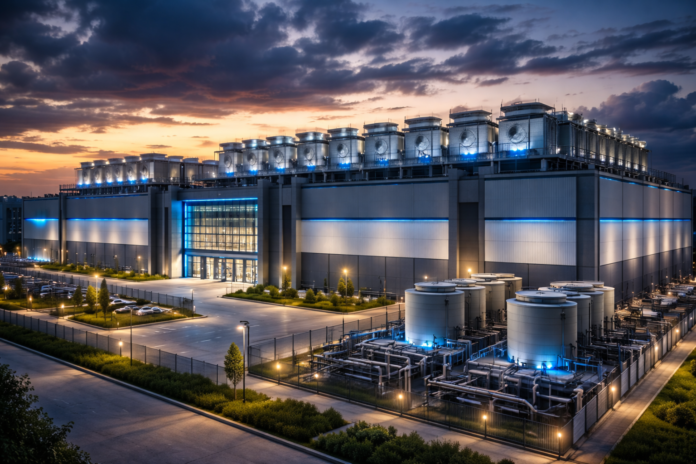
- Liquid Cooling: Traditional air conditioning is no longer sufficient. Modern data center real estate must now incorporate “rear-door heat exchangers” or “immersion cooling” infrastructure. This technical complexity increases the “moat” for investors—only those who can build or retrofit these systems can capture the high-margin AI tenants.
Strategic Locations: Beyond Northern Virginia
While Ashburn, Virginia, remains the data center capital of the world, 2026 has seen the rise of “Secondary” and “Edge” markets. Savvy investors are looking for locations that offer three things: low natural disaster risk, favorable tax incentives, and—most importantly—proximity to renewable energy sources.
Emerging Hubs in 2026
- The Nordic Region: Norway and Sweden have become magnets for sustainable data centers due to their abundant hydroelectric power and cold climates, which naturally reduce cooling costs.
- The “Edge” Cities: As applications like autonomous driving and remote surgery require ultra-low latency, we are seeing a boom in “Edge Data Centers.” These are smaller facilities located in cities like Phoenix, Barcelona, and Johor Bahru, bringing data closer to the end-user.
Triple-Net Leases: The Landlord’s Dream
From a financial structure perspective, data centers often utilize Triple-Net (NNN) Leases. This is a major reason why the niche is so lucrative. In an NNN lease, the tenant is responsible for:
- Real estate taxes
- Building insurance
- Maintenance and utilities
Because power is the largest variable cost in a data center, the NNN structure protects the landlord from fluctuations in energy prices. The tenant pays for the electricity they consume, while the landlord collects a stable, high-margin rent for the space and the “right” to use the power infrastructure.
Common Mistakes and Risks to Avoid
Despite the “gold rush” feel of 2026, data center investment is not without its pitfalls.
- Underestimating Obsolescence: Technology moves fast. A facility built five years ago without the structural floor loading capacity or ceiling height for modern cooling systems might become “legacy” and see its value plummet.
- Ignoring “NIMBY” Opposition: “Not In My Backyard” is a real threat. Many communities are pushing back against data centers due to their noise (from cooling fans) and their heavy drain on the local power grid.
- Connectivity Blind Spots: A building with power but no fiber diversity is useless. Investors must ensure the site has access to multiple “carrier-neutral” fiber paths to prevent a single point of failure.
- Over-leveraging on High Interest Rates: While data centers have high yields, the capital expenditure (CapEx) to build them is enormous. If interest rates remain elevated, the cost of debt can eat into the “Cap Rate” (Capitalization Rate) quickly.
Sustainability: The New Mandate
As of March 2026, you cannot discuss data centers without discussing ESG (Environmental, Social, and Governance) criteria. Major tenants like Microsoft and Google have committed to being carbon-neutral or carbon-negative.
This means that “Brown” data centers (powered by coal or gas) are being traded at a discount, while “Green” data centers (powered by solar, wind, or nuclear) are fetching premium valuations. Investors who focus on energy-efficient designs, such as those with a PUE of 1.2 or lower, are finding it much easier to secure low-cost “Green Bonds” for financing.
How to Get Involved: The Three Paths
For those looking to enter this lucrative niche in 2026, there are three primary routes:
1. Publicly Traded REITs
This is the easiest path for individual investors. Companies like Equinix (EQIX) and Digital Realty (DLR) are massive owners of global data center footprints. They offer liquidity and professional management, though their stock prices can be volatile and are often influenced by broader tech-sector trends.
2. Private Equity and Syndications
For accredited investors, private equity firms (like Blackstone or KKR) frequently raise multi-billion dollar funds specifically for digital infrastructure. These allow for direct exposure to the asset class with less daily price volatility than the stock market, though they require longer “lock-up” periods of 5 to 10 years.
3. Direct Development
This is the highest-risk, highest-reward path. It involves buying land with power entitlements, securing a tenant, and building a purpose-built facility. In 2026, this requires a deep network of relationships with local utility providers and a sophisticated understanding of mechanical and electrical engineering.
Conclusion
The data center real estate market of 2026 represents the ultimate convergence of infrastructure and technology. As we have seen, the “lucrativeness” of this niche doesn’t just come from high rents; it comes from the indispensable nature of the asset. In a world where every industry—from finance to healthcare—is becoming a software industry, the physical buildings that host that software are the most valuable “dirt” on earth.
However, the easy money has been made. To succeed in the latter half of the 2020s, investors must be more than just landlords; they must be energy strategists and tech-savvy visionaries. The focus has shifted from “how much space can we build?” to “how much power can we secure and how efficiently can we cool it?”
If you are looking to future-proof your real estate portfolio, the data center niche offers a compelling combination of long-term stability and tech-driven growth. The barrier to entry is high, the power constraints are real, but the rewards for those who navigate these complexities are likely to outpace almost every other real estate sector for the remainder of the decade.
Next Steps for Investors:
- Analyze your current exposure: Check your existing REIT or mutual fund holdings for digital infrastructure components.
- Research the “Power Map”: Look for regions with upgrading electrical grids and pro-renewables legislation.
- Evaluate Sustainability: Prioritize assets that are “Future-Ready” with liquid cooling capabilities and low PUE ratings.
FAQs
1. What makes a data center “lucrative” compared to an office building?
Data centers benefit from much longer lease terms (often 10–15 years) and significantly lower tenant turnover. Additionally, while office tenants might require expensive “tenant improvements” (TI) every few years, data center tenants typically invest their own capital into the server equipment, making them very unlikely to leave the facility.
2. How does the AI boom affect data center valuations in 2026?
AI workloads require significantly more power and cooling than traditional cloud storage. This allows data center owners to charge a premium for “AI-ready” space. Furthermore, the specialized infrastructure required for AI creates a scarcity of supply, which drives up the valuation of existing facilities that can handle high-density loads.
3. Is the data center market in danger of being overbuilt?
While some localized markets may see temporary oversupply, the global demand for data—driven by 5G, AI, and the Internet of Things (IoT)—is currently outstripping the speed at which we can build new facilities. The primary bottleneck is not the buildings themselves, but the availability of power from the electrical grid.
4. What is PUE, and why should an investor care?
PUE stands for Power Usage Effectiveness. It is a ratio of how much power enters the data center versus how much is actually used by the IT equipment. A PUE of 1.0 is a perfect score. In 2026, investors care about PUE because lower ratios mean lower operating costs and higher attractiveness to environmentally-conscious “hyperscale” tenants.
5. Can I invest in data centers with a small amount of capital?
Yes. Through publicly traded Data Center REITs (Real Estate Investment Trusts) or ETFs that focus on digital infrastructure, individual investors can gain exposure to this niche with the price of a single share.
References
- CBRE Research (2025/2026): “Global Data Center Trends Report” – Authoritative data on vacancy rates and absorption.
- JLL Real Estate: “Data Center Outlook 2026” – Insights into secondary markets and edge computing growth.
- International Energy Agency (IEA): “Electricity 2026 Report” – Data on global energy consumption by data centers.
- Uptime Institute: “Annual Data Center Survey” – Technical benchmarks for PUE and cooling trends.
- Equinix Investor Relations: “2025 Annual Report” – Financial performance and lease structure examples.
- Digital Realty: “The State of the Digital Core” – Analysis of hyperscale vs. colocation demand.
- Gartner: “Forecast: Public Cloud Services, Worldwide, 2024-2027” – Projections for the underlying demand for data center space.
- U.S. Department of Energy: “Data Center Energy Efficiency Program” – Official guidelines on sustainable infrastructure.