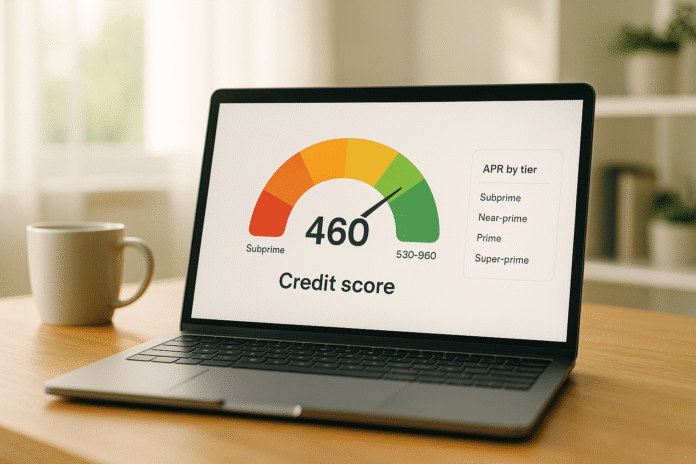
Credit score ranges sort borrowers into risk tiers that lenders use to set approval odds and prices. In U.S. consumer lending, the common tiers are deep subprime (<580), subprime (580–619), near-prime (620–659), prime (660–719), and super-prime (≥720)—labels that map to how likely you are to repay on time and what rates you’ll be offered. Most consumer scores span 300–850, with FICO® and VantageScore® being the two most used models. This guide explains the ranges, how lenders apply them across mortgages, auto loans, and credit cards, and proven ways to move up a tier. (Educational information only; not financial, legal, or tax advice.)
1. The Core Risk Tiers: Deep Subprime to Super-Prime (What Each One Means)
The five risk tiers describe broad likelihoods of on-time repayment and are widely referenced by lenders: deep subprime (<580), subprime (580–619), near-prime (620–659), prime (660–719), and super-prime (≥720). In practice, the lower the tier, the higher the expected rate and the stricter the underwriting; the higher the tier, the better your approval odds and pricing. While every lender sets its own cutoffs, this 5-tier map is the clearest, data-driven way to understand how “subprime” and “prime” sit on the same spectrum. Knowing your tier helps you predict outcomes and plan concrete steps to move up (e.g., lowering utilization or cleaning up late payments) before you apply.
Typical U.S. tier map (general conventions)
- Deep subprime (<580): Access is limited, higher down payments or security deposits often required.
- Subprime (580–619): Access possible, but rates and fees are elevated; shorter terms more common.
- Near-prime (620–659): Transitional tier; approvals expand, pricing improves.
- Prime (660–719): Broad access and competitive pricing across products.
- Super-prime (≥720): Best-in-market rates and terms for qualified borrowers.
1.1 Numbers & guardrails
- Models & scale: Most consumer scores (FICO, VantageScore) run 300–850. Category names (e.g., “Good,” “Very Good”) differ by model and bureau, but the risk tiers above remain a consistent lens for pricing.
- Not universal law: Lenders may slide boundaries slightly by product; treat tiers as conventions, not legal rules. Experian
- APR spreads are real: As of Q2 2025, Experian data show auto APRs ranging roughly from ~5.27% (superprime new) to ~15.97% (deep subprime new), with similar spreads for used cars—illustrating how tiers translate into money.
1.2 Mini example
If two shoppers finance $20,000 used cars for 60 months, one at 9.39% (prime) and another at 18.90% (subprime), the prime borrower’s monthly payment is about $419 vs. $518 for subprime—over $5,900 more in interest for the subprime buyer. Same car, different tier, very different cost.
Bottom line: Start by identifying your tier on this 5-step ladder; then target the fastest moves that push you into the next rung, where pricing materially improves.
2. FICO® vs. VantageScore®: Same Scale, Different Labels
Both FICO and VantageScore use 300–850, but they label “good,” “very good,” and related ranges differently, which can confuse comparisons. FICO’s commonly cited categories: Poor (<580), Fair (580–669), Good (670–739), Very Good (740–799), Exceptional (800–850). VantageScore 3.0/4.0 uses categories roughly aligned as Excellent (781–850), Good (661–780), Fair (601–660), Poor (500–600), Very Poor (300–499). The outcome: a 730 FICO sits in “Good,” while a 730 VantageScore falls squarely in “Good” too—yet some lenders treat these labels and thresholds differently. For mortgages, especially, many lenders must use specific FICO versions, not VantageScore, so check which score a lender will pull.
2.1 Numbers & guardrails
- Shared scale: Most broad-based scores 300–850; “good” is ~670–739 (FICO) and ~661–780 (VantageScore).
- Mortgage reality: Mortgage lenders are required to use designated FICO versions; the “free score” you see (often VantageScore) may differ from the mortgage pull.
- Ranges vary by publisher: Bank and bureau education pages may show slightly different labels; use them as guidance, not gospel.
2.2 Quick list: translating labels to tiers
- FICO Good (670–739) ≈ Prime/Near-Prime
- FICO Exceptional (800–850) ≈ Super-prime
- Vantage Good (661–780) spans Prime into Super-prime territory.
These are heuristics, not fixed lender rules.
Bottom line: Know which model and version a lender uses. The label on your app may not match the score that prices your loan.
3. How Ranges Drive Mortgage Options (Conventional, FHA, VA)
Credit tier has outsized impact in mortgages because minimums and pricing adjust sharply with score. Conventional (Fannie Mae/Freddie Mac) loans generally require ≥620 for eligibility; borrowers at 740+ often see better pricing and lower mortgage insurance costs. FHA allows 3.5% down with ≥580 and permits 500–579 with 10% down. VA does not set a minimum score, though many lenders impose their own (commonly around 620). Because mortgage underwriting is rule-bound and rate-sensitive, moving from near-prime to prime can meaningfully cut monthly cost and upfront fees. (Details are U.S.-specific; always confirm current guidelines.)
3.1 How to prepare (mini-checklist)
- Aim for 620+ if you want broad conventional options; 740+ typically unlocks stronger pricing.
- Consider FHA if you’re rebuilding: ≥580 for 3.5% down; 500–579 with 10% down—calculate MIP trade-offs.
- VA borrowers: Confirm with your lender; VA sets no minimum, but lender overlays apply.
- Cluster rate quotes: Keep mortgage inquiries within a focused window to minimize scoring impact (see Essential #7). Consumer Financial Protection Bureau
3.2 Numbers & guardrails (as of Sep 2025)
- Conventional minimums: 620 baseline per Fannie Mae Selling Guide.
- Policy documents update regularly; rely on current Selling Guide/Handbooks over blog summaries. Fannie Mae Single-Family
Bottom line: For mortgages, the 620 line opens the door; every 20–40 points above that often improves pricing. FHA and VA provide paths when you’re still climbing tiers.
4. Auto Loans & Credit Cards: Pricing by Tier in the Real World
Auto financing is a clear window into how tiers price risk. As of Q2 2025, Experian’s market data show average new-car APRs around 5.27% (superprime), 6.78% (prime), 9.97% (nonprime 601–660), 13.38% (subprime 501–600), and 15.97% (deep subprime 300–500); used-car APRs are higher across all tiers. The practical meaning: a 50–80 point score shift can trim hundreds to thousands in lifetime interest on a typical car loan. For credit cards, prime and super-prime tiers unlock broader product choices, richer rewards, and higher starting limits; subprime often means secured cards, higher APRs, and annual fees.
4.1 Steps to improve your auto-tier outcome
- Rate-shop smart: Submit applications within a short window (see Essential #7) and compare total cost (APR, term, fees).
- Pad your down payment: Lowers LTV and may offset risk-based pricing. (Lender practice varies.)
- Use preapproval: A credit union or bank preapproval sets a rate benchmark.
- Avoid simultaneous new credit: Hard pulls for unrelated credit can nudge you down a tier during underwriting.
4.2 Mini case: same car, different tiers
On a $28,000 new car for 72 months, moving from 9.97% (nonprime) to 6.78% (prime) cuts the payment by roughly $44–$55/month and can save ~$3,000–$4,000 in total interest—savings you can redirect to principal, insurance, or maintenance. (Illustrative; your terms will vary.)
Bottom line: Auto and card markets price in tiers you can see. Even one tier up can be the difference between “affordable” and “ouch.”
5. What Actually Moves You Between Tiers (The Scoring Math That Matters)
The fastest, most reliable way to climb tiers is to align your habits with what the models weigh most. FICO’s five major factors are: payment history (35%), amounts owed/credit utilization (30%), length of credit history (15%), new credit (10%), and credit mix (10%). Consistently paying on time, keeping revolving utilization low, and avoiding avoidable hard inquiries do the heavy lifting. Lowering aggregate utilization below ~30% is helpful; pushing to <10% (without risking fees/interest) is a powerful signal. None of this requires gimmicks—just disciplined, repeated actions that the algorithms reward.
5.1 Mini-checklist to gain a tier
- Autopay the minimums + sweep extra to stop late-payment damage (never let 30+ days elapse).
- Target utilization: Pay revolving balances to <30% first, then <10% for optimization. myFICO
- Sequence your moves: Ask for limit increases before closing any cards; closing reduces available credit and can spike utilization.
- Batch applications: Time-box hard pulls (see Essential #7).
5.2 Numeric example
If your total card limits are $10,000 and balances are $7,000 (70% utilization), paying $6,000 over several months drops utilization to 10%. That one metric alone touches the 30% “amounts owed” bucket in FICO and can be the difference between subprime and near-prime/prime pricing.
Bottom line: Scores reward on-time payments and low revolving balances. Build those two habits and your tier—hence your rates—will follow.
6. Don’t Be Surprised by Different Numbers: Specialty Scores & Older Versions
Lenders don’t all use the same score. Auto lenders often use a FICO Auto Score that ranges 250–900 and weighs your car-loan history more; card issuers may rely on bankcard-specific models; mortgage lenders frequently use older, “classic” FICO versions due to regulatory and investor requirements. Meanwhile, the score you see in an app may be a VantageScore. That’s why your “free score” and a lender’s pull can differ by dozens of points even when pulled on the same day. When stakes are high, ask the lender which model and version they use and calibrate your expectations accordingly.
6.1 Tools/Examples
- Auto example: A borrower might see 730 VantageScore in a consumer app but a dealer may price off a FICO Auto Score of 705. The direction is consistent (both good), but the exact number and pricing can differ.
- Mortgage reality check: Expect a lender to use specified FICO versions; don’t be alarmed if your in-app score doesn’t match the Loan Estimate.
6.2 Why it matters
Knowing the model and version helps you set rate expectations, time applications, and choose which behaviors to optimize (e.g., paying down revolving balances before an auto loan vs. adding a small installment account for credit mix).
Bottom line: “Score” isn’t singular. Clarify the model/version before you apply, so you’re not blindsided by a different number.
7. Smart Shopping & Common Myths (Protect Your Tier While You Borrow)
You can borrow strategically without torpedoing your score. Rate-shopping windows exist so you can compare offers: FICO treats multiple mortgage/auto/student-loan inquiries within a window (often up to 45 days in newer versions) as one; VantageScore uses ~14 days. Soft inquiries (like checking your own score) don’t affect your score; hard inquiries (credit applications) can nudge it down temporarily. For mortgages specifically, the CFPB confirms that multiple lender checks within 45 days count as a single inquiry for scoring. Use these windows deliberately, and avoid unnecessary new credit while you’re mid-application.
7.1 Common myths—debunked
- “Checking my score hurts it.” False. Soft pulls don’t impact your FICO Score; hard pulls might, briefly. myFICO
- “Closing old cards boosts my score.” Often false. Closing can raise utilization and trim available credit, which can lower scores.
- “All inquiries are equal.” No. Rate-shopping inquiries for installment loans get grouped; credit card applications generally do not.
7.2 Mini plan: how to shop without slipping a tier
- Pull your reports and scores, fix errors first.
- Batch applications inside a safe window (14 days if unsure; 45 days for newer FICO versions).
- Avoid other new credit until after funding.
- If you’re on a tier cusp, pay down cards before the next statement cut so the lower balances report in time.
Bottom line: Use the rules to your advantage: shop smart within the window, keep utilization low, and protect your tier while you lock a deal.
FAQs
1) What’s the difference between “subprime” and “poor” credit?
“Subprime” is a lender risk category typically referring to scores below ~620; “poor” is a label used by some models (e.g., FICO <580) to describe a segment of the 300–850 scale. Both imply higher risk, but they’re not identical terms. Lenders often price by subprime/prime tiers; bureaus and models display Poor/Fair/Good categories for consumers.
2) Which score do mortgage lenders use—FICO or VantageScore?
Most mortgage lenders are required to use designated FICO models, not VantageScore. The consumer score in your banking app may be VantageScore, so don’t be surprised if the lender’s number is different. Ask which model/version they’ll pull before you apply.
3) What credit score do I need for a conventional mortgage?
Conventional loans typically require ≥620 for eligibility. Higher scores (often 740+) can improve pricing and mortgage insurance costs. If you’re rebuilding, FHA offers alternatives with different minimums (see next FAQ). Always verify current guidelines.
4) What are FHA and VA credit score rules?
FHA: ≥580 may qualify for 3.5% down; 500–579 may qualify with 10% down. VA: The VA itself sets no minimum score, but many lenders apply their own thresholds. Confirm with your lender.
5) Why does my “free score” differ from the lender’s score?
Scores vary by model (FICO vs. VantageScore) and version (e.g., classic vs. newer). An auto dealer might use a FICO Auto Score (250–900 range) that weighs past auto history more heavily than broad-based scores. Different inputs, different numbers.
6) Are average U.S. credit scores falling or rising?
As of April 2025, FICO reports the average U.S. FICO Score is 715, down from 717 a year earlier—reflecting higher utilization and resumed student-loan delinquency reporting. It’s still a relatively high national average by historical standards.
7) How quickly can I move up a tier?
It depends on what’s holding you back. Late payments take time to heal, but utilization can change within a billing cycle. Paying cards down from 70% to <10% utilization can move some borrowers from subprime/near-prime to prime quickly; just be sure the lower balances report before applying. myFICO
8) Do income or savings affect my credit score?
Not directly—scores use credit-report data, not income. Lenders, however, review income, savings, and debt-to-income alongside your score to decide approval and terms. Paying on time and keeping utilization low remain the best score levers.
9) Does rate shopping hurt my score?
Not if you do it correctly. FICO groups mortgage/auto/student-loan inquiries within a de-dup window (often up to 45 days in newer versions) as one; VantageScore uses about 14 days. Credit card applications don’t get this treatment. Plan your timing accordingly.
10) Should I close old credit cards to boost my score?
Usually not. Closing reduces available credit and can raise utilization, which may lower your score. If a card is costly, consider a product change or a retention offer; otherwise, keep it open and unused to preserve your limits and history. myFICO
Conclusion
Understanding credit score ranges is really about understanding risk tiers and how they price your borrowing. The deep-subprime to super-prime ladder explains why two people can buy the same car or apply for the same mortgage and walk away with entirely different costs. The good news: the behaviors that move you up are simple and repeatable—pay on time, lower revolving balances, avoid unnecessary inquiries, and apply with intention during rate-shopping windows. For mortgages, 620 opens more doors; for auto and cards, even one tier higher can unlock dramatically better pricing. If your score is already healthy, keep utilization low and your oldest accounts open; if you’re rebuilding, FHA and VA can be useful stepping-stones while you climb. Check which model/version a lender uses so you can set expectations, and rely on up-to-date, primary sources when rules change.
Take the next step now: pull your credit reports, set up autopay, and plan a 90-day sprint to drop utilization before your next big application.
References
- Borrower Risk Profiles — Consumer Financial Protection Bureau (CFPB), n.d. Consumer Financial Protection Bureau
- The Effects of Credit Score Migration on Subprime Auto Loan and Credit Card Delinquencies — Board of Governors of the Federal Reserve System (FEDS Notes), Jan 12, 2024. Federal Reserve
- What Is a Credit Score? / What Is a Good Credit Score? — myFICO (Fair Isaac), n.d. ; https://www.myfico.com/credit-education/credit-education/score-basics/what-is-a-good-credit-score/ myFICO
- What Are the Different Credit Score Ranges? — Experian, Dec 18, 2024. Experian
- Credit Score Ranges & What They Mean — Equifax, n.d. Equifax
- Average US FICO Score Drops to 715 — FICO Newsroom, Apr 16, 2025. FICO
- What Minimum Credit Score Do You Need to Buy a Car? — NerdWallet (citing Experian Q2 2025 data), Updated Sep 3, 2025. https://www.nerdwallet.com/article/finance/credit-score-needed-to-buy-car NerdWallet
- B3-5.1-01: General Requirements for Credit Scores — Fannie Mae Selling Guide, current page (accessed Sep 2025). selling-guide.fanniemae.com
- FHA Single Family Housing Policy Handbook 4000.1 — U.S. Department of Housing and Urban Development (HUD), May 20, 2024. HUD
- VA Home Loan Guaranty Buyer’s Guide — U.S. Department of Veterans Affairs, n.d. (accessed Sep 2025). benefits.va.gov
- What Is a VantageScore Used For? — VantageScore, Dec 28, 2022. VantageScore
- How Are FICO Scores Calculated? — myFICO, n.d. myFICO
- How to Rate Shop and Minimize the Impact to Your FICO® Scores — myFICO, Jul 5, 2023. myFICO
- Thinking About Applying for a Loan? Shop Around to Find the Best Offer — VantageScore, Dec 8, 2023. VantageScore