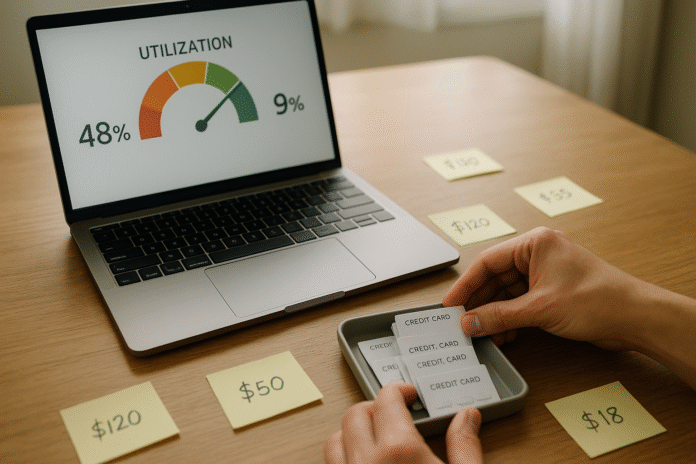
When you’re juggling multiple debts, the “debt snowball” (paying the smallest balances first) gives you quick wins. But how does that choice play with your credit score—especially your credit utilization? Short answer: eliminating entire small balances can reduce both overall and per-card utilization and may create a noticeable score lift, provided you keep payments on time and avoid new debt. The sections below unpack exactly how snowballing smaller accounts can influence utilization, payment history, account mix, and other score factors so you can pick a plan that both feels motivating and supports long-term credit health.
Quick definition: Credit utilization is your revolving balances divided by your credit limits; lower is generally better, with common guidance to stay below 30% and ideally in the single digits.
This article is education, not individualized financial advice. Credit scoring models differ, and issuers’ reporting schedules vary. As of September 2025, guidance and references are current.
1. Paying Off a Small Balance Can Lower Both Overall and Per-Card Utilization
Paying off a smaller account entirely reduces your total revolving balances and, if it’s a credit card, sets that card’s individual utilization to 0%. Because scoring models look at overall utilization and utilization on individual cards, zeroing out a card can be more impactful than spreading the same dollars thinly across many cards. That’s a core reason the snowball approach can help your score even if it’s not the mathematically cheapest path on interest. FICO notes “Amounts Owed” (which includes utilization) accounts for about 30% of a typical FICO® Score, so material changes here can move the needle—especially if a card was previously high-utilization.
1.1 Why it matters
- Two lenses: Models evaluate aggregate utilization and per-card utilization; very high utilization on any single card can hurt, even if your total looks okay.
- Zeroing a card helps optics: Wiping one card to 0% removes a potential red flag from that card’s individual utilization.
- Behavioral boost: Quick wins keep motivation high, making it likelier you’ll stick with the plan. Research shows people prefer closing small debts first (“account aversion”).
1.2 Mini case: $2,000 vs $500 card
- Card A: limit $2,000, balance $1,000 (50%).
- Card B: limit $500, balance $450 (90%).
- Total limit $2,500; balances $1,450 → overall utilization 58%.
- Pay off Card B first (snowball): total balances drop to $1,000 → overall utilization 40%, and Card B goes to 0%. That’s a double improvement: overall drops 18 points, and you eliminate a 90% outlier card, which models view negatively.
Bottom line: Snowballing a small, high-utilization card can punch above its weight for scoring optics while building momentum to tackle the rest.
2. Your Payment History Still Drives More of the Score—Protect It While You Snowball
While utilization is critical, payment history remains the single biggest FICO category (about 35%). Missing any minimum payment while you attack small balances can erase utilization gains and drag your score for years. The snowball method must never come at the expense of on-time minimums across all accounts. If cash is tight, automate minimums first, then target extra dollars toward your smallest balance.
2.1 How to protect payment history while snowballing
- Autopay minimums for every card to avoid a 30-day late—the threshold when issuers typically report delinquencies. LanternCredit
- Choose the right pay date: Issuers generally report after the billing cycle closes; know yours so payments are credited before reporting.
- Keep a buffer: A small cash cushion prevents a single surprise bill from causing a missed payment and interest snowball.
2.2 Numbers & guardrails
- One 30-day late can dent your score far more than a moderate utilization fluctuation; late payments can remain on your report for up to 7 years.
- “Amounts Owed” is ~30%, but “Payment History” at ~35% generally dominates. Treat utilization improvements as additive—not a substitute for on-time payments.
Bottom line: Snowball to cut utilization, but never at the cost of a single late payment. Minimums first, momentum second.
3. Target the “Smallest High-Utilization Card” First for Maximum Score Impact
A refined snowball twist is to sort your smallest balances with an eye to utilization. If your smallest debt also sits at 80–100% utilization, that’s the ideal first target. Scoring models view maxed-out or near-maxed cards as risky, even when your total utilization isn’t catastrophic. Eliminating a high-utilization outlier can reduce negative scoring signals quickly and visibly.
3.1 How to do it
- List each card: balance, limit, utilization %, minimum payment.
- Prioritize the smallest balance that is also above 50% utilization; if two are similar, pick the one with the higher utilization.
- Snowball sequence: After payoff, roll that freed payment to the next smallest high-utilization card.
3.2 Mini case: utilization-aware snowball
- Card X: $300 / $1,000 (30%).
- Card Y: $450 / $500 (90%).
- Both are “small,” but paying off Card Y first removes a 90% utilization red flag and slashes overall utilization more than paying Card X.
Bottom line: A utilization-aware snowball preserves the psychological benefits of quick wins while aligning with how scores read risk.
4. Don’t Rush to Close Paid-Off Cards—Utilization and Age Both Matter
After you zero a small card, it’s tempting to close it for simplicity. Be careful: closing a card immediately removes its credit limit from your available credit, potentially raising your utilization and nudging scores down. The CFPB cautions that closing a card can increase utilization and lower your score; if there’s no annual fee or risk of misuse, consider leaving it open. Also remember that positive, closed accounts in good standing can stay on reports for up to 10 years, helping your history, but the limit no longer counts toward utilization once the account is closed.
4.1 Mini checklist
- Annual fee? If no fee and you can avoid overspending, consider keeping it open.
- Oldest card? Be extra cautious; closing can shorten average age over time.
- Temptation risk? If a card tempts overspending, weigh mental health and budget discipline over a few points of utilization.
4.2 Why utilization may change after closure
- Utilization = balances ÷ limits. Close a card, and the denominator shrinks. The math alone can push your ratio higher—even if your spending doesn’t change.
Bottom line: Celebrate the payoff, but think strategically before closing the account; in many cases, keeping a zero-balance card open supports a lower utilization profile.
5. Pair Snowball With Credit-Limit Management to Accelerate Utilization Gains
You can amplify snowball’s utilization benefits by raising the denominator—your total available credit—while you lower balances. Requesting a credit limit increase (CLI) on a well-managed card (on-time payments, modest existing utilization) can drop your ratio even before you finish paying off small balances. Some issuers grant soft-pull CLIs; others use a hard inquiry. Meanwhile, avoid opening multiple new cards just for limits; that can ding “new credit” and may tempt overspending.
5.1 Practical steps
- Ask about soft-pull CLIs first; if a hard pull is required, decide if the utilization drop is worth the short-term inquiry trade-off.
- Time the CLI: Right after a statement that shows a low balance and on-time history can improve your odds.
- Don’t undermine discipline: A higher limit only helps if spending habits stay steady.
5.2 Example: math meets behavior
- Total limits $5,000; balances $1,500 → 30% utilization.
- You snowball a $300 card to zero (new balances $1,200 → 24%).
- Then secure a $1,500 CLI on another card (limits $6,500 → 18%).
- Result: Utilization falls from 30% to 18% with one payoff and one CLI, often supportive of better scores.
Bottom line: Snowball reduces the numerator; a thoughtful CLI can enlarge the denominator. Together, they can push you toward single-digit utilization faster.
6. Snowball vs. Avalanche: When a Hybrid Approach Serves Your Credit Score Best
The snowball prioritizes motivation by killing small balances first; the avalanche minimizes interest by focusing on the highest APR. In practice, a hybrid often works: lead with one or two quick snowball wins (especially if they’re high-utilization cards), then pivot to your highest-interest balance. The CFPB explains both methods and notes snowball’s psychological edge, but acknowledges avalanche may cost less interest over time. Since utilization and payment history respond to balances and behavior—not APR—think of avalanche as your long-run savings plan and snowball as your adherence plan.
6.1 Decision rules
- If a small card is near maxed: snowball it first for a utilization/score bump.
- If interest costs are crushing cash flow: pivot to avalanche to preserve budget and avoid late payments.
- After 1–2 quick wins: roll the larger combined payment into your highest APR debt.
6.2 Evidence note
Behavioral research shows people are more likely to stick with plans that show early progress—even when those plans are not interest-optimal. Sticking with a plan that you follow beats abandoning a “perfect” plan.
Bottom line: Use snowball to build momentum and improve utilization optics, then avalanche to minimize costs—an approach that supports both score and savings.
7. Reporting Timing: Statement Closing Date Is the Snapshot That Drives Utilization
Even if you pay in full every month, your utilization can appear high if you happen to have a big balance on the statement closing date, because issuers typically report around that time. To align snowball progress with what scores “see,” make a mid-cycle payment or pay down the small target balance before the statement closes. Knowing each card’s cycle helps your score reflect your real progress sooner.
7.1 Quick checklist
- Find your dates: Look for “statement closing date” on your last statement.
- Schedule payments 3–5 days before closing to ensure posting in time.
- Staggered cycles: Because cycles differ by card, plan payments per card rather than all at month-end. CreditCards.com
7.2 Example: making progress visible
- You pay off a $400 small card on September 2. The card’s statement closes on September 28. Without a mid-cycle payment, the old high balance might still be what’s reported until the cycle ends; paying before September 28 ensures the zero is captured in that month’s reporting, letting utilization and scores reflect your progress sooner.
Bottom line: Snowball progress counts when it’s reported; time your payments so the bureaus see the utilization you’re actually carrying.
8. Balance Transfers and New Accounts: Help or Harm to Utilization?
A 0% APR balance transfer can supercharge debt payoff by lowering interest, but opening a new card adds a hard inquiry and a new account, and it can change your average age of credit. On the plus side, the new limit can drop your utilization, and moving debt from a nearly maxed card to a much higher limit card can clean up per-card utilization optics. On the negative side, transferring debt without a plan can lead to higher total balances. Consider a transfer only if you have a clear payoff timeline (preferably within the promo period), and avoid new spending on the old card.
8.1 Pros and cons (utilization-specific)
- Pros: Lowers per-card utilization on the old card; may lower overall utilization if the new limit is large.
- Cons: New account/inquiry; temptation to run up the old card again; fees can offset interest savings.
- Neutral: Closed vs. open old card—closing removes its limit from utilization math; consider leaving it open if there’s no fee and you’ll avoid spending.
8.2 Guardrails
- Payoff plan: Divide the transferred balance by promo months to set an automatic payment that retires it before the promo ends.
- Freeze the old card in your wallet or lock it in the app to prevent backsliding.
Bottom line: Balance transfers can complement a snowball by reshaping utilization, but only with disciplined payoff behavior and careful account management.
9. Monitor, Dispute Errors, and Build Habits That Keep Utilization Low
Snowball is a sprint for quick wins; long-term credit health is a marathon of monitoring, error-checking, and steady habits. Pull your credit reports regularly, watch each card’s utilization, and dispute inaccuracies promptly. Many lenders and bureaus update monthly, but timing varies; don’t panic if improvements take a cycle or two to show. Keep a small emergency fund so a single surprise expense doesn’t force a high-utilization spike.
9.1 Ongoing practices
- Track utilization: Overall and per-card; aim for under 30% and, when feasible, single digits.
- Use alerts: Set app alerts for balances above set thresholds (e.g., 20% of limit).
- Dispute errors: Inaccuracies can undermine your progress; disputes are free. TransUnion
- Right-size limits: Periodically request CLIs to keep utilization flexible—if spending stays disciplined. Equifax
9.2 Mini case: from 46% to 8%
- Three cards, $6,000 total limits, $2,760 balances (46%).
- Snowball knocks out a $360 card to zero; you also make a $500 mid-cycle payment on another card before its closing date; then you secure a $1,000 CLI.
- New balances $1,900; new limits $7,000 → 27%. Keep rolling snowball payments and mid-cycle payments; within two more cycles, balances are $560 → 8%. Multiple small levers combine for a big utilization change.
Bottom line: Pair snowball with steady monitoring, timely disputes, and habit-building to keep your utilization—and your stress—consistently low.
FAQs
1) What is the debt snowball, in one sentence?
It’s a payoff strategy that targets your smallest balances first, rolling each freed payment into the next balance so your repayment “snowballs,” delivering early wins that improve adherence even if interest costs are somewhat higher than the avalanche method.
2) How exactly does snowball help my credit score?
By zeroing out entire cards, snowball can reduce both overall utilization and per-card utilization; since “Amounts Owed” is about 30% of a typical FICO score, those reductions can help—assuming you also keep payments on time and avoid new debt.
3) Is it true I should stay under 30% utilization?
“Under 30%” is widely cited as a practical guideline, and many consumers with top-tier scores keep utilization in the single digits. There’s no single magic number across all models, but lower is generally better—both overall and on each card.
4) My score didn’t improve right after I paid a card to zero. Why?
Creditors typically report after the billing cycle closes. If you paid just after reporting, you might not see a change until the next cycle. Mid-cycle payments made before the statement closing date can help the new balance be what gets reported.
5) Should I close a paid-off card?
Often, no—especially if it has no annual fee. Closing a card removes its limit from utilization math and can raise your utilization; the CFPB notes closing can lower your score by increasing your ratio. Consider leaving it open and using it sparingly.
6) Does paying in full every month make utilization irrelevant?
Not quite. Utilization is typically captured around your statement closing date; if your balance is high on that day, your reported utilization can still look high, even if you later pay in full by the due date. Time payments so the statement balance is low.
7) Is a balance transfer good or bad for my score?
It can help by lowering per-card and overall utilization (thanks to a new, larger limit) but can hurt in the short term via a hard inquiry and a new account. It helps only if you avoid re-using the old card and pay the transfer off in the promo window.
8) Do all debts affect utilization?
No. Revolving accounts (credit cards, lines of credit) drive utilization. Installment loans (auto, mortgage, student) don’t count toward utilization, though balances and payment history on them still matter to your score. Equifax
9) Is there proof that paying small balances first helps people stick to the plan?
Yes. Research on “account aversion” shows many people prefer closing small debts first, which can improve adherence even if it’s not interest-optimal. That adherence can make the snowball an effective real-world strategy.
10) What else should I watch besides utilization?
Payment history (largest factor), new credit/inquiries, length of history, and credit mix all influence scores. Keep paying on time, be selective about new accounts, and maintain older accounts when possible.
11) How can I estimate the score impact of my snowball plan?
There’s no universal formula because scoring models differ, but track: (1) overall utilization trend, (2) number of cards over 50% utilization, (3) on-time payment streak, and (4) hard inquiries. Many bureaus provide simulators that approximate changes using these inputs. TransUnion
12) How long do positive changes stay on my report?
Closed, positive accounts can remain for up to 10 years, supporting your history. Negative items (e.g., late payments) may remain up to 7 years. Keeping utilization low and payments on time builds enduring positives. TransUnion
Conclusion
The debt snowball gives you what most payoff plans lack: momentum. From a credit-scoring perspective, that momentum shows up when entire small cards hit 0% utilization, smoothing out both per-card and overall ratios. Combine that with perfect on-time minimums, smart timing around statement closing dates, and occasional credit-limit right-sizing, and you get tangible score tailwinds without losing the psychological benefit that keeps you in the game. A utilization-aware snowball (targeting the smallest high-utilization card first) offers the best of both worlds: quick wins for motivation and quick removal of the risk signals models dislike. Round out your plan with disciplined balance-transfer decisions, careful choices about closing accounts, and steady monitoring and disputes to keep your report accurate. Do that, and your snowball won’t just clear small balances—it will carve a path to sturdier credit health, cheaper borrowing, and calmer money days.
CTA: Pick your first target card, set autopay for all minimums, and schedule a pre-statement payment today.
References
- How Are FICO® Scores Calculated? myFICO, accessed 2025. myFICO
- What Should My Credit Utilization Ratio Be? myFICO, Feb 9, 2022. myFICO
- What Is a Credit Utilization Rate? Experian, Nov 5, 2023. Experian
- When Do Credit Card Payments Get Reported? Experian, Mar 22, 2021. Experian
- What Is Credit Utilization Ratio? TransUnion, Nov 27, 2023. TransUnion
- Why Did My Credit Score Drop? TransUnion, Jan 9, 2025. TransUnion
- What Is a Credit Utilization Ratio? Equifax, accessed 2025. Equifax
- Does it hurt my credit to close a credit card? Consumer Financial Protection Bureau, Jan 14, 2025. Consumer Financial Protection Bureau
- How to reduce your debt (Snowball method), Consumer Financial Protection Bureau, Jul 16, 2019. Consumer Financial Protection Bureau
- Credit Utilization Ratio: The Lesser-Known Key to Your Credit Health VantageScore, Oct 16, 2024. VantageScore
- Winning the Battle But Losing the War: The Psychology of Debt Management (working paper; Journal of Marketing Research), SSRN, 2011. SSRN
- How Often Do Credit Scores and Reports Update? TransUnion, Sept 2025. TransUnion