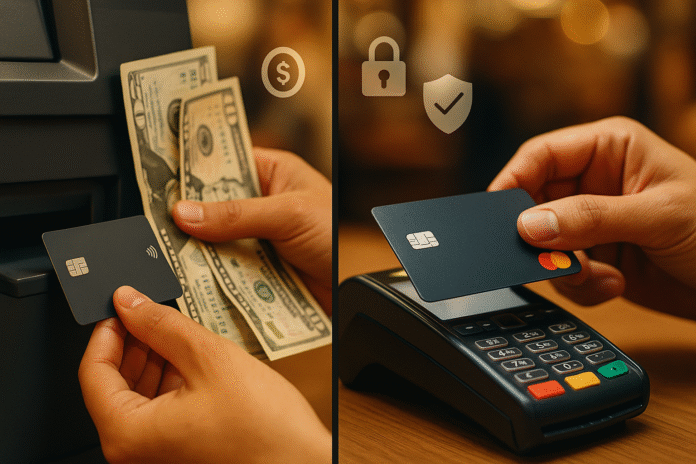
If you’re deciding between a prepaid card and a credit card, the fastest way to choose is to understand the big differences in how they work, what they cost, and the protections you get. Prepaid cards use money you’ve already loaded; credit cards let you borrow from a revolving line and charge interest if you don’t pay in full. That single distinction changes fees, fraud protections, credit-building, budgeting, travel, and more (as of now). This guide breaks down 11 clear, practical differences, with numbers, examples, and guardrails so you can pick confidently. Quick note: this is general education—terms vary by issuer and region; always check your cardholder agreement.
1. Who’s Funding the Purchase?
Prepaid cards draw on your own deposited funds, while credit cards extend a lender’s money that you must repay. That’s the core, defining difference. With a prepaid card, you load cash or transfer money to the card account first; then you spend only what’s on it—no debt, no APR. With a credit card, you receive a credit limit; purchases reduce available credit, and you repay later. Fail to pay in full and interest can accrue; pay on time and in full, and many purchases enjoy a grace period. The practical upshot: prepaid is pay-now; credit is pay-later—with obligations and potential interest attached. The CFPB’s consumer guidance and prepaid rule pages explain these fundamentals and why registering a prepaid card unlocks key protections.
1.1 Why it matters
- Risk & discipline: Prepaid prevents overspending beyond the loaded amount; credit requires self-control to avoid debt.
- Access: Prepaid can be easier to obtain (no credit approval); credit cards require underwriting and credit checks.
- Grace period: Credit cards often (not always) give a grace period on purchases; prepaid has none because there’s no borrowing.
1.2 Mini example
- Load $300 on a prepaid card; that’s the hard cap you can spend.
- Get a $1,000 credit limit; spend $300, then either pay $300 by the due date (no interest, if a grace period applies) or carry a balance and incur interest.
In short, prepaid = your cash; credit = a loan governed by more rules but potentially more benefits.
2. Fees & Interest: What You’ll Actually Pay
Prepaid cards typically charge program fees—e.g., monthly fees, ATM withdrawal fees, cash reload fees, customer service fees, and sometimes foreign transaction fees. Since 2019, issuers must present “short form” and “long form” fee disclosures for prepaid accounts to help you compare costs. Credit cards, by contrast, may have annual fees, late fees, cash-advance fees, balance transfer fees, and sometimes foreign transaction fees—plus interest (APR) on balances you carry. Many credit cards provide a grace period on purchases, but cash advances usually accrue interest immediately and often at a higher APR.
2.1 Numbers & guardrails
- Prepaid: Expect line-item fees disclosed up front (post-2019 prepaid rule). Compare short-form disclosures before you buy.
- Credit: Cash advances often start accruing interest right away; purchases may have a grace period if you pay in full.
- Foreign transaction: Commonly around 1%–3% on many cards (issuer-dependent). Some cards charge $0.
2.2 Checklist for comparing costs
- Scan the prepaid short form at purchase.
- On credit cards, review APR tables, cash-advance terms, late fees, and foreign fees.
- If you travel, consider a card with no foreign transaction fees.
Bottom line: prepaid concentrates costs in explicit fees; credit can be cheap if you pay in full—or expensive if you revolve or use cash advances.
3. Spending Limits, Utilization & Control
A prepaid card caps you at the funds you’ve loaded—you can’t spend what isn’t there. That makes overspending harder and budgeting simpler. A credit card gives you a credit limit and tracks your credit utilization ratio (balances ÷ limits). High utilization can hurt your credit scores; keeping it low is usually better. If you routinely approach your limit, purchases may be declined or fees could apply. For prepaid, your main constraints are load amount and any program/ATM withdrawal caps; for credit, it’s the issuer-assigned limit and your repayment habits.
3.1 Tools & tips
- Prepaid: Use issuer apps to monitor balance and set load reminders; consider automatic reloads from payroll if offered.
- Credit: Aim to keep utilization under ~30% across cards; mid-cycle payments can help lower reported balances.
3.2 Mini example
- If your total credit limit is $5,000 and balances total $1,250, your utilization is 25%—healthy for many scoring models. Push to 80% and your score could suffer. Experian
Takeaway: prepaid naturally enforces spending caps; credit requires active management of limits and utilization to protect your score.
4. Fraud Liability & Error Resolution
For credit cards, federal law caps your liability for unauthorized use at $50, and many issuers/pan-network policies offer zero liability. You also have strong, formal procedures to dispute billing errors. For prepaid (and debit), protections flow from Regulation E: liability depends on how quickly you report the loss and can range from $0 to tiers of $50, $500, or potentially more if you delay. Card-network “zero liability” policies often apply to registered prepaid or debit cards but can exclude certain transactions (e.g., anonymous cards, some ATM/PIN transactions). Always register your prepaid card to ensure you qualify.
4.1 Numbers & guardrails
- Credit (Reg Z/FCBA): Max $50 by law; strong dispute timelines.
- Prepaid/Debit (Reg E): Report within two business days to limit liability to $50; delays can raise exposure.
- Zero liability (networks): Broad coverage with exceptions (e.g., unregistered prepaid).
4.2 Mini checklist if your card is compromised
- Freeze the card in-app and call the issuer immediately.
- File the appropriate billing error (credit) or unauthorized EFT (prepaid/debit) claim.
- Follow up in writing to preserve rights.
Short version: both card types can protect you, but laws differ—credit cards get FCBA/Reg Z; prepaid falls under Reg E and network policies once registered.
5. Disputes for “Not Delivered as Agreed” Purchases
When goods aren’t delivered or services don’t match the contract, credit cards offer codified dispute rights under the Fair Credit Billing Act and Regulation Z—you can notify the issuer, withhold payment on the disputed amount, and the issuer must investigate within set timelines. Prepaid (and debit) disputes follow Reg E error-resolution procedures, which focus on unauthorized or processing errors, not product-quality disputes—so you may have fewer legal levers for “merchant disputes” compared with credit cards. Issuer and network rules may still help, but they’re not the same statutory rights.
5.1 How to do it (credit)
- Send a written dispute within 60 days of the first statement showing the error.
- The issuer must acknowledge within 30 days and resolve within two billing cycles (≤90 days). Consumer Advice
5.2 Guardrails (prepaid/debit)
- Start with the merchant; if that fails, ask your issuer about chargeback assistance.
- For unauthorized card use, invoke Reg E error procedures promptly. Consumer Financial Protection Bureau
Net: if you prioritize strong chargeback rights for undelivered goods, a credit card provides clearer, stronger federal procedures.
6. Credit Building (or Not)
Credit cards can help you build credit because issuers typically report account activity to credit bureaus. Paying on time and keeping utilization low can boost scores. Prepaid cards do not build credit—there’s no borrowing, so there’s nothing to report as a revolving trade line. If you’re new to credit or rebuilding, a secured credit card (a credit card backed by a refundable deposit) is often a better tool than a prepaid card for score growth. The CFPB explicitly notes prepaid cards don’t establish credit history.
6.1 Numbers & habits that matter
- Payment history and amounts owed/utilization weigh heavily in many scoring models.
- Keeping utilization under ~30% is a common rule of thumb. Consumer Financial Protection Bureau
6.2 Mini plan
- If approved, open a low-limit card, put one recurring bill on it, automate full payments, and monitor utilization monthly.
Bottom line: use a credit card (possibly secured) to build credit; use prepaid for budgeting/spend control, not scoring.
7. Cash, ATM Access & Cash Advances
With prepaid, ATM access is common but may carry out-of-network and balance inquiry fees. With credit cards, cash at ATMs is a cash advance that usually costs a fee and starts accruing interest immediately—often at a higher APR than purchases and with no grace period. If you regularly need ATM cash, prepaid may be cheaper than cash advances, though fees vary by program. Always compare your prepaid ATM schedule vs. your credit card’s cash-advance fee/ APR terms before tapping an ATM.
7.1 Quick tips
- Prefer in-network ATMs on prepaid to minimize fees.
- Avoid credit card cash advances unless urgent; repay quickly to limit interest.
7.2 Mini example
- A $200 cash advance with a 5% fee costs $10 up front and begins accruing interest the same day, compounding until paid. Consumer Financial Protection Bureau
Summary: prepaid is cash-friendly (fees permitting); credit card cash advances are costly and start the interest clock instantly.
8. Holds at Gas Stations, Hotels & Rentals
When the final amount isn’t known (fuel pumps, hotels, car rentals), merchants place pre-authorization holds. On prepaid/debit, that can tie up your balance for days; on credit, it reduces available credit but doesn’t drain your bank cash. As of 2022, Visa and Mastercard permitted gas stations in the U.S. to place holds up to $175; actual amounts vary by merchant. Rental car companies often won’t accept prepaid at pickup (though some accept prepaid for final payment); many prefer credit cards and may require extra documentation when using debit. For hotel incidentals, a credit card generally creates fewer headaches.
8.1 Common situations
- Gas pumps: Temporary holds can exceed your fuel cost until the transaction settles. AARP
- Hotels: Expect a daily hold for room+incidentals; funds unfreeze after checkout.
- Car rentals: Policies vary—many brands decline prepaid at pickup; debit may require a return ticket and a larger deposit. Alamo
8.2 Quick strategies
- Use a credit card for check-in and car rentals; settle with debit/prepaid later if allowed.
- At the pump, pay inside with a fixed amount to avoid large holds.
Takeaway: holds are routine, but credit cards absorb them better; prepaid balances can be locked up right when you need them.
9. Travel & International Purchases
Both card types can work abroad, but acceptance and fees differ. Many credit cards are widely accepted for hotels, rentals, and online bookings; prepaid acceptance can be spottier for deposits and recurring payments. For costs, foreign transaction fees commonly run ~1%–3% on many cards, though some issuers charge $0. On prepaid, foreign transaction and ATM fees can also apply. Network exchange rates and dynamic currency conversion (DCC) can affect totals. If you travel often, a no-foreign-fee credit card is usually the smoothest path—and remember that some rental counters decline prepaid at pickup.
9.1 Numbers & guardrails
- Expect 1%–3% foreign fees unless your card explicitly says $0. Forbes
- Some issuers list foreign fees in required disclosures; look for that row. Consumer Financial Protection Bureau
9.2 Mini checklist
- Carry at least one no-FX-fee credit card.
- Turn on travel alerts and transaction notifications.
- Decline DCC; pay in the local currency.
Bottom line: for travel, a credit card with no foreign fees and robust protections often wins on convenience and cost. Kiplinger
10. Rewards, Perks & Purchase Benefits
Credit cards often offer rewards (cash back, points, miles) and extras like extended warranty, purchase protection, travel insurance, and airport benefits—though the value and rules vary and rewards can be devalued. Prepaid cards rarely match that bundle; some offer light rewards or budgeting tools, but comprehensive travel/perk ecosystems are uncommon. Regulators have recently scrutinized how some rewards are marketed and administered, urging clearer disclosures and fairer practices. If rewards matter and you always pay in full, a no-fee or low-fee rewards credit card can deliver net value.
10.1 How to evaluate rewards (quick math)
- Estimate annual rewards value (earn rate × expected spend).
- Subtract annual fee and any likely interest (ideally $0 if you pay in full).
- Weigh non-cash perks you’ll actually use. Consumer Financial Protection Bureau
10.2 Common mistakes
- Chasing bonuses while carrying a balance (interest often dwarfs rewards).
- Ignoring redemption rules and devaluations called out by regulators. Consumer Financial Protection Bureau
Takeaway: rewards are a credit-card strength when used debt-free; prepaid is better for simple spend control than for perks.
11. Eligibility, Setup & Insurance of Funds
Getting a prepaid card is usually simpler: you typically need to verify your identity and fund the card, but there’s no credit check. To receive full legal protections (and deposit insurance eligibility), you should register the card. FDIC pass-through insurance can protect funds if specific requirements are met (e.g., card registration and proper record-keeping by the issuer’s bank). Credit cards require a credit application and approval; terms may depend on your credit profile. Secured cards can bridge the gap for thin files.
11.1 Region notes (U.S. context)
- The CFPB’s Prepaid Rule (effective April 1, 2019) standardized prepaid fee disclosures and protections. Other countries have different regimes—check local rules. Consumer Financial Protection Bureau
11.2 Quick setup checklist
- Prepaid: Register the card; read the short/long form fee schedules; set up alerts and a secure PIN.
- Credit: Review APRs/fees; enable autopay; monitor utilization; link to a budgeting app.
Bottom line: prepaid is easy entry with conditions (register for protections, know fees); credit cards need approval but can unlock broader benefits if managed wisely.
FAQs
1) Which is safer for online shopping—prepaid or credit?
Credit cards typically offer stronger statutory dispute rights under the Fair Credit Billing Act (Reg Z) for goods not received or not as agreed. Prepaid cards can still be safe, especially if registered and used via a major network with zero-liability policies, but merchant-dispute rights are not identical. If maximum protection is your goal, use a credit card and pay in full.
2) Can a prepaid card build my credit score?
No. Prepaid cards don’t involve borrowing and therefore don’t build credit history. If your aim is credit building, consider a secured credit card and follow best practices (on-time payments, low utilization). Consumer Financial Protection Bureau
3) Do credit cards always have a grace period?
No. Issuers are not required to provide a grace period, though most do for purchases. Cash advances generally accrue interest immediately, and often at a higher APR than purchases. Always confirm your card’s Schumer box disclosures.
4) Are prepaid card funds FDIC-insured?
They can be, if the card is eligible, properly registered, and pass-through insurance conditions are met at the issuing bank. Insurance applies if the bank fails, not for merchant disputes or identity theft.
5) What happens if someone makes unauthorized charges?
For credit cards, liability is capped at $50 by law and often $0 under network policies. For prepaid/debit, Reg E liability tiers depend on how quickly you report. Act fast and in writing to preserve rights.
6) Which is better for travel?
A no-foreign-fee credit card usually offers smoother acceptance at hotels and car rentals, and stronger dispute mechanisms. Prepaid can work for day-to-day spend but may face declines at check-in or larger holds. The Points Guy
7) Do prepaid cards charge foreign transaction fees?
Many do, often as a percentage of the transaction. Check your prepaid card’s fee schedule; not all cards are enabled for international use. Consumer Financial Protection Bureau
8) Why was there a big hold at a gas pump on my card?
Gas stations commonly place pre-authorization holds because the final amount isn’t known at the start. Networks allowed holds up to $175 at pumps in the U.S., which can temporarily reduce your balance or available credit. Kbb.com
9) Can I rent a car with a prepaid card?
Often no at pickup. Many rental brands accept prepaid cards only for final payment, not for the security deposit/authorization at checkout. Policies vary—check the rental company’s terms before you book. Hertz
10) I’m on a strict budget—what should I choose?
A prepaid card can be a powerful budget tool because you can’t overspend what you’ve loaded, and fees are known up front. If you also want rewards and travel perks (and you pay in full), a credit card may deliver more value—but only if you avoid interest.
Conclusion
Choosing between a prepaid and a credit card starts with one question: do you want to spend money you’ve already set aside, or borrow then repay? From that decision flows everything else—fees, interest, protections, and how each card fits your life. Prepaid keeps you within a hard cap, clarifies costs through standardized fee disclosures, and sidesteps debt, but it offers fewer dispute rights and perks. Credit cards can be incredibly convenient and rewarding—especially for travel and online shopping—yet demand discipline to avoid costly interest and cash-advance traps. If building credit is a priority, a well-managed (possibly secured) credit card wins; if airtight budgeting is the goal, prepaid keeps you honest. Whichever you choose, register the card, turn on alerts, review statements monthly, and know your rights.
Ready to act? Pick one card type that fits your next 90 days, set up autopay/alerts, and review your fees and protections before your first swipe.
References
- Prepaid cards and other prepaid accounts, Consumer Financial Protection Bureau (Apr 19, 2024). https://www.consumerfinance.gov/consumer-tools/prepaid-cards/
- 1026.12 Special credit card provisions (liability for unauthorized use), Consumer Financial Protection Bureau. https://www.consumerfinance.gov/rules-policy/regulations/1026/12
- 1005.6 Liability of consumer for unauthorized transfers (Regulation E), Consumer Financial Protection Bureau. https://www.consumerfinance.gov/rules-policy/regulations/1005/6
- Comment for 1005.6—Limitations on Amount of Liability, Consumer Financial Protection Bureau. https://www.consumerfinance.gov/rules-policy/regulations/1005/Interp-6
- Prepaid Cards and Deposit Insurance Coverage, FDIC (May 13, 2020). https://www.fdic.gov/deposit/deposits/prepaid.html
- Is the Money on My Prepaid Card FDIC-Insured?, FDIC Consumer News (Sept 2019). https://www.fdic.gov/consumers/consumer/news/september2019.html
- §1005.18 & §1005.19 Prepaid fee disclosures and Internet posting, Consumer Financial Protection Bureau (multiple pages; core rule effective Apr 1, 2019). https://www.consumerfinance.gov/rules-policy/regulations/1005/18 and https://www.consumerfinance.gov/rules-policy/regulations/1005/19
- How are prepaid cards, debit cards, and credit cards different?, Consumer Financial Protection Bureau (Oct 19, 2023). https://www.consumerfinance.gov/ask-cfpb/how-are-prepaid-cards-debit-cards-and-credit-cards-different-en-433/
- What is a grace period for a credit card?, Consumer Financial Protection Bureau (Sept 25, 2024). https://www.consumerfinance.gov/ask-cfpb/what-is-a-grace-period-for-a-credit-card-en-47/
- Can I withdraw money from my credit card at an ATM? (Cash advances), Consumer Financial Protection Bureau (Dec 10, 2024). https://www.consumerfinance.gov/ask-cfpb/can-i-withdraw-money-from-my-credit-card-at-an-atm-en-34/
- Using Credit Cards and Disputing Charges, Federal Trade Commission (FTC) (last reviewed 2022). https://consumer.ftc.gov/articles/using-credit-cards-and-disputing-charges
- 1026.13 Billing error resolution (FCBA guidance), Consumer Financial Protection Bureau. https://www.consumerfinance.gov/rules-policy/regulations/1026/13
- Visa Zero Liability Policy, Visa (accessed Sept 2025). https://usa.visa.com/supporting-info/zero-liability.html