In an era defined by information overload and polarized narratives, the quest for “truth” has become increasingly complex. Traditional methods of forecasting—expert pundits, opinion polls, and bureaucratic analysis—frequently fall short due to cognitive biases, lack of accountability, and tribalism. Enter prediction markets: exchange-traded platforms where individuals trade contracts based on the outcome of future events. Unlike a standard poll that asks what people think, a prediction market asks what people are willing to bet on.
Key Takeaways
- Information Aggregation: Prediction markets synthesize vast amounts of dispersed, private information into a single, actionable price.
- Skin in the Game: The financial incentive forces participants to be honest and rigorous, filtering out “noise” and “virtue signaling.”
- Superior Accuracy: Historically, these markets often outperform experts and polls in domains ranging from elections to corporate product launches.
- Decentralization: Modern blockchain technology is removing the “middleman,” making these markets more resistant to censorship and manipulation.
Who This Is For
This deep dive is designed for institutional decision-makers looking to sharpen their strategic planning, economists interested in market efficiency, and curious citizens seeking a more reliable “north star” for understanding global trends. Whether you are a skeptic of traditional media or a fan of collective intelligence, this guide explores how we can use financial incentives to uncover the objective truth.
Safety Disclaimer: The following content is for educational and informational purposes only. Participation in prediction markets may involve financial risk and is subject to local jurisdictional laws and regulations. This is not financial, legal, or investment advice.
The Fundamental Mechanics of Truth Discovery
To understand how a prediction market “discovers” truth, we must first view it as a giant, decentralized calculator. At its core, a prediction market functions by assigning a monetary value to a specific outcome.
How the Price Reflects Probability
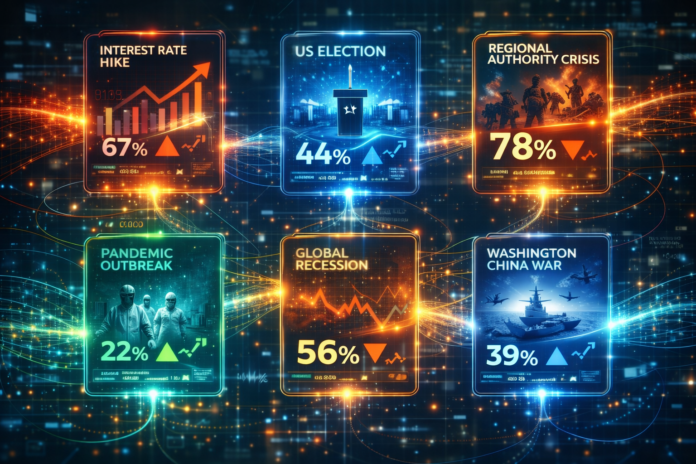
In a typical binary market (a “Yes” or “No” outcome), contracts are usually priced between $0.00 and $1.00. If a contract for “Candidate A wins the election” is trading at $0.65, the market is effectively signaling a 65% probability of that event occurring.
If you possess information suggesting the true probability is 80%, you are incentivized to buy the contract at $0.65. Your purchase drives the price up. Conversely, if someone believes the probability is only 40%, they will sell, driving the price down. This constant tug-of-war continues until the price reaches an equilibrium that reflects the sum total of all available information held by the participants.
The “Skin in the Game” Factor
The philosopher Nassim Taleb popularized the concept of “skin in the game,” arguing that systems function best when those making decisions are exposed to the consequences of those decisions. In traditional punditry, an “expert” can be wrong 90% of the time and still keep their job, provided they are entertaining. In a prediction market, being wrong results in a direct financial loss. This creates a powerful evolutionary pressure: over time, “dumb money” leaves the market, and “smart money” (those with better data or better analytical models) gains more influence.
Why Markets Outperform Polls and Experts
For decades, the “Gold Standard” of forecasting was the scientific opinion poll. However, recent years have exposed significant cracks in this foundation.
The Weakness of Polls
- Social Desirability Bias: People often lie to pollsters to appear more moral or socially aligned (the “Shy Tory” or “Shy Trump” factor).
- Lack of Incentive: A poll respondent has no “cost” for being wrong. They might provide a low-effort answer or use the poll to “send a message” rather than provide a forecast.
- Static Data: Polls are snapshots in time. By the time they are published, they are often obsolete.
The Strength of Markets
Prediction markets solve these issues by being real-time and incentive-compatible. Because the market is open 24/7, any new piece of information—a breaking news story, a sudden economic shift, or a leaked document—is instantly “priced in.”
As of March 2026, we have seen this play out in various geopolitical conflicts. While news anchors debated the likelihood of a ceasefire, prediction markets often moved hours before official announcements, reacting to the movement of capital from insiders or highly specialized analysts.
The Role of Decentralization and Blockchain
The traditional hurdle for prediction markets has been regulation. In the United States, the Commodity Futures Trading Commission (CFTC) has historically been wary of these platforms, often viewing them as a form of unregulated gambling. However, the rise of Decentralized Finance (DeFi) has changed the landscape.
Solving the “Oracle Problem”
One of the greatest technical challenges in truth discovery is the “Oracle Problem”: How does a digital contract know what happened in the physical world?
Decentralized platforms like Polymarket or Augur use “oracles”—networks of reporters who are financially incentivized to report the correct outcome. If a reporter lies, they lose their staked tokens. This creates a secondary market for truth-telling that supports the primary prediction market.
Censorship Resistance
Because these platforms live on the blockchain, they are difficult for any single government to shut down. This allows for “Global Truth Discovery,” where participants from across the world can contribute their local knowledge to a global pool of intelligence.
Futarchy: Using Markets to Govern
One of the most radical applications of prediction markets is Futarchy, a concept proposed by economist Robin Hanson. The slogan for Futarchy is: “Vote on values, but bet on beliefs.”
In a Futarchy-based system:
- The public or a board of directors votes on a metric (e.g., “We want to maximize GDP” or “We want to reduce carbon emissions”).
- Prediction markets are then used to determine which policy will best achieve that metric.
For example, a company might open two markets:
- Market A: Stock price in 1 year if “CEO X” stays.
- Market B: Stock price in 1 year if “CEO X” is fired.
If Market B consistently shows a higher predicted stock price, the board is compelled by the market’s “truth” to fire the CEO. This removes ego and office politics from the equation, replacing them with cold, hard data.
Common Mistakes in Interpreting Market Data
While prediction markets are powerful, they are not infallible. Understanding their limitations is key to using them effectively for truth discovery.
1. Confusing Low Liquidity with Certainty
If only $100 is bet on a market, a single irrational actor can swing the price wildly. This is not “truth”; it’s noise. Always look for markets with high liquidity (the total amount of money traded). High-volume markets are much harder to manipulate and generally provide more accurate signals.
2. The “Favorite-Longshot” Bias
Behavioral economics has shown that people tend to overvalue “longshots” (unlikely events) and undervalue “sure things.” In prediction markets, this often manifests as the “Yes” side of an unlikely event being slightly overpriced (e.g., a 1% chance event trading at 5%).
3. Regulatory Chokepoints
Even decentralized markets can face “front-end” censorship, where the website interface is blocked in certain countries. While the underlying contract still exists, the loss of users can reduce the market’s collective intelligence.
Case Study: Prediction Markets in Science
The “Replication Crisis” has plagued the scientific community for years, with many landmark studies failing to produce the same results when repeated. Prediction markets have offered a surprising solution.
In various experiments, researchers set up prediction markets for scientists to bet on whether a specific study would successfully replicate. Time and again, these markets were more accurate at identifying “flimsy” science than the traditional peer-review process. The markets identified the “truth” of the study’s validity long before the expensive, time-consuming process of physical replication was completed.
The Ethics of Betting on “Bad” Events
A common critique of prediction markets is the “moral” concern. Should people be allowed to profit from a pandemic, a war, or a natural disaster?
While seemingly distasteful, proponents argue that information is a public good. If a prediction market accurately forecasts a famine in a specific region, aid organizations can move resources before the disaster hits. In this sense, the “profit” earned by the trader is a payment for providing life-saving information to the world. The discovery of truth, even when that truth is grim, is almost always more beneficial than remaining in the dark.
The Future of Truth Discovery (2026 and Beyond)
As we move further into 2026, the integration of Artificial Intelligence (AI) and prediction markets is set to explode. We are seeing the rise of “AI Agents” that participate in these markets. These agents can process millions of data points—satellite imagery, shipping manifests, social media sentiment—far faster than any human.
This leads to a “Hyper-Efficient Market” where the gap between an event happening and the market reflecting that event shrinks to milliseconds. In this future, prediction markets won’t just be for speculators; they will be the “Information Infrastructure” that powers every decision, from government policy to personal insurance rates.
Conclusion: Embracing the Market Mindset
The journey toward truth is rarely a straight line. It is a messy, iterative process of trial and error. Prediction markets offer a way to harness our natural competitive instincts and turn them into a collaborative tool for clarity. By requiring “skin in the game,” these platforms filter out the noise of the “outrage economy” and provide a grounded, probabilistic view of the world.
For the individual, following prediction markets is a lesson in intellectual humility. It teaches us to think in terms of probabilities rather than certainties. For society, it offers a path away from “Alternative Facts” and back toward a shared reality based on evidence and accountability.
The next time you see a sensationalist headline or a confident “expert” prediction, ask yourself one question: “What does the market say?” Usually, that is where the truth is hiding.
Next Steps for Readers:
- Observe: Visit a platform like Polymarket or Kalshi and track a topic you are familiar with. Compare the market price to the media coverage.
- Learn the Math: Brush up on Bayesian Inference. Understanding how to update your beliefs based on new data is the “superpower” of successful market participants.
- Start Small: If you choose to participate, start with small amounts to understand the “psychology of the trade” before committing significant capital.
FAQs
1. Are prediction markets legal?
The legality varies significantly by country and state. In the US, some markets are regulated by the CFTC (like Kalshi), while others operate in a legal gray area or are decentralized. Always check your local regulations before participating.
2. Can prediction markets be manipulated by “Whales”?
While a wealthy individual can temporarily move the price by placing a large bet, they are essentially handing out “free money” to anyone with better information. If the whale moves the price away from the “truth,” rational actors will bet against them, eventually moving the price back and profiting from the whale’s mistake.
3. How do these markets differ from sports betting?
Sports betting is focused on entertainment and is usually a “house vs. player” model where the bookie takes a large cut (the vig). Prediction markets are “peer-to-peer” and focus on real-world events, often with much lower fees and a primary goal of information aggregation.
4. What is the “Oracle Problem” in simple terms?
It is the difficulty of getting reliable, real-world data onto a blockchain or into a smart contract without a centralized authority that could lie or be bribed.
5. Why are prediction markets more accurate than experts?
Experts often face “incentive misalignment.” They might be rewarded for being bold, controversial, or loyal to a political party. Market participants are only rewarded for being right.
References
- Hanson, R. (2013). Shall We Vote on Values, But Bet on Beliefs? Journal of Political Philosophy.
- Wolfers, J., & Zitzewitz, E. (2004). Prediction Markets. Journal of Economic Perspectives.
- Surowiecki, J. (2004). The Wisdom of Crowds. Doubleday.
- Tetlock, P. E. (2005). Expert Political Judgment: How Good Is It? How Can We Know? Princeton University Press.
- Arrow, K. J., et al. (2008). The Promise of Prediction Markets. Science Magazine.
- Commodity Futures Trading Commission (CFTC). (2024). Official Guidance on Event Contracts and Prediction Markets.
- Dreber, A., et al. (2015). Using Prediction Markets to Estimate the Reproducibility of Scientific Research. Proceedings of the National Academy of Sciences (PNAS).
- Varian, H. R. (2003). The New Economy: Why Prediction Markets Work. The New York Times Economic Scene.