Disclaimer: This article is for informational purposes only and does not constitute financial, legal, or investment advice. Financial technology regulations vary by jurisdiction. Always consult with a certified professional before making significant financial decisions or sharing sensitive data.
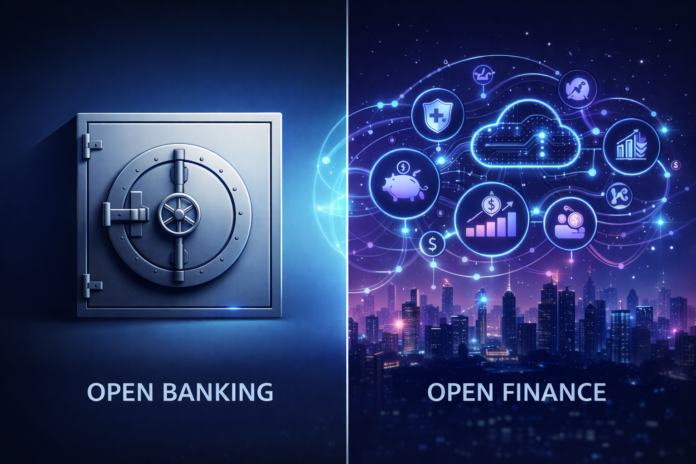
The world of money is no longer just about coins in a vault; it is about bits in a cloud. As of March 2026, we have moved past the initial “honeymoon phase” of digital transformation and entered what many experts call the “Data War.” At the center of this conflict are two terms often used interchangeably but representing vastly different scopes: Open Banking and Open Finance.
What is the Difference?
Open Banking is the practice of sharing financial information—like your transaction history and spending habits—from your bank account with third-party providers (TPPs) through secure “digital pipes” called APIs. This is strictly limited to payment accounts (checking, savings, and some credit cards).
Open Finance is the ambitious older sibling. It takes the principles of Open Banking and applies them to your entire financial footprint. This includes your mortgage, your private pension, your insurance policies, your stock portfolio, and even your utility bills.
Key Takeaways
- Scope: Open Banking covers cash and payments; Open Finance covers everything from investments to insurance.
- Empowerment: Both movements aim to shift data ownership from the institution to the individual.
- Technology: They rely on Application Programming Interfaces (APIs) rather than old-school “screen scraping.”
- Regulation: While Open Banking is well-regulated (think PSD2/PSD3 in Europe), Open Finance is the new frontier currently being codified globally.
Who This Article Is For
This deep dive is designed for fintech entrepreneurs seeking to understand the next wave of opportunity, policy-makers drafting data frameworks, and the “conscious consumer” who wants to know exactly why their banking app is suddenly asking for permission to see their life insurance policy.
The Genesis: How Open Banking Started the Revolution
To understand the current “Data War,” we have to look at the first shot fired. In the mid-2010s, regulators realized that big banks held a monopoly on consumer data. This “data silo” made it nearly impossible for new, innovative startups to compete. If a startup wanted to build a better budgeting tool, they had to ask you for your bank password—a practice known as “screen scraping” that was both insecure and clunky.
The Rise of PSD2 and PSD3
In the European Union and the UK, the Second Payment Services Directive (PSD2) changed the game. It mandated that banks must share customer data with authorized third parties, provided the customer gave explicit consent.
As of March 2026, we are now seeing the full implementation of PSD3 and the Payment Services Regulation (PSR). These updates have tightened security requirements (SCA – Strong Customer Authentication) and improved the reliability of those digital pipes (APIs). The “war” began here because banks suddenly lost their status as the exclusive gatekeepers of financial truth.
AISPs and PISPs: The Two Pillars
Under Open Banking, two types of service providers emerged:
- Account Information Service Providers (AISPs): These apps “read” your data. They aggregate your accounts in one place so you can see your total net worth.
- Payment Initiation Service Providers (PISPs): These apps “write” or “act” on your data. They can move money from your bank account to pay a merchant without you ever needing to touch a credit card.
Expanding the Map: The Transition to Open Finance
If Open Banking was the pilot program, Open Finance is the full-scale launch. The “Data War” intensifies here because the stakes are higher. Your mortgage data reveals your long-term debt; your pension data reveals your future security; your insurance data reveals your risk profile.
The Scope of Open Finance
Open Finance moves beyond the “payment account” and enters the broader financial ecosystem. Imagine a world where:
- Your mortgage provider can see your real-time savings and automatically lower your interest rate as your equity grows.
- Your pension app scans all your old workplace accounts and consolidates them with a single click.
- Your insurance broker monitors your driving data (with permission) to offer a discount on your premium every Friday.
Why It’s a “Data War”
The “war” isn’t just between banks and fintechs; it’s a battle over interoperability. In Open Banking, the data format was relatively simple (debits and credits). In Open Finance, the data is complex. An insurance policy has hundreds of variables. A pension fund has fluctuating tax implications.
Incumbent firms in the insurance and investment sectors have historically been slower to modernize than banks. They are currently fighting to define the standards—who pays for the API infrastructure, who is liable for a data breach, and how much “friction” can be legally put in the consumer’s way.
The Technical Engine: APIs vs. Screen Scraping
The primary weapon in this data war is the API (Application Programming Interface).
The Death of Screen Scraping
For years, fintechs used screen scraping. This involved a bot logging into your account using your credentials and “reading” the screen like a human would. It was fragile; if the bank changed its website font, the bot broke. More importantly, it was a security nightmare.
Modern Open Finance relies on RESTful APIs using the Financial-grade API (FAPI) security profile. This allows for:
- Tokenized Access: The third-party app never sees your password. It receives a “digital key” that only opens specific doors.
- Granular Consent: You can allow an app to see your balance but not your transaction history.
- Revocability: You can “kill” the digital key at any time from your bank’s dashboard.
The Role of “The Middlemen”
Companies like Plaid, Tink, and TrueLayer act as the logistics providers in this war. They build the connectors to thousands of different institutions so that a small developer doesn’t have to build 500 different APIs just to launch a simple savings app.
Global Perspectives: How the War Varies by Region
The “Data War” isn’t being fought the same way everywhere. As of 2026, three distinct models have emerged:
1. The Regulatory Model (UK/EU/Brazil)
In these regions, the government forced the door open. They dictated the standards and timelines.
- Brazil has become a world leader, moving from Open Banking to Open Finance at breakneck speed, integrating it with their instant payment system, PIX.
- The UK remains the gold standard for API performance thanks to the Open Banking Implementation Entity (OBIE).
2. The Market-Led Model (USA)
The US took a “wait and see” approach. For years, it was the Wild West. However, the CFPB (Consumer Financial Protection Bureau) Rule 1033 has finally provided a formal framework. The US war is largely fought by giant fintechs and massive legacy banks negotiating private data-sharing agreements.
3. The Economy-Wide Model (Australia)
Australia is perhaps the most ambitious. Their Consumer Data Right (CDR) started with banking but has already moved into energy and telecommunications. They view “Open Finance” as just one chapter in “Open Data.”
Use Cases: The Spoils of the Data War
What do consumers actually get out of this conflict? The “spoils” are better products and lower costs.
Hyper-Personalized Lending
Traditional credit scoring is archaic. It looks at your past mistakes. Open Finance allows “Cashflow Underwriting.” A lender can see that while you might have a low credit score, you’ve paid your rent and utilities on time for five years straight. This increases financial inclusion for those with “thin” credit files.
Automated “Sweeping”
This is the “killer app” of Open Banking. Using Variable Recurring Payments (VRP), an app can automatically “sweep” excess cash from your checking account into a high-interest savings account or an investment portfolio the moment your paycheck hits.
The “All-in-One” Insurance Dashboard
Instead of having five different apps for car, home, life, pet, and travel insurance, Open Finance enables a single dashboard that identifies overlaps in coverage and finds cheaper alternatives automatically.
Risks and Challenges: The Fog of War
It’s not all innovation and rainbows. The Data War has significant casualties, primarily in the realms of privacy and security.
1. The “Consent Fatigue” Problem
We’ve all seen the cookie banners on websites. There is a real risk that Open Finance will lead to “Consent Fatigue,” where users blindly click “Allow” on data-sharing requests without understanding what they are giving away.
2. Data Monopolies in Reverse
The goal was to break the banks’ monopoly. However, there is a risk that a few “Big Tech” players (Google, Apple, Amazon) will become the new gatekeepers. If Apple Finance integrates all your bank, insurance, and investment data, they possess a profile of you that is more intimate than any bank ever had.
3. Liability: The “Blame Game”
If a fraudulent transaction occurs via a third-party app using an Open Banking API, who is responsible? The bank? The app? The API aggregator? As of March 2026, legal frameworks are still catching up to the speed of the technology.
Common Mistakes in Understanding Open Finance
When discussing the “Data War,” many professionals and consumers fall into the same traps:
- Mistake #1: Thinking Open Banking is “Gone.” Open Finance doesn’t replace Open Banking; it absorbs it. Open Banking is the foundation; Open Finance is the skyscraper built on top.
- Mistake #2: Confusing Open Finance with Crypto/Web3. While they both value decentralization, Open Finance is generally built on traditional (centralized) banking rails and is heavily regulated by government bodies.
- Mistake #3: Assuming Data Sharing is “All or Nothing.” Modern APIs allow for specific data “scopes.” You can share your “Identity Data” (name/address) without sharing your “Transaction Data.”
- Mistake #4: Ignoring “Offline” Data. Open Finance is increasingly looking at how to digitize and share data from paper-heavy sectors like commercial real estate and legacy trusts.
The Future: From Open Finance to Open Data
The “Data War” is merely the penultimate chapter. The final destination is Open Data.
By 2030, the distinction between “financial data” and “lifestyle data” will blur. Your smart meter data (Energy), your health insurance data (Medical), and your investment data (Finance) will converge to create a “Digital Twin” of your economic life.
The Role of Artificial Intelligence
In 2026, AI is the general leading the charge. AI agents can now act on your behalf within the Open Finance ecosystem. Instead of you looking for a better mortgage, your “Financial AI” will continuously scan the market, use your Open Finance data to pre-qualify you, and present you with a “Press to Switch” button.
Conclusion: How to Navigate the War
The transition from Open Banking to Open Finance is the most significant shift in the history of retail finance. It represents a fundamental change in power: the data now belongs to you. However, with that power comes the responsibility of digital hygiene.
The “Data War” will continue as institutions fight to keep their customers within their own ecosystems, while fintechs fight to pull them away. As a consumer or a business leader, your best strategy is to embrace the transparency while remaining vigilant about consent.
Next Steps for You:
- Audit Your Permissions: Open your primary banking app and look for the “Linked Apps” or “Open Banking” settings. See who has access to your data and revoke anything you no longer use.
- Experiment with Aggregators: Try a regulated “Wealthtech” app to see all your accounts in one place. Experience the benefit of a holistic financial view.
- Stay Informed on PSD3: If you are in the UK or EU, keep an eye on how new consumer protection laws regarding “vulnerable customers” and “fraud reimbursement” affect your digital transactions.
FAQs
1. Is Open Finance safe?
Yes, generally. It uses bank-level encryption and API tokens, which are significantly safer than sharing your password or using screen-scraping bots. However, you must only grant access to firms regulated by your national financial authority (e.g., the FCA in the UK or the SEC/CFPB in the US).
2. Does Open Finance mean the bank can see everything I do on other apps?
No. Data sharing is a one-way street based on your consent. If you link your insurance app to your bank, the insurance app gets data from the bank. The bank does not automatically get data from the insurance app unless you specifically authorize a “reciprocal” share.
3. Will Open Finance affect my credit score?
It can, but usually for the better. By opting into “Open Data” sharing with credit bureaus, you can provide a more accurate picture of your financial health, potentially qualifying you for lower interest rates that a traditional credit check might miss.
4. Can I opt-out of Open Finance?
Absolutely. Open Finance is “Opt-In” by design. If you do nothing, your data remains in its current silos. You have to actively give permission for any data to be shared.
5. What happens if a fintech app I use goes bust?
Your data access rights are revoked, but your actual money remains safe in the underlying bank account (which is typically protected by government deposit insurance like the FDIC or FSCS). Open Finance is about data, not necessarily about holding your deposits.
References
- Financial Conduct Authority (FCA): “The transition from Open Banking to Open Finance.” [Official Policy Document]
- European Banking Authority (EBA): “Final Report on PSD3 and PSR1.” [Regulatory Standards]
- Consumer Financial Protection Bureau (CFPB): “Rule 1033: Personal Financial Data Rights.” [US Federal Regulation]
- FDATA Global: “The State of Open Finance 2025-2026.” [Industry Analysis]
- World Bank: “Open Finance: A Framework for Financial Inclusion in Emerging Markets.” [Academic Research]
- The OBIE (Open Banking Implementation Entity): “API Performance and Security Standards 2026.” [Technical Documentation]
- Journal of Financial Transformation: “The Impact of Open Finance on the Insurance Sector.” [Peer-reviewed Article]
- UK Joint Regulatory Oversight Committee (JROC): “The Future of Open Banking in the UK.” [Strategic Roadmap]