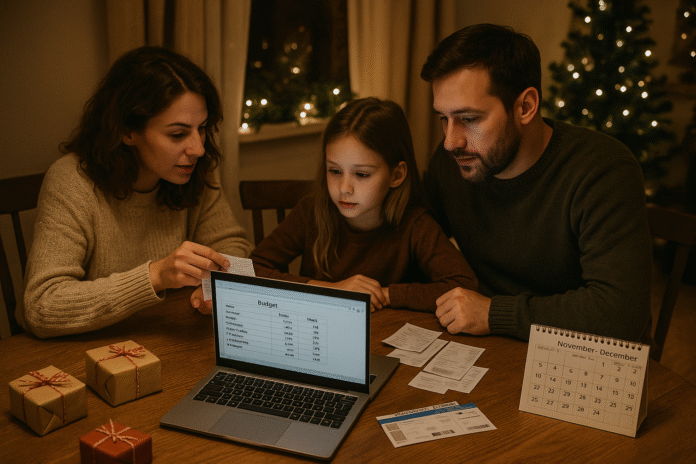
Holiday costs rarely surprise us—they arrive on the same weeks every year—yet they still derail budgets when we don’t plan for them month by month. This guide turns seasonal spending into a manageable, year-round process: you’ll set a realistic cap, fund it gradually, and pressure-test your cash flow before travel, gifts, higher utility bills, and entertaining pile up. If you manage a household budget (solo, couple, or family), you’ll learn practical timelines, guardrails, and examples you can copy today. We’ll cover payment choices (including credit and BNPL), returns strategies, and a January “reset” so you don’t carry a December hangover into the new year. Brief note: this is general information, not financial, tax, or legal advice—use it to inform your decisions.
Definition (quick): “Monthly review and holiday spending” means capping seasonal costs, funding them through a monthly sinking fund, and adjusting budget vs. actuals each month to stay on track.
At a glance — the playbook:
- Set a single holiday spending cap.
- Build a year-round sinking fund.
- Tag and track seasonal categories in your monthly review.
- Lock travel, utilities, and entertaining plans early.
- Choose safe payment methods and plan returns.
- Run a January post-season reset.
1. Set a Single Holiday Spending Cap You Can Actually Fund
Start by choosing one number that covers gifts, travel, hosting, decor, donations, shipping, and “surprise” spend. A single cap forces trade-offs and keeps you from optimizing one category while blowing the rest. To calibrate, look at last year’s actuals and adjust for this year’s travel and guest count. Use credible benchmarks only as a sense-check—not as a goal. For instance, U.S. consumers planned about $902 per person for 2024 winter holidays (gifts, food, decor, other), but households vary widely by region, culture, and travel patterns. Tie your cap to cash on hand and realistic savings between now and the holidays; if the math doesn’t work, lower the cap, not your essential bills. A good litmus test: you can hit 100% of the cap with your sinking fund alone.
1.1 How to do it
- Pull last year’s card/bank statements for Nov–Jan and tag seasonal spend.
- List this year’s known events (travel, hosting dates, school holidays).
- Price the big rocks first: flights/hotels, top-tier gifts, major meals.
- Add a 10–15% buffer for shipping, returns, and last-minute invites.
- Lock the cap and publish it to everyone involved (partner/roommates).
1.2 Numbers & guardrails (example)
- If your total target is $1,200 and you have 4 months to save, set the sinking fund at $300/month.
- If the cap can only be $800 on current cash flow, cut travel class, gift count, or hosting scope until it fits.
Close the loop with a one-line rule: No new holiday purchases if the sinking fund balance lags the cap by more than one month.
2. Build a Year-Round Sinking Fund for Seasonal Expenses
A sinking fund is a dedicated bucket you fund monthly for known, non-monthly costs (holidays, festivals, back-to-school, annual subscriptions). By treating December as a bill due every month, you eliminate the “it’s only once a year” overspend. Automate transfers to a separate savings pocket or a sub-account titled “Holiday & Seasonal.” Labeling matters: when the name matches the goal, you’re less likely to raid it for unrelated spending. If you’ve missed the ideal start month, compress the schedule; otherwise, run it January to December and roll any surplus forward. Consider a second bucket for “Other seasonal” items (school photos, uniforms, spring festivals) so holiday funding remains intact.
2.1 Mini-checklist
- Open a dedicated bucket/sub-account; nickname it clearly.
- Schedule an automatic monthly transfer on payday.
- Track the balance visibly in your budget app or a simple sheet.
- Refill immediately after any holiday purchase drains the fund.
2.2 Tools/Examples
- Budget apps with “goals” or “targets”: YNAB, Monarch Money, Tiller (Sheets), or a plain Google Sheet.
- Example: Annual cap $1,500 → $125/month year-round; unexpected party invite? Spend only from this fund.
Wrap with intent: the goal is not perfection; it’s to make December’s costs feel like “just another bill you already paid” rather than an emergency.
3. Tag Seasonal Categories in Every Monthly Review
In your month-end close, tag line items as Holiday: Gifts, Travel, Utilities-Winter, Entertaining, Decor, Shipping, Donations. This structure lets you see variance early (e.g., travel overage in October) and re-balance before December. Use budget vs. actuals for each tag, and track Committed (booked flights), Forecast (planned meals), and Risk (unpriced gifts) so your total stays honest. If you share finances, define “green/yellow/red” thresholds so both parties know where you stand without debate. The earlier you surface slippage, the cheaper the fix: swapping a flight day or reducing guest count beats last-minute credit card interest.
3.1 How to do it
- In your app/sheet, add a “Seasonal Tag” column.
- During reconciliation, mark each relevant transaction.
- Review variance by tag; reallocate from lower-priority tags if needed.
- Show a one-page dashboard with cap, funded amount, and free-to-spend.
3.2 Mini example
- Cap: $1,200; Funded to date: $750; Committed: $500; Forecast: $400 → $300 left.
- Travel ran $120 over? Cut decor by $120 now, not on December 23.
Close with a rhythm rule: What’s measured monthly gets managed in time to matter.
4. Make a Gift List With Per-Person Caps (and Lock the Rules)
Gifts are emotional and social; boundaries prevent scope creep. Start with the people you must buy for, then the nice-to-have list. Assign a per-person cap and one “signature” idea each. Share the framework with family to set expectations (price ranges, gift exchanges, or experiences). Decide your stance on peripheral spending—cards, wrapping, shipping—and include it in the cap so it doesn’t ambush you. Keep a running “deals” note, but don’t let sales invent new recipients. If your culture includes cash gifts or red envelopes, make envelopes part of the original cap.
4.1 Mini-checklist
- One tab: Recipient, Cap, Idea, Status, Purchased?, Wrapped?, Shipped?
- Template rules: no add-ons after Dec 10; one gift per person; experiences trump clutter.
- Keep receipts in a digital folder by recipient for easy returns.
4.2 Numeric example
- 8 recipients × $40 average = $320 + cards/wrapping $40 + shipping $30 → $390 total.
Synthesis: clarity beats generosity-creep—your best gift is staying solvent in January.
5. Plan Travel Early and Price the Full Door-to-Door Cost
Holiday travel compounds fixed costs (peak fares, baggage, fuel, lodging) with uncertainty (weather, schedule changes). Treat it like a mini-project. Decide whether you’ll travel this year at all; if yes, lock dates early and use trackers for airfare or award availability. On drives, price fuel using realistic mileage and maintenance. For lodging, compare hotel fees vs. renting an extra room near family. Remember ancillary costs: pet care, gifts shipped instead of carried, and airport meals. If travel crowds look heavy, build more layover time to de-risk misconnects.
5.1 Why it matters
- U.S. Thanksgiving travel pushes volumes to record levels most years, raising prices and congestion risk; 2024 projections neared 80 million travelers, the highest since 2019. Booking early and choosing off-peak departure days reduces both cash and stress.
5.2 Numbers & guardrails
- Use a door-to-door calculator: Airfare $650, baggage $70, airport transport $60, meals $40, pet boarding $120 → $940 before gifts.
- Driving? 600 miles round-trip at 28 mpg and $3.60/gal ≈ $77 fuel + wear/tear estimate $0.10/mi → $60 more = $137 baseline.
Close with a planning mantra: lock dates early, lock budgets earlier.
6. Budget for Utilities and Home Energy Spikes
Winter and summer bring predictable swings in energy use. Build those spikes into your seasonal plan rather than absorbing them on the fly. If you heat with electricity, gas, oil, or propane, expect costs to track temperatures and wholesale prices; weather volatility is the wild card. Consider budget billing to smooth monthly cash flow, and review draft-proofing or thermostat settings for quick savings. For renters, ask about building-wide energy programs; for homeowners, calendar a one-hour DIY audit (window seals, filters, water heater temp). If you host guests, remember extra laundry, showers, and cooking can nudge bills up.
6.1 What recent outlooks suggest
- U.S. EIA’s 2024 Winter Fuels Outlook expected many households’ heating spend to be about the same as the prior winter, with weather the key uncertainty. That means budgeting a steady baseline plus a margin, rather than assuming either a spike or a drop.
6.2 Mini-checklist
- Enroll in budget billing (if offered).
- Replace filters; set thermostat schedules; seal obvious drafts.
- Add a $20–$40/month winter buffer to the sinking fund.
- If traveling, lower thermostats safely and use smart plugs for lights.
Synthesis: assume “similar spend plus a weather margin,” not wishful savings—your cash flow will thank you.
7. Price Out Meals, Groceries, and Entertaining
Entertaining is a budget black hole if you price only the main dish. Scope the event: guest count, dietary needs, and whether it’s a potluck. Build a menu and shop your pantry first; then list every ingredient with a realistic unit price. Don’t forget disposables, ice, and serving extras. If you’re traveling, cost out “host gifts” and shared meals. When buying in bulk, compare unit prices and storage life—holiday deals are only deals if you’ll use them. If money is tight, swap a full dinner for brunch or desserts-and-games night; the point is time together, not a restaurant replica.
7.1 How to do it
- Menu → ingredient list → quantities → unit prices (store app or receipts).
- Mark items you can batch-prep or freeze to avoid last-minute takeout.
- Negotiate contributions early (e.g., “you bring beverages for 10”).
7.2 Numeric example
- Potluck for 10: you cover mains and dessert ($95), two guests bring sides, one brings drinks, one brings bread/fruit → total event food spend $140–$160 instead of $260+.
Bottom line: put food on a spreadsheet before it lands in your cart.
8. Choose Payment Methods Deliberately—Interest Is the Grinch
Your payment mix can quietly double the cost of December by February. Avoid store-card traps and deferred-interest promos unless you’re certain you’ll pay in full. Average credit-card APRs remain elevated; carrying balances through winter sales is expensive. If you must use credit, consider a true 0% intro APR (watch the fee math) and automate payoff well before the promo ends. When using rewards, confirm redemption values haven’t quietly devalued—plan redemptions you can execute now, not hypotheticals. Default to debit/cash from your holiday fund whenever possible.
8.1 Numbers & guardrails
- U.S. credit-card APRs averaged ~21% in May 2025—expensive “financing” for gifts.
- Some rewards programs have faced regulatory scrutiny for devaluations or opaque terms; read the fine print before banking on points.
8.2 Mini-checklist
- If you can’t pay the statement in full, don’t swipe for discretionary gifts.
- Avoid store-card “deferred interest.”
- Set autopay to statement balance on all cards.
- Track promo end dates in your calendar.
Synthesis: the cheapest gift is the one you’ve already funded.
9. Use Buy Now, Pay Later (BNPL) Carefully—Stacking Can Snowball
BNPL “pay-in-four” can smooth cash flow when used sparingly, but stacking multiple loans across merchants or providers creates a stealth debt spiral. Unlike credit cards, BNPL schedules don’t always align with your pay cycle, and late fees can cascade. Returns can be awkward: refunds may not sync perfectly with your repayment plan. Treat BNPL like a short-term installment loan: one at a time, only for budgeted items, and only when the sinking fund is truly short-term illiquid (not empty).
9.1 Why it matters
- Recent research from the U.S. CFPB highlights risks like loan stacking (multiple BNPL loans at once) and the interaction with other unsecured debts—issues that can strain budgets during peak shopping months.
9.2 Mini-checklist
- Never hold more than one BNPL at a time.
- Align installments with payday; avoid weekend due dates.
- Confirm the merchant’s returns-to-BNPL process before buying.
Wrap-up: BNPL is a tool—keep it a bridge, not a crutch.
10. Plan for Returns and Exchanges Before You Buy
Returns are part of modern holiday shopping, and handling them well protects your budget. Before purchasing, read the return window, fees, and whether refunds go to original payment or store credit. Keep digital receipts and tags intact; consider gifting retailers with generous policies for items with size/style risk. For online buys, price the return shipping (or identify in-person drop-offs) to avoid fees that wipe out “savings.” After the holidays, dedicate one afternoon to process returns so credits hit your account before January bills are due.
10.1 What the data says
- Retail returns are a significant slice of commerce; industry estimates put 2024 returns at roughly 16.9% of sales, underscoring why a returns plan is worth your time. nrf.com
10.2 Mini-checklist
- Save receipts in a single cloud folder (by recipient).
- Note final return dates on your calendar as you purchase.
- Prefer retailers with free, easy drop-offs for risky items.
Synthesis: a smooth returns process is part of the plan—not an afterthought.
11. Pressure-Test January Cash Flow (and Pre-Schedule Payoffs)
December spending meets January realities: rent/mortgage, utilities, memberships, and maybe higher heating costs. Run a January forecast in your monthly review and ensure you can pay statements in full. If you’ll carry a balance, schedule an aggressive payoff plan now. Consider a 60-day “no new discretionary buys” sprint and direct all surplus to debt. If you took advantage of a 0% promo, set calendar reminders 30/7 days before the rate resets. Reviewing autopay dates for utilities and subscriptions ensures your cash account doesn’t dip below thresholds.
11.1 Signals & stats
- Revolving credit growth (credit cards) remained strong into mid-2025, a reminder that balances can climb fast if you outsource December to plastic. Treat this as a red flag for your forecast and aim to avoid it. Federal Reserve
11.2 Mini plan (example)
- Balance $900 at 21% APR → minimum only costs $15–$25/mo but drags for months; instead, pay $450 in Jan and $450 in Feb to erase interest quickly.
Synthesis: spend ten minutes now to avoid ten weeks of stress later.
12. Run a Post-Holiday Review and Reset the Sinking Fund
In early January, close the loop. Compare cap vs. actuals by tag, note what drove variance, and document one change for next season (e.g., earlier travel bookings, fewer white-elephant gifts, potluck hosting). Return or resell unused decor or duplicate gifts while demand still exists. Archive your gift list with notes on sizing and preferences to avoid repeats. Finally, restart the sinking fund on the very next payday—and if you overspent, spread the shortfall across the first quarter so you aren’t depriving essentials.
12.1 How to do it
- Build a one-page “Seasonal After-Action Review”: What worked? What didn’t? What to change?
- Reset the cap based on reality; update monthly transfer amount.
- Label a storage bin “Holidays—Inventory on Lid” and list what you already own.
Close with momentum: you’ve turned a once-a-year scramble into a repeatable system.
FAQs
1) How much should I budget for holiday spending if I’m starting late in the year?
Work backward from cash flow and remaining paychecks. If you can save $200 across the next 3 pay periods, your realistic cap is $600 plus any existing savings—not what you wish you could spend. Prioritize travel commitments and essential gifts first, then trim decor and extras. If the math still strains January, scale down events or opt for experiences and potlucks.
2) Is a sinking fund better than just using a 0% APR card?
Usually, yes. A sinking fund prevents debt altogether and removes promo-end risk. A true 0% offer can work if you auto-pay the principal on a schedule that retires the balance before the intro period ends. Watch for balance-transfer fees and don’t spend beyond the cap “because it’s 0%.” The best plan is the one you can execute even if life gets noisy in December.
3) What if my family expects expensive gifts?
Expectations change when information changes. Share your cap early, propose price ranges, or run a name-draw (Secret Santa). Offer experiences or skill-based gifts that punch above their cost. If you’re supporting kids, keep adults on a “cards and dessert” plan. Remember: generosity includes protecting your household’s essentials and future.
4) How do I avoid overspending during sales events?
Create a pre-approved shopping list with maximum prices per item. If a sale appears on an item not on your list, it’s a no. Use price history tools and track “cart totals vs. cap” in real time. Turn off one-click checkout for the season, and remove stored cards from browsers to add friction. You won’t miss 90% of impulse buys 48 hours later.
5) Are store credit cards ever a good idea for holiday shopping?
They’re risky because of high APRs and deferred-interest traps. If you never carry a balance and a one-time discount is substantial on a large planned purchase, it can occasionally pencil out—but only if you close or park the card afterward and never revolve. In most cases, rewards from a general-purpose card you can pay in full are safer.
6) Should I use BNPL for gifts?
Only if the item is already in your cap and you’re using one BNPL at a time aligned to payday. Stacking multiple BNPL loans can make cash flow unpredictable and set up missed payments and fees. Ensure the merchant’s returns process plays nicely with your BNPL provider so you aren’t left paying installments after a return.
7) How do I budget for higher winter utilities when I don’t know the weather?
Use last year’s winter average as the baseline and add a small buffer (e.g., $20–$40/mo). If your utility offers budget billing or levelized plans, enroll to smooth spikes. Cheap wins—sealing drafts, thermostat schedules, clean filters—help regardless of forecasts. Revisit the buffer in your monthly review if a cold snap hits.
8) What’s the smartest way to handle returns?
Before buying, check the return window, fees, and whether refunds go back to the original payment. Keep receipts and tags; choose retailers with in-person drop-offs. Block one afternoon in late December or early January to process returns and exchanges so credits hit before card statements close. This alone can save real interest.
9) How can couples coordinate holiday spending without fighting?
Publish the single cap, assign category leads (you = travel, partner = gifts), and meet for a 20-minute weekly huddle. Use “green/yellow/red” status for each tag and agree on escalation rules (e.g., any change over $100 requires a quick check-in). Decisions live in the budget doc—not in text threads at checkout.
10) What if unexpected travel (illness, family needs) blows up my plan?
Treat it as an exception with its own mini-budget: transportation, lodging, meals, pet care. Pause nonessential holiday buys and reallocate from decor/entertaining. If you must use credit, choose the lowest-cost option you can genuinely pay down in 60–90 days and schedule those payments now. Then adjust next year’s sinking fund to include a small “family emergency travel” line.
Conclusion
Holidays don’t have to hijack your budget if you run them like any other recurring project: define the scope, price the big rocks, fund monthly, and audit as you go. The single cap keeps choices honest; the sinking fund makes December feel like a bill you already paid. By tagging seasonal categories in your monthly review, you’ll catch variance early enough to swap travel days, adjust menus, or right-size gifts before emotions and crowds take over. Your payment choices—avoiding high-APR balances and BNPL stacking—protect you from expensive January surprises, and a returns plan ensures cash boomerangs back quickly. Finally, a simple January reset closes the loop and seeds next year’s plan. Do this once, and future seasons become lighter on your wallet and calmer in your home.
Copy-ready CTA: Block 30 minutes today to set your cap, open a sinking fund, and schedule next month’s transfer.
References
- 2024 Holiday Spending Expected to Reach New Record, National Retail Federation (NRF), Oct 22, 2024 — https://nrf.com/media-center/press-releases/2024-holiday-spending-expected-reach-new-record
- Winter Holidays: Data & Trends (Historical Holiday Sales), National Retail Federation (NRF), 2024 — https://nrf.com/research-insights/holiday-data-and-trends/winter-holidays
- Nearly 80 Million Americans Expected to Travel Over Thanksgiving, AAA Newsroom, Nov 18, 2024 — https://newsroom.aaa.com/2024/11/nearly-80-million-americans-expected-to-travel-over-thanksgiving/
- 197 Million Consumers Shop Over Thanksgiving Holiday Weekend, National Retail Federation (NRF), Dec 3, 2024 — https://nrf.com/media-center/press-releases/197-million-consumers-shop-over-thanksgiving-holiday-weekend
- EIA Expects Average U.S. Heating Costs This Winter to Be Similar to Last Year, U.S. Energy Information Administration (Press Release), Oct 8, 2024 — https://www.eia.gov/pressroom/releases/press561.php
- Winter Fuels Outlook 2024–2025 (PDF), U.S. Energy Information Administration, Oct 9, 2024 — https://www.eia.gov/outlooks/steo/report/perspectives/2024/10-winterfuels/2024_winter_fuels.pdf
- Commercial Bank Interest Rate on Credit Card Plans, All Accounts (TERMCBCCALLNS), Federal Reserve Bank of St. Louis (FRED), updated Jul 8, 2025 — https://fred.stlouisfed.org/series/TERMCBCCALLNS
- Consumer Use of Buy Now, Pay Later and Other Unsecured Debt, Consumer Financial Protection Bureau, Jan 13, 2025 — https://www.consumerfinance.gov/data-research/research-reports/consumer-use-of-buy-now-pay-later-and-other-unsecured-debt/
- CFPB Takes Action on Bait-and-Switch Credit Card Rewards Tactics (Circular 2024-07), Consumer Financial Protection Bureau, Dec 18, 2024 — https://www.consumerfinance.gov/about-us/newsroom/cfpb-takes-action-on-bait-and-switch-credit-card-rewards-tactics/
- 2024 Consumer Returns in the Retail Industry / NRF and Happy Returns Report, National Retail Federation, Dec 5, 2024 — https://nrf.com/research/2024-consumer-returns-retail-industry