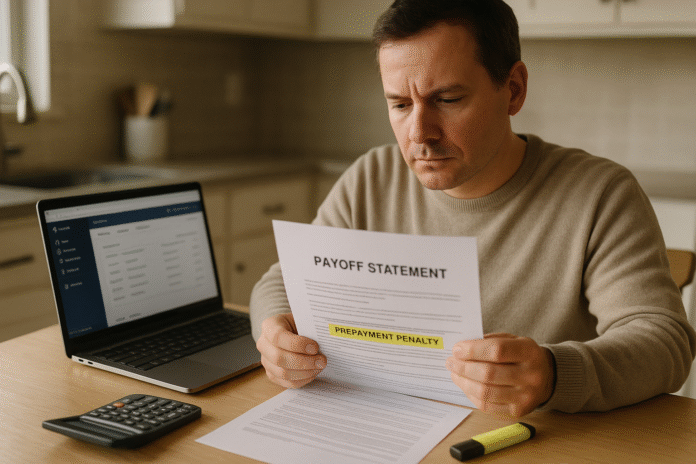
Paying off a loan early can save interest and reduce stress—but it can also trigger a loan prepayment penalty if your agreement allows one. In simple terms, a loan prepayment penalty is a fee charged when you repay a loan (in full or in part) before the contract says you will. These fees exist to compensate lenders for interest they expected to earn but won’t due to your early payoff. Whether you’re selling a home, refinancing, or crushing debt faster, understanding how these penalties work will help you decide if early repayment is worth it and how to avoid surprises. This guide breaks down 11 essentials—what the penalty is, where it’s allowed, how it’s calculated, and practical ways to minimize or eliminate it. (Definition and scope, )
Quick answer: A loan prepayment penalty is a contract fee for paying off a loan early. It appears in some mortgages and certain other loans; rules limit or prohibit it in many cases.
Heads-up: This article is educational, not legal or financial advice. Talk to your lender or an independent advisor before acting.
1. What a Loan Prepayment Penalty Is—And Why Lenders Use It
A loan prepayment penalty is a contractual fee that kicks in when you repay a loan ahead of schedule. Lenders design these fees to cover the interest income they expected to receive over the life of the loan. Without a penalty, a lender faces “reinvestment risk”: the money you return may need to be re-lent at a lower rate, reducing the lender’s return. Prepayment penalties appear most visibly in some mortgages and certain commercial real estate loans, but you can also find early-termination or “recapture” fees in other products. The specifics—percentage of principal, months of interest, or a “step-down” schedule—depend on the note and applicable laws. Understanding the terms up front is the key to avoiding costly surprises. (General concept, )
1.1 Why it matters
- It directly affects the cost to refinance or sell within the first few years.
- It can wipe out the savings from a lower rate if the fee is high.
- It influences timing decisions—waiting out the penalty window can be cheaper.
- It signals lender risk/return tradeoffs: aggressive pricing sometimes pairs with stricter prepay terms.
1.2 Common structures
- Percentage of balance: e.g., 2% of remaining principal.
- Months of interest: e.g., six months’ interest on the amount prepaid.
- Step-down: e.g., 2% in year 1, 1% in year 2, 0% after.
- Make-whole / yield maintenance: present-value formula to keep lender’s yield (more common in commercial loans).
Synthesis: Think of a prepayment penalty as a “cost to change plans.” If you expect to move, refinance, or repay fast, choose terms with little or no prepay risk.
2. Where Prepayment Penalties Are Allowed (and Banned) as of September 2025
Mortgage prepayment penalties in the U.S. are tightly limited: Regulation Z allows them only on certain Qualified Mortgages (QMs) that are fixed-rate, not higher-priced, and even then only for the first three years, capped at 2% in years 1–2 and 1% in year 3; none after. Lenders must also offer you a similar loan without the penalty. These restrictions dramatically reduced how often consumers see prepay penalties on home loans. Separately, private student loans may not charge prepayment penalties at all under federal law, and federal student loans also lack such penalties. Auto and personal loans vary by contract and state; many don’t have prepay fees, but early-termination charges or interest “precomputed” methods can mimic a penalty. Credit cards are open-end credit and don’t use prepayment penalties. (Mortgage caps and definitions, ; student loan prohibition, ; CFPB general guidance, )
2.1 Snapshot by loan type
- Mortgages (consumer): Strict limits under ATR/QM; see above.
- Student loans: Prepayment penalties are prohibited for both federal and private loans.
- Auto loans: Check your contract and state law; some states restrict penalties and some lenders don’t use them.
- Credit cards: No “prepayment” concept; separate fee rules apply. NCUA
- HELOCs: May charge “early closure” or closing-cost recapture if you close the line within a set period (often 24–36 months).
Synthesis: Rules differ by product. For mortgages, protections are strong; for autos and HELOCs, the details live in your contract and state law.
3. Types of Penalties: Soft vs. Hard, Step-Downs, and Yield-Maintenance
Not all prepayment penalties are created equal. A soft penalty applies if you refinance with another lender but usually not if you sell the property; a hard penalty applies whether you refinance or sell. Many consumer loans, where allowed, use a simple step-down (e.g., 2% → 1% → 0%). Commercial loans often get more technical: yield maintenance and make-whole formulas aim to keep the lender whole, requiring a payment equal to the present value of interest you would have paid, discounted at a benchmark like a Treasury yield. Some loans also include lockouts (no prepayment at all for a period) or defeasance (substituting collateral like Treasuries instead of cash payoff). (Yield maintenance basics, )
3.1 Numbers & guardrails
- Step-down example: Year 1: 2%; Year 2: 1%; Year 3+: 0%.
- Months-of-interest: If your rate is 7% on $300,000, six months’ interest ≈ $10,500 (0.07 × $300,000 ÷ 2).
- Yield maintenance: Penalty roughly equals PV of the rate difference × remaining balance, discounted at a risk-free benchmark.
3.2 Common mistakes
- Assuming “no prepay” because the salesperson said so—read the note.
- Confusing early closure fees (HELOC) with prepayment penalties—they’re related but distinct.
- Ignoring defeasance costs in commercial deals.
Synthesis: Learn which type you’re facing; a soft, step-down clause is far more forgiving than hard or make-whole structures.
4. How to Spot It in Your Documents (and the Exact Words to Look For)
If you’re getting a home loan, the federal Loan Estimate and Closing Disclosure must clearly state whether your loan includes a prepayment penalty, the maximum amount, and when the penalty period ends. Look under “Loan Terms” and “Additional Information About This Loan.” For auto and personal loans, scan the promissory note for “prepayment,” “prepayment fee,” “early termination,” or “precomputed interest.” For HELOCs, search for “early closure,” “recapture of closing costs,” or “minimum draw period.” When in doubt, request a sample note before you lock and ask the lender to point to the exact section. (TRID disclosure requirements and CFPB explainer, )
4.1 Mini-checklist
- Loan Estimate / Closing Disclosure: Does it say Yes for prepayment penalty? If yes, note the cap and end date.
- Promissory note: Search for “prepayment,” “penalty,” “precomputed,” “yield maintenance.”
- HELOC addenda: Look for “early termination” or “recapture.”
- Ask for a payoff quote: It should itemize the penalty (if any) and per diem interest.
4.2 Tools/Examples
- Request a written payoff; compare it to your note to confirm calculations.
- Keep every page of your Closing Disclosure; it’s your reference for maximum possible penalty. Consumer Financial Protection Bureau
Synthesis: Don’t rely on verbal assurances—your Loan Estimate, Closing Disclosure, and note tell the truth in black and white.
5. How Much Could It Cost? Realistic Ranges and Calculations
Prepayment penalties range widely by loan type and contract. On consumer mortgages where allowed, caps are 2% of the outstanding balance in years 1–2 and 1% in year 3; nothing after year 3. On a $350,000 balance, that’s up to $7,000 in years 1–2 or $3,500 in year 3. HELOC “early closure” or closing-cost recapture fees may be a flat $300–$1,000 or the actual third-party costs the lender paid, often triggered if you close within 24–36 months. Commercial loans using yield maintenance or make-whole can be substantially larger if rates have fallen. (Mortgage caps and HELOC practices, )
5.1 Step-by-step: Estimating your penalty
- Confirm the formula in your note (percent of balance, months of interest, or make-whole).
- Calculate the base: remaining principal or required interest.
- Apply timing rules: step-downs or end dates.
- Add any recapture fees (HELOC) or admin charges.
- Compare against savings from refinancing or selling sooner.
5.2 Mini case
- You owe $280,000 and want to refinance in month 18. Your clause is 2% in years 1–2. Estimated penalty: $5,600.
- If the refinance saves 0.75% on rate, interest savings over three years might outweigh the fee; run the math.
Synthesis: Translate the clause into dollars now—then decide whether to prepay, wait, or negotiate.
6. Should You Still Repay Early? A Clear Break-Even Framework
Even with a penalty, early repayment can make sense if your interest savings exceed the fee and any closing costs. Compare the present value of your future payments at the current rate to the cost of refinancing or selling early, including penalties. Consider tax impacts (mortgage interest deductions may change), your cash cushion, and opportunity cost (what else your money could earn). If the penalty expires soon, waiting might beat paying the fee. But if rates are much lower now or your life plans demand a move, absorbing a small penalty can still be the right call.
6.1 Quick framework
- 1) Identify costs: penalty + closing costs + any new loan fees.
- 2) Quantify benefits: lower rate savings, shorter term, debt-free timeline.
- 3) Compute break-even: months until savings surpass the penalty.
- 4) Add guardrails: keep an emergency fund; avoid draining retirement accounts.
- 5) Reassess timing: if the penalty ends within 3–6 months, consider waiting.
6.2 Numeric example
- Old loan: $325,000 at 7.25%, 28 years left; new loan: 6.25%.
- Penalty: 1% = $3,250; closing costs: $3,800; total hurdle: $7,050.
- Monthly interest/principal savings ≈ $210–$260 (depends on taxes/MIP). Break-even ~ 27–34 months; if you’ll keep the home longer than that, refinancing may still win.
Synthesis: Decisions hinge on break-even time. If your horizon is longer than the break-even, prepaying or refinancing can pay off even with a fee.
7. Strategies to Avoid or Reduce a Penalty (Before and After Closing)
The best strategy is prevention: shop for loans without prepayment penalties, and if a lender insists, ask for a soft, short penalty with a clear step-down. Under mortgage rules, creditors must offer an alternative without a prepay penalty when they offer one with a penalty—use that leverage to compare total cost. After closing, you can still lower the hit: schedule payoff right after the penalty period ends, limit prepayments to the allowed percentage, or refinance with the same lender if they agree to waive part of the fee. For HELOCs, keep the account open past the early-closure window to avoid recapture. (Alternative-offer and cap rules, )
7.1 Practical tips
- Ask for “no prepay”—or at least a short, soft step-down.
- Compare the “with penalty” vs “no penalty” offers side by side.
- Time your sale/refi for the day after the penalty expires.
- Negotiate a waiver if you keep other business with the lender.
- HELOC: Don’t close it early; reduce the limit instead.
7.2 Mini-checklist at application
- Confirm if a penalty exists, the maximum, and the end date on the Loan Estimate/Closing Disclosure.
- Ask for the no-penalty alternative and compare APRs and payments.
Synthesis: You have options—negotiate up front, and if you already have the loan, manage timing and structure to minimize costs.
8. Payoff Quotes, Per-Diem Interest, and the “Right” Day to Repay
When you’re ready to repay, ask your servicer for a written payoff quote with a “good-through” date. This statement should itemize principal, accrued per-diem interest, and any prepayment penalty or early-closure/recapture fees. Payoffs typically must be received by a certain time (often mid-afternoon) to count for that day’s interest. For FHA-insured loans closed on or after January 21, 2015, lenders may only charge interest through the payoff date (no extra “post-payment” interest), so picking the date precisely matters less than before—but confirm your loan’s closing date and servicing rules. (FHA interest-through-payoff rule context, )
8.1 Steps to avoid overpaying
- Request the payoff at least 7–10 days before funding.
- Verify wire cutoff times and time zones.
- Double-check per-diem math and the penalty line item.
- If delayed, request an updated payoff to avoid shortages.
8.2 Region-specific notes
- Some payoff wires credit same day if received before the cutoff; after that, one extra day of interest may accrue.
- County recording or escrow processes can affect the final interest date in real-estate transactions.
Synthesis: The cheapest payoff is a precise payoff—get it in writing, mind the clock, and verify every line.
9. Special Cases by Loan Type: Mortgages, Autos, Students, HELOCs, and Personal Loans
Mortgages: Today, many mainstream lenders avoid prepay penalties entirely, but they can appear on certain fixed-rate QMs and are capped by federal rules (see Section 2). Your Loan Estimate and Closing Disclosure are your first line of defense; the presence, cap, and end date must be disclosed. Auto loans: Some contracts have prepayment language or use interest methods that can make early payoff savings smaller than expected; state law may also limit fees—so check your contract and your state’s rules. Student loans: Federal law prohibits prepayment penalties on private education loans, and federal student loans are penalty-free. HELOCs: Instead of classic penalties, lenders often recapture closing costs if you close the line within 2–3 years. Personal loans: Many are penalty-free, but verify your note. (CFPB guidance and statutes, )
9.1 Quick compare table (conceptual)
- Mortgage: Penalties limited; check TRID forms.
- Auto: Contract + state law govern; verify clause.
- Student: Penalties banned.
- HELOC: Early-closure/recapture common.
- Personal: Usually none, but read the note.
Synthesis: The label changes by product—penalty, recapture, or early termination—but the effect is the same: a cost for exiting early.
10. Commercial Real Estate Reality: Yield Maintenance, Defeasance, and Lockouts
Commercial and multifamily loans often include lockouts (no prepayment allowed for a period) followed by yield maintenance or defeasance. Yield maintenance calculates a fee equal to the present value of interest you would have paid, discounted by a benchmark like the Treasury yield—when rates fall, this can be expensive. Defeasance replaces your property collateral with a portfolio of securities that replicates the loan’s cash flows; it’s often complex and requires specialists. HUD/FHA multifamily executions frequently pair a lockout with a long, declining step-down schedule (e.g., 8% down to 1%) before reaching zero. (Definitions and typical structures, )
10.1 Tools/Examples
- Yield maintenance: If your loan rate is 6.5% and 5-year Treasuries are 4.0%, the penalty roughly equals the PV of that 2.5% spread over the remaining balance/term.
- Defeasance: Expect legal, accounting, and consultant costs, not just the replacement collateral.
10.2 Mini-checklist for investors
- Get a prepayment analysis from your servicer and a third-party advisor.
- Model multiple rate scenarios; penalties are rate-sensitive.
- Negotiate shorter lockouts or carve-outs (sale vs. refi).
Synthesis: In commercial lending, prepayment is a structured exit, not a switch you flip—budget for it early and negotiate the fine print.
11. What to Do If You’re Charged a Penalty You Don’t Owe
Start with your note and Closing Disclosure to verify that a penalty exists, that you’re still within the penalty window, and that the amount matches the contractual formula. If the number looks wrong, escalate—in writing—to the servicer’s escrow, payoff, or customer advocacy team and ask for a corrected payoff. If you believe the fee violates law or wasn’t disclosed properly, file a complaint with the CFPB and, for housing issues, consider contacting a HUD-approved housing counselor for free guidance. Document every call and save emails; if needed, speak with a local consumer-law attorney. (How to find counselors and submit complaints, )
11.1 Steps to resolve
- Re-read your note and TRID forms; capture screenshots and page numbers.
- Ask for a recalculated payoff and written explanation.
- If unresolved, submit a CFPB complaint and attach documentation; most companies must respond promptly. Consumer Financial Protection Bureau
- For mortgages, contact a HUD-approved counselor for free help. Consumer Financial Protection Bureau
11.2 Crisp takeaway
Most payoff errors are fixable with a clear paper trail; escalate early and use regulators and counselors when needed.
Synthesis: Verify, escalate, document, and—if necessary—get backup from the CFPB and HUD-approved counselors to correct improper charges.
FAQs
1) What is a loan prepayment penalty, in one sentence?
It’s a contract fee charged by a lender when you repay your loan early (in full or in part), intended to compensate the lender for lost interest income, and it’s allowed only in specific situations depending on the loan type and law.
2) Are prepayment penalties still common on mortgages?
They’re far less common than before the financial crisis. Where they exist, federal rules limit them to certain fixed-rate Qualified Mortgages, cap the amount to 2% in the first two years and 1% in the third year, and require a no-penalty alternative offer.
3) Do student loans have prepayment penalties?
No. Federal law bans prepayment penalties on private education loans, and federal student loans also don’t assess such penalties. Always specify that extra payments should go to principal.
4) What about auto loans—can I pay off early without a fee?
Often yes, but it depends on your contract and state law. Some lenders use interest methods or early-termination fees that reduce or offset savings from early payoff; read your note and check your state’s rules.
5) Are HELOC early-closure fees the same as prepayment penalties?
Not exactly. Many HELOCs allow early closure fees or “closing-cost recapture” if you close the account within 24–36 months, which function like a penalty but are structured differently from classic mortgage prepay clauses.
6) How can I tell if my mortgage has a prepayment penalty before closing?
Look at your Loan Estimate and Closing Disclosure: they must disclose whether a penalty applies, the maximum amount, and when the penalty period ends. Ask your lender to show you the exact section on both forms.
7) How much can a mortgage prepayment penalty cost?
By rule, if permitted at all, it’s capped at 2% of the outstanding balance in years 1–2 and 1% in year 3; no penalty after year 3. Example: on a $300,000 balance, that’s up to $6,000 or $3,000, respectively.
8) What’s the difference between a “soft” and “hard” prepayment penalty?
A soft penalty typically applies to refinancing but not sale; a hard penalty applies to both. Soft penalties are more forgiving if you might sell your property, while hard penalties constrain both exit paths.
9) What is “yield maintenance” or “make-whole,” and should I worry about it?
It’s a commercial-loan mechanism that uses a present-value calculation to keep the lender’s expected yield intact when you repay early; penalties can be large if market rates fall. Most consumer mortgages don’t use it, but many commercial loans do.
10) What if my lender miscalculated the penalty or charged it after the end date?
Request a corrected payoff with a written explanation. If the issue persists, submit a CFPB complaint and consider a HUD-approved housing counselor or consumer-law attorney; keep detailed records of every step.
Conclusion
A loan prepayment penalty is ultimately about timing and tradeoffs: the lender priced your loan assuming interest over time, and paying early changes that plan. For consumer mortgages, today’s rules sharply limit where penalties can appear and how large they can be; for HELOCs, auto loans, and commercial deals, early-closure or yield-maintenance structures may still bite if you exit soon. The smartest path is to identify whether a penalty exists, translate it into dollars now, and decide if waiting, refinancing, or negotiating gives you the best outcome. Use your Loan Estimate and Closing Disclosure to spot issues before you sign; once you’re in a loan, time your payoff and verify the payoff quote line by line. If errors happen, escalate early and use available consumer protections and counseling resources.
Bottom line: read the clause, run the math, and choose the payoff path that saves you the most—without unpleasant surprises. Ready to act? Ask your lender to confirm, in writing, whether your loan has a prepayment penalty and what it would cost to repay next month.
References
- What is a prepayment penalty? Consumer Financial Protection Bureau (CFPB). September 13, 2024. https://www.consumerfinance.gov/ask-cfpb/what-is-a-prepayment-penalty-en-1957/
- 12 CFR § 1026.43 — Minimum standards for transactions secured by a dwelling (ATR/QM Rule). Electronic Code of Federal Regulations (eCFR). Accessed September 2025. https://www.ecfr.gov/current/title-12/chapter-X/part-1026/subpart-E/section-1026.43
- Ability-to-Repay and Qualified Mortgage Rule — Small Entity Compliance Guide. CFPB. April 2021. https://files.consumerfinance.gov/f/documents/cpfb_atr-qm_small-entity_compliance-guide.pdf
- § 1026.37 — Content of disclosures for certain mortgage transactions (Loan Estimate). CFPB Regulation Z. Accessed September 2025. https://www.consumerfinance.gov/rules-policy/regulations/1026/37
- Closing Disclosure Explainer. CFPB. October 10, 2023. https://www.consumerfinance.gov/owning-a-home/closing-disclosure/
- 15 U.S. Code § 1650 — Preventing unfair and deceptive private education lending practices (prepayment penalty ban). Legal Information Institute (Cornell Law School). Accessed September 2025. https://www.law.cornell.edu/uscode/text/15/1650
- HELOC Loan Prepayment Penalties (early closure / cost recapture). Investopedia. July 2022 (accessed September 2025). https://www.investopedia.com/heloc-loan-prepayment-penalties-5509618
- Yield Maintenance: Definition, Formula, and How It Works. Investopedia. Accessed September 2025. https://www.investopedia.com/terms/y/yieldmaintenance.asp
- Yield Maintenance 101 (Multifamily/Commercial context). Greystone. February 23, 2024. https://www.greystone.com/insights/yield-maintenance-101/
- Can I prepay my auto loan at any time without penalty? CFPB. January 30, 2024. https://www.consumerfinance.gov/ask-cfpb/can-i-prepay-my-loan-at-any-time-without-penalty-en-843/
- Do FHA loans have prepayment penalties? Investopedia. Accessed September 2025. https://www.investopedia.com/ask/answers/112615/do-fha-loans-have-prepayment-penalties.asp
- Submit a complaint. CFPB Consumer Complaint Portal. Accessed September 2025. https://www.consumerfinance.gov/