Financial Disclaimer: The information provided in this guide is for educational purposes only and does not constitute professional financial, legal, or insurance advice. Insurance regulations and rates vary significantly by state and individual circumstances. Always consult with a licensed insurance agent or financial advisor before making significant changes to your coverage. As of March 2026, many carriers have integrated AI-driven underwriting and telematics into their standard quoting processes.
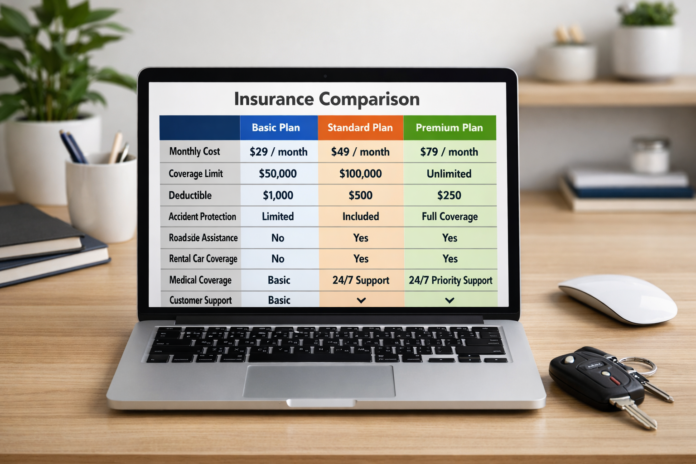
Comparing auto insurance quotes online is the process of evaluating multiple policy offers from different insurance carriers to find the best balance between cost and protection. Instead of sticking with the same provider out of habit, “shopping around” allows you to leverage market competition to your advantage. In today’s digital landscape, this process has evolved from making dozens of phone calls to using sophisticated algorithms and aggregators that can provide side-by-side comparisons in minutes.
Key Takeaways
- Comparison is Essential: Prices for the exact same coverage can vary by hundreds of dollars between companies.
- Apples-to-Apples Comparison: Ensure you are comparing the same liability limits, deductibles, and optional coverages across all quotes.
- Data Accuracy Matters: Small errors in your driving history or annual mileage can lead to “rate shocks” later when the company runs your official reports.
- Leverage Technology: Usage-based insurance (UBI) and telematics are now standard ways to secure lower rates for safe drivers.
Who This Guide Is For
This guide is designed for anyone looking to optimize their vehicle expenses. Whether you are a first-time car buyer navigating the complexities of “full coverage,” a long-time policyholder seeing your premiums rise due to inflation, or a parent adding a teen driver to your policy, these steps will help you navigate the 2026 insurance market with confidence.
Step 1: Gather Your Personal and Vehicle Information
Before you open a single browser tab, you need to have your “data house” in order. Insurance companies use complex risk-assessment models, and the more accurate your input, the more accurate the quote.
Required Documentation
To get an accurate quote, you will need:
- Vehicle Identification Number (VIN): While some sites allow you to search by make and model, a VIN provides the exact safety features and trim level, which affects the rate.
- Driver’s License Numbers: For all household members who will be on the policy.
- Current Policy Declarations Page: This is the “cheat sheet” that lists your current coverage limits and what you are currently paying.
- Mileage Estimates: How many miles do you drive per year? Be realistic; underestimating could lead to a claim denial later.
- Driving History: Note the dates of any accidents, tickets, or claims from the last three to five years.
Why Your Credit Score Matters
In many states (where legal), insurance companies use a “credit-based insurance score.” This is different from your FICO score but relies on similar data. As of March 2026, insurers are placing even higher weight on financial stability as a predictor of claim frequency. Having your credit info handy can help you understand why certain quotes might be higher or lower than expected.
Step 2: Understand the “Big Three” Coverage Types
You cannot effectively compare auto insurance quotes if you don’t understand what you’re buying. A common mistake is choosing the “cheapest” option only to realize it doesn’t cover your own car’s damage.
1. Liability Coverage (Bodily Injury & Property Damage)
This is the foundation of every policy and is required by law in almost every state. It pays for the other person’s medical bills and car repairs if you are at fault.
- Pro Tip: Never settle for state minimums. If you cause a multi-car accident, state minimums can be exhausted in seconds, leaving your personal assets (house, savings) at risk.
2. Collision Coverage
This pays to repair or replace your car if you hit another vehicle or an object (like a fence or pole), regardless of fault. If you have a car loan or lease, this is usually mandatory.
3. Comprehensive Coverage
Often called “other than collision,” this covers damage from theft, vandalism, fire, natural disasters, or hitting an animal.
- Glass Coverage: Check if your comprehensive coverage includes a $0 deductible for windshield repair, a common feature in 2026 policies.
Step 3: Deciphering Limits and Deductibles
The “math” of your insurance policy lives in the relationship between your limits and your deductibles.
Choosing Your Policy Limits
Limits are expressed in a string of numbers like 100/300/100.
- $100,000 for bodily injury per person.
- $300,000 for bodily injury per accident.
- $100,000 for property damage.In the current economic climate, experts recommend at least 100/300/100 for most middle-class drivers.
Selecting Your Deductible
The deductible is the amount you pay out of pocket before the insurance kicks in.
- High Deductible ($1,000+): Lowers your monthly premium but requires you to have an emergency fund ready.
- Low Deductible ($250–$500): Higher monthly premiums but less financial “sting” during a claim.
- Common Mistake: Choosing a high deductible to save $10 a month when you don’t have $1,000 in savings. If you can’t pay the deductible, your car stays in the shop.
Step 4: Use Online Comparison Tools vs. Direct Quoting
There are two primary ways to shop online: comparison marketplaces and direct carrier websites.
Online Insurance Marketplaces (Aggregators)
Sites like Progressive (which offers a comparison tool), The Zebra, or Gabi allow you to enter your info once and see multiple rates.
- Pros: Fast, high-level view of the market.
- Cons: Not all companies participate (e.g., State Farm or GEICO often require direct quotes), and you may receive follow-up marketing calls.
Direct Quoting
Going directly to a company’s website (e.g., Allstate.com, Travelers.com).
- Pros: Most accurate pricing and access to specific “niche” discounts.
- Cons: Time-consuming to enter data multiple times.
The Hybrid Strategy: Use an aggregator to find the top three cheapest carriers, then go to those three websites directly to “fine-tune” the coverage and see if additional discounts apply.
Step 5: Evaluate 2026 Tech-Based Savings (Telematics)
As of March 2026, usage-based insurance (UBI) has become the most effective way to lower premiums. When comparing quotes, look for programs like “Snapshot,” “Drive Safe & Save,” or “SmartRide.”
How Telematics Works
You agree to let the insurance company track your driving through a smartphone app or a plug-in device. They monitor:
- Braking intensity: (Avoid “hard brakes”).
- Time of day: (Driving at 3 AM is considered high risk).
- Speeding: (Staying within 5-10 mph of the limit).
- Phone usage: (Hands-free is essential).
Warning: Some companies now use “two-way” telematics. This means while you can get a discount for good driving, your rates could actually increase if the data shows you are a high-risk driver. Read the terms carefully during the quote process.
Step 6: Maximize Every Possible Discount
During the online quote process, you will be asked a series of “Yes/No” questions. These are your opportunities to stack discounts.
| Discount Category | How to Qualify | Potential Savings |
| Bundling | Combine Auto + Home or Renters insurance. | 10% – 25% |
| Multi-Car | Insure more than one vehicle on the same policy. | 8% – 15% |
| Safety Features | Modern ADAS (Advanced Driver Assistance Systems). | 3% – 5% |
| Good Student | Full-time students with a “B” average or higher. | 5% – 15% |
| Professional/Affiliation | Alumni associations, military (USAA), or certain employers. | Variable |
| Paperless/Paid in Full | Pay the 6-month premium upfront and skip paper mail. | 5% – 10% |
Step 7: Assess the Company’s Reputation and Financial Strength
A low price is meaningless if the company takes six months to process a claim or goes bankrupt after a major catastrophe.
Check Financial Ratings
Look for AM Best ratings. You want a company with an “A” (Excellent) or better rating. This ensures they have the cash reserves to pay out claims even during a bad year.
Check Claims Satisfaction
Consult JD Power’s Auto Insurance Study. This annual report ranks companies based on real customer feedback regarding their claims experience. In 2026, look for companies that offer “Photo-Based Estimating,” which can speed up the repair process significantly.
Step 8: Common Mistakes to Avoid When Comparing
Even seasoned shoppers fall into these traps. Being aware of them can save you thousands over the life of your policy.
1. The “Introductory Rate” Trap
Some companies offer a very low price for the first six months to lure you in, then hike the rates at renewal. Always ask (or check the fine print) if the rate includes “new customer” discounts that expire.
2. Overlooking Uninsured/Underinsured Motorist Coverage
As car prices and medical costs have risen in 2026, more people are driving with insufficient insurance. If someone with no insurance hits you, your Uninsured Motorist coverage pays for your medical bills. Skipping this to save $5 a month is a massive risk.
3. Misrepresenting Your Garage Location
Using a parent’s address in a rural area to get lower rates than your city apartment is considered insurance fraud. Companies use GPS data and public records to verify your location. If caught, they can deny a claim or cancel your policy immediately.
4. Ignoring the Claims Process
Does the company require you to use their “network” of shops? While this can be convenient, it might prevent you from using your preferred local mechanic. Check the “Right to Repair” clauses in the quote.
Step 9: Finalizing Your Choice and Switching
Once you’ve found the winner, the process isn’t over until the paperwork is signed and the old policy is dead.
- Set the Start Date: Ensure your new policy starts at least 24 hours before your old one ends. A “lapse” in coverage, even for one day, can cause your future rates to skyrocket.
- Confirm the Down Payment: Most online quotes require the first month’s payment (or the full amount) to “bind” the coverage.
- Cancel Your Old Policy: Do not just stop paying the bill. Call your old carrier or use their app to officially cancel. You may be entitled to a pro-rated refund if you paid in advance.
- Print Your ID Cards: Digital ID cards are legal in almost all states, but having a physical backup in the glovebox is a smart move.
Conclusion
Comparing auto insurance quotes online is no longer a chore—it is a critical financial habit. By moving beyond a simple search for the “lowest price” and focusing on the value of coverage, deductibles, and modern telematics, you can protect your financial future while keeping your monthly expenses in check.
The 2026 insurance market is more data-driven than ever. Carriers are using AI to predict risk with startling accuracy, which means your individual behavior—from your credit management to your braking habits—is your greatest tool for negotiation.
Your Next Steps:
- Open your current policy and highlight your “Liability Limits” and “Deductibles.”
- Visit at least one major aggregator and two direct carrier websites today.
- Compare the resulting quotes against your current premium. If you can save more than $200 per year for the same coverage, it’s time to switch.
- Re-shop your policy every 12 months or after any major life event (moving, getting married, or buying a new car).
FAQs
1. Does checking insurance quotes online hurt my credit score?
No. When insurance companies check your credit, they perform a “soft pull.” This does not affect your FICO score or appear on credit reports seen by lenders. It is purely for the purpose of generating an insurance risk score.
2. How often should I compare insurance quotes?
Most experts recommend shopping around once a year or every time your policy comes up for renewal (usually every 6 months). You should also shop quotes after a major life change, such as improving your credit score, moving to a new zip code, or having a speeding ticket fall off your record.
3. What is “Full Coverage,” and do I need it?
“Full coverage” isn’t an official insurance term, but it typically refers to a policy that includes Liability, Collision, and Comprehensive insurance. If your car is worth more than $5,000 or if you have a loan/lease, you almost certainly need these coverages. If you drive an older vehicle with low market value, you might consider dropping collision and comprehensive to save money.
4. Why is my online quote different from the final price?
An online quote is an estimate based on the information you provided. The “final” price is determined after the company runs your official Motor Vehicle Report (MVR) and Comprehensive Loss Underwriting Exchange (CLUE) report. If you forgot to mention a minor fender bender from two years ago, the price will likely increase once those reports are processed.
5. Can I get insurance the same day I get a quote?
Yes. Most major online carriers allow for “instant binding.” Once you complete the application and make your initial payment, you can download your insurance ID cards and be legally covered within minutes.
References
- National Association of Insurance Commissioners (NAIC): Official consumer guides on auto insurance standards.
- Insurance Information Institute (III):
- J.D. Power:
- AM Best: Financial strength ratings for insurance carriers.
- Insurance Institute for Highway Safety (IIHS): Vehicle safety ratings that impact insurance costs.
- Consumer Reports:
- Federal Trade Commission (FTC): Understanding credit-based insurance scores.
- U.S. Department of Transportation: 2026 driving statistics and safety trends.