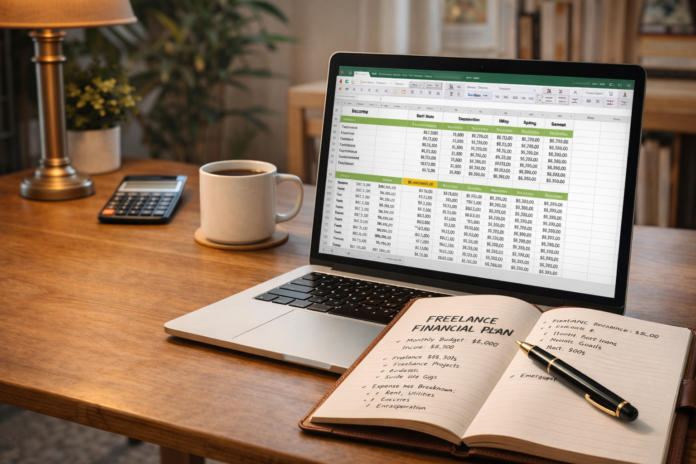
Budgeting is often taught as a simple math problem: “You earn $X per month, your bills are $Y, and you save $Z.” But for freelancers, real estate agents, gig workers, and small business owners, $X is a moving target. One month you might feel like royalty; the next, you’re wondering if you can afford the “premium” brand of pasta.
Irregular income budgeting is the art of managing your cash flow so that your lifestyle remains stable even when your paycheck doesn’t. Instead of reacting to your bank balance, you are proactively directing every dollar based on its priority.
Key Takeaways
- The “Lean Month” Strategy: Base your essential living expenses on your lowest-earning month of the previous year.
- The Buffer Method: Maintain a “hills and valleys” fund to smooth out months where income dips.
- Tax Proactivity: Always set aside 25–30% of every check for the IRS before touching a dime.
- The Reverse Emergency Fund: You need more than the standard 3-6 months of savings to handle the inherent volatility of variable pay.
Who This Is For
This guide is designed for anyone whose income fluctuates—whether you are a full-time freelancer, a commission-based salesperson, a seasonal worker, or a side-hustler trying to turn a passion project into a career.
Step 1: Calculate Your “Bare-Bones” Survival Number
When your income is unpredictable, you cannot budget based on your “average” earnings. Averages are dangerous; if you earn $2,000 one month and $8,000 the next, your average is $5,000—but that won’t help you pay rent when you’re in a $2,000 month.
Start by listing your Non-Negotiables:
- Housing: Rent/Mortgage, utilities, and insurance.
- Food: Groceries (not dining out).
- Transportation: Car payments, gas, or transit passes.
- Debt Minimums: The smallest amount required to keep your credit score intact.
- Basic Communication: Phone and internet (essential for finding more work).
Total these up. This is your Baseline. As of February 2026, with inflation impacting many service sectors, it is vital to re-evaluate this number every quarter.
Step 2: Establish Your “Hill and Valley” Fund
The biggest mistake people with irregular income make is spending their entire “windfall” during a high-earning month. This is the “Hill.” To survive the “Valley” (the low-earning month), you must move money from the hill to the valley.
How to set it up:
- Open a separate high-yield savings account.
- In a high-earning month, pay yourself your “Average Monthly Need.”
- Any surplus goes into the Hill and Valley Fund.
- In a low-earning month, draw from this fund to meet your baseline.
This acts as a “buffer” between your business revenue and your personal life. It prevents the psychological stress of seeing a low bank balance because you are essentially paying yourself a steady salary from your own reserves.
Step 3: Master the “Age of Money” Technique
In a traditional budget, you spend money you haven’t earned yet (credit) or money you just received. To thrive with an irregular income, your goal is to live on last month’s income.
If you earn $5,000 in January, you don’t touch it in January. You use it to pay February’s bills. This 30-day buffer provides an incredible safety net. If a client is late on a payment or a project gets pushed back, it doesn’t result in an immediate crisis because you’ve already secured the funds for the current month.
Step 4: Automate Your Taxes and Business Expenses
If you are self-employed, the money that hits your bank account is not “yours.” A significant portion belongs to the government.
The 30% Rule: Every time a check clears, immediately transfer 25–30% to a dedicated “Tax Savings” account. Do not wait until the end of the quarter. In 2026, self-employment tax rates remain a significant burden, and failing to plan for them is the fastest way to derail an irregular income budget.
Common Mistake: Mixing personal and business expenses. Even if you are a sole proprietor, have a dedicated business checking account. All income goes there first. You pay your business expenses, set aside taxes, and then “pay” your personal account a flat transfer.
Step 5: Use a “Priority List” Instead of a Fixed Budget
Since you don’t know exactly how much you’ll have, you can’t use a traditional spreadsheet. Instead, use a Ranked Priority List.
- Priority 1: Survival Number (Rent, Food, Utilities).
- Priority 2: Tax Set-aside.
- Priority 3: Minimum Debt Payments.
- Priority 4: Hill and Valley Fund (until it reaches 1 month of expenses).
- Priority 5: Emergency Fund (3–6 months).
- Priority 6: Discretionary spending (Dining out, streaming services).
- Priority 7: Extra Debt Repayment or Long-term Investments.
When money comes in, you fill the buckets from the top down. If you only earn enough for the first three, you stop. If you have a massive month, you might clear the whole list.
Step 6: Plan for Sinking Funds
Irregular income earners are often blindsided by “surprise” annual expenses like car registrations, professional memberships, or holiday spending.
Sinking Funds are small categories where you save a little bit each month for a specific future expense.
- Annual Software Subs: $120/year = $10/month.
- Holiday Gifts: $600/year = $50/month.
- Car Maintenance: $480/year = $40/month.
Even in a “valley” month, try to contribute the minimum to these funds to avoid a massive financial shock later in the year.
Step 7: The “What If” Scenario Planning
With variable income, you need three versions of your budget:
- The Lean Budget: Just the essentials (Step 1).
- The Moderate Budget: Essentials + modest lifestyle + some savings.
- The Growth Budget: All the above + aggressive debt payoff + luxury spending.
Knowing exactly what to cut during a dry spell removes the “panic” element. You already have a plan to cancel the gym membership or stop eating out before the crisis actually hits.
Step 8: Managing Debt with Variable Income
Paying off debt is harder when you don’t know your cash flow. The best approach is the “Percentage of Surplus” method.
Rather than committing to a fixed $500 extra payment every month, commit to “50% of everything earned above my baseline.” This allows you to pay off debt aggressively during your “hills” without suffocating yourself during the “valleys.”
Step 9: Re-evaluating Professional Rates
Sometimes an “irregular income problem” is actually an “under-earning problem.” As of 2026, the cost of living has shifted. If you find yourself consistently unable to cover your baseline even in “average” months, it is time to audit your rates.
- Audit your time: Are you spending too much time on non-billable tasks?
- Market comparison: Are your freelance rates consistent with 2026 industry standards?
- Client quality: Are “slow-pay” clients hurting your ability to budget?
Common Mistakes in Irregular Income Budgeting
- Treating a “Big Month” as the New Normal: If you have one $10k month, do not upgrade your lifestyle to a $10k/month level.
- Neglecting Retirement: Freelancers often forget that they are their own HR department. Use a SEP IRA or Solo 401(k).
- Ignoring Insurance: Health and disability insurance are non-negotiable for those without a corporate safety net.
- Borrowing from Tax Reserves: This is a high-interest loan from the government that you can’t afford.
Conclusion
Building a budget with an irregular income is not about restriction; it is about predictability. By creating a buffer, prioritizing your spending, and living on last month’s income, you can enjoy the freedom of the gig economy or self-employment without the constant “financial noise” that causes burnout.
The goal isn’t to have a perfect spreadsheet; it’s to have a resilient system. Start today by identifying your “Survival Number.” Once you know the bare minimum you need to stay afloat, the rest of the strategy falls into place. Remember, your income might be irregular, but your financial security doesn’t have to be.
Next Step: Review your last three months of bank statements. Identify your “lowest” income month and use that number to build your baseline budget for next month.
FAQs
1. How much should I keep in my “Hill and Valley” fund?
Ideally, you want enough to cover the difference between your lowest-earning month and your average-earning month, multiplied by three. If your low is $2k and your average is $4k, try to keep $6k in the buffer.
2. Should I use budgeting apps like YNAB or Mint?
Apps that use “zero-based budgeting” (like YNAB) are excellent for irregular income because they only let you budget money you currently have, rather than projecting future earnings.
3. How do I handle quarterly estimated taxes?
Set aside a percentage of every check into a high-yield savings account. Pay the IRS quarterly based on your actual earnings to avoid underpayment penalties.
4. What if my “Survival Number” is higher than my average income?
This indicates a structural issue. You either need to reduce fixed costs (downsize) or increase your income through higher rates or additional revenue streams.
5. Can I still save for a house or big purchase with variable income?
Yes. Treat these as “Priority 7” items. Use your “hill” months to make large, lump-sum contributions to these goals rather than small, monthly ones.
6. Is it better to pay myself a salary?
If you have an S-Corp or an LLC, paying yourself a set “reasonable salary” is often required and highly recommended for budgeting stability.
References
- Internal Revenue Service (IRS): Self-Employed Individuals Tax Center.
- Consumer Financial Protection Bureau (CFPB): Managing Fluctuating Income.
- U.S. Small Business Administration (SBA): Financial Management for Small Businesses.
- Financial Planning Association (FPA): Guide to Variable Income.
- Journal of Financial Planning: Behavioral Finance in Gig Economy Workers.
- National Endowment for Financial Education (NEFE): Strategies for Seasonal Income.