Financial Safety Disclaimer: The strategies, frameworks, and technologies discussed in this article are for educational and informational purposes only. The implementation of artificial intelligence in financial reporting requires rigorous compliance with corporate governance, SOX controls, and local data privacy laws. Always consult with certified financial professionals and IT security teams before deploying automated reporting systems in production environments.
Introduction to FP&A Agent Orchestration
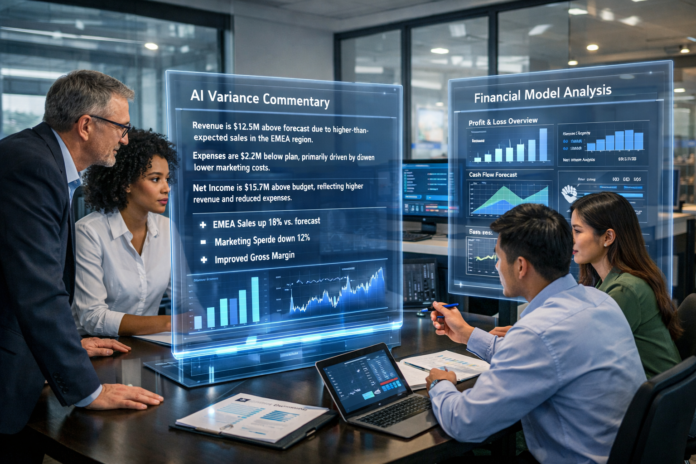
In the fast-paced world of corporate finance, the month-end close has historically been a grueling marathon. Financial Planning and Analysis (FP&A) teams spend days locked in spreadsheets, hunting down data discrepancies, and manually typing out variance explanations. But as of February 2026, the landscape has fundamentally shifted. The solution is no longer just adding more headcount or relying on rigid macros; it is FP&A agent orchestration.
Definition: Orchestrating an FP&A agent involves designing and managing a sequence of autonomous, AI-driven workflows that connect to your financial data, calculate variances, reason through the root causes, and draft management-ready commentary. Unlike basic generative AI chatbots that simply respond to static prompts, an “agentic” system has agency. It can run Python scripts, query Enterprise Resource Planning (ERP) systems, validate its own math, and collaborate with human reviewers.
Key Takeaways
- Math Must Be Deterministic: Never ask a Large Language Model (LLM) to calculate complex variances. Use Python and ERP rules for the math, and use the AI agent solely for narrative generation.
- Agentic Workflows Beat Giant Prompts: Breaking tasks into a “Supervisor and Specialist” pattern yields highly accurate, auditable financial commentary.
- Operational Integration is Mandatory: The best variance commentary connects financial outcomes to operational drivers (e.g., “Revenue dropped due to a 15% decrease in enterprise bookings,” not just “Revenue is down”).
- Human-in-the-Loop is Non-Negotiable: AI drafts the insight; the FP&A professional validates and refines it.
Who This Is For
This guide is designed for modern CFOs, Directors of FP&A, Controllers, and Financial Systems Architects who want to modernize their tech stack. If you are tired of your finance team operating as transactional data processors and want to elevate them to strategic business advisors, this deep-dive tutorial will provide the architectural blueprint you need.
The Evolution of Finance AI: Why 2026 is the Year of the Agent
Despite decades of digital transformation, many finance organizations have remained stuck in a cycle of human-orchestrated manual tasks. For years, the gold standard of month-end close automation was Robotic Process Automation (RPA). RPA was excellent at moving data from Point A to Point B based on rigid, rules-based logic. However, if a cell moved or a new General Ledger (GL) account was added, the bot broke.
Then came the boom of Generative AI. Finance teams experimented with pasting trial balances into public LLMs to generate commentary. This often resulted in “hallucinations”—where the AI fabricated numbers or confidently delivered wildly inaccurate business drivers.
As of February 2026, we have entered the era of Agentic AI. According to recent industry projections by Gartner, 60% of enterprise brands will deploy agentic AI by 2028. Agentic AI bridges the gap between the strict rules of RPA and the creative reasoning of generative AI.
An FP&A agent does not just execute rules or generate text; it perceives context, reasons through complex financial scenarios, executes actions across multiple tools, and learns from user feedback. When orchestrated correctly, early enterprise adopters report reducing month-end close cycles by 40-60% and reallocating up to 70% of their finance team’s capacity toward strategic analysis.
Understanding the Architecture of an FP&A Agent Orchestrator
Before you build, you must understand the architecture. Orchestrating an AI agent for finance requires strict adherence to data governance and auditable workflows.
The Supervisor and Specialist Pattern
The most common mistake in generative AI for finance is the “Giant Prompt” approach—giving one AI model the entire trial balance, previous months’ reports, and a massive list of instructions, hoping it figures it out. This leads to prompt bloat, high latency, and unpredictable results.
Instead, the industry standard in 2026 is the Supervisor + Specialists pattern.
- The Supervisor Agent: This is the orchestrator. It receives the trigger (e.g., “Commence Month-End Variance Run”) and breaks the project into smaller tasks.
- The Data Extraction Specialist: A sub-agent dedicated solely to securely fetching trial balances from your ERP via API.
- The Quantitative Specialist: A deterministic agent (often running secure Python scripts) that calculates the exact percentage and dollar variances.
- The Narrative Specialist: An LLM-powered agent that takes the validated math, cross-references it with operational context (like Salesforce data or news feeds), and drafts the commentary.
- The Policy Checker: A final guardrail agent that reviews the drafted commentary against corporate tone guidelines and ensures no unverified claims are made.
State Machines and Bounded Decisions
To ensure compliance (such as SOX requirements), orchestration must be a “state machine.” This means the workflow moves through explicit, logged phases: Plan -> Validate -> Execute. The AI is allowed to make bounded decisions (e.g., “Which template should I use for the EMEA region?”), but it cannot make unilateral changes to the financial system of record. Every tool call and prompt variation must be version-controlled and tracked with correlation IDs for auditability.
Step-by-Step Guide: Orchestrating an FP&A Agent for Month-End Commentary
Implementing this system requires bridging data engineering with financial expertise. Here is the blueprint for building a secure, automated month-end commentary pipeline.
Step 1: Establish the Deterministic Data Foundation (Python & ERP Integration)
Generative AI models are probabilistic; they guess the next most likely word. Financial math must be deterministic; 10 minus 8 must always equal 2. Therefore, your orchestration must begin outside of the LLM.
- Automated Data Aggregation: Use an orchestrator to trigger a data pull from your ERP (e.g., SAP, Oracle Fusion, Dynamics 365) and your operational databases.
- Account Mapping with Python: Use Python scripts to handle GL account mapping. For example, your script can automatically map any account containing the word “Revenue” to the “Sales” category. If a newly created account lacks a mapping rule, the script isolates it and flags it for human review rather than guessing.
- Variance Calculation: Run a Python script to calculate actuals vs. budget, and actuals vs. prior year. Set materiality thresholds (e.g., “Only flag variances greater than $50,000 or 5%”).
Output of Step 1: A clean, perfectly calculated JSON or Excel file containing only the material variances that require explanation.
Step 2: Context Retrieval via RAG (Retrieval-Augmented Generation)
An AI cannot explain why a variance occurred if it only has numbers. It needs context. This is where RAG comes in.
Your FP&A agent should be orchestrated to query a secure, internal vector database containing:
- Prior month management commentaries.
- The company’s annual operating plan (AOP) assumptions.
- Recent operational updates (e.g., HR headcount reports, marketing spend logs, or supply chain disruption notices).
When the agent identifies a $100,000 positive variance in “Software Subscriptions,” it searches the RAG database and finds a recent operational note that the IT team renegotiated a major enterprise vendor contract earlier than expected.
Step 3: Prompt Engineering for Financial Storytelling
Now, the Supervisor Agent hands the validated numbers and the retrieved context to the Narrative Specialist. The prompt must be highly structured.
Example System Prompt:
“You are a senior FP&A analyst. Your task is to write month-end variance commentary for the Executive Leadership Team. RULES:
- Use the EXACT numbers provided in the input JSON. Do not recalculate.
- Structure your response by identifying the root cause, not just restating the math. Avoid generic terms like ‘timing’ or ‘growth’.
- Connect financial shifts to the provided operational drivers.
- Maintain a professional, objective corporate tone.
- If the root cause is not present in the provided context, state: ‘[REQUIRES HUMAN INVESTIGATION]’.”
This strict prompting ensures the AI focuses on narrative assembly rather than guessing the underlying business realities.
Step 4: Human-in-the-Loop (HITL) Validation and Approval
The final, and most critical, step of orchestration is the human handoff. The agent should not autonomously email the CFO.
Instead, the orchestrator pushes the drafted commentary into a familiar interface—such as Microsoft Excel, Teams, or a specialized FP&A platform like Cube or Vena. The FP&A analyst reviews the draft. If the AI marked a variance as [REQUIRES HUMAN INVESTIGATION], the analyst reaches out to the relevant department head, updates the text, and finalizes the report.
Over time, you can capture this finalized human feedback and feed it back into the agent’s memory, creating a continuous learning loop.
Leading Tools and Frameworks for Finance AI in 2026
You do not necessarily need to build this from scratch using raw Python and OpenAI APIs. As of 2026, the market offers robust enterprise platforms tailored specifically for finance AI orchestration.
Microsoft Copilot for Finance
Microsoft Copilot for Finance (integrated heavily into Excel, Outlook, and Teams) has become a dominant force. It connects directly to ERP systems like Dynamics 365 and SAP. Copilot excels at financial reconciliation and variance explanation. For instance, you can define reconciliation vectors in Excel, and Copilot will instantly identify unmatched transactions. For month-end commentary, variance analysis features in Copilot can automatically read deviations from the forecast, pull natural language drivers (like currency fluctuations), and draft a summary directly into a PowerPoint deck or Word document.
Specialized Enterprise AI Agents
Several platforms offer pre-built, SOC 2 compliant finance agents:
- Oracle Fusion Cloud EPM: Oracle’s AI agents offer native variance detection, root cause analysis, and explainable predictive forecasting right within the ERP ecosystem.
- IBM Watsonx Orchestrate: IBM provides “no-code” AI agents designed for finance that streamline order-to-cash and record-to-report workflows, significantly reducing invoice cycle times and shortening the monthly close.
- ChatFin AI: A purpose-built FP&A AI agent platform that combines deep financial planning methodology with predictive analytics, boasting major reductions in budget cycle times.
- Sana Agents: Known for enterprise readiness, Sana offers RAG-powered finance agents with zero-copy architecture (meaning your financial data is not duplicated or exposed to external models), ensuring maximum privacy.
Custom Python and Open-Source Orchestrators
For organizations requiring highly bespoke logic, frameworks like LangGraph are incredibly popular. LangGraph allows engineering teams to map out agent workflows as literal graphs with explicit nodes and edges. This is ideal for finance because it supports “state tracking” and native human-in-the-loop checkpoints, ensuring the AI pauses for human approval before proceeding to the next node.
Common Mistakes in FP&A Agent Orchestration
Implementing AI in the finance department is fraught with unique risks. Avoiding these common pitfalls will save your team from costly reporting errors.
1. Neglecting Data Foundations (Garbage In, Garbage Out)
AI cannot fix a broken Chart of Accounts. If your entity structures, cost centers, and departmental mappings are inconsistent across the organization, the AI will generate nonsensical commentary. Perfect data isn’t a prerequisite to start, but standardized hierarchies and clean locked trial balances are non-negotiable for month-end reporting.
2. The Fallacy of AI Handling “Novel” Events
AI models are prediction engines built on historical pattern recognition. They are fantastic at explaining recurring variances (e.g., standard seasonality, volume vs. price mix). However, AI struggles with completely novel business events. If your company executes its first-ever merger and acquisition, experiences a unique regulatory shift, or pivots its core product line, the AI will lack the historical context to explain the resulting variances. FP&A professionals must always step in to handle unprecedented strategic shifts.
3. Ignoring Security and Access Controls (RBAC)
Feeding sensitive, unreleased financial data into a public LLM is a massive security violation. Furthermore, not every sub-agent needs access to all data. Enterprise orchestration requires strict Role-Based Access Control (RBAC). An agent drafting commentary for the marketing department’s budget variance should not have access to executive payroll data. Always ensure your orchestration framework utilizes private endpoints, field-level encryption, and zero data-retention policies from the LLM provider.
Conclusion
Orchestrating an FP&A agent for month-end commentary in 2026 is no longer a futuristic concept—it is a practical, competitive necessity. By transitioning from manual data aggregation to an AI-orchestrated workflow, finance teams can shift their focus from looking backward at what happened, to looking forward at what needs to happen next.
The secret to success lies in the architecture: relying on Python and deterministic systems for financial math, utilizing specialized agent routing for tasks, grounding the AI with RAG for operational context, and keeping the human FP&A expert firmly in the driver’s seat for final validation. When you blend the speed of machine computation with the strategic judgment of a human analyst, you create a world-class finance function.
Next Step: Would you like to start small? I can help you write a basic Python script to automate your GL account mapping, which is the perfect foundational step before introducing an AI agent to your month-end workflow. Let me know if you want to see the code!
Frequently Asked Questions (FAQs)
Q: Can an FP&A AI agent completely replace human financial analysts? A: No. AI agents are designed to augment, not replace, finance professionals. While agents excel at data aggregation, variance calculation, and drafting initial narrative summaries, human analysts are required to interpret novel business events, manage sensitive accounts, and provide the final strategic judgment that leadership relies on.
Q: What is the difference between Generative AI and Agentic AI in finance? A: Generative AI (like a standard ChatGPT prompt) passively waits for a user prompt to generate text based on learned patterns. Agentic AI is proactive and autonomous; it can break down a complex goal into steps, trigger Python scripts to do math, query secure ERP databases, and orchestrate a multi-step workflow without continuous human prompting.
Q: How do we prevent AI from making math errors in our financial commentary? A: You must separate the mathematics from the language generation. Best practices dictate using deterministic systems (like your ERP’s native logic or secure Python scripts) to calculate exact variances. The AI agent is then fed these finalized, validated numbers strictly to generate the qualitative narrative, bypassing the LLM’s weak mathematical reasoning.
Q: Is it secure to use AI agents with confidential month-end financial data? A: Yes, provided you use enterprise-grade solutions. You must never use public, consumer-facing AI models for corporate finance. Secure orchestration requires SOC 2 Type II compliance, zero-copy architecture, private cloud deployments, and strict Role-Based Access Control (RBAC) to ensure data is encrypted and not used to train external models.
Q: How long does it take to implement an FP&A agent for variance analysis? A: It depends on your data readiness. If your Chart of Accounts is standardized and you use a modern ERP, a pilot (focusing on one department or product line) can be deployed in 30 to 60 days using tools like Microsoft Copilot for Finance or specialized platforms like ChatFin. Scaling it organization-wide typically takes a few quarters.
References
- Oracle. “AI-Driven FP&A: Shift from Hindsight to Foresight.” Oracle Enterprise Resource Planning. https://www.oracle.com/fr/erp/ai-driven-financial-planning-and-analysis/
- FP&A Trends. “Three Practical Ways to Speed Up Month-End Closing with AI.” FP&A Trends Group. https://fpa-trends.com/article/three-practical-ways-speed-month-end-closing-ai
- IBM Institute for Business Value. “FP&A 2026 Trends.” IBM Insights. https://www.ibm.com/think/insights/fpa-trends-future
- FloQast. “The CAO’s Guide to AI-Powered Variance Analysis: From Compliance Checkbox to Strategic Advantage.” FloQast Blog. https://www.floqast.com/blog/the-caos-guide-to-ai-powered-variance-analysis
- Microsoft Adoption. “Using Copilot in Finance (Copilot Scenario Library).” Microsoft. https://adoption.microsoft.com/en-us/scenario-library/finance/
- Forbes Technology Council. “Agent Orchestration: Best Practices And Pitfalls.” Forbes. https://www.forbes.com/councils/forbestechcouncil/2025/12/16/agent-orchestration-best-practices-and-pitfalls/
- Sana Labs. “7 Best Enterprise AI Agents for Financial Services in 2025.” Sana Blog. https://sanalabs.com/agents-blog/best-enterprise-ai-agents-financial-services-2025
- HatchWorks AI. “Orchestrating AI Agents in Production: The Patterns That Actually Work.” HatchWorks. https://hatchworks.com/blog/ai-agents/orchestrating-ai-agents/