Food delivery services make it possible to tap a few buttons and have dinner show up—no dishes, no driving. In plain terms, these platforms connect you, a restaurant, and a courier through an app that handles menus, payments, and logistics. This guide walks you through the real-world trade-offs so you can decide when delivery is worth it and when pickup or cooking might be smarter. (General consumer guidance only; for budgeting, health, or dietary decisions, consult qualified professionals.)
Quick evaluate checklist:
- Scan fees at checkout (delivery, service, small-order, busy-area).
- Compare pickup vs delivery in the same app.
- Check ETA and item availability before tipping and placing the order.
- Verify temperature-sensitive items (hot foods hot, cold foods cold).
- Use memberships or promos selectively, and run simple break-even math.
- Tip fairly and keep privacy settings tight.
1. Convenience and Time Saved (Pro)
Delivery shines when time is scarce. You avoid the round-trip drive, parking, waiting in line, and cleanup, and the app consolidates ordering, payment, and tracking. If your evening is stacked—kid pickup, a late call, or just depleted energy—outsourcing the “last mile” can give you a genuine margin of relief. The platforms are designed to streamline decision-making (filters, favorites, reorder buttons), and both DoorDash and Uber Eats show live progress as the courier heads to the restaurant and then to you. When everything clicks—restaurant is on time, courier is nearby—you convert a 60- to 90-minute meal effort into minutes of tapping plus a short wait. That margin can be enough to finish a deadline, make a workout window, or simply relax.
Numbers & guardrails
- Time trade-off example: Cooking a 30-minute recipe often implies ~15 minutes of prep and cleanup (45 minutes total). Driving to pick up food might add 20–30 minutes round-trip. A delivery flow could be ~5 minutes to order and ~35 minutes to wait, letting you reclaim ~5–35 active minutes.
- Reliability swing: Peak mealtimes, weather, and restaurant backlog can stretch ETAs. A quick “prep time” check in-app (many menus show it) helps you spot delays early.
- Decision rule: If you’re trying to protect a 30-minute block—study, bedtime routine, or call—delivery is typically the fastest path to a hot meal with the least active effort.
Mini-checklist
- Save favorites to speed ordering.
- Check restaurant prep time before submitting.
- Turn on delivery instructions (gate codes, landmarks) to reduce courier delays.
In short, if your main constraint is active time, the convenience dividend can be meaningful, especially during busy nights.
2. Total Cost, Fees, and Markups (Con—sometimes)
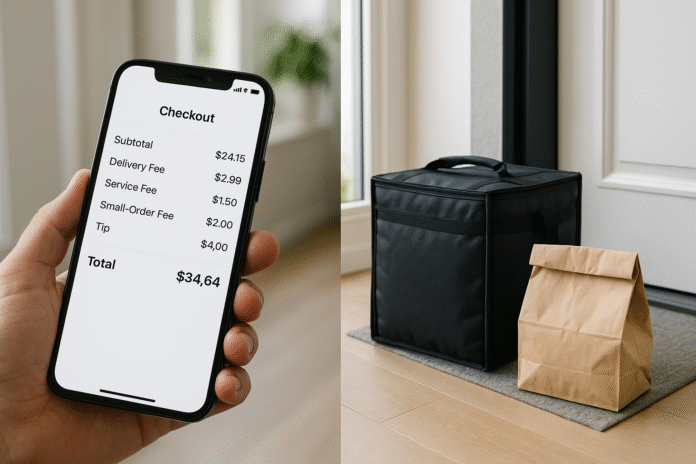
The headline price in your cart is rarely the final price. Delivery apps commonly add a delivery fee, a service/marketplace fee, small-order fees, and occasionally busy-area fees, all shown at checkout. DoorDash discloses delivery and service fees (and notes small-order minimums may apply). Uber Eats lists service and other fees and explains busy-area surcharges during peak demand. These are legitimate, but they can be confusing until you know what triggers each one and how to minimize them.
Fee decoder (typical meanings—not amounts):
| Fee | Where you’ll see it | What triggers it |
|---|---|---|
| Delivery fee | DoorDash, Uber Eats | The “last mile” delivery cost; varies by restaurant/location. |
| Service/Marketplace fee | Both | Platform operations; percentage or variable amount; shown at checkout. |
| Small-order fee | Both | Subtotal below a threshold; add an item to remove it. |
| Busy-area fee | Uber Eats | Demand exceeds available couriers in an area. |
Numbers & guardrails
- Illustrative cart math: Subtotal $22.00; service fee (example) 10% → $2.20; delivery fee (example) $2.49; small-order fee $0; taxes vary; tip $3.00 → estimated total ≈ $29.69. (Service fees and delivery fees vary by merchant and location; always rely on the app’s itemized breakdown.)
- Markups: Some restaurants list higher menu prices in apps to offset platform commissions; compare the restaurant’s own website or pickup price when value matters. (Platform merchant pages discuss commission structures that influence pricing strategies.)
Mini-checklist
- Add one small item to clear a small-order fee if it’s cheaper overall.
- Toggle to pickup in-app to skip delivery fees when you’re already out.
- Watch for busy-area icons; ordering slightly earlier/later can avoid surcharges.
Bottom line: delivery can be excellent value for groups or when time is precious, but for single-item cravings, fees can outweigh convenience.
3. Choice and Coverage (Pro)
Delivery apps aggregate restaurants, grocery, and convenience stores into one marketplace, which expands your options beyond walking or driving distance. If you’re in a dense area, you’ll see dozens of cuisines and specialty shops; in less dense areas, selection is smaller but still typically broader than calling around. The app’s filters—dietary tags, ratings, prep times, distance—compress the “search cost” of deciding what to eat. You also get consistent UX across merchants: clear menus, modifiers for dietary needs, and digital receipts for expense tracking.
How to get better results
- Use distance filters to reduce long delivery legs that can hurt food quality.
- Favor high-rating, high-volume merchants for reliability at mealtimes.
- Check store hours and special instructions; out-of-stock items can derail orders.
Mini case
Ordering for a group of four with mixed preferences (gluten-free salad, vegan bowl, kids’ pasta, spicy wings) would normally require multiple calls or stops. Within an app, you can consolidate orders from one merchant with broader menus or run two quick orders in parallel—still less effort than driving between locations.
Choice is a clear win: when you need variety without logistics, the marketplaces reduce friction—and indecision—to nearly zero.
4. Food Quality, Temperature, and Reliability (Mixed)
Food quality hinges on time-to-table and packaging. The longer hot foods dwell below safe holding temperatures or cold foods ride above them, the worse the taste—and potentially the safety. Food safety agencies emphasize keeping hot foods at or above 140 °F (60 °C) and cold foods at or below 40 °F (4 °C); the range in between is often called the “danger zone” because bacteria can multiply rapidly. That doesn’t mean delivered food is unsafe by default—restaurants and couriers use insulated bags—but it does mean timing matters, especially for soups, fried items, and dairy-based dishes.
Numbers & guardrails
- Best-case ETA: A 10-minute restaurant prep with a 12-minute courier leg keeps most items closer to their intended temperature; long staging (e.g., 20 minutes) increases quality loss.
- Packaging reality: Vent holes help fried foods stay crisp; sealed containers preserve broths and sauces but can steam fries—choose accordingly.
- Safe-handling reminder: Hot foods should remain ≥140 °F (60 °C); cold foods ≤40 °F (4 °C) until eaten or refrigerated promptly.
How to do it
- Prefer short-distance merchants for fries, ramen, and ice cream.
- Leave clear drop-off instructions so the courier finds you fast.
- Transfer leftovers to shallow containers and refrigerate quickly.
Close the loop by ordering foods that travel well and by meeting your courier promptly. When you manage the variables, quality stays high; when an ETA stretches, temper expectations.
5. Nutrition and Portion Trade-offs (Con for many, unless you plan ahead)
Restaurant meals often come in larger portions with more sodium, saturated fat, and calories than home cooking. Multiple studies show typical out-of-home meals overshoot healthy benchmarks for energy and sodium; people also tend to underestimate calories and salt when ordering from restaurants. Delivery doesn’t cause those nutrition profiles, but it extends them into your home, where it’s easier to keep snacking after the bag arrives. If you’re monitoring energy intake, think hard about defaults like sides and sugary beverages.
Numbers & guardrails
- Research snapshot: Analyses of chain-restaurant meals frequently find averages near or above ~900–1,000 kcal per main dish, with many items exceeding recommended per-meal energy targets and sodium limits.
- Labeling helps (a bit): Menu calorie labeling is associated with modest reductions in calories ordered or consumed, but the effect is small—so conscious choices still matter. BMJ Open
How to do it
- Customize: Drop sauces, swap sides, or choose half portions when available.
- Split meals: Plate half now, half for later to avoid passive overeating.
- Leverage labels: Many menus display calories—use them to compare like-for-like.
If you treat delivery as an occasional treat or plan portions deliberately, you can enjoy the convenience without derailing nutrition goals.
6. Impact on Local Restaurants and Pricing Dynamics (Mixed)
Marketplaces expand a restaurant’s reach but charge commissions on marketplace orders, which can pressure tight margins. DoorDash and Uber Eats publish merchant pricing pages that outline platform and processing fees (and, in some cases, tiered plans). Those economics help explain why some restaurants list slightly higher menu prices in apps or promote pickup discounts. As a customer, it’s useful to understand that your delivery fees don’t replace merchant commissions—they’re separate line items serving different parties (platform operations vs. merchant acquisition).
Numbers & guardrails
- Illustrative margin math: On a $30 order, a 20% commission equals $6 to the platform (merchant side), while you might also pay a few dollars in delivery/service fees (customer side). If a restaurant’s net margin per order is only a few dollars, a commission can be material—hence modest app markups or pickup incentives. (Commission specifics vary by plan and region; check merchants’ own pages for precise terms.)
- Direct ordering options: Both platforms also offer commission-light or direct-order products for merchants (separate from marketplace), often with small processing fees instead of commissions.
How to do it
- When convenient, order pickup to support local spots that prefer it.
- Look for restaurant-run sites linked from the app profile (some list direct ordering).
- Tip the courier either way; pickup reduces platform fees but doesn’t pay drivers.
Understanding the two-sided economics helps you align convenience with community support—choosing delivery when it’s worth it and pickup when it’s better for your favorite spot.
7. Memberships and Promotions ROI (Pro when you clear the break-even)
DashPass (DoorDash) and Uber One (Uber Eats/Uber) offer $0 delivery fees on eligible orders and reduced service fees—plus periodic promos. They can be a strong value if you order often enough and meet subtotal minimums, but they’re not automatic wins. The trick is to compare the membership cost with your per-order savings on fees and then decide whether you’ll actually place enough qualifying orders in a typical month to break even. Membership benefits and thresholds are spelled out in each platform’s pages; read the fine print since eligibility can vary by merchant and region.
Numbers & guardrails
- Break-even math: If the membership costs $X per month and each eligible order saves you about $S in delivery + reduced service fees, you need ceil(X ÷ S) orders to break even.
- Example: If you typically save ~$4 per order, you’d need 3 orders to come out ahead (since 2 orders would save ~$8 and 3 would save ~$12).
- Eligibility: $0 delivery applies only to eligible orders over the minimum subtotal; reduced service fees still apply. Always confirm the line items before ordering.
How to do it
- Stack promos with membership (when allowed) for bigger wins.
- Use order grouping: combine two small cravings into one eligible cart.
- If you’re under the threshold, toggle to pickup to avoid small-order fees.
Memberships excel for habitual users who routinely hit minimums; occasional users may save more by staying à la carte and hunting for one-off promos.
8. Drivers, Tipping, and Delivery Ethics (Pro for fair, transparent tipping)
Couriers make delivery possible, and tipping is the clearest way to compensate the person doing the last-mile work. Both platforms state that 100% of tips go to the courier/driver, on top of their base pay; tipping is optional, but it directly affects worker earnings. Add clear delivery notes (gate codes, landmarks) and choose meet-at-door if it helps. If an order is severely delayed, stay respectful—many delays stem from restaurant prep or traffic outside the driver’s control.
Numbers & guardrails
- Impact example: On a $24 order, a $3–$5 tip raises courier earnings meaningfully relative to a short route—often more than marginal changes in platform pay for that trip.
- When to adjust tips: If the courier communicates well and solves problems (e.g., substitutes, complex apartment access), consider a post-delivery tip adjust.
- Transparency: DoorDash explicitly notes Dashers receive 100% of customer tips; Uber confirms couriers keep 100% of tips.
Mini-checklist
- Default to meet-at-door unless contactless is needed.
- Add precise notes; they save time and headaches.
- Tip based on effort and distance, not just order subtotal.
A fair tip and clear instructions make delivery smoother for everyone—and keep the ecosystem healthy.
9. Data, Privacy, and Algorithmic Choice (Con if unmanaged; neutral if you control it)
Delivery apps collect data to run the service—location, order history, device/app analytics—and use it to route couriers, improve ETAs, and surface recommendations. Both companies provide privacy documentation and allow you to review or download some of your data. You can often limit precise location access to “While Using the App” or turn off certain ad tracking. It’s reasonable to expect basic telemetry; what matters is that you understand it and dial in your preferences.
Numbers & guardrails
- What’s in the data: Uber’s help pages note your Uber Eats data includes restaurant names, items ordered, prices, times, and a window of mobile event data (device OS, model, language, app version, time and location of collection).
- Location usage: Both platforms describe collecting geolocation to operate deliveries; settings on your device can limit precise tracking outside active use. DoorDash
Mini-checklist
- Permissions: Set location to While Using; disable background access unless you want active tracking.
- Ads & sharing: Explore in-app privacy/ad settings to limit data for targeted ads. Uber
- Data hygiene: Periodically download your data to see what’s stored and prune saved addresses you no longer use. Uber
With a few settings tweaks, you can keep the benefits of personalization and routing without over-sharing by default.
FAQs
Is pickup usually cheaper than delivery?
Often, yes. Pickup removes the delivery fee and can avoid small-order fees; you’ll still see service or processing charges in some cases. Some restaurants also list lower prices on their own sites for pickup. Compare the same cart under both modes before you commit; the app’s line-item breakdown makes the differences clear.
Which is cheaper, DoorDash or Uber Eats?
It depends on your location, the merchant, and current promos. Delivery and service fees vary, and some areas may have busy-area surcharges at peak times on Uber Eats. Your best move is to build the same order in both apps and compare totals at checkout—including promotions and any small-order or busy-area fees.
How do I avoid small-order fees without overspending?
Add a low-cost item that you actually want—sides, drinks, or pantry basics—to clear the threshold. Sometimes toggling to pickup is cheaper than padding the cart. Both platforms explain that small-order fees apply below a minimum subtotal and disappear once you meet it.
Are memberships like DashPass or Uber One worth it?
They can be if you place enough eligible orders. Use simple break-even math: monthly cost divided by your average per-order savings (delivery + reduced service fees). If you’re ordering sporadically, stick to promos. Membership pages clearly outline that $0 delivery applies only to eligible orders over minimums, with reduced service fees still in play.
How should I tip?
Tip what feels fair based on distance, weather, and effort. Remember that both platforms state couriers receive 100% of tips, which go directly to the person delivering your food. You can adjust after delivery if service exceeded expectations.
What foods travel best?
Bowls, curries, stews, and sandwiches tend to travel better than fried foods or delicate crispy items. For quality and safety, limit long trips and be ready to refrigerate leftovers promptly; keep hot foods hot (≥140 °F/60 °C) and cold foods cold (≤40 °F/4 °C). Food Safety and Inspection Service
Why do menu prices sometimes look higher in the app?
Restaurants may list higher prices in marketplaces to offset platform commissions on marketplace orders. Platforms outline merchant fee structures publicly; those economics influence whether a restaurant nudges prices in-app or steers you to pickup.
Is my data safe when I use delivery apps?
Both companies publish privacy notices and tools to view or download certain data. You can reduce data collection by limiting background location and turning off some ad personalization. Review privacy pages and help articles for details about what data is collected and why.
Do busy-area fees mean my order will arrive faster?
Not necessarily faster, but they’re designed to attract more couriers to a high-demand area. The app flags busy zones with an icon and includes the fee at checkout; shifting your order time can often avoid it. Uber
What’s the single smartest way to save without sacrificing convenience?
Plan a once-per-week group order that hits membership minimums, clears small-order fees, and spreads delivery cost across multiple meals or people. Stack an in-app promo when available, and choose a restaurant within a short delivery radius to preserve quality. Uber
Conclusion
Delivery apps are powerful tools: they trade a small pile of logistics for convenience and variety. The upsides are real—time saved, broad selection, and end-to-end ease. The downsides are manageable when you know how to spot them: fees that add up on small orders, foods that don’t travel well, and data you might prefer to keep close. If you apply a few simple rules—compare pickup vs delivery, check fees in the cart, tip fairly, order foods that endure a short trip, and tune privacy settings—you’ll keep the convenience while avoiding most pitfalls. In other words: use delivery deliberately.
Ready to try it? Build the same order two ways (pickup and delivery), compare totals, and choose the win that fits your night.
References
- What fees may apply to my order? Uber Help — https://help.uber.com/prs-AF/ubereats/restaurants/article/what-fees-may-apply-to-my-order
- How do the charges work on Uber Eats? Uber Help — “Service fee…typically 10% of the basket.” — Uber
- What fees do I pay? DoorDash Help Center — DoorDash Help
- What is DashPass? DoorDash Help Center — benefits and eligibility — DoorDash Help
- Uber One | Membership. Uber — membership overview — https://www.ubereats.com/uber-one Uber Eats
- Do Dashers receive tips? DoorDash Help Center — “Dashers receive 100% of tips.” — DoorDash Help
- Understanding how tips work. Uber Help — “100% of the tips you earn are yours.” — Uber
- “Danger Zone” (40 °F–140 °F). USDA FSIS — safe holding temperatures — Food Safety and Inspection Service
- Safe Handling of Take-Out Foods. USDA FSIS — handling guidance — Food Safety and Inspection Service
- Safe Food Handling. U.S. FDA — cooling and storage pointers — U.S. Food and Drug Administration
- (Over)eating out at major UK restaurant chains. BMJ (Open) — main-meal energy content analysis — PubMed
- Measured energy content of frequently purchased restaurant meals. BMJ — cross-country energy measures — BMJ
- Consumer Privacy. DoorDash — summary of practices — DoorDash
- What’s in your Uber data download? Uber Help — data contents (orders, device events, location/time) — Uber
- How Uber uses location information. Uber Help — geolocation use — Uber
- Pricing for Merchants. Uber Eats — processing/commerce pricing page — Uber
- Commission and Fees on DoorDash, Explained. DoorDash for Merchants — overview of commission/processing — DoorDash Merchants