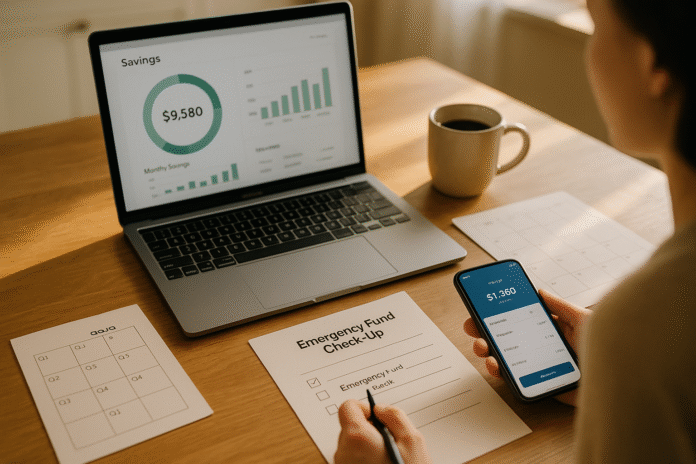
A well-kept emergency fund isn’t “set it and forget it”—it’s a living safety system. This guide gives you seven practical review routines that keep your cash buffer the right size, in the right place, and ready to use. If you’ve ever wondered how often to check, what to change, or how to squeeze more safe yield without sacrificing access, you’re in the right spot. Quick note: this article is educational and not personalized financial advice; consider your own circumstances and local regulations.
Definition (fast answer): An emergency fund check-up is a scheduled review of your cash safety net—size, location, access rules, and automation—to confirm it still fits your life and can be used immediately when needed. Most households benefit from a quarterly review and an ad-hoc check after big life events.
If you want a mini “how-to” up front:
- Pick a quarterly review date and note major life-event triggers;
- Recalculate your target using current essential expenses;
- Verify where the money sits (yield, insurance, and access);
- Stress-test how fast you can use it;
- Reconcile with debt and insurance;
- Re-tune automations and contributions;
- Document rules, track progress, and align with your household.
1. Set a Review Cadence and Clear Triggers
Your emergency fund stays reliable when reviews are automatic, not ad hoc. The most effective cadence for most people is quarterly (four times a year), with event-based reviews whenever your life meaningfully changes. Start this section by locking in a recurring date on your calendar and making a short list of triggers that force a check—job changes, a new baby, moving, new insurance deductibles, a major purchase, or changes to variable expenses. The aim is simple: your cash cushion should always reflect your current reality, not last year’s budget. If quarterly feels too frequent at first, start semiannually and move to quarterly once you’ve done two rounds; momentum matters more than perfection.
1.1 Why it matters
- Emergencies don’t schedule themselves; reviews ensure your fund matches today’s bills and risks.
- Rates, fees, and account features change; a quick scan can add hundreds in safe interest each year as of now.
- Deposit-insurance rules are stable but nuanced across countries and ownership types—periodic checks help you stay within coverage.
1.2 How to do it (quick checklist)
- Pick a day: e.g., the first Saturday of Jan/Apr/Jul/Oct.
- Add life-event triggers: job/income change, new dependent, move, insurance updates, debt payoff, or a >10% expense swing.
- Prep a one-page worksheet: current balance, target size, where funds live, APY, insurance/coverage, access test, and action items.
- Time-box to 45 minutes: the scope is focused—no full budget overhaul unless red flags pop up.
- Track a single KPI: “Months of essential expenses covered” (rounded to 0.1 month).
Synthesis: Build the habit first; the optimization will follow. A predictable cadence plus explicit triggers is the foundation for every other improvement here.
2. Recalculate Your Target Using Real Expenses and Risk Factors
The correct emergency fund size is the amount that covers essential life for a reasonable window—commonly 3–6 months of essential expenses, with more for unstable income or higher dependents. Start by recalculating your current essential monthly outgoings (housing, utilities, food, transport, minimum debt payments, insurance, childcare/health basics). Then multiply by a risk-adjusted duration: salaried two-income households may feel fine near three months; single-income or gig-based households often target six months or more. Seasonal workers or those with variable healthcare costs may stretch further. The goal of the check-up is to make your number present-tense, not aspirational.
2.1 Numbers & guardrails
- Widely cited guidance: 3–6 months of essential expenses; start smaller and build.
- UK perspective: instant-access savings with 3–6 months’ essentials is a solid rule of thumb.
- Australia: separate high-interest account and automate contributions; three months is a common baseline. Moneysmart
- Reality check: in 2024, 63% of U.S. adults could cover a $400 emergency with cash or equivalent—progress, but hardly universal. Use it to benchmark your resilience.
2.2 Mini example
- Essential outgoings today: $3,200/month.
- Risk profile: one income, dependent child, variable commission.
- Target window: 6 months ⇒ $19,200.
- Current fund: $11,000 ⇒ shortfall $8,200.
- Contribution plan: $475/month + two windfalls ($1,000 each) ≈ full target in ~12 months.
2.3 Common mistakes
- Using gross income instead of actual essential expenses.
- Forgetting new deductibles or co-pays after changing insurance.
- Not updating for rent increases, childcare changes, or a new car’s maintenance profile.
Synthesis: Re-running the math quarterly keeps your target honest; even a 5–10% drift in expenses can turn a “full” fund into an overconfident guess.
3. Optimize Where the Money Lives: Yield, Safety, and Coverage
Your check-up should confirm your cash is safe, insured, and earning a competitive risk-appropriate return while remaining immediately accessible. In practice, that usually means a high-yield savings account (HYSA) or insured money market deposit account for the bulk, not an investment fund. As of now, competitive HYSAs commonly post APYs in the ~4–5% range, with top offers slightly above that; traditional brick-and-mortar rates can be far lower. The “where” decision is never one-and-done; institutions change rates, features, and fees—so your quarterly sweep can pay.
3.1 Safety first (know your coverage)
- U.S. banks: FDIC insurance typically covers up to $250,000 per depositor, per insured bank, per ownership category.
- U.S. credit unions: NCUA share insurance mirrors the $250,000 limit; categories can increase total coverage.
- UK: FSCS protects up to £85,000 per eligible person (more for certain temporary high balances for six months).
- EU: harmonized protection up to €100,000 per depositor.
3.2 What not to confuse
- Money market deposit account (bank) = FDIC/NCUA insured, good for EF.
- Money market fund (investment) = not FDIC insured; low risk but not risk-free.
3.3 Tools & examples (tiering for liquidity)
- Tier 1 (Immediate): HYSA or insured MMDAs—primary EF.
- Tier 2 (Near-cash): Short no-penalty CDs or Treasury bills; minor yield boost with predictable access.
- Tier 3 (Overflow/longer horizon): I Bonds as inflation-hedged, with lockups/limits (e.g., current composite rate 3.98% for bonds issued).
3.4 Quick rate sanity check
- National “average/cap” metrics change, and banks adjust frequently; verify your APY still competes with top HYSAs.
Synthesis: Keep most of your fund in insured, instantly accessible accounts; revisit APY and coverage each quarter, and only layer beyond that if the liquidity trade-off fits your household.
4. Stress-Test Liquidity and Access (Before You Need It)
An emergency fund is only useful if you can use it—fast. Your check-up should confirm how many hours or days it takes to get money in hand, and through which channels (debit, ATM, branch cash, instant transfer). Transfer rails, daily limits, and fraud locks vary, and “instant” apps can still have deposit holds. Your aim is to simulate a likely emergency (e.g., $1,200 auto repair today; $4,000 medical bill this week; one month of rent after a job loss) and ensure there’s a friction-free path to payment.
4.1 How to run a 20-minute liquidity drill
- Confirm limits: daily ATM withdrawal caps, transfer caps, and cut-off times.
- Do a $50 transfer from EF to checking to confirm credentials and speed.
- Check backup access: second bank, second card, joint account holder’s access, and a branch within reach.
- Keep remittance options handy: account/routing numbers and virtual card numbers if your bank offers them.
4.2 Rules & protections worth knowing
- Electronic transfer error-resolution timelines exist (e.g., U.S. Reg E investigation and correction windows), offering consumer protections when things go wrong—but they still take time. Build slack into your plan. Consumer Financial Protection Bureau
4.3 Mini example: timing matters
- If your bank’s “instant” transfer to an external account actually settles next business day and you discover that on a Friday evening, funds may land Monday.
- Workaround: keep one month of expenses at your primary bank and any overflow at a high-yield partner; maintain two debit/ATM paths.
- For international readers: check local weekend/holiday clearing rules and cash-advance fees before you’re under pressure.
Synthesis: A 20-minute drill can expose multi-day delays you’d rather not discover mid-crisis. Make short test transfers part of every check-up.
5. Integrate With Debt, Insurance, and Job Risk
Your emergency fund doesn’t exist in a vacuum; it sits in a triangle with debt and insurance. The check-up is the time to rebalance. If you carry high-interest debt, it often makes sense to hold a smaller buffer (e.g., 1–2 months) while aggressively paying down debt, then rebuild the fund to your full target. On the insurance side, align your EF with deductibles (health, auto, home) and your job’s income stability. A lower premium with a higher deductible may be fine—if your EF explicitly covers that deductible and potential co-pays.
5.1 Practical guardrails
- Debt vs. EF: Keep at least 1 month of essentials in cash; direct surplus to debts whose APRs dwarf safe APYs; then refill to the full EF target once the expensive debts fall.
- Insurance alignment: Add a cushion equal to your highest deductible + one month of co-pays/coinsurance you’d realistically face.
- Income stability: Stretch to 6+ months if your income is variable or tied to commissions, tips, or grants. Widely cited guidance supports 3–6 months as baseline; push higher as risk rises.
5.2 Case example
- Household with $2,800/month essentials, $900 health deductible, and $8,000 at 21% APR credit-card debt.
- Plan: Maintain $3,000 in EF; channel $500/month extra to debt until APR falls (via payoff or 0% transfer), then rebuild EF to $16,800 (6 months + deductible).
- Outcome: Lower interest drag without running bare on cash.
Synthesis: Let your EF size and placement respond to real trade-offs—expensive debt and your biggest insurance risks should steer your allocations.
6. Audit Contributions, Automations, and Windfalls
The easiest emergency funds are built (and maintained) on autopilot. Your quarterly check-up is the moment to re-tune transfers, direct deposits, and savings rules in your banking apps. If you received a raise, bonus, refund, or a one-off payout, allocate a portion to close the gap to your updated target. Strong automation also prevents drift—quietly topping up after any emergency withdrawal and nudging your balance back to baseline.
6.1 How to set your autopilot
- Rule of thumb: choose an amount you’ll barely notice (e.g., 2–5% of take-home pay) and schedule it for payday+1.
- “Escalator” rule: any raise gets a 50/50 split—half to future goals, half to lifestyle. Direct the “future” half to the EF until target.
- Windfalls: pre-commit a fixed % (e.g., 30–50%) of tax refunds or bonuses to the EF. Widely recommended by investor-education sources.
6.2 12-month build example
- Shortfall: $8,200 (from §2).
- Monthly transfer: $475 (automatic).
- Two windfalls: $1,000 each (months 3 and 9).
- Result: Fund reaches target at month 12 with room for rate variability.
6.3 Tools & nudges
- Bank “vaults/buckets” to separate EF from other savings.
- Round-up features to add painless drips.
- Notifications when balance dips below target → triggers an automatic top-up.
Synthesis: Systems beat intentions. Use each check-up to turn dials—then let automation carry the load between reviews.
7. Document Rules, Track Progress, and Communicate
Emergencies are stressful; clarity is your ally. Your check-up should end by updating a one-page “EF Playbook” that spells out what counts as an emergency, how to access funds, replenishment rules, and who does what in a crisis. If you share finances, treat this as a household debrief: who holds logins, who moves money, which card gets used first, and how you’ll replace withdrawn funds. Track progress visibly—on a simple dashboard showing months covered, current APY, and coverage status (FDIC/NCUA/FSCS/EU).
7.1 Mini checklist to finalize each review
- Definition: “Emergencies = job loss, medical, critical home/car repairs; not vacations.”
- Access plan: primary/backup accounts, transfer paths, limits, and a branch/ATM map.
- Insurance & coverage: current deductibles, deposit-insurance status, and ownership titles.
- Replenish rule: automatic top-ups resume until the target is back, plus 5% buffer.
- Audit log: note APY, provider changes, and any issues (e.g., transfer delays).
- Owner & date: sign and date the playbook; store a copy where both partners can access it.
7.2 Quick household example
- Two-person household sets “emergency only” rules; keeps one month at the main bank for instant access and the rest at a high-yield partner.
- After a $1,600 furnace repair, they log the event, turn on a $150/month temporary top-up for four months, and reset their target at the next quarterly review.
Synthesis: Written rules and shared visibility turn your fund from “money in an account” into a dependable household system.
FAQs
1) How often should I review my emergency fund?
Quarterly works well for most people because expenses, pay, and account rates shift through the year. Always add event-based reviews after a job change, new dependent, move, or insurance update. This cadence keeps the fund matched to reality without turning it into a weekly chore.
2) How much should I keep—three or six months?
Start with three months of essential expenses if your income is stable and you have broad insurance coverage. Stretch to six months or more if you’re self-employed, have dependents, rely on bonuses/tips, or work in a cyclical industry. Recalculate the number quarterly so today’s bills—not last year’s—set the target.
3) Where should I keep the money?
Prefer insured, instant-access accounts like high-yield savings or money market deposit accounts. They’re designed for liquidity and safety and are typically covered by FDIC/NCUA in the U.S., FSCS in the UK, and harmonized DGS in the EU. Check current APYs and account terms during each review.
4) Are money market funds okay for an emergency fund?
Generally, no—for the core layer. Money market funds (mutual funds) are not FDIC/NCUA insured and, while historically low risk, they can fluctuate and have rare but real risks. If you use them at all, treat them as overflow beyond your immediate-access layer. Investor
5) How do I balance high-interest debt with building my EF?
Keep a 1-month cash buffer to avoid new debt, then direct surplus to high-APR balances. After you lower the interest burden, rebuild the EF to the full target (3–6+ months). This approach reduces interest drag while preserving basic resilience.
6) What counts as an “emergency”?
Think: unplanned, necessary, and urgent—job loss, medical costs, essential home/car repairs, travel for family emergencies. Not: holidays, routine upgrades, or predictable annual bills (budget those separately). Write the definition in your Playbook to prevent “just this once” erosion.
7) What if I’m paid irregularly (gig/commission)?
Increase your target window to 6–9 months and run monthly micro-reviews for the first two quarters. Keep at least one month at your primary bank for instant access, then ladder the balance across a high-yield account and short T-bills or no-penalty CDs if they still fit your liquidity needs.
8) How do deposit-insurance limits work with joint or multiple accounts?
Coverage is per depositor, per insured institution, per ownership category. Joint accounts typically get coverage per co-owner, and different ownership categories (e.g., single, joint, certain retirement, trust) can increase total insured amounts. Check your local rules and titles carefully.
9) Should I keep some physical cash at home?
A small amount (e.g., $100–$500) can help if cards or networks are down, but weigh theft and disaster risks. Focus most of your EF on insured accounts with reliable access and documented backup methods (second card/account, branch/ATM plan).
10) Can I earn more without losing access?
Sometimes. As of now, competitive HYSAs offer around 4–5% APY at reputable institutions; you can also consider no-penalty CDs for a sliver of extra yield or very short Treasury bills for the overflow layer. Reconfirm rates each quarter.
11) What if I have health deductibles or high co-pays?
Add at least your largest deductible plus likely co-pays/coinsurance to your EF target. That way, a claim doesn’t force a high-interest card swipe during recovery.
12) Is an emergency fund different from a “rainy day” fund?
Yes. The EF is for unexpected, necessary events. A rainy-day or “buffer” fund can be smaller and used for minor surprises—parking tickets, appliance maintenance, or small vet bills. Keep the EF ring-fenced with clear rules and automatic top-ups after any withdrawal.
Conclusion
Your emergency fund is a system, not just a balance. When you schedule regular emergency fund check-ups, you ensure three things stay true at all times: the size fits your life, the location balances safety and yield, and the access path works under stress. The seven routines in this guide give you a practical rhythm—review cadence and triggers; risk-aware target sizing; account optimization and insurance coverage; real-world liquidity drills; alignment with debt and insurance; automation that does the heavy lifting; and a simple household playbook that keeps everyone on the same page. The result isn’t just more money—it’s confidence when it matters most.
Next steps: put a 45-minute quarterly review on your calendar, complete the one-page Playbook, and run a $50 test transfer this week. Your future self will thank you.
CTA: Start your first 45-minute emergency fund check-up today and lock in your safety net.
References
- “An essential guide to building an emergency fund,” Consumer Financial Protection Bureau (CFPB), December 12, 2024 — https://www.consumerfinance.gov/an-essential-guide-to-building-an-emergency-fund/
- “How to Prepare for and Survive Financial Hardship,” FINRA Investor Education Foundation, April 30, 2024 — https://www.finra.org/investors/insights/prepare-survive-financial-hardship
- “National Rates and Rate Caps – September 2025,” Federal Deposit Insurance Corporation (FDIC) — https://www.fdic.gov/national-rates-and-rate-caps
- “Deposit Insurance FAQs,” FDIC, April 1, 2024 — https://www.fdic.gov/resources/deposit-insurance/faq
- “Share Insurance Coverage,” National Credit Union Administration (NCUA), May 20, 2025 — https://ncua.gov/consumers/share-insurance-coverage
- “What we cover,” Financial Services Compensation Scheme (FSCS) — https://www.fscs.org.uk/what-we-cover/
- “Deposit guarantee schemes,” European Commission — https://finance.ec.europa.eu/banking/banking-regulation/deposit-guarantee-schemes_en
- “Deposit Guarantee Schemes data,” European Banking Authority (EBA) — https://www.eba.europa.eu/activities/single-rulebook/regulatory-activities/depositor-protection/deposit-guarantee-schemes-data
- “Report on the Economic Well-Being of U.S. Households in 2024,” Board of Governors of the Federal Reserve System, May 28, 2025 — https://www.federalreserve.gov/publications/files/2024-report-economic-well-being-us-households-202505.pdf
- “I bonds interest rates,” U.S. Treasury (TreasuryDirect) — https://www.treasurydirect.gov/savings-bonds/i-bonds/i-bonds-interest-rates/
- “Money Market Funds,” Investor.gov (U.S. SEC), updated November 4, 2024 — https://www.investor.gov/introduction-investing/general-resources/news-alerts/alerts-bulletins/investor-bulletins/updated-12
- “Emergency savings – how much is enough?” MoneyHelper (UK) — https://www.moneyhelper.org.uk/en/savings/types-of-savings/emergency-savings-how-much-is-enough
- “5 steps to help build an emergency fund,” FINRA, March 18, 2025 — https://www.finra.org/investors/insights/tax-refund
- “Best No-Fee High-Yield Savings Rates,” Kiplinger — https://www.kiplinger.com/personal-finance/savings-accounts/best-no-fee-high-yield-savings-rates
- “Got $30,000 in Savings? This Common Misstep Could Cost You Thousands,” Investopedia — https://www.investopedia.com/got-30000-dollars-in-savings-this-common-misstep-could-cost-you-thousands-11819176