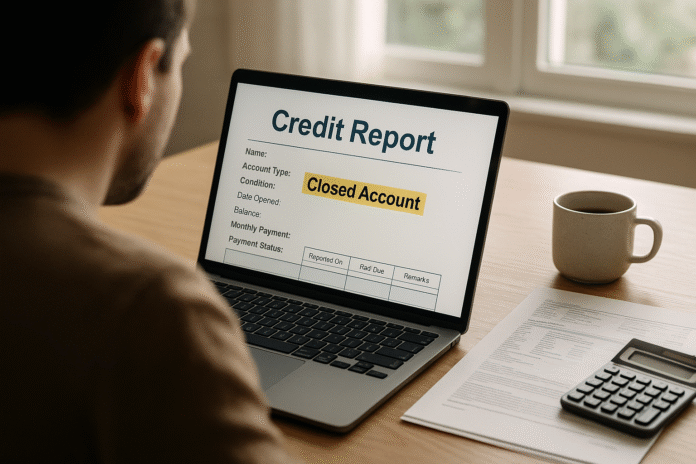
Closing an account is a big decision—especially when you care about your credit. This guide explains, in plain language, what happens on your credit reports when you close a credit card or pay off a loan, how long closed accounts remain, and the real-world score effects people see. It’s written for consumers, homebuyers, and anyone managing multiple accounts and wondering whether shutting one down will help or hurt. Quick note: this article shares general education, not personalized legal or financial advice.
Short answer: no—closing an account does not remove it from your credit reports. In the U.S., closed accounts generally remain for 7 years if they contain negative information and up to 10 years if they’re in good standing. You can only remove a closed account early if it’s inaccurate, incomplete, or outdated, and you succeed with a dispute.
1. Closure ≠ Removal: How Long a Closed Account Stays on Your Reports
Closing an account does not erase its history. A closed account that’s paid as agreed typically remains on your reports for up to 10 years, while a closed account with late payments, charge-offs, or collections usually remains for 7 years from the date of the first delinquency. Those timelines exist because lenders want a complete picture of how you’ve handled credit over time—good and bad. Practically, that means the “closed” line item still appears when a lender pulls your file. It can continue to help your scores (if positive) or hurt them (if negative) until it finally ages off. The presence of the word “closed” simply signals the account isn’t open for new transactions; it doesn’t trigger deletion. If you see a closed account you don’t recognize, you’ll need to dispute it; otherwise, expect it to remain for its standard reporting period.
1.1 Why It Matters
A common myth is that closing a credit card makes it “disappear.” Believing that myth leads people to close accounts to “clean up” their file, only to watch the entry persist for years. Understanding persistence helps you plan: keep positive accounts open if the fee is fair; if you must close, know the history will remain visible and may still contribute to your scores.
1.2 Numbers & Guardrails
- Positive/paid-as-agreed closed accounts: typically remain up to 10 years.
- Negative entries (late payments, charge-offs, collections): usually 7 years.
- Bankruptcy: 7–10 years, depending on type.
- When they drop: removal is automatic once timelines expire—no action needed.
Mini-checklist
- Confirm the status (paid as agreed vs. negative).
- Note the expected fall-off date (often shown on bureau reports).
- Don’t pay “deletion” services for accurate, timely information—they can’t shorten legal retention periods.
Bottom line: Closure changes the status of the account, not its visibility. Expect it to remain for the standard 7–10 year window, depending on whether it was positive or negative.
2. The Utilization Hit: Why Closing a Card Can Lower Your Score
Closing a revolving account (credit card, line of credit) can raise your credit utilization ratio because your total available credit shrinks. Utilization—your balances divided by your limits—is a major scoring factor. Even if you don’t carry big balances, closing a card can nudge your utilization into a higher bracket, which can cost points. This is why people often see a dip after shutting a card, even one they rarely use. The utilization effect is immediate, while benefits such as a simpler wallet or lower fees are longer-term. If you plan a major loan (mortgage, auto), it’s usually safer to delay closure until after funding to avoid disrupting your ratios.
2.1 Quick Example
- Before closure: total limits $20,000, balances $2,000 → utilization 10%.
- Close a card with a $5,000 limit; new total limit $15,000.
- Utilization becomes $2,000 / $15,000 = 13.3%.
- That looks small, but moving from ~10% toward >10–20% can shave points—especially if any single card creeps above 30%.
2.2 Practical Tips
- Pay balances below 10% of limits before closing.
- Ask for a credit line increase on another card (if appropriate) to offset lost limit.
- Avoid closing your highest-limit card unless the fees are untenable.
- Stagger closures if you must close multiple cards—don’t do them all at once.
- For store cards with low limits, the utilization impact may be minor; weigh that against fees or risk.
Bottom line: Closing revolving accounts reduces available credit and can increase utilization—often the biggest short-term score impact of closing a card.
3. Age of Credit History: What Really Happens When You Close an Account
A closed account can still count toward your length of credit history for a long time. Many scoring models consider the age of both open and closed accounts while they remain on your reports. That means closing an old card doesn’t instantly shorten your length metrics. However, when that closed account eventually falls off (often up to 10 years later if positive), your average age can drop—sometimes noticeably. VantageScore and FICO may weigh closed accounts differently, but the big idea remains: your oldest tradelines help anchor your profile’s age, and losing them (now or later) can matter.
3.1 Why It Matters
People sometimes close their oldest card to simplify life or avoid fees. That can be costly later, when that card ages off and your file loses historical depth. If that old card has a fee, ask about a downgrade/product change to a no-fee version to preserve age without the cost.
3.2 Guardrails & Nuance
- Closed positive accounts may keep contributing to age until they drop off.
- Closed negative accounts fall earlier (typically 7 years) and won’t help your age thereafter.
- Authorized user history may be removed if you’re taken off the account (more in Section 8).
- Installment loans paid off can slightly reduce “age of open accounts,” but help payment history.
Mini-checklist
- Identify your oldest account. If it has a fee, explore downgrades.
- Avoid closing legacy cards before major loans.
- Expect a later age impact when a beloved old card finally falls off.
Bottom line: Closing a card doesn’t wipe out your history today, but it can reshape your average age in the future when that line eventually leaves your file.
4. What Actually Gets an Entry Removed: Inaccuracy, Fraud, or Obsolescence
If you want a closed account gone before its natural drop-off, you need a valid reason under the Fair Credit Reporting Act (FCRA): the information must be inaccurate, incomplete, or outdated. “I just don’t want it showing” isn’t grounds for deletion. If the balance, dates, payment history, or ownership are wrong—or if the entry is older than allowed—you can dispute it with the credit bureaus and the furnisher (the company that reported it). The bureaus typically have 30 days to investigate and must correct or delete entries they can’t verify. For identity theft, you’ll also want to file an FTC report and consider a fraud alert or credit freeze.
4.1 How to Dispute (Step-by-Step)
- Pull all three reports free weekly at AnnualCreditReport.com and cross-check details.
- Gather evidence: statements, payoff letters, correspondence, police/FTC reports.
- File disputes with Experian, Equifax, and TransUnion (online or mail) and with the furnisher.
- Be precise: identify the account, the exact error, and the correction you seek.
- Track responses; if unresolved, add a statement of dispute and escalate (CFPB complaint or legal help).
4.2 Common Mistakes
- Disputing accurate information—you’ll waste time and may hurt credibility.
- Using generic “dispute letters” without evidence.
- Ignoring the furnisher; resolve upstream when the data source is wrong.
- Paying for “credit repair” that promises deletions of accurate, timely info—those claims are red flags.
Bottom line: Outside of natural aging, only errors or unverifiable data come off early. Document, dispute precisely, and follow through.
5. When Closing Makes Sense—and How to Do It Safely
Sometimes closing is the smart move: high annual fees you can’t justify, a card you never use that tempts overspending, a product that doesn’t fit, or a line you opened solely for a promo. Closing can also reduce fraud risk if you can’t monitor accounts. The key is to close strategically so you don’t take an avoidable score hit. Work a plan: reduce utilization first, time the closure away from major loans, and consider product changes that preserve age and limit while eliminating fees. If you must close, do it cleanly and get the paper trail.
5.1 Smart Closure Checklist
- Pay down balances (aim <10% utilization overall and per-card).
- Redeem rewards; many issuers forfeit them at closure.
- Downgrade to a no-fee product if available to preserve history and limit.
- Update autopays and recurring charges to avoid missed payments post-closure.
- Request a closure letter (or secure message) confirming “closed at consumer’s request.”
- Monitor reports for correct status and zero balance.
5.2 Timing Tips
- Avoid closures 90–120 days before applying for a mortgage/auto loan.
- If you must close multiple cards, space them by a few months.
- Consider closing a newer, low-limit card first; keep old/high-limit cards when possible.
Bottom line: There are good reasons to close. Just sequence your moves and keep documentation so the closure achieves your goals with minimal collateral damage.
6. Credit Cards vs. Loans: Different After-Effects on Your File
Closing revolving credit and closing installment loans behave differently. Paying off an auto loan, student loan, or personal loan typically closes that account automatically. That’s normal and expected—and usually positive because it caps a history of on-time payments. It can, however, slightly reduce your credit mix and the number of open accounts, which might move your score a bit. But unlike cards, closed loans don’t affect utilization, because utilization is primarily a revolving-credit concept. With cards, by contrast, a closure instantly reduces your total limit and can push utilization up even if you pay on time.
6.1 Practical Differences
- Installment payoff: helpful for cash flow; score impact modest, often neutral-to-positive.
- Card closure: can harm scores via utilization; benefit is lower fees or less temptation.
- Refinancing: closes an old loan and opens a new one—expect a hard inquiry and a younger average age.
6.2 Do/Don’t
- Do celebrate installment payoffs; keep records and ensure a $0 balance reports.
- Don’t chase a “boost” by closing cards; focus on paydowns, not closures.
- Do keep at least one or two major bankcards active to maintain mix and ongoing positive data.
Bottom line: Installment closures are normal and usually fine; card closures need extra planning because they can raise utilization and nudge scores down.
7. If a Closed Account Was Delinquent, Charged Off, or Sent to Collections
A closed account can be marked “paid as agreed” or closed in bad standing (late, charge-off, or collection). Bad-standing closures typically remain 7 years from the original delinquency that led to the negative status. Paying a collection doesn’t erase it from your reports (unless it’s medical under $500 or otherwise removed by policy); it changes the status to “paid,” which some lenders—and certain score versions—treat more favorably. As of now, a federal court has vacated the CFPB’s medical-debt rule that would have removed medical bills from credit reports nationwide, but the credit bureaus’ earlier voluntary changes still matter: paid medical collections and most medical collections under $500 had already been removed industrywide. Non-medical collections still generally remain for the standard 7 years.
7.1 What You Can Do
- Validate the debt; insist on accuracy in amount and ownership.
- Negotiate pay-in-full or settlement if appropriate; get terms in writing.
- Don’t rely on “pay-for-delete”—many furnishers won’t agree, and policies vary.
- For medical debts, confirm whether they fall under the industry’s sub-$500 removal or other policy.
- Track the obsolescence date so the item drops on time; dispute if it doesn’t.
7.2 Guardrails
- A charge-off is still collectible in many states until the statute of limitations runs; paying can reset that clock in some jurisdictions—get legal advice if needed.
- Re-aged accounts (where a collector resets delinquency dates improperly) should be disputed promptly.
Bottom line: Negative closed accounts follow the 7-year rule in most cases. You can improve how they’re viewed by paying or settling, but only errors or outdated items come off early.
8. Special Cases: Authorized Users, Business Cards, Joint Accounts, and Student Loans
Not all closed accounts operate the same way. If you’re an authorized user (AU) on someone else’s card, asking to be removed can lead that tradeline to drop from your reports more quickly (often as soon as the issuer updates the bureaus). That can help if the AU account is hurting you (e.g., high utilization or late payments), and it won’t harm the primary accountholder’s history. Business cards may or may not report to your personal credit, depending on the issuer and whether the account is delinquent; some small-business cards only report to personal credit if you default. Joint accounts (less common with modern cards) make both people equally responsible; closing one doesn’t absolve either of liability for existing balances. Student loans often split into multiple tradelines; consolidation or refinancing closes the old ones and creates new ones, with the usual effects on average age and inquiries.
8.1 What to Know by Type
- Authorized user: Removal can quickly take the AU account off your file; consider this if it’s dragging your scores.
- Business cards: Read terms—many major issuers report only to business bureaus unless delinquent.
- Joint accounts: Closing requires $0 balance and issuer approval; both parties remain responsible until then.
- Student loans: Consolidation closes old loans; check that old lines report paid in full and reflect accurate dates.
8.2 Quick Actions
- If an AU account is hurting you, ask the primary to remove you; confirm the change appears on your reports.
- For business credit, track both business and personal bureaus so surprises don’t appear during lending.
- With joint accounts, document the closure and ensure statements show zero liability going forward.
Bottom line: Account type and your role (primary, joint, AU) shape how and when a closed line appears—or disappears—on your personal reports.
9. A Smart, Timing-Based Action Plan Before You Close Anything
Before you close an account, build a plan that respects both your goals and the way scoring works. Start by pulling your three reports (free weekly) and mapping your utilization, age of accounts, and any negatives. Decide what you’re optimizing for: fee savings, simplicity, mortgage readiness, or fraud reduction. Sequence actions—pay down balances first, then consider a product change instead of closure, and only then close if the benefits outweigh the score risk. If a major loan is on the horizon, prioritize stability over simplification; lenders love boring, predictable files.
9.1 Mini Roadmap (30–60 Days)
- Day 1–7: Pull Equifax, Experian, TransUnion at AnnualCreditReport.com; list each card’s balance and limit; compute overall and per-card utilization.
- Day 8–14: Pay down cards to <10% utilization; consider one responsible credit line increase to offset a planned closure.
- Day 15–21: Ask issuers about downgrades to no-fee products; move recurring charges off any card you’ll close.
- Day 22–30: Close only if you still need to—starting with newest/low-limit cards. Get written confirmation.
- Day 31–60: Verify bureau updates: $0 balance, closed at consumer’s request, and accurate dates. Dispute errors promptly.
9.2 Timing Around Major Loans
- Home/auto loan within 3 months: avoid nonessential changes; focus on on-time payments and low utilization.
- 6–12 months out: you can tidy your wallet, but stagger changes and keep utilization low.
- No big loans coming: optimize around fees and simplicity—just preserve your oldest/high-limit anchors if possible.
Bottom line: A thoughtful sequence—check, pay down, downgrade, then (maybe) close—protects scores while meeting your money goals.
FAQs
1) Does closing an account remove it from reports?
No. Closing an account changes its status to “closed,” but the tradeline remains. Positive closed accounts commonly stay up to 10 years, while negative ones typically remain 7 years. Only inaccurate, incomplete, or unverifiable entries can be removed early through disputes. If a site promises to delete accurate information for a fee, be skeptical.
2) How long will a closed, paid-as-agreed account remain?
Up to 10 years is typical. Many consumers want to keep a long, positive account visible because it showcases responsible use and on-time payments. When it finally ages off, you might see a small shift in your average age of accounts—one reason to avoid closing your oldest card if you can product-change to a no-fee version instead.
3) If I close my oldest card, will my score crash?
Not instantly—but it can dip. You may lose available credit (raising utilization) and, later on, when the tradeline falls off, your average age can decline. You can mitigate this by paying balances down first, keeping other high-limit cards open, and downgrading instead of closing if a fee is the only problem.
4) What about installment loans I’ve paid off?
Those accounts close when you finish paying. They usually remain on your reports (often up to 10 years if positive), documenting successful repayment. You might see a small movement from having fewer open accounts or a changed credit mix, but there’s no utilization impact because utilization is mainly a revolving-credit measure.
5) Do closed accounts still count toward the length of my credit history?
Often yes—while they remain on your reports, many scoring models consider closed accounts in age calculations. That’s good news if the closed line is old and positive. The effect can change when the account finally falls off years later, which may shorten your average age if your remaining lines are newer.
6) Can I remove a closed, negative account by paying it?
Paying can improve how lenders view the account and how some score versions treat it, but it doesn’t guarantee deletion. The tradeline typically remains for 7 years. For medical collections, industry changes removed many paid items and sub-$500 debts, but nationwide regulatory rules that would have banned medical-debt reporting were vacated by a court in 2025; check your report specifics.
7) Is “pay for delete” legit?
Some collectors agree to delete after full payment, but many do not, and policies vary widely. There’s no requirement that accurate, timely collections be deleted upon payment. If you try, negotiate in writing before paying. Never rely on verbal promises and always prioritize accuracy and validation before negotiating.
8) Will closing unused cards help me qualify for a mortgage?
Usually not. Underwriters care about payment history, debt-to-income ratio, and your current credit profile. Closing cards can raise utilization and reduce available credit, potentially lowering your scores. If you plan to apply soon, focus on paying balances down, keeping accounts stable, and avoiding new hard inquiries.
9) I’m an authorized user on a problematic card—what’s my best move?
Ask the primary cardholder to remove you. Once you’re removed and the issuer updates the bureaus, that AU tradeline may disappear from your reports, which can help if high utilization or late payments on that card were hurting you. Verify the change across all three bureaus within a month or two.
10) How do I get a closed account corrected or removed if it’s wrong?
Dispute with all three bureaus and with the furnisher. Provide documents showing the error (e.g., payoff letter, corrected dates). Bureaus generally have 30 days to investigate. If they can’t verify, they must correct or delete. If they verify incorrectly, escalate with a CFPB complaint or seek legal help.
11) Where can I monitor my reports without paying?
Use AnnualCreditReport.com to get free weekly reports from each bureau. Reviewing regularly lets you verify closure status, balances, and fall-off dates—and catch fraud early. Remember your scores aren’t included with the free reports; many banks and card issuers provide scores at no cost.
12) Is there any reason to close a well-aged, no-fee card?
Generally, no. A no-fee card can sit open, contributing to available credit and length of history. If there are security concerns, you can lock the card, minimize limits, or keep it sock-drawered with a small recurring charge and autopay. Closing is more compelling when fees exceed the value you get or when an account truly creates risk.
Conclusion
Closing an account is a status change, not a magic eraser. The account remains on your credit reports for years—typically 10 if it was paid as agreed and 7 if it contained negative information. That means the smarter strategy isn’t to close accounts hoping they’ll vanish, but to curate your profile: pay balances down to keep utilization low, preserve aging lines (especially old, no-fee cards), and close only when the benefits outweigh the scoring tradeoffs. When you do close, plan the timing, secure written confirmation, and monitor your reports to ensure they show $0 balance and closed at consumer’s request. If something’s wrong, dispute with the bureaus and the furnisher using clear evidence. Finally, remember that major policy changes—like those around medical debt—can shift over time; staying current and checking your reports weekly (free) is the best defense.
Copy-ready next step: Pull your three free reports at AnnualCreditReport.com, calculate your utilization, and decide whether to downgrade or close—in that order.
References
- How long does negative information remain on my credit report? Consumer Financial Protection Bureau (CFPB). Updated June 6, 2023. https://www.consumerfinance.gov/ask-cfpb/how-long-does-negative-information-remain-on-my-credit-report-en-323/
- When Are Closed Accounts Deleted? Experian. May 18, 2023. https://www.experian.com/blogs/ask-experian/when-are-closed-accounts-deleted/
- Does Closing a Credit Card Hurt Your Credit? Experian. September 9, 2024. https://www.experian.com/blogs/ask-experian/will-closing-a-credit-card-hurt-your-credit/
- How Long Does Information Stay on Credit Report? Equifax. https://www.equifax.com/personal/education/credit/report/articles/-/learn/how-long-does-information-stay-on-credit-report/
- Understanding Accounts That May Affect Your Credit Utilization Ratio. myFICO. June 24, 2024. https://www.myfico.com/credit-education/blog/accounts-credit-utilization-ratio
- More Scoring Myths: Closing Credit Cards. FICO Blog. July 5, 2011 (evergreen guidance). https://www.fico.com/blogs/more-scoring-myths-closing-credit-cards
- How Does Length of Credit History Affect Credit Score? Experian. August 28, 2025. https://www.experian.com/blogs/ask-experian/length-of-credit-history-affect-credit-scores/
- You now have permanent access to free weekly credit reports. Federal Trade Commission (FTC). January 4, 2024. https://consumer.ftc.gov/consumer-alerts/2023/10/you-now-have-permanent-access-free-weekly-credit-reports
- Equifax, Experian and TransUnion Remove Medical Collections Debt Under $500 from U.S. Credit Reports. Experian plc Press Release. April 11, 2023. https://www.experianplc.com/newsroom/press-releases/2023/equifax-experian-and-transunion-remove-medical-collections-debt-under-500-from-us-credit-reports
- CFPB Finalizes Rule to Remove Medical Bills from Credit Reports. Consumer Financial Protection Bureau. January 7, 2025. https://www.consumerfinance.gov/about-us/newsroom/cfpb-finalizes-rule-to-remove-medical-bills-from-credit-reports/
- Texas federal judge vacates CFPB’s medical debt rule. ABA Banking Journal. August 1, 2025. https://bankingjournal.aba.com/2025/08/texas-federal-judge-vacates-cfpbs-medical-debt-rule/
- An Overview of Medical Debt: Collection, Credit Reporting, and Consumer Financial Protection (IF12169). Congressional Research Service. August 29, 2025. https://www.congress.gov/crs-product/IF12169