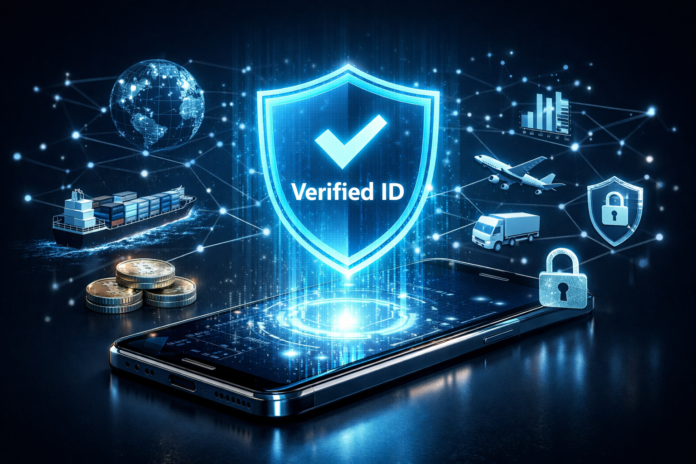
The landscape of global trade is undergoing its most significant shift since the invention of the shipping container. As of March 2026, the catalyst for this transformation isn’t a new physical infrastructure, but a digital one: the Digital Identity Wallet (DIW).
A Digital Identity Wallet is a secure, user-centric application—typically residing on a mobile device—that allows individuals and businesses to store, manage, and share “Verifiable Credentials” (VCs). Unlike traditional wallets that hold physical plastic cards, these digital counterparts hold encrypted, cryptographically signed data that proves who you are, what you own, or what you are authorized to do, without requiring a central authority to vouch for you in real-time.
Key Takeaways
- User Sovereignty: Users own their data; no more “Login with Google/Facebook” tracking.
- Global Interoperability: Standards like W3C’s Verifiable Credentials allow a wallet issued in Berlin to be verified in Tokyo instantly.
- Frictionless Compliance: Automated KYC (Know Your Customer) and AML (Anti-Money Laundering) checks reduce onboarding time from days to seconds.
- Privacy-by-Design: Techniques like Zero-Knowledge Proofs (ZKP) allow you to prove you are over 21 without revealing your actual birth date.
Who This Guide Is For
This deep-dive is designed for FinTech executives, e-commerce merchants, policy makers, and compliance officers who need to understand how the convergence of identity and payments is redefining the 2026 global economy.
1. The Foundation of Modern Trust: Understanding SSI
At the heart of Digital Identity Wallets lies Self-Sovereign Identity (SSI). To understand global commerce in 2026, one must understand that we have moved past the “federated” model (where a third party manages your identity) to a “decentralized” model.
The SSI model relies on the “Trust Triangle,” which consists of three parties:
- The Issuer: An authority (like a government, university, or bank) that signs a credential.
- The Holder: You, the user, who stores the credential in your Digital Identity Wallet.
- The Verifier: A merchant, employer, or border agent who needs to verify the credential.
In this ecosystem, the Blockchain or Distributed Ledger Technology (DLT) often acts as a “Verifiable Data Registry.” It doesn’t store your personal data (which would be a GDPR nightmare); instead, it stores public keys and revocation lists. This allows the Verifier to check if the credential is authentic and hasn’t been tampered with, all without ever talking directly to the Issuer.
2. Regulatory Catalysts: eIDAS 2.0 and the Global Domino Effect
As of March 2026, the European Union’s eIDAS 2.0 regulation has set the global gold standard. It mandates that every EU member state provide a Digital Identity Wallet to its citizens. This isn’t just a “nice to have”; it’s a legal requirement for large platforms (like Amazon and Booking.com) to accept these wallets for authentication.
The Impact on Global Markets
- The United States: While a federal wallet doesn’t exist, various states (led by California and New York) have adopted ISO 18013-5 standards for Mobile Driver’s Licenses (mDL), which are now compatible with most commercial DIWs.
- APAC Region: Singapore’s Singpass and Australia’s Digital ID framework have bridged the gap, allowing for mutual recognition of professional certifications and business identities.
- Emerging Markets: In Africa and Latin America, DIWs are bypassing traditional banking entirely, allowing “unbanked” individuals to build a credit history through verifiable trade data.
3. How Digital Identity Wallets Power Global Trade
The “Global Commerce” aspect of these wallets goes far beyond just logging into a website. It is about the tokenization of trust.
Frictionless KYC and AML
In the old world, a business opening a bank account in a foreign country required weeks of paperwork, notarized copies, and manual verification.
The 2026 Reality: A business owner presents a “Verifiable Business Identity” (vLEI) from their wallet. The bank’s system automatically verifies the business’s registration, its beneficial owners, and its tax status in milliseconds. This reduces the cost of “Customer Due Diligence” by an estimated 80%.
Smart Contracts and Conditional Payments
Digital Identity Wallets are now frequently integrated with Central Bank Digital Currencies (CBDCs) or stablecoins.
Example: A shipment of electronics leaves a port in Vietnam. The Digital Identity of the “IoT sensor” on the container confirms the temperature remained stable. Once the “Digital Identity” of the receiving port confirms arrival, the “Smart Contract” triggers an instant payment from the buyer’s wallet to the seller’s wallet.
4. Technical Standards: The “Nuts and Bolts”
For a wallet to be truly “global,” it must speak a universal language. As of 2026, the industry has consolidated around three core technical pillars:
- DIDs (Decentralized Identifiers): A new type of identifier that enables verifiable, decentralized digital identity. Unlike a URL or email, a DID is owned by the user.
- Verifiable Credentials (VCs): The data format for the “claims” inside the wallet.
- OID4VC (OpenID for Verifiable Credentials): The protocol that allows your wallet to communicate with websites and terminals.
The Role of ISO/IEC 18013-5
This is the specific standard for mobile driving licenses. It is crucial because it allows for “offline verification.” You can tap your phone against a merchant’s terminal in a basement with no internet, and they can still verify your ID via NFC or QR code.
5. Security and Privacy: The Human-First Approach
The primary fear regarding digital IDs is the “Big Brother” scenario—a centralized database that can track your every move. Digital Identity Wallets are designed to prevent exactly this.
Zero-Knowledge Proofs (ZKP)
ZKP is the “magic” of modern cryptography. It allows a user to prove a statement is true without revealing the data that proves it.
- Application: A customer wants to buy a luxury item on credit. Instead of sending their full bank statement (revealing every coffee and grocery purchase), the wallet sends a ZKP proving: “This person has a balance greater than $10,000 and a credit score over 700.” The merchant gets the “Yes,” but never sees the private data.
Biometric Binding
Modern wallets use Level 4 Security (L4). This means the private keys are stored in the smartphone’s “Secure Enclave” (the same place Apple/Android store face/fingerprint data). The wallet cannot be opened or a transaction signed without the user’s live biometric scan, making it significantly more secure than a physical credit card.
6. Common Mistakes in DIW Implementation
For businesses looking to integrate with the Digital Identity ecosystem, avoid these 2026 “pitfalls”:
- Building a “Walled Garden”: If your wallet only works within your own app, it’s not a DIW; it’s just a digital loyalty card. You must support open standards (W3C/OID4VC).
- Over-collecting Data: Under GDPR and eIDAS 2.0, collecting more data than is strictly necessary for a transaction is a liability. Use “Selective Disclosure.”
- Ignoring Offline Use Cases: Global commerce often happens in places with spotty connectivity (warehouses, ships). Your verification flow must support offline NFC/Bluetooth handshakes.
- Neglecting “Identity Recovery”: If a user loses their phone, how do they recover their identity without a central “reset password” button? Implementing “Social Recovery” or “Cloud Backup with User-Controlled Keys” is essential.
7. Use Case Deep-Dive: The “Travel and Hospitality” Sector
Travel is the ultimate test of global commerce. In 2026, the “Seamless Travel” initiative uses DIWs to eliminate the “Airport Queue.”
- Booking: You share a “Verifiable Passport” credential with the airline.
- Security: Your face is your boarding pass, linked to the DID in your wallet.
- Hotel Check-in: As you walk through the lobby, your wallet shares your identity via BLE (Bluetooth Low Energy), and your digital room key is instantly delivered to your phone. No front desk, no physical ID.
8. The Economic Impact: Reducing the “Identity Tax”
Economists refer to the friction caused by identity verification as the “Identity Tax.” In global commerce, this “tax” accounts for trillions in lost GDP due to abandoned carts, fraudulent transactions, and administrative overhead.
| Feature | Legacy Identity (2020) | DIW Identity (2026) |
| Verification Speed | 3–5 Business Days | < 2 Seconds |
| Fraud Rate | High (Synthetic IDs) | Near Zero (Cryptographic) |
| User Privacy | Low (Data Silos) | High (ZKP/SSI) |
| Cost per Onboarding | $50 – $200 | $0.50 – $2.00 |
9. Challenges to Universal Adoption
Despite the progress, the road to a fully “Wallet-Ready” world has hurdles:
- Technical Debt: Many legacy banking systems (COBOL-based) struggle to process decentralized identifiers.
- Regulatory Fragmentation: While eIDAS 2.0 is a leader, other nations are still debating “Centralized” vs “Decentralized” models.
- Digital Divide: How do we ensure that those without high-end smartphones are not excluded from global commerce? (Answer: Smart cards with embedded chips that mirror DIW functionality).
10. The Convergence of Identity and Value
As we move toward the end of 2026, the distinction between a “Payment Wallet” (like Apple Pay) and an “Identity Wallet” is blurring. We are entering the era of the Super-Wallet.
In this era, a single transaction involves the simultaneous exchange of:
- Identity (Who am I?)
- Authorization (Am I allowed to buy this?)
- Value (The payment itself)
- Receipt (A Verifiable Credential of purchase)
This “Atomic Transaction” ensures that the buyer, the seller, and the regulator are all satisfied in a single, encrypted pulse of data.
Conclusion
Digital Identity Wallets are no longer a “future tech” concept; they are the operational reality of global commerce in 2026. By shifting the control of personal and professional data from centralized siloes back to the individual, we are creating a more secure, efficient, and inclusive global economy.
For businesses, the mandate is clear: Adopt or be excluded. The ability to accept a Verifiable Credential will soon be as fundamental as the ability to accept a credit card. Merchants who embrace DIWs will enjoy lower fraud rates, reduced compliance costs, and a significantly improved customer experience.
Next Steps for Your Organization
- Audit Your Onboarding: Identify where “identity friction” causes user drop-off in your current funnel.
- Evaluate Standards: Ensure your tech stack is compatible with W3C Verifiable Credentials and OpenID4VC.
- Pilot a Use Case: Start with a low-risk implementation, such as verifiable employee badges or loyalty programs, before moving to high-value KYC.
- Monitor Regulation: Keep a close watch on the “eIDAS 2.0 Implementation Acts” to ensure compliance with international data sharing.
FAQs
What happens if I lose my phone with my Digital Identity Wallet?
As of 2026, most DIWs use “Social Recovery” or “Encrypted Cloud Backups.” You can authorize a set of trusted friends or a secondary device to help you regenerate your wallet on a new phone. Because the data is stored as Verifiable Credentials, the “Issuer” (like the DMV) can also re-issue the credential to your new DID.
Is a Digital Identity Wallet the same as a Crypto Wallet?
Not exactly. While both use cryptography and sometimes blockchain, a Crypto Wallet stores “Keys to Assets” (like Bitcoin), whereas a Digital Identity Wallet stores “Keys to Data” (like your ID). However, many modern wallets are “Hybrid,” capable of holding both.
Does a DIW track my purchases?
No. Unlike a credit card company or a “Big Tech” login, a true SSI-based Digital Identity Wallet does not report back to a central server every time you use it. The verification happens locally between your phone and the merchant’s terminal.
Can a government turn off my Digital Identity Wallet?
In a truly decentralized SSI model, the government can revoke a specific credential (like your driver’s license), but they cannot “turn off” the wallet itself or access the other credentials inside it (like your university degree or private memberships).
Do I need internet access to use my Digital ID?
Many credentials follow the ISO 18013-5 standard, which allows for offline verification via NFC or QR codes. You can prove your identity to a police officer or a merchant even in “Airplane Mode.”
References
- European Commission. (2024). eIDAS Regulation – European Digital Identity. [Official EU Documentation on eIDAS 2.0].
- W3C. (2022). Verifiable Credentials Data Model v2.0. [World Wide Web Consortium Standards].
- DIF (Decentralized Identity Foundation). (2025). Interoperability Profiles for DIWs. [Industry Technical Whitepaper].
- ISO/IEC. (2021). ISO/IEC 18013-5:2021 – Personal identification — ISO-compliant driving licence — Part 5: Mobile driving licence (mDL) application.
- Gartner. (2025). Top Strategic Technology Trends: Decentralized Identity. [Market Research Report].
- World Bank. (2024). Digital Identity for Development (ID4D) Global Report. [Academic/Development Study].
- OpenID Foundation. (2025). OpenID for Verifiable Credentials (OID4VC) Specification. [Technical Standards].
- FATF (Financial Action Task Force). (2023). Guidance on Digital Identity for AML/CFT. [Regulatory Framework].
- Journal of Cybersecurity. (2025). Privacy Implications of Zero-Knowledge Proofs in Digital Wallets. [Academic Peer-Reviewed Paper].
- GLEIF (Global Legal Entity Identifier Foundation). (2026). The vLEI: A Digital Identity for Businesses Worldwide. [Official Organizational Site].