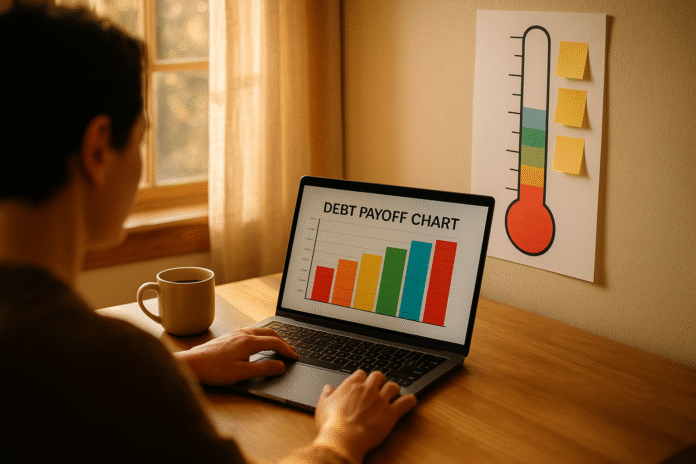
If you’ve ever felt like your balances are a mountain that never shrinks, the right debt payoff tracker can turn that view into a time-lapse of real progress. This guide is for anyone who wants to make their debt journey visible—so motivation stays high, decisions stay clear, and victories feel tangible. You’ll find 12 visual methods—charts, dashboards, apps, and rituals—that help you watch balances drop and morale rise. Quick definition: a debt payoff tracker is any visual system (spreadsheet, app, whiteboard, or printout) that shows balances, timelines, and milestones so you can see momentum at a glance. Research shows that recording and publicly sharing progress boosts goal attainment, so visuals aren’t fluff; they work. PubMed
Note: This article is educational and not financial advice. Consider consulting a qualified professional for guidance tailored to your situation.
1. The “Debt Mountain” Area Chart (Total Balance Melting Over Time)
The simplest way to prove to yourself that the mountain is melting is to plot your total debt balance as a filled area chart over time. Start by summing all balances on the first of each month, then record the same number monthly. The first sentence of the method’s promise is straightforward: this chart shows whether you’re ahead or behind. The second is why it matters: the slope of the curve tells you momentum. As the line trends down and the shaded area shrinks, you get a visceral sense that the mountain is melting. Research on progress monitoring is clear—visually recording progress increases goal achievement, especially when you write it down or share it.
- How to build it (Sheets/Excel):
- Create two columns: Date and Total Balance. Enter month-start dates and totals.
- Insert → Chart → Area chart. Add a faint target line for your debt-free date.
- Add a 3-point moving average series to smooth month-to-month noise.
- Shade major milestones (75%/50%/25%) with vertical reference lines.
- Optional: annotate months with large extra payments.
Why it works
Seeing the shaded area recede taps into the “small wins” effect—evidence of progress fuels more progress. When you can literally point to a smaller mountain, the next payment feels purposeful, not invisible.
Mini case
If your starting balance is $38,400 and you budget $1,050/mo with 18% blended APR, the area chart will likely flatten early (interest heavy) and steepen later as more goes to principal (that’s how amortization curves behave). Expect the slope to improve as balances fall.
Close by reaffirming: update monthly, not daily—the goal is to see trend, not chase noise.
2. Snowball Timeline Dashboard (Fast Wins, Big Motivation)
If you need early momentum, build a dashboard that shows which account you’ll close next and when. The snowball approach targets the smallest balance first while making minimums elsewhere. The immediate payoff is emotional clarity: you’ll see “Account A closes in March,” then “Account B closes in July,” and so on—a drumbeat of wins. Studies suggest that closing smaller accounts first can be extra motivating, even if it’s not the mathematically optimal path. That motivation can sustain you through a long journey.
- Tools/Examples
- Undebt.it creates a month-by-month plan with timeline graphs and a debt-free date. No signup is required to try the calculator; you can save if you want an account.
- Vertex42 Debt Reduction Calculator (Excel/Sheets) supports snowball and variants; it outputs payoff order and charts.
2.1 How to read the dashboard
Look for:
- Next-closure date (circle it): your immediate milestone.
- Snowball amount growth: the extra dollars that roll to the next debt once a balance is gone.
- Interest saved versus minimums: the quiet compounding of discipline.
2.2 Common mistakes
- Switching methods too often; pick a plan and stick with it for a quarter.
- Ignoring cash buffer; one emergency can undo momentum.
Synthesis: early “wins” aren’t vanity—they’re fuel. If motivation is your bottleneck, snowball visuals are your friend.
3. Avalanche Interest-Saved Dashboard (Maximum Efficiency, Minimal Interest)
If your priority is saving the most interest, build an avalanche tracker that ranks debts by APR and shows cumulative interest avoided versus making only minimums. This method targets the highest-rate debt first; it’s mathematically optimal for minimizing cost and often time. In your chart, add a running tally of interest saved and a “what-if” baseline of minimum payments. Seeing that gap widen is a strong motivator for analytical brains.
- How to build it
- Columns: Debt, Balance, APR, Min Payment, Extra, sorted by APR.
- Use an amortization schedule per account to calculate monthly interest; sum across debts for the baseline vs. your plan.
- Chart the cumulative interest saved as a line above the baseline.
3.1 Numbers & guardrails (as of September 2025)
Avalanche often saves hundreds to thousands in interest when APRs vary widely. But if your highest APR also has a large balance, visible wins are slower; combine avalanche math with snowball-style micro-milestones to keep spirits high.
3.2 Tools/Examples
- Any Sheets or Excel amortization template works; Vertex42 and Investopedia’s calculators are solid starting points.
Synthesis: if you love seeing cost savings quantified, avalanche visuals will keep you locked in.
4. Account Thermometers & Printable Trackers (Physical Proof on the Wall)
Some brains need ink, not pixels. A wall thermometer or grid tracker for each account gives you visible proof in your space. The first promise: you always know what “10 more squares” means. The second: physically coloring in progress is its own micro-reward. Meta-analyses show that recording progress—especially physically and/or publicly—improves goal attainment. Put the trackers where you’ll see them daily (fridge, hallway, closet door).
- Where to get templates
- Vertex42 offers printable payoff charts and editable PDFs that auto-fill goal amounts once you enter balances.
4.1 Mini-checklist
- One tracker per debt; add account nickname and APR.
- Mark 25/50/75% milestones; pre-choose small non-spend rewards.
- Snap a photo of each fill-in to create a “flipbook” of progress.
4.2 Region notes
No special tech needed—great for households where apps don’t fit or data links are limited.
Synthesis: ink the win. The act of shading a square can be the jolt that keeps you on plan.
5. Agile-Style Burndown Chart (Planned vs. Actual)
A burndown chart pits your planned total balance curve against your actual curve. The first two sentences do the work: if the actual line sits below the plan, you’re ahead; if it sits above, you’re behind. That clarity is comforting—you’ll know in week three if a month is drifting. Add scope changes (new debt, rate hikes) as clear annotations. It’s honest, and honesty protects morale by preventing unpleasant surprises late in the game.
- How to build it
- Plan line: project monthly balances assuming consistent payments (use amortization logic).
- Actual line: your real total balances by month.
- Add variance bands (±3%) to show normal noise versus real slippage.
5.1 Common mistakes
- Hiding new charges off-chart; show new debt as a vertical step—no shame, just facts.
- Updating too infrequently; monthly is fine, but a quick mid-month check helps.
5.2 Numbers & guardrails
Amortized loans naturally accelerate principal repayment later; don’t panic if early months feel “flat”—the geometry tends to steepen as interest shrinks. Investopedia
Synthesis: burndown puts reality and plan in one frame, making course-corrections obvious.
6. Calendar Heatmap for “Debt Actions” (Build the Habit)
Consistency beats intensity. A calendar heatmap shows streaks of daily debt actions: reconciling transactions, scheduling payments, logging no-spend days, or batch-cooking to free extra cash. The first sentence answers the sub-intent: color blocks make habits visible. The second: habits usually take weeks to months—median ~66 days in one study—so your goal is a streak, not perfection. Use darker shades for days you complete the planned action; gaps are signals, not failures.
- Habit ideas (choose one to start)
- Reconcile accounts every other day.
- Log one no-spend day per week.
- Move “found money” (refunds, bonuses) into an extra-payment jar.
- Batch-scan for monthly subscriptions to cancel.
6.1 Why it matters
A well-studied meta-analysis confirms that frequent progress monitoring helps people reach goals; making it public or physically recorded helps even more. Share your weekly streak in a group chat or on a family whiteboard if you’re comfortable.
6.2 Mini case
After 10 weeks, a three-times-weekly “debt action” habit (30+ blocks) usually aligns with steadier payoff curves—even if monthly dollars haven’t changed—because fewer late fees and impulse buys slip through.
Synthesis: the habit is the engine; the heatmap is your odometer.
7. Sinking Funds + “Age of Money” Gauge (Protect Your Progress)
Nothing kills morale like backsliding. Pair sinking funds (earmarked categories for predictable expenses) with an “Age of Money” gauge (how long your cash sits before being spent) so emergencies don’t force new debt. In YNAB’s system, Age of Money measures the average time between earning and spending; a higher number implies a thicker buffer. Visuals here are preventative: you’re tracking the shield that keeps your payoff line from zig-zagging.
- How to set it up
- Create categories for car repairs, medical deductibles, travel, gifts, etc.; auto-save monthly.
- Display Age of Money beside your payoff chart; aim for ~30 days as a first milestone (as YNAB examples often suggest).
- Celebrate crossing each 10-day increment with a small, free reward.
7.1 Tools/Notes (as of September 2025)
YNAB reports and blogs explain the concept; other apps mimic the buffer idea even if they don’t use the term. The point is the visual—show that your buffer is aging, not just your balances shrinking. YNAB
Synthesis: build the umbrella while you melt the mountain; visuals make “prevention” feel like progress.
8. Cash-Flow Waterfall (Where Each Dollar Goes Before Debt)
A cash-flow waterfall diagram shows income at the top and how it cascades into essentials, minimum payments, and extra debt dollars. The first two sentences answer the sub-intent: this makes tradeoffs visible and highlights the lever that matters—your extra payment. Draw the waterfall monthly; try to widen the “extra” bar by 5–10% each quarter via optimization (cancellations, negotiation, frugal sprints). Visualizing the funnel reduces decision fatigue.
- Build it quickly
- Blocks: Income → Fixed Needs → Variable Needs → Minimums → Extra to Debt → Savings Buffer.
- Add labels with amounts and % of income.
- Put last month and this month side-by-side to see gains.
8.1 Common pitfalls
- Hiding annual costs; pro-rate them (divide by 12) so the waterfall isn’t lying to you.
- Ignoring timing; align blocks to pay-cycle reality to prevent overdrafts.
8.2 Mini case
If your “extra” bar averages $250/mo, adding an extra $100/mo can knock months off your debt-free date—especially on high-APR cards (that’s how amortization math behaves). A simple calculator will quantify the effect. Investopedia
Synthesis: widen the “extra” bar and the mountain melts faster—now you can see it.
9. Net-Worth Line with Zero-Crossing Milestone (Big-Picture Motivation)
Debt is only half the story. A net-worth line (assets minus liabilities) with a bold zero-crossing milestone turns a series of small wins into a life-changing inflection point. The immediate answer: this keeps you motivated when a single large, low-interest loan (like a mortgage) makes the “total balance” chart feel slow. The broader point: momentum often shows up in net worth earlier than you expect as debt shrinks and cash buffers grow.
- How to set it up
- Update assets monthly (include reasonable, conservative values).
- Subtract total debts; plot the result with a horizontal zero line.
- Add milestone flags at −$10k, −$5k, $0, +$5k, etc.
9.1 Cautions
- Be conservative with volatile assets (crypto/stocks); the line should guide behavior, not whip moods.
- Don’t compare to others; your run-rate and risk are personal.
9.2 Why it helps
People respond strongly to small, visible wins; watching the line approach zero can be a surprisingly strong push to sustain payoff intensity.
Synthesis: when zero comes into view, motivation spikes—give yourself that view.
10. Purpose-Built Apps with Visuals (YNAB, Monarch, Tiller, Undebt.it)
If you prefer ready-made visuals, pick an app with charts that match your brain. As of September 2025, four options stand out for tracking and display (coverage varies by country and bank connectivity):
- YNAB: budgets with an “Age of Money” lens and goal tracking; helpful for buffers and cash-flow rhythm.
- Monarch Money: clean goals and debt tracking; a joint view for partners; tutorials and help docs on setting & tracking goals.
- Tiller Money: automated bank feeds into Google Sheets/Excel; you can build any chart you want, and the Marketplace listing confirms wide adoption and recent updates.
- Undebt.it: focused payoff planning with snowball/avalanche, month-by-month tables, and timeline graphs. Undebt.it
10.1 How to choose
- Do you want flexibility (Tiller/Sheets) or opinions (YNAB/Monarch)?
- Do you need shared visibility (Monarch) or payoff sequencing (Undebt.it)?
10.2 Region notes
US bank connectivity is strongest. Elsewhere, you can import CSV statements or track balances manually; the visuals still work, just with an extra step.
Synthesis: choose the tool that shows what your brain needs to see—clarity beats features.
11. Public Scoreboard & Accountability Loop (Share the Graph)
Make your progress social—a monthly screenshot in a private chat, or a shared Notion/Google Doc with one chart and three bullets. Meta-analysis shows that reporting progress publicly amplifies results; your future self will post the update if five friends are waiting. Keep it respectful and numbers-light if that’s more comfortable; even a green/red emoji on your plan-vs-actual line is enough.
- Simple monthly cadence
- Post your total-balance area chart and burndown snapshot.
- Add 3 bullets: one win, one lesson, one tweak for next month.
- Celebrate each closed account with a small group ritual (emoji flood, short voice note).
11.1 Why it works
Beyond accountability, the ritual builds a story arc; you’re not just paying bills—you’re starring in a series with episodes and season finales. Behavioral research on commitment and peer monitoring shows that social structures can boost follow-through and savings. J-PAL
Synthesis: quiet support, visible progress, better odds.
12. Milestones Map & Rewards (Gamify the Journey Without Overspending)
Finally, build a milestones map from 0% to 100% of your payoff goal, with rewards pre-planned at 25/50/75/100%. The short answer: this turns a long march into four sprints. The longer answer: small wins reliably fuel motivation, and debt research shows that early victories can help people stick with a plan. Keep rewards modest and aligned with your budget—experiences beat purchases when cash is tight.
- Design tips
- Use a single page with a big horizontal bar and four milestone flags.
- Under each flag, write the specific reward (e.g., “sunrise hike + fancy coffee”).
- Print it and put it next to your area chart or in your app’s notes.
12.1 Numbers & guardrails
Set rewards that cost ≤2–3% of the dollars you’ve retired since the last milestone. If you paid off $4,000 since 25%, keep the reward under $80–$120 and pay cash.
12.2 Mini case
Someone with $28,000 in starting debt might set rewards at $7k/$14k/$21k, with the final being a weekend trip budgeted in a sinking fund so it doesn’t delay the last payment.
Synthesis: planned celebration keeps the fire burning without relighting the debt.
FAQs
1) What’s the fastest way to see progress if my balances are large?
Use a burndown chart with a weekly update and an avalanche plan to target the costliest interest first. Add micro-milestones (every $500–$1,000 reduced) so you get visible wins along the way. If your highest-APR balance is huge, consider hybridizing: avalanche order, snowball-style celebration.
2) Is the debt snowball “wrong” because it can cost more interest?
It’s a tradeoff. Snowball’s early closures can boost motivation and adherence; if that keeps you on plan, it may beat a theoretically cheaper plan you abandon. Recognize the cost difference and mitigate it—e.g., add extra payments when possible. Kellogg Insight
3) How often should I update my charts?
Monthly is ideal for balance trends; weekly for habit streaks. Over-updating can create noise and decision fatigue. The goal is to see direction and take action, not micromanage every dollar daily. Evidence suggests frequent (but purposeful) monitoring supports goal attainment.
4) Which app is best for visual tracking?
It depends. YNAB for buffer/“Age of Money” insight, Monarch for shared goals and clean visuals, Tiller if you love spreadsheets and custom charts, Undebt.it for detailed payoff sequencing. Try trials and pick the one you’ll actually open.
5) How do I avoid backsliding while paying off debt?
Visually protect your buffer with sinking funds and an Age of Money gauge. Seeing that number rise (e.g., toward 30 days) signals resilience; you’re less likely to reach for credit after a surprise expense.
6) Can I build these visuals without linking my bank?
Yes. Many trackers work with manual entry or CSV imports. Vertex42 spreadsheets and Undebt.it calculators are great without live feeds; the key is consistent updates.
7) Does publicly sharing my progress actually help?
Often, yes. Meta-analysis suggests progress monitoring has stronger effects when results are reported or made public—a simple monthly post to trusted friends can move the needle.
8) How long until these routines feel automatic?
Habit formation varies widely. One study found a median ~66 days (range roughly 18–254), so plan on at least a couple of months of consistent “debt actions.” That’s why visual streaks and small rewards matter.
9) Are there risks to focusing too much on visuals?
Aesthetic dashboards can become procrastination. Keep visuals lean, tie each chart to a decision (e.g., “increase extra by $50”), and schedule a 20-minute monthly review. The point is action, not art.
10) What’s the minimum viable tracker to start today?
A single total-balance area chart plus a cash-flow waterfall. Together they show outcome (mountain melting) and mechanism (where extra dollars come from). You can layer snowball/avalanche dashboards later.
11) How do I handle variable income?
Use a 3-month rolling average for the cash-flow waterfall and set a baseline extra that’s safe in lean months. When income spikes, allocate a fixed share (e.g., 30%) to an extra payment and record it as a big notch on your area chart.
12) Do visuals help couples get on the same page?
Yes—especially shared dashboards (Monarch) or a simple monthly “state of the mountain” screenshot. Decide in advance which metric you’ll celebrate together: next account closure, a buffer milestone, or net-worth zero.
Conclusion
Debt payoff is a long project, not a weekend chore. Visuals make that project human: you can see what changed, feel progress, and decide what to do next. Start with the simplest lens—the total-balance area chart—and add one or two visuals that solve your specific bottleneck: burndown if you need honest plan-vs-actual feedback, avalanche interest-saved if numbers motivate you, habit heatmaps if consistency is the hurdle, or app dashboards if you want clean automation. Protect progress with sinking funds and an Age of Money gauge, then make your journey social with a monthly scoreboard. Over time, the mountain will shrink—and you’ll have the pictures to prove it.
Take the next step: pick one method above, build it tonight, and schedule your first 20-minute update for the first of next month.
References
- Does Monitoring Goal Progress Promote Goal Attainment? A Meta-Analysis, American Psychological Association / Psychological Bulletin, 2016. American Psychological Association
- Frequently monitoring progress toward goals increases likelihood of success, American Psychological Association (press release), Oct 19, 2015. American Psychological Association
- How to reduce your debt, Consumer Financial Protection Bureau (CFPB), Jul 16, 2019. Consumer Financial Protection Bureau
- Can Small Victories Help Win the War? Evidence from Consumer Debt Management, Journal of Marketing Research (Gal & McShane), 2012. JSTOR
- The Power of Small Wins, Harvard Business Review (Amabile & Kramer), May 2011. Harvard Business Review
- What Is an Amortization Schedule?, Investopedia, accessed 2025. Investopedia
- Debt Avalanche: Meaning, Pros and Cons, and Example, Investopedia, accessed 2025. Investopedia
- Debt Reduction Calculator (Snowball/Avalanche), Vertex42, Jan 11, 2023. Vertex42.com
- Debt Payoff Charts and Trackers (printables), Vertex42, 2021. Vertex42.com
- Debt Snowball Calculator & Timeline Graphs, Undebt.it, accessed 2025. Undebt.it
- Age of Money (What it Means), You Need A Budget – Support/Blog, 2017–2019. ; https://www.ynab.com/blog/what-is-the-ideal-age-of-money YNAB Support
- Tiller Money Feeds (Google Sheets/Excel bank feeds), Google Workspace Marketplace, updated Sep 4, 2025. Google Workspace
- Using Goals (Help Center), Monarch Money, updated May 7, 2025. Monarch Money Help
- Modelling/Modeling habit formation in the real world, European Journal of Social Psychology (Lally et al.), 2010. Wiley Online Library