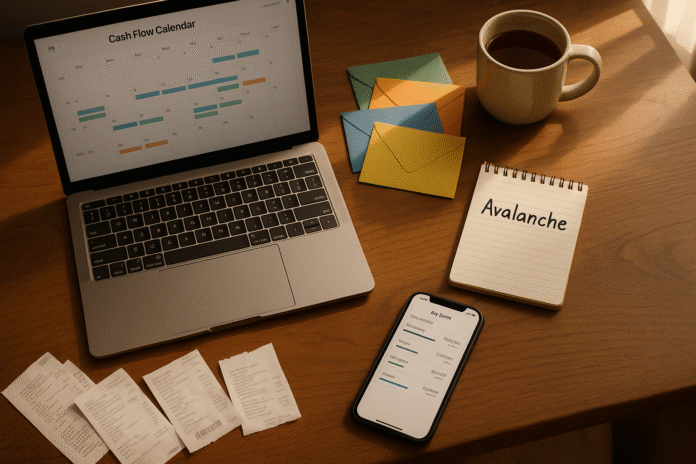
If your paychecks swing from feast to famine—gig work, tips, or commission checks—you can still use the debt avalanche method reliably by staggering payments to match when money actually arrives. Debt avalanche simply means you make minimums on all debts and send every extra dollar to the balance with the highest APR, then move down the list—an approach that mathematically minimizes interest. The twist for variable earners is timing: pay minimums on-time from a small buffer and push frequent, smaller extra payments to the highest-APR debt as income hits. (This article is educational, not financial or tax advice; consult a qualified pro for your situation.) For quick orientation: credit card interest typically accrues daily on an average daily balance, so paying sooner—weekly, not just monthly—reduces interest.
Fast-start steps: Map income and due dates, automate minimums from a buffer, send every inflow through a “rules” checklist, sweep a fixed % to your highest-APR debt weekly, and protect tax/sinking funds so avalanche dollars aren’t derailed.
1. Build a One-Month Payment Buffer So Minimums Never Miss
The most reliable way to run avalanche on irregular income is to separate timing risk from interest savings: keep one month (or at least two weeks) of minimum payments parked in cash so bills are always on time, then send extra money to the highest APR when you actually get paid. This buffer eliminates late fees and protects your credit while keeping the avalanche intact. Start by totaling all monthly minimums, including loans and credit cards. Park that amount in a high-yield savings account (HYSA) or a dedicated “bills” sub-account so it’s distinct from spending money. Refill the buffer first whenever it dips; then avalanche the rest.
1.1 Why it matters
- Late payments can add fees and potentially trigger penalty APRs; a buffer prevents that domino effect and keeps your avalanche steady even in lean weeks.
- Because credit card interest commonly accrues daily, extra payments made mid-cycle reduce interest faster—but they only help if minimums are safe.
1.2 How to build it fast
- Compute: Sum all minimums (e.g., $85 + $47 + $62 + $140 = $334).
- Stage: Aim for $334–$668 in a separate “Bills” bucket.
- Fund: Use the next windfall, small side gigs, or temporarily pause extra avalanche dollars until you hit target.
- Automate: Autopay minimums from this buffer; top the buffer up from each deposit.
- Guard: No spending from the buffer except scheduled minimums.
Mini example: If your minimums total $300 and you earn $1,200 one week and $200 the next, autopay covers minimums from the buffer regardless; you then sweep 20% of each deposit ($240 and $40) to your highest-APR debt. Interest costs drop because you’re paying earlier and more often.
Bottom line: The buffer makes your payments punctual and your avalanche consistent—even when your income isn’t.
2. Map a Cash-Flow Calendar and Stagger Due Dates to Your Pay Cycle
To keep cash tight but controlled, line up due dates after your typical income arrival. Most issuers will change a due date on request. Start by plotting when money lands: paydays, client payouts, platform transfers. Then lay your current bill due dates on the same calendar. If a big bill hits before your cash does, request a new due date that falls a few days after your usual deposit. The goal is to cluster (or intentionally split) due dates to match inflows so the buffer doesn’t get drained at once.
2.1 How to do it
- Print the month: Mark income arrival dates.
- Overlay bills: Highlight the ones falling ≥7 days before income.
- Call/chat: Ask issuers to move due dates; many allow it (not guaranteed).
- Sequence: Space large payments about a week apart if your income is staggered.
- Review quarterly: Re-map if client schedules shift.
2.2 Tools/References
- The CFPB provides a worksheet and guidance for requesting bill due-date changes and suggests mapping income first so bills follow cash.
Mini example: Your main payout hits on the 15th. Move Card A’s due date to the 18th and Loan B to the 23rd. Minimums clear from the buffer; extra income received on the 15th goes to your highest-APR card on the 16th to lower average daily balance immediately.
Bottom line: Align dates with deposits so your avalanche plan runs on rails rather than luck.
3. Lock In Minimums with Autopay—Then Push Extra Payments Manually (or Weekly)
Automate minimums to eliminate late fees and preserve your credit standing. Then, manually (or via scheduled weekly transfers) send extra payments to your highest-APR debt as money arrives. Autopay is a powerful default—research shows it shapes how people pay—but relying on “autopay minimum only” can quietly increase total interest if you never add extra. So set autopay to the minimum from your buffer and separately schedule frequent avalanche payments.
3.1 Numbers & guardrails
- With a 24% APR card (daily rate ≈ 0.24/365 ≈ 0.000657), paying $200 on the 10th instead of the 25th reduces 15 days of interest on that $200.
- Many issuers calculate interest daily on the average daily balance; earlier payments mean less interest accrued.
- Consider weekly standing orders (e.g., every Friday sweep 20% of that week’s deposits to your highest-APR card).
3.2 Mini-checklist
- Enable autopay minimum from the buffer.
- Turn on payment alerts 3–5 days before due dates.
- Create a weekly avalanche transfer rule (percentage-based).
- Revisit autopay amount if your income stabilizes.
Bottom line: Autopay protects you from missed payments; your weekly avalanche sweeps are what shrink interest.
4. Use Weekly Micro-Allocations: Every Deposit Triggers a % Sweep to the Highest APR
Because most credit card interest compounds daily, frequency wins. Assign a fixed rule—say 20% of every deposit—to the highest-APR balance. Micro-allocations keep momentum in low-income weeks and supercharge progress in high-income weeks, all without breaking the avalanche logic.
4.1 How to do it
- Pick a flat percentage (10–30%) that still leaves room for essentials and taxes.
- Apply it to each inflow, not just monthly totals.
- Pay immediately after money lands to cut the average daily balance window.
- If cash is tight, route the first slice to refill the buffer, then apply the rest to avalanche.
4.2 Numeric example
- Balances: Card X $3,200 at 28% APR; Card Y $1,900 at 18% APR; Personal loan $5,600 at 9%.
- Weekly deposits in a choppy month: $150, $650, $0, $1,100.
- Rule: 20% to avalanche + weekly extra $25 if deposits >$500.
- Avalanche sends: $30, $155 (plus $25 kicker = $180), $0, $220.
- That $430 total paid earlier in the cycle lowers interest more than a single $430 at month-end, because daily accrual shrinks faster.
Bottom line: A simple “% of every deposit” rule operationalizes avalanche for volatile pay without mental math each week.
5. Protect Avalanche Dollars with Sinking Funds for Taxes, Insurance, and Gear
Irregular earners often derail debt payoff by forgetting non-monthly expenses—quarterly taxes, annual insurance, equipment repair. Create sinking funds (separate buckets) and feed them automatically so you don’t raid your avalanche to cover predictable spikes. For U.S. freelancers, also plan for estimated taxes using safe-harbor thresholds to avoid penalties (as of now, most taxpayers avoid penalties if they pay ≥90% of current-year tax or 100% of last year’s tax; high-income filers may need 110% of last year’s tax).
5.1 How to do it
- List annual/quarterly costs (insurance, licenses, CPA, laptop).
- Divide by 12 (or by the number of pay periods) and auto-transfer to sub-accounts.
- For U.S. taxes, review IRS guidance and Form 2210 rules; consider 90%/100% (or 110% for higher incomes) safe harbor and pay quarterly.
5.2 Region notes
- U.S. specifics above; other countries have different provisional tax systems—check your local revenue authority.
- In the U.S., the IRS confirms safe harbor thresholds and allows unequal payments via annualized income to reflect irregular earnings.
Bottom line: Pre-funding known spikes keeps avalanche money flowing toward interest savings rather than emergencies masked as “surprises.”
6. Use a Tiered “Paycheck Rules” Flow: Essentials → Minimums → Buffer → Avalanche
Irregular income needs a default order of operations so you don’t decide from scratch each week. A simple four-tier flow works: (1) essentials (rent, utilities, basic groceries), (2) minimums on all debts, (3) buffer refill back to target, (4) avalanche the rest to your highest-APR balance. This preserves housing and credit in thin weeks while still harvesting high-APR savings in strong weeks.
6.1 Mini case
- Friday deposit: $1,200.
- Rules route: $700 to essentials due next 7–10 days → $300 to refill buffer from $150 back to $450 → $200 to avalanche Card X at 28% APR.
- Next Wednesday deposit: $350 → $100 essentials remainder → $250 to avalanche.
6.2 Tips & mistakes to avoid
- Avoid “all-or-nothing” thinking: send something to avalanche every positive week.
- Don’t starve essentials: if rent is due, adjust the avalanche percentage down temporarily.
- Audit quarterly: if your average deposit changed by ≥20%, re-set the buffer target and avalanche %.
- Use alerts: calendar prompts 3–5 days before essentials and due dates keep the order intact.
Bottom line: A written flow removes decision fatigue and keeps you out of late-fee territory while still maximizing interest savings.
7. Route Inflows with Buckets and “If-This-Then-That” Bank Rules
Modern banks and apps let you create sub-accounts/buckets/spaces and auto-rules—perfect for variable income. Set your checking to sweep each deposit by percentages: 50% essentials, 10% taxes, fixed dollars to buffer until full, then 100% of the remainder to your highest-APR debt. If your bank lacks rules, use scheduled transfers or budgeting tools to mimic them. The key is to codify your avalanche so it runs even on hectic weeks.
7.1 Practical setup
- Create sub-accounts: Essentials, Taxes, Buffer, Avalanche.
- Automate splits by percentage of each deposit where supported; otherwise, create templates for manual sweeps right after deposits.
- Schedule a weekly avalanche transfer (e.g., every Friday afternoon) to catch any unallocated funds.
7.2 Checklist
- Bank supports sub-accounts/buckets or “spaces.”
- Deposit notifications enabled.
- Weekly audit reminder.
- Extra-income “windfall rule”: 50% to avalanche, 30% to taxes, 20% to savings (adjust for your situation).
Bottom line: Buckets and rules transform good intentions into repeatable actions that compound into real interest savings.
8. Set Guardrails: When to Pause or Bend the Avalanche (0% Promos, Hardship, Emergencies)
Avalanche should be your default—but not a straitjacket. Pause extra payments temporarily when: (a) you’re in a true cash emergency (medical, housing, essential car repair), (b) a 0% APR promotion or balance transfer changes what’s “highest cost,” or (c) you can enter a formal hardship arrangement to lower rates or delay payments. Regulators and consumer resources note that issuers may adjust terms, and your agreements disclose how interest is calculated and displayed on periodic statements—understand those details before you deviate. Consumer Financial Protection Bureau
8.1 How to decide (quick triage)
- Life/health/safety first: pause avalanche, preserve cash.
- 0% APR window: if a balance is truly at 0% and fees are low, avalanche other debts; resume before promo ends.
- Hardship: ask your issuer or a nonprofit credit counselor about temporary rate reductions; document everything.
8.2 Why weekly payments still help
- When interest accrues daily, even during hardship, small earlier payments reduce the balance-at-risk.
Bottom line: Smart exceptions protect you from bigger setbacks and keep you in position to resume the avalanche quickly.
9. Track APRs, Trendlines, and Wins: A One-Screen Dashboard
What gets measured gets managed. Build a simple dashboard that lists each debt, APR, current balance, minimum, due date, and priority rank. Add a chart of weekly payments and a cumulative interest-saved estimate. Review monthly to ensure the highest APR still gets the extra. For education, reputable explainers confirm avalanche saves interest vs snowball—use that knowledge to stay motivated, especially if high-APR balances are also large.
9.1 Metrics that matter
- Highest-APR focus: confirm all extra dollars hit #1 on your list.
- Weighted average APR (WAPR): track as it falls; it’s your portfolio “cost of debt.”
- Days to debt-free (projection): recalc monthly with actuals.
- On-time rate: aim for 100% (buffer + autopay make this realistic).
- Payment frequency: weekly is ideal for daily-accrual debts.
9.2 Example layout
- Table columns: Debt | APR | Balance | Minimum | Due date | Priority | Extra this month | Notes.
- Graphs: running total paid this month; balances over time.
- Alerts: 3 days pre-due, and a weekly “sweep reminder” on deposit days.
Bottom line: Seeing progress—especially on interest avoided—keeps you engaged through the uneven months.
FAQs
1) What is the debt avalanche, in one sentence?
It’s a repayment strategy where you pay minimums on all debts and send every extra dollar to the highest-APR balance first, then move down the APR list—an approach that minimizes total interest over time and often shortens payoff length versus other methods, assuming consistent payments. Authoritative explainers corroborate this definition.
2) How does staggering payments save money if the total paid is the same?
With most credit cards, interest is calculated daily on an average daily balance. Paying earlier (e.g., weekly) lowers the balance sooner, which reduces interest accrual even if the total paid that month is unchanged. That’s why frequent micro-payments punch above their weight for high-APR revolving debt.
3) I’m a freelancer—how big should my payment buffer be?
Start with one month of minimums; two weeks is a workable interim target. This covers due dates when a client pays late, eliminating late fees and credit dings. Keep the buffer in a separate bills sub-account (or HYSA) and refill it before sending extra avalanche dollars so timing risk doesn’t sabotage your plan.
4) Can I change my credit card due date to match my pay cycle?
Often yes—many issuers allow due-date changes upon request. The CFPB even provides a worksheet to help you map your income and request date changes. Expect each issuer to have its own rules and limits, but asking is usually worth it.
5) Should I use autopay for the full statement balance or the minimum?
If you can, autopay the full statement balance to avoid interest entirely. If cash flow is too variable, autopay at least the minimum from your buffer to prevent late fees, then push extra payments manually or weekly to the highest-APR debt. Be aware that defaulting to “autopay minimums only” can lead to higher long-run interest if you don’t add extras.
6) How do taxes affect my avalanche if I’m self-employed in the U.S.?
Protect avalanche dollars by funding a dedicated tax bucket. As of now, most taxpayers avoid underpayment penalties if they’ve paid at least 90% of current-year tax or 100% of last year’s tax by year-end; higher-income filers may need 110% of last year’s tax. Pay quarterly, and consider the annualized income method if your income is lumpy. IRS
7) Avalanche vs. snowball—what’s better for irregular income?
Avalanche usually saves more interest by attacking the highest APR. Snowball can be more motivating by clearing small balances first. If your income is volatile, use avalanche but borrow from snowball’s psychology: celebrate small wins, track progress visually, and use weekly micro-payments for momentum. Investopedia
8) Should I refinance or consolidate before starting avalanche?
If you can lower APRs meaningfully—via a balance transfer with a low fee or a consolidation loan at a lower rate—your avalanche gets easier. Just weigh transfer fees, promo durations, and the risk of new spending on old cards. During 0% periods, place that debt lower in your avalanche priority until the promo ends, then reprioritize.
9) What percentage of each deposit should I sweep to the avalanche?
Pick a rule you’ll obey in lean weeks—10–30% of each inflow is common. The right number depends on your rent/utilities load and tax savings targets. Start conservatively, track a month, then adjust. The beauty of percentage rules is that they scale up on high-income weeks automatically.
10) Does paying biweekly or weekly hurt my credit score?
No—credit scores don’t penalize frequent payments. In fact, lower reported balances relative to credit limits can help your utilization ratio. Just ensure your issuer credits payments promptly and that your minimum is satisfied by the due date every cycle.
11) Is there ever a reason to pause avalanche for an emergency fund?
Yes. If you have no emergency cash, pausing extra payments to build $500–$1,500 (or one month of essentials) can prevent new high-APR debt from surprise expenses. Resume avalanche as soon as your basic cushion is in place.
12) How do I track progress without getting overwhelmed?
Use a one-page sheet or simple spreadsheet. Columns: Debt, APR, Balance, Minimum, Due date, Priority, Extra this week, Notes. Add a chart of total extra paid weekly and balances over time. Review monthly and celebrate milestones—interest saved, balances that cross $1,000 thresholds, or APRs eliminated.
Conclusion
When your income isn’t predictable, the secret to a consistent debt avalanche is decoupling timing from intent. A small, dedicated buffer makes minimums bulletproof. A realistic cash-flow calendar aligns due dates with deposits. A short set of paycheck rules—essentials, minimums, buffer refill, avalanche—removes decision fatigue. And weekly micro-payments convert every deposit into forward motion, slashing interest because most credit card balances accrue daily. Protect the plan with sinking funds (especially taxes if you’re self-employed), and use bank buckets and rules to automate your decisions. Track the right metrics—APR, balances, and on-time rate—so progress is visible even when months are uneven. Put it together and you get a system that’s humane, flexible, and relentlessly efficient at turning irregular income into regular debt payoff.
Take the next step: Set up your buffer and a 20% weekly sweep to your highest-APR debt before your next deposit—then watch the trendlines bend.
References
- Debt Avalanche: Meaning, Pros and Cons, and Example — Investopedia, Updated September 16, 2025. https://www.investopedia.com/terms/d/debt-avalanche.asp
- What is a “daily periodic rate” on a credit card? — Consumer Financial Protection Bureau (CFPB), September 25, 2024. https://www.consumerfinance.gov/ask-cfpb/what-is-a-daily-periodic-rate-on-a-credit-card-en-46/
- How does my credit card company calculate the amount of interest I owe? — CFPB, January 22, 2024. https://www.consumerfinance.gov/ask-cfpb/how-does-my-credit-card-company-calculate-the-amount-of-interest-i-owe-en-51/
- Estimated Taxes — Internal Revenue Service (IRS), Page Last Reviewed/Updated: August 7, 2025. https://www.irs.gov/businesses/small-businesses-self-employed/estimated-taxes
- Underpayment of Estimated Tax by Individuals Penalty — IRS. https://www.irs.gov/payments/underpayment-of-estimated-tax-by-individuals-penalty
- Instructions for Form 2210 (Underpayment of Estimated Tax) — IRS, 2024 Instructions. https://www.irs.gov/instructions/i2210
- Publication 505 (2025), Tax Withholding and Estimated Tax — IRS, 2025. https://www.irs.gov/pub/irs-pdf/p505.pdf
- Adjusting your bill due dates can help you stay on top of your bills and manage your cash flow — CFPB Blog, November 28, 2018. https://www.consumerfinance.gov/about-us/blog/adjusting-your-bill-due-dates-can-help-you-stay-top-your-bills-and-manage-your-cash-flow/
- Request a change in your bill due date (worksheet) — CFPB, 2018. https://files.consumerfinance.gov/f/documents/cfpb_request-change-bill-due-date_worksheet.pdf
- To Pay or Autopay? Fintech Innovation and Credit Card Payments — CFPB Research Paper (J. Wang), 2023. https://files.consumerfinance.gov/f/documents/cfpb_wang-2023-to-pay-or-autopay.pdf
- How Does Credit Card Interest Work? — U.S. Bank, July 23, 2025. https://www.usbank.com/credit-cards/credit-card-insider/credit-card-basics/how-does-credit-card-interest-work.html
- Can You Change Your Credit Card Due Date? — NerdWallet, September 11, 2025. https://www.nerdwallet.com/article/credit-cards/change-billing-date-credit-card