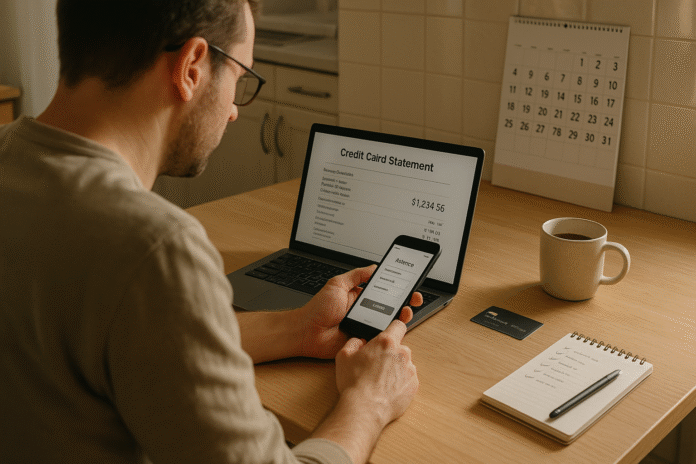
Credit cards can be a force for good when you use them as a payment tool—never as a long-term loan. This guide shows you exactly how to align everyday card use with habits that build stability: on-time payments, low balances, a budget that actually fits your life, and guardrails that prevent costly slip-ups. You’ll learn how to structure payments to avoid interest, what “utilization” really means, how to automate without losing awareness, and how to use rewards without overspending. If you’re new to credit or rebuilding, these rules will help you move from reactive to proactive. If you’re already organized, they’ll sharpen your system.
Short answer: treat your card like cash due next month; pay the statement balance on time, keep utilization low, automate safety checks, and review reports regularly.
Note: This guide is educational and not individualized financial advice.
1. Pay the statement balance in full and on time
The most important habit is simple: pay your statement balance by the due date every month. That single move unlocks the grace period most cards offer on purchases, meaning you won’t owe interest on new purchases as long as you paid the prior cycle’s statement balance in full. Paying the “current balance” is fine too, but the statement balance is the minimum target to preserve interest-free days. If you only pay the minimum, interest usually starts accruing on the remaining balance and can compound quickly. Legally, issuers must mail or deliver statements at least 21 days before the payment due date, but mail or email delays can still catch you off-guard—so set digital reminders and autopay. When life gets messy, make some payment before the cut-off to avoid a late mark, then fix the rest right after. These two rules—pay in full and pay on time—drive the lion’s share of credit-building.
1.1 Why it matters
- Paying the statement balance preserves your grace period on purchases and prevents interest. Consumer Financial Protection Bureau
- On-time payments directly support your credit scores; late payments can linger on your reports for years.
- Consistency compounds: a flawless payment streak builds resilience for future underwriting.
1.2 How to do it
- Turn on autopay for at least the statement balance; add a calendar reminder 3–5 days ahead.
- Schedule a mid-cycle “balance check” to prevent surprises before the due date.
- If cash is tight, pay something before the due date to avoid a late fee/mark, then finish paying ASAP.
Mini-checklist: Autopay = ON (statement balance) → Alerts set → Mid-cycle review booked → Pay early if possible.
Synthesis: Paying the statement balance on time is the habit that makes every other rule easier and cheaper.
2. Keep credit utilization low (aim under 30%, ideally under 10%)
Utilization is your balances divided by your credit limits, and keeping it low is the second-biggest driver of strong scores. As a rule of thumb, try to finish each statement cycle under 30% on each card and overall; if you’re chasing top-tier scores, keeping it in the single digits is even better. You don’t have to carry a balance—carrying one doesn’t help your scores and costs you interest. If you routinely charge large amounts for rewards or work expenses, consider multiple mid-cycle payments or a higher limit to keep utilization down on the statement closing date. Remember that utilization snapshots at statement close, not the due date, often feed the scores lenders see. Finally, if you’re rebuilding, low utilization plus on-time payments is the fastest path to visible improvement.
2.1 Numbers & guardrails
- Good: <30% on each card and overall. Better: <10%.
- Example: Limit ₨300,000 (or $3,000). Keep reported balance under ₨30,000 ($300) for ~10% utilization.
2.2 Tools/Examples
- Turn on issuer balance alerts at custom thresholds (e.g., 20%, 30%).
- Make a mid-cycle payment after big purchases or reimbursements.
- Ask for a credit limit increase only if you won’t spend more.
Synthesis: Low utilization signals control and keeps your credit flexible when you need it most.
3. Align due dates with your cash flow and automate safely
The best system fits your pay schedule. Move credit card due dates to a few days after payday so cash is available when autopay hits. Use autopay for the statement balance (or at least the minimum as a fail-safe), then confirm you can pause or change it if needed. U.S. rules under the Electronic Fund Transfer framework give you rights to revoke a company’s automatic debits and to place stop-payment orders with your bank, which is useful if something goes wrong. Set text or app alerts for “statement ready,” “payment scheduled,” and “payment posted.” For cards you use rarely, set autopay to minimum + calendar reminder to avoid late marks. The goal is a system that runs itself 98% of the time but keeps you in the loop.
3.1 How to do it
- Change due dates to 3–5 days after your payday.
- Autopay: statement balance where possible; minimum payment as a backstop elsewhere.
- Alerts: set for statement, due date, large purchases, international charges.
3.2 Common mistakes
- Relying on autopay without checking statements.
- Autopay set to minimum when you intended statement balance.
- Ignoring email changes or expired cards on file.
Synthesis: Automation reduces errors, but pairing it with simple checks keeps you firmly in control.
4. Build an emergency buffer so your card stays a payment tool, not a loan
Credit cards become traps when emergencies force you to revolve balances at high APRs. Cushion yourself by building an emergency fund—typically 3–6 months of essential expenses, adjusted for job stability and dependents. Start small if that horizon feels far away: even one month of expenses—or a flat target like ₨50,000 ($500) rising to ₨300,000 ($3,000)—dramatically reduces the odds you’ll carry debt. Automate transfers the day after payday into a separate savings account with no debit card attached. As your buffer grows, everything else (utilization, on-time payments, flexibility) gets easier.
4.1 How to do it
- Pick a starter goal (₨50,000 / $500) and a stretch goal (1–3 months), then escalate to 3–6 months.
- Automate a fixed transfer the day after payday; increase it after raises or debt payoffs.
- Park the fund in a high-yield savings account; don’t co-mix with spending.
4.2 Mini case
- If your essentials are ₨150,000/month ($1,500), a 3-month target is ₨450,000 ($4,500). At ₨15,000/month, you’ll get there in 30 months—faster with windfalls.
Synthesis: A real cash buffer is the silent partner that lets every credit-building habit stick. FDIC
5. Let a simple budget (like 50/30/20) fund your card on time—every time
A budget isn’t about deprivation; it’s a plan that tells your money what to do. The popular 50/30/20 rule allocates roughly 50% to needs, 30% to wants, and 20% to savings/debt. Use it as a starting point—then tune the percentages to your reality (for variable income, think ranges over absolutes). The mechanism that matters for credit-building is funding your card payments before the due date and preventing “surprise utilization” at statement close. Put the card payment in the “needs” bucket if you typically charge necessities. If you charge discretionary spending for rewards, cap that category and set weekly limits so you never outpace cash.
5.1 Steps
- Map paycheck → buckets → bills; treat “credit card payment (statement balance)” as a bill.
- Add weekly guardrails for dining/shopping to protect end-of-month payment capacity.
- For irregular income, build a 1-month smoothing buffer before scaling spending.
5.2 Tools/Examples
- Apps: YNAB, Monarch Money, Rocket Money, Tiller, PocketGuard.
- Spreadsheet users: set a “utilization cell” that flags red above 30%.
Synthesis: A lightweight budget that funds your card first keeps utilization low and your grace period intact. files.consumerfinance.gov
6. Review every statement and set alerts to catch errors and fraud early
Healthy habits include awareness. Skim each statement for unfamiliar charges, duplicate transactions, or subscription creep. Set issuer alerts for “transaction over ₨X,” “card not present,” “international,” and “refund posted.” Weekly app checks build a rhythm: you’ll spot a free-trial that converted or a small test charge that hints at fraud. If you see anything off, lock the card in the app and contact your issuer; most have zero-liability policies for unauthorized charges when you report promptly. This practice also keeps your category spending honest—if dining is running hot mid-cycle, you can course-correct before statement close.
6.1 Mini-checklist
- Alerts on for large/online/international charges and refunds.
- Weekly 5-minute review ritual.
- Immediate card lock + dispute when needed.
- Audit subscriptions quarterly.
6.2 Region-specific note
- Consumer protections, chargeback windows, and dispute processes differ by country. Check your issuer’s policy and local regulations for timelines and documentation requirements.
Synthesis: A five-minute weekly review eliminates most “how did that balance get so high?” moments before they start.
7. Chase rewards—never interest (APR is still punishing as of now)
Rewards can be great if you never revolve. As of now, the average interest rate on credit card plans in U.S. banking data sits a little above 21%, which will overwhelm typical cashback earnings if you carry balances. That reality makes “pay the statement balance” worth more than any sign-up bonus. If you do use rewards, keep the play simple: a 2% cashback card for everyday, a no-foreign-transaction-fee card for travel, and a category card only if it matches your natural spending. Treat redemptions as a “savings booster,” not a reason to spend more. If you ever slip and revolve, switch focus to debt payoff and pause the rewards game until you’re back to zero.
7.1 Numbers & examples
- 2% cashback on ₨100,000 spend = ₨2,000. One month at 21% APR on ₨100,000 balance ≈ ₨1,750 interest—nearly wipes out a year of rewards.
- Use “Pay-Now Rewards”: redeem cashback to savings automatically each month.
7.2 Mini-checklist
- No annual fee unless benefits clearly exceed it.
- No-FX-fee card for travel purchases.
- Stop rewards if you revolve a balance.
Synthesis: Rewards should amplify good habits—not subsidize expensive debt.
8. Build length of credit history deliberately (open few, keep longest)
Credit scores also care about time: the age of your oldest account, average age across accounts, and how recently you opened new lines. You won’t speed this up with tricks; instead, open only what you need, keep your oldest, no-fee card open, and avoid churning new accounts if you’re planning major financing soon. If you’re early in your journey, one well-chosen starter card—plus perhaps a secured card you’ll graduate from—builds a base. Adding an authorized user spot on a trusted family member’s long, clean card can sometimes help with age and limits, but only if the account is truly well-managed and the issuer reports authorized users to your bureau. Over time, this slow-and-steady approach strengthens your scores without noise.
8.1 How to do it
- Keep your oldest no-fee card open to preserve account age.
- Space new applications (e.g., 6+ months apart) to protect average age and avoid score dings.
- If using authorized-user strategy, confirm on-time history and low utilization.
8.2 Common mistakes
- Closing the oldest card to “simplify.” Consider sock-drawer usage (a small, recurring bill + autopay) instead.
- Opening many cards in a short window for bonuses.
Synthesis: Credit history grows like a tree—plant well, prune carefully, and give it time.
9. If you carry a balance, use a payoff method and a written plan
When balances happen, switch from “optimize rewards” to “extinguish interest.” Pick a method and commit. The avalanche targets the highest APR first to minimize total cost; the snowball pays the smallest balance first to build motivation—both work if you stick with them. Automate minimums on all cards to avoid late marks, then funnel every extra rupee toward your chosen target. Consider a 0% intro APR balance transfer only if the math is clearly in your favor and you’ll finish the plan before the promo ends. Track progress weekly; small wins keep your plan alive.
9.1 Steps
- List debts (balance, APR, minimum).
- Choose avalanche (cheapest) or snowball (fastest wins).
- Automate minimums; pay target weekly; celebrate payoffs.
9.2 Numeric example
- ₨300,000 at 26% APR vs ₨200,000 at 18%. Avalanche: attack ₨300,000 first to save interest; Snowball: kill a ₨50,000 card first to build momentum.
Synthesis: The best method is the one you’ll finish—pick it, automate it, and track it.
10. Pull your credit reports routinely and turn on extra security
Healthy credit habits include monitoring your official reports and locking down your identity. In the U.S., you can now access free weekly credit reports from each bureau at AnnualCreditReport.com—use this to verify accounts, payment history, and personal info. Rotate through the three bureaus (Equifax, Experian, TransUnion) so you see fresh data monthly. For extra safety, consider a free credit freeze with each bureau; it doesn’t affect your current cards and helps block new-account fraud. Add virtual card numbers for online purchases when your issuer offers them. Document disputes in writing with dates and copies.
10.1 Mini-checklist
- Calendar a monthly report check (rotate EQ → EX → TU).
- Freeze credit at all three bureaus; thaw only when applying.
- Use virtual numbers and transaction alerts for online purchases.
10.2 Region-specific note
- Outside the U.S., report access frequency and bureau coverage differ; check your country’s official credit reference agencies and rights.
Synthesis: Regular report checks + a simple security stack catch errors early and deter identity thieves.
11. Avoid high-cost traps: deferred interest, cash advances, and sloppy spend
Some products look cheap but aren’t. Deferred interest deals back-charge interest from day one if any balance remains at promo end; miss by even ₨1 and you can owe months of interest. Cash advances often start accruing interest immediately, usually with extra fees and no grace period. And “buy now, pay later” can encourage over-ordering and hidden late fees if you mis-time payments, especially when split across multiple providers. If you use promotions, set payoff dates two weeks before the promo ends and automate the final payment. Otherwise, stick to the cleanest rule in this guide: use the card for purchases you can pay off next month—nothing more.
11.1 Pitfalls to watch
- “No interest if paid in full” (deferred interest) vs. true 0% APR (no back-charge).
- Cash advances: fee + no grace period + higher APR.
- BNPL stacking across apps.
11.2 Mini-checklist
- Read promo terms; set a payoff reminder 14 days early.
- Avoid ATM withdrawals on credit.
- Keep BNPL to one active plan at a time, if at all.
Synthesis: Complexity hides cost—prefer simple terms you can execute flawlessly. Consumer Financial Protection Bureau
12. Run a monthly 30-minute “financial habits review”
Good habits stick when you review them. Once a month, sit down with your statements and budget for 30 minutes. Confirm last month’s payment in full posted, check utilization on each card, scan for disputes, and compare category spending to budget caps. Note any life changes (rent increase, new subscription) and adjust autopay or category caps before the next cycle. Track two metrics on a simple dashboard: (1) on-time payment streak (target: unbroken), and (2) end-of-cycle utilization (target: under 30%, stretch: under 10%). Finish by scheduling any mid-cycle payments needed to keep utilization low. This short ritual closes the loop so your system improves every month.
12.1 Mini-checklist
- Utilization check (overall and per card).
- Statement balance paid? Y/N → if N, fix today.
- Fraud/fee scan and disputes.
- Adjust budgets/alerts; schedule any mid-cycle payments.
12.2 Tools/Examples
- Use a notes app template with the checklist above.
- Keep a tiny “wins” log (e.g., “3 months under 10% util”) to maintain momentum.
Synthesis: A simple monthly review turns your system into a habit engine that protects your score and your cash flow.
FAQs
1) Do I need to carry a balance to build credit?
No. Carrying a balance doesn’t help scores and costs interest. Scores reward on-time payments and low utilization; paying the statement balance in full each month preserves your grace period and avoids interest.
2) What’s the difference between statement balance and current balance?
The statement balance is the amount from your last billing cycle; paying it by the due date preserves your grace period on purchases. The current balance adds new charges since the statement closed. Aim to pay the statement balance in full; if current balance is higher and you want to report low utilization, make an extra payment before statement close.
3) How low should my utilization be?
Under 30% is a widely cited guardrail; under 10% tends to be optimal for top-tier scores. This applies both per-card and overall. If you spend heavily for rewards or work, make mid-cycle payments or request a higher limit without increasing spend. Consumer Financial Protection Bureau
4) Does using autopay remove my rights if there’s an error?
No. You can revoke authorizations and place stop-payment orders with your bank; you should also dispute erroneous charges with your card issuer promptly. Keep records and confirm changes in writing. Consumer Financial Protection Bureau
5) How often should I check my credit reports?
In the U.S., you can check reports weekly for free at AnnualCreditReport.com. Many people rotate bureaus monthly (EQ → EX → TU) for an ongoing view. Consumer Advice
6) Are balance transfers worth it?
Sometimes. They can buy time at a low or 0% promo rate if you’ll finish the payoff before the promo ends and the transfer fee doesn’t erase your savings. Set a payoff schedule that clears the balance two weeks before the promo expires to avoid residual interest traps.
7) Does closing a card help my credit?
Usually not. Closing removes available credit and can raise utilization; it may also reduce average account age over time. Consider keeping no-fee cards open with a small recurring charge and autopay.
8) What if my bill arrived late—do I get extra time?
Issuers must establish procedures to ensure statements are sent at least 21 days before the due date, but you’re still responsible for paying by the due date shown. Use digital statements/alerts to avoid mail delays.
9) Are rewards worth it if I sometimes carry a balance?
Generally no. With average APRs above 21% as of now, even modest balances can wipe out a year’s worth of cashback or points value. Focus on eliminating interest first, then resume rewards optimization.
10) What if I’m new to credit or have thin credit history?
Start with one beginner-friendly card (secured if needed), keep utilization low, and pay on time. Consider becoming an authorized user on a long-standing, well-managed card in your household if available and appropriate. Over 6–12 months, those simple habits can establish enough history for better terms.
Conclusion
Credit cards don’t build good financial habits by themselves—you do. But the right system makes the good choice the easy choice. Pay the statement balance on time to preserve your grace period and avoid interest; keep utilization low so your score reflects control; and automate what can be automated while checking in weekly and monthly so nothing goes off the rails. Layer in a budget that funds card payments first, a growing emergency buffer so you never have to revolve, and simple security practices that protect your identity and your progress. The result is a virtuous cycle: lower costs, stronger scores, and more options when you truly need them.
Copy-ready next step: Turn on autopay for the statement balance, set a mid-cycle utilization alert, and book a 30-minute monthly review on your calendar.
References
- What’s in my FICO® Scores?, myFICO (accessed Sep 2025). myFICO
- What is a grace period for a credit card?, Consumer Financial Protection Bureau, Sep 25, 2024. Consumer Financial Protection Bureau
- I received my bill late—can I get more time to pay?, Consumer Financial Protection Bureau, Sep 10, 2024. Consumer Financial Protection Bureau
- What affects your credit scores?, Experian, Jul 30, 2025. Experian
- Credit score myths and utilization guidance, Consumer Financial Protection Bureau, Jun 2018. Consumer Financial Protection Bureau
- Will paying off my credit card balance every month improve my score?, Consumer Financial Protection Bureau, Feb 2024. Consumer Financial Protection Bureau
- Consumer Credit—G.19; Commercial Bank Interest Rate on Credit Card Plans (TERMCBCCALLNS), Board of Governors of the Federal Reserve System via FRED, updated Jul 8, 2025. FRED
- Free Credit Reports, Federal Trade Commission, Jan 4, 2024. Consumer Advice
- AnnualCreditReport.com (Official Site), Central Source LLC (accessed Sep 2025). https://www.annualcreditreport.com/ annualcreditreport.com
- How to reduce your debt (snowball vs. highest-rate methods), Consumer Financial Protection Bureau, Jul 16, 2019. Consumer Financial Protection Bureau
- Reducing debt worksheet (avalanche vs snowball), CFPB toolkit PDF, 2017. files.consumerfinance.gov