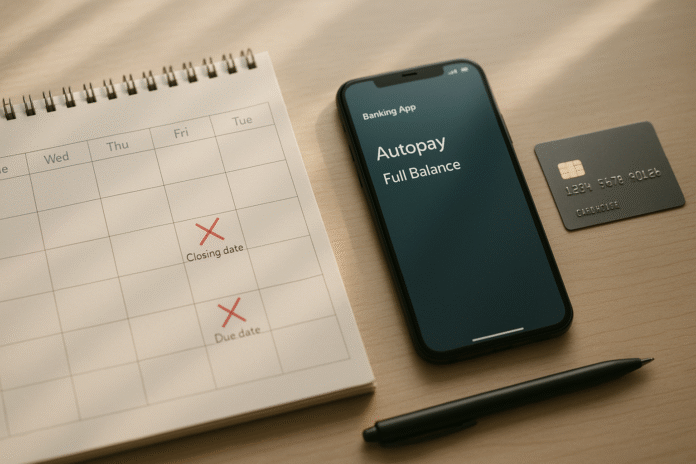
Paying your credit card in full every month can effectively give you a short, interest-free loan—known as the grace period—between the statement closing date and the payment due date. In plain terms: if your card offers a grace period and you pay the full statement balance by the due date, you won’t be charged interest on purchases made during the prior cycle. Many (but not all) U.S. cards offer this, typically with at least 21 days between statement and due date. The catch is that you must avoid carrying a balance and pay on time; otherwise, interest can accrue from the purchase date. Below, you’ll learn exactly how to use grace periods to your advantage, what can break them, and practical tactics to maximize your interest-free float.
Quick steps to capture the benefit:
1) Know your statement closing date and due date. 2) Make most purchases right after the statement closes. 3) Autopay the full statement balance by the due date, every cycle.
Brief, important note: This article is educational, not individualized financial advice. Always check your cardholder agreement and local rules.
1. Understand the Grace Period Mechanics (and the “Pay in Full” Requirement)
A grace period is the window between the end of your billing cycle (statement closing date) and your payment due date in which purchases typically don’t accrue interest—if you pay your statement balance in full by the due date. Start here because this definition drives everything else: to get the interest-free float, you need a card that offers a grace period, you need to avoid carrying a balance from prior cycles, and you need to pay on time. In the U.S., card issuers must get your bill to you at least 21 days before the due date, which is why most grace periods are at least three weeks. However, not all transactions qualify (cash advances almost never do), and if you don’t pay in full one month, you may lose the grace period for that month and often the next. The safest default is to set full-balance autopay and to confirm it’s processing before the due date.
1.1 Why it matters
- The grace period is effectively a short-term, interest-free loan on purchases when managed correctly.
- It’s a binary benefit: either you pay the statement balance in full and avoid purchase interest, or you don’t and interest can accrue from the purchase date.
- Federal rules define what counts as a grace period and clarify that issuers don’t have to offer one—but most do for purchases.
1.2 Numbers & guardrails
- Minimum length: Issuers must mail/deliver statements at least 21 days before the due date when a grace period applies.
- Common window: Roughly 21–25 days; check your statement for exact dates.
- Eligibility: Typically lost if you carry a balance into the next cycle; cash advances and many balance transfers are excluded.
Synthesis: Maintaining a true grace period is simple in theory—pay the full statement balance on time—but it’s unforgiving if you slip. Master the dates, and you’ll unlock interest-free days every month.
2. Time Purchases Right After the Statement Closes to Maximize Interest-Free Days
To stretch your interest-free loan, cluster big purchases right after your statement closing date. Purchases made the day after a cycle closes won’t be due until the following due date—often delivering nearly a full billing cycle plus the grace period. For example, if your statement closes on the 30th and the due date is the 21st of the next month, a purchase on the 1st could float interest-free for ~50 days before you must pay (about 29 days to the next close plus ~21 days of grace). This timing doesn’t change how much you owe, but it changes when the money leaves your account, which can be powerful for cash-flow planning—especially if your income arrives on a predictable schedule. The caveat: never delay a necessary payment past the due date, and don’t “time” purchases to justify extra spending.
2.1 Mini case: The 50-day float
Assume your card closes June 30 with a July 21 due date. You buy a laptop on July 1. That charge appears on the July 31 statement and is due August 21, giving you ~51 interest-free days. If you pay the full July statement by August 21, no purchase interest is owed.
2.2 Checklist to execute
- Identify your statement closing date (it often stays the same each month).
- Schedule large, planned purchases 1–3 days after closing.
- Keep the full statement balance on autopay to preserve the grace period.
- Track returns/refunds to ensure the full balance still gets paid.
Synthesis: Purchase timing won’t lower the bill, but it safely extends your interest-free runway when you always pay in full by the due date.
3. Automate Full-Balance Payments and Build Fail-Safes
The easiest way to keep your grace period every month is to automate payment of the full statement balance by the due date. Autopay removes memory and mood from the equation and dramatically reduces the risk of a missed payment that would both trigger a late fee and potentially erase your grace period. Remember that many banks process payments late in the evening Eastern Time; if your bank account has a cut-off, a payment submitted on the due date might post the next day. Build in a cushion of a few days, and use bank alerts for when statements generate and payments post. Also, verify your withdrawal account has enough funds several days before the due date so you don’t get a returned payment, which can also cost you fees and jeopardize your grace period. Finally, check that autopay is set to full balance, not minimum due, and re-confirm settings after card upgrades or replacements.
3.1 Mini-checklist
- Turn on autopay: full statement balance (not minimum).
- Set a backup calendar reminder 3–5 days before the due date.
- Enable bank/SMS alerts for statement ready, payment scheduled, and payment posted.
- Keep a small buffer in your checking account to avoid returns.
- If traveling, pay early—time zones and bank holidays can shift posting times.
3.2 Common mistakes
- Assuming a weekend/holiday extends the due date (your issuer’s policy may vary).
- Changing banks or closing an account without updating autopay.
- Paying “manually” at 11:58 p.m. local time when the issuer uses another time zone cutoff.
Synthesis: Automation plus a few simple guardrails preserves your grace period with near-zero effort—and helps you avoid avoidable fees and interest entirely.
4. Avoid the Traps That Cancel Your Grace Period: Carryovers, Cash Advances, and Deferred Interest
Your grace period can vanish if you carry a balance—even once. If you don’t pay the statement balance in full, many issuers will charge interest on purchases from the purchase date and you may lose your grace period for that cycle and the one after. Cash advances and some balance transfers typically never enjoy a grace period; interest starts accruing immediately. Additionally, “deferred interest” plans (often marketed as “no interest if paid in full in 12 months”) are not the same as a grace period; if any amount remains at the end of the promo, accrued interest can be added retroactively. Finally, even when you pay off a carried balance, you might see residual (trailing) interest—the extra interest that accumulates between statement close and the day your payoff posts. Understanding these mechanics helps you avoid surprise charges and keep your future purchases interest-free.
4.1 What to watch
- Carrying a balance: Often removes purchase grace next cycle; interest can accrue from purchase dates.
- Cash advances: Interest from day one; usually also carry separate fees.
- Deferred interest promos: Miss by a penny, and retroactive interest may post.
- Residual interest: A small final interest amount can appear even after a payoff when you previously carried a balance.
4.2 Practical guardrails
- If you’ve carried a balance, call your issuer and ask when your purchase grace period is restored (often after paying in full for one or two cycles).
- To clear residual interest, consider making a $0 balance + extra payment and check again a week later.
- Avoid cash advances; consider cheaper alternatives (credit union small-dollar loans, payroll advances).
Synthesis: Grace periods reward full, on-time payments; carrying a balance, taking cash advances, or misreading deferred-interest promos can erase the benefit quickly.
5. Use Two Cards (and Staggered Close Dates) to Smooth Cash Flow—Without Overspending
If you have more than one card, you can stagger statement closing dates to smooth cash flow and preserve a near-continuous interest-free window. For example, set Card A to close around the 1st and Card B around the 15th. Time bigger purchases to fall just after each card’s close; you’ll still pay each full statement by its due date, but your outflows are distributed across the month. This approach is most helpful for freelancers or households with irregular paydays, or for people aligning expenses with a partner’s pay cycle. The risk is psychological: having “room” on two cards can tempt overspending. A firm monthly budget and app-based category limits help. Also remember that using multiple cards means multiple due dates—miss one and you could lose that card’s grace period and trigger fees. Use calendar blocks and autopay on both cards so the system works on autopilot.
5.1 Tools & examples
- Budget and alerts: YNAB, Monarch, or your bank’s app categories.
- Statement scheduling: Many issuers let you request a new due date; the closing date shifts accordingly.
- Example: Rent and utilities on Card A (close 1st; due 22nd); groceries and fuel on Card B (close 15th; due next month 6th).
5.2 Region note (as of September 2025)
Grace-period rules and disclosures vary by country; this article references U.S. rules (for example, the 21-day statement delivery lead time). If you live elsewhere, confirm terms in your cardholder agreement and local regulations.
Synthesis: Two cards with staggered close dates can make the grace period’s interest-free float more usable—provided you still pay both statements in full and on time every month.
6. Track Returns, Refunds, and Disputes So the Full Balance Still Gets Paid
Returns and dispute credits can complicate full-balance payments. A refund issued after your statement cuts may not land until the next cycle, meaning your current statement still must be paid in full to preserve the grace period—even if you’ve returned an item. Likewise, if you dispute a charge, pay the undisputed portion of the statement; your issuer will adjust later if you win. If you skip payment because you’re “waiting for the refund,” you could lose the grace period and trigger interest from the purchase date. The cleanest workflow is to pay the full statement, let refunds offset future charges, and audit the following statement to ensure the credit posted and no residual interest slipped through. Also, watch category-limited promos (e.g., 0% on medical) that might have different grace rules.
6.1 Mini-checklist
- Always pay the current statement in full—even if returns are pending.
- Keep receipts and return confirmations until you see the credit post.
- If a merchant issues store credit instead of a refund, your card still needs full payment.
- For disputes, pay the undisputed amount; follow your issuer’s instructions for the rest.
6.2 Numeric example
You bought a $300 appliance that broke. The statement closes with that charge. You return it the day after, but the refund posts two weeks later (next cycle). You still pay the full statement now; the refund lowers next month’s balance. Skip payment and you may lose the grace period and owe interest from the purchase date.
Synthesis: Treat refunds as future credits; paying today’s full statement is what protects your grace period and keeps purchases interest-free.
7. Know the Math: How Interest Is Calculated If You Slip—and How Much You’re Saving
Understanding how interest is calculated helps you see the real value of paying in full. Most cards compute purchase interest using a daily periodic rate applied to the average daily balance. If your APR is 24% (0.24/365 ≈ 0.0006575 daily), a $1,000 carried balance costs about $0.66 per day, or about $19.80 over a 30-day cycle. By keeping your grace period active and paying in full, you avoid that purchase interest entirely. If you do carry a balance, expect residual (trailing) interest to appear on the next statement because interest continues to accrue between statement close and the date your payoff posts. That’s normal under card terms and disappears after a cycle in which you pay in full and regain eligibility for purchase grace.
7.1 Numbers & guardrails
- Daily periodic rate: APR/365; interest accrues daily on your balance.
- Residual interest: A small post-payoff charge when you previously carried a balance; it accrues after the statement closes until your payment posts.
- Grace period savings: Avoids purchase interest entirely when you pay the statement balance by the due date.
7.2 Example: Savings from the grace period
If you spend $1,200 on travel right after your statement closes and pay the next statement in full, you pay $0 in purchase interest. If you instead carry that balance for one month at 24% APR, you’d owe roughly $19–$24 in interest depending on the day count method—money you keep by leveraging the grace period.
Synthesis: The math is simple but compelling: paying in full turns the grace period into a reliable, interest-free float and keeps your dollars compounding for you, not the bank.
FAQs
1) What exactly is a credit card grace period?
It’s the time from the statement closing date to the payment due date during which new purchases typically don’t accrue interest—if you pay the full statement balance by the due date. Not all cards offer a grace period, and it often applies only to purchases, not cash advances or certain balance transfers. Always check your card’s terms to confirm what qualifies.
2) Do grace periods apply to cash advances or balance transfers?
Generally no. Cash advances almost always accrue interest from the transaction date and may include separate cash-advance fees. Some balance transfers may have promotional APRs but that’s different from a purchase grace period. Read the transaction-type sections of your agreement to understand what enjoys a grace period and what doesn’t.
3) I paid in full last month but still saw a tiny interest charge. Why?
That’s likely residual (trailing) interest, which accrues between the date your previous statement closed and the day your payment posted when you had carried a balance. It often goes away after one more cycle in which you again pay in full, or you can call your issuer to request the exact payoff amount to the day.
4) How long is the grace period?
U.S. issuers must deliver your statement at least 21 days before the due date if a grace period applies, so most grace periods are at least that long. Some issuers give a bit more time, but the exact window is spelled out on your statement.
5) What’s the difference between a grace period and “no interest if paid in full in 12 months”?
That’s deferred interest, which is not a true grace period. With deferred interest, if any amount remains at the end of the promo, the issuer can add back all the interest that accrued during the promo period. Grace periods waive purchase interest each cycle when you pay in full by the due date; there’s no retroactive add-back.
6) Does paying early help or hurt my grace period?
Paying before the due date is fine and doesn’t reduce your grace period on purchases already made. Early payments can lower your reported balance (which may help credit utilization). Just make sure the full statement balance is paid by the due date so eligibility for the grace period continues.
7) If I miss a payment by a day, do I immediately lose the grace period?
You risk losing it for that cycle and possibly the next, and you may be charged a late fee. Some issuers offer courtesy waivers for a first-time slip, but that doesn’t guarantee grace period preservation. Contact your issuer, pay the full balance immediately, and ask when purchase grace will be restored.
8) How is interest calculated if I carry a balance?
Most cards use an average daily balance method with a daily periodic rate (APR/365). For example, with a 24% APR (≈0.0006575 daily), a $1,000 balance costs about $0.66 per day, or around $19–$20 over a 30-day cycle. The exact amount depends on your daily balances and the day count. Navy Federal Credit Union
9) Can I change my due date to line up with payday?
Often yes. Many issuers let you request a new due date, which usually shifts the statement closing date as well. This can make autopay and cash-flow planning easier and help you consistently pay in full to keep the grace period. Check your online account settings or call customer service.
10) Do international cards work the same way?
Conceptually similar, but details vary by country and issuer. In the U.S., specific rules (like the 21-day statement lead time) apply. If you’re outside the U.S., consult your agreement and local consumer-protection agency guidance to understand grace-period eligibility, exclusions, and timelines.
Conclusion
Grace periods are a simple, powerful tool: they turn everyday credit card purchases into a predictable, short-term, interest-free loan—as long as you pay your statement balance in full and on time, every month. By mastering your statement closing date and due date, timing large purchases just after the close, automating full-balance payments, and avoiding traps like cash advances and deferred-interest gotchas, you can preserve that interest-free window indefinitely. The math reinforces the habit: a typical 24% APR costs around $20 per $1,000 per month if you carry a balance, while a maintained grace period costs nothing in purchase interest. Use staggered close dates if you manage multiple cards, and treat refunds as future credits so you never miss a full payoff. Do these consistently and you’ll keep fees and interest to a minimum while maximizing cash-flow flexibility.
Next step: Turn on full-balance autopay today and add a calendar reminder 3–5 days before each due date.
References
- What is a grace period for a credit card?, Consumer Financial Protection Bureau (last reviewed Sept. 23, 2024). https://www.consumerfinance.gov/ask-cfpb/what-is-a-grace-period-for-a-credit-card-en-47/
- § 1026.54 Limitations on the imposition of finance charges (Regulation Z), Consumer Financial Protection Bureau (current regulation page). https://www.consumerfinance.gov/rules-policy/regulations/1026/54
- I got a credit card promising no interest for a purchase if I pay in full within 12 months—how does this work?, Consumer Financial Protection Bureau (Feb. 2, 2024). https://www.consumerfinance.gov/ask-cfpb/i-got-a-credit-card-promising-no-interest-for-a-purchase-if-i-pay-in-full-within-12-months-how-does-this-work-en-40/
- What Is a Grace Period on a Credit Card?, American Express Credit Intel (June 19, 2024). https://www.americanexpress.com/en-us/credit-cards/credit-intel/credit-card-grace-period/
- Residual Interest: What You Need To Know, Bankrate (Mar. 31, 2025). https://www.bankrate.com/credit-cards/advice/is-interest-after-credit-card-payoff-legal/
- How Does Credit Card Interest Work?, Capital One (Apr. 29, 2025). https://www.capitalone.com/learn-grow/money-management/calculate-credit-card-interest/
- Credit Card Interest Calculator, NerdWallet (updated July 10, 2025). https://www.nerdwallet.com/article/credit-cards/credit-card-interest-calculator