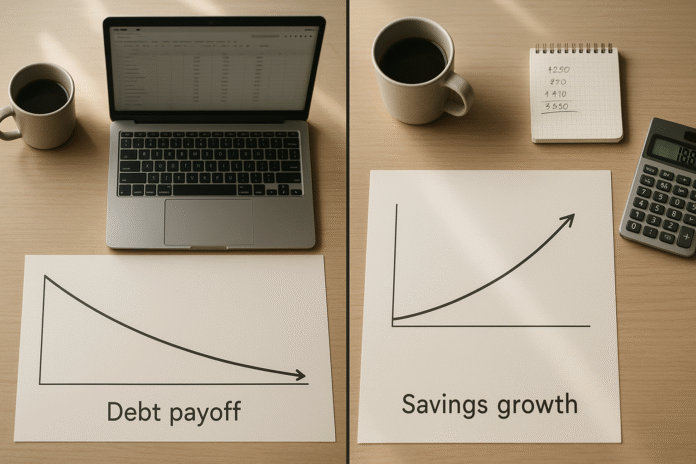
Paying off credit cards versus saving the same monthly amount feels like a tug-of-war. This guide gives you nine practical credit card calculations—each paired with a simple timeline chart you can recreate—to see exactly how fast debt falls and how quickly savings grows. You’ll learn which order to pay cards, how 0% balance transfers change the clock, and when investing can (or can’t) beat paying down high-interest balances. If you’re a household CFO, recent grad, or anyone juggling balances and savings goals, this is for you. Quick take: A credit card calculation is a side-by-side timeline of your balance declining vs. a savings balance growing when you put the same monthly amount into each. Because card APRs are high on average (~21% as of July 2025), paying debt first usually wins on risk-adjusted returns.
Friendly disclaimer: This article is educational, not personalized financial advice. Consider your risk tolerance, taxes, and local rules; verify details with your statements and a qualified adviser where needed.
1. Minimum Payments vs. Saving the Minimum
The answer up front: Minimum payments almost always keep you in debt far longer than you expect, and saving that same small amount won’t outgrow the interest compounding on your card. Most issuers calculate interest daily on the average daily balance, which means carrying a balance is expensive—even before fees. A timeline chart here makes reality visible: a slow, shallow downward line for your card balance (minimum-only) versus a modest upward line for savings. You’ll likely see years of drag on the debt line compared to modest growth on the savings line, because minimum payments are designed to be low, not fast. Statements even include a “minimum payment warning” box to show how long payoff could take at the minimum.
1.1 Why it matters
- Daily compounding vs. monthly saving: Cards typically use a daily periodic rate (APR/365). Interest adds to your balance each day you carry it.
- Reality check on time: Statements disclose how long a balance may take to pay off with the minimum—often measured in years, not months.
- Average APR is high: With card rates around ~21% on average (May–July 2025 readings), even a decent savings rate can’t keep up.
1.2 How to chart it (5-minute spreadsheet)
- Column A: Month 1…N.
- Column B (Debt, minimum-only): Start with balance; each month add daily interest approximation (APR/12 × current balance), then subtract the minimum.
- Column C (Savings): Start at 0; each month add the minimum amount and apply your savings APY/12.
- Plot B and C as lines; label “Debt (min)” sloping down slightly, and “Savings (min)” sloping up modestly.
- Stop when balance hits 0 or at 60 months to compare.
Mini case: $5,000 at 21% APR, 2% minimum (~$100 then shrinking). Month 1 interest ≈ 0.21/12 × $5,000 = $87.50, so only ~$12.50 reduces principal. Meanwhile, saving $100/month at 4% APY grows slowly. The debt line crawls; the savings line inches up—debt wins (in a bad way). Synthesis: Your chart will almost certainly show that minimums prolong debt and that saving the minimum is too small to offset daily-accruing interest.
2. The Debt Avalanche Timeline (Fastest Interest Savings)
Avalanche means you pay the highest-APR card first while making minimums on the rest. The direct answer: Avalanche usually finishes sooner and costs less interest than alternatives, because it attacks the priciest interest first. Your timeline chart shows the steepest early drop on the high-APR balance, then accelerated drops as freed-up dollars roll to the next card. In side-by-side comparisons, the avalanche curve often reaches zero months faster than snowball, especially when APRs are spread out. Behavioral trade-off: it may require patience when your highest-APR balance is also your biggest, so early “wins” are delayed.
2.1 How to do it
- List balances, APRs, minimums; sort descending by APR.
- Pick a fixed extra (e.g., $300/month) beyond the total of all minimums.
- Pay extra to the highest APR card; when it hits $0, roll that card’s payment into the next highest APR.
- Keep savings contributions minimal (e.g., a basic emergency buffer) until debt’s gone.
2.2 Numbers & guardrails
- With ~21% APR common, every $100 extra put against a high-APR balance saves material interest.
- If motivation falters, schedule micro-milestones (e.g., “$1,000 principal chunks”).
- Consider a basic buffer ($500–$1,500) while avalanching to avoid new debt from surprise bills.
Mini case: Three cards—$4,000 @ 26%, $3,000 @ 22%, $2,000 @ 18%; extra $300/mo. Chart shows the 26% balance plunging fastest. Total interest paid is lowest vs. other strategies. Synthesis: If your goal is mathematical efficiency, the avalanche timeline reliably wins on interest savings.
3. The Debt Snowball Timeline (Fastest Motivation)
Snowball means you pay the smallest balance first, regardless of APR. The direct answer: Snowball often costs a bit more interest, but the quick win can boost momentum and completion rates. Your timeline chart shows an early, satisfying drop to zero on a small card, then progressively larger drops as payments snowball. Research and major financial educators note the motivation effect: seeing quick progress can increase follow-through, which for many people is the critical variable.
3.1 When to pick snowball
- You’ve tried and stalled on avalanche; behavior > math for you.
- APRs are clustered (e.g., 19–23%), so the interest-cost gap vs. avalanche is modest.
- You need early psychological wins to stick with the plan.
3.2 How to chart it
- Sort debts by lowest balance first.
- Pay the minimum on all; throw every extra dollar at the smallest until it’s gone.
- Roll the freed payment to the next smallest; continue until all are paid.
- Add a savings line at a small, fixed monthly amount to maintain a buffer.
Mini case: $900, $1,800, and $5,500 balances with similar APRs. The first bar disappears in a few months, your line drops to zero quickly on card #1, and the visual momentum helps you stay consistent. Synthesis: If motivation is your bottleneck, a snowball timeline can be the best practical choice, even if it’s not the interest-optimal one.
4. 0% Balance Transfer Timeline (Using the Promo Window)
The short answer: A 0% APR balance transfer can dramatically shorten your payoff timeline—if you clear the balance within the promo period and watch fees. Your chart flattens interest during the intro window, so payments attack principal directly. The catch: transfer fees (often a percentage) add to your new balance, and missing a payment can end the promo rate early. Regulations require intro rates to last at least six months (often longer); always check the exact term and fee.
4.1 How to execute safely
- Compare offers: promo length (e.g., 12–21 months), transfer fee (e.g., 3–5%), ongoing APR.
- Move only balances you can pay off before the promo ends.
- Automate payments; never pay late (some promos terminate after a serious late payment).
- Don’t spend on the new card unless the promo applies to new purchases too.
4.2 Chart setup
- Debt line: Month 1 balance plus transfer fee; interest set to 0% during promo, then revert to go-forward APR.
- Payment line: Extra amount required so the balance hits $0 by month N (promo end).
- Savings line: If possible, keep a small emergency contribution so you don’t backslide.
Mini case: $6,000 moved to a 0% card for 18 months with a 3% fee ($180). Required payment to be debt-free by month 18 ≈ $6,180/18 ≈ $343/month. The chart shows a straight drop to $0 with no interest if you stick to the plan. Synthesis: For disciplined payers, a balance transfer timeline can be the fastest path to zero interest, but treat the promo end date like a hard deadline.
5. Starter Emergency Fund + Payoff (The Hybrid Timeline)
Hybrid means building a starter emergency fund (e.g., $500–$1,500) while paying down debt aggressively. The direct answer: This timeline slightly delays debt freedom but reduces the risk of new debt from surprise expenses. Your chart shows two lines rising and falling together—a small savings line that stabilizes early, and a debt line that descends steadily. Regulatory and investor education sources consistently note that eliminating high-interest debt is exceptionally valuable, but an emergency buffer helps you avoid re-charging expenses mid-plan.
5.1 How to balance it
- Divert the first $500–$1,500 to a high-yield savings account.
- Then switch to avalanche or snowball with a fixed extra payment.
- Refill the buffer after any emergency spend before resuming extra debt payments.
- Avoid investing in volatile assets until toxic (high-APR) debt is under control.
5.2 Mini checklist
- Target: 1–3 months of essential expenses after debt payoff begins to free up cash flow.
- Keep the emergency fund liquid (FDIC/NCUSIF insured where applicable).
- Review monthly; if savings exceeds your target, redirect overflow to the debt line.
Synthesis: The hybrid timeline trades a small delay for resilience; for many households, that stability prevents costly relapses into revolving debt.
6. Pay Debt First vs. Invest First (Risk-Adjusted Reality Check)
The clear answer: With typical credit card APRs around ~21%, paying off balances is, in most eras, the superior risk-adjusted move versus investing—because that “return” is guaranteed. Time series from regulators and educators emphasize that few strategies beat eliminating high-interest debt; your chart will show the payoff line to zero months while the hypothetical investing line grows but remains below the “interest avoided” line for a long time at common return assumptions. Even if markets can return 7–10% over long spans, that’s still usually below credit card APRs today.
6.1 Numbers & guardrails
- Assumption test: Compare your card APR (e.g., 21%) to your after-tax expected investment return (e.g., 6–8%).
- Guaranteed vs. uncertain: Debt payoff “returns” are risk-free (rate = APR), while investments fluctuate.
- Edge cases: 401(k) match or tax-advantaged accounts can justify split strategies.
6.2 Mini case
- Extra $500/mo either to a 21% card or to a portfolio expecting 7% annually.
- Debt-first: “return” ≈ 21% risk-free until balance hits $0.
- Invest-first: portfolio may underperform the interest you’re accruing daily for years.
Synthesis: Unless you have a powerful employer match or unusually low APR, the timeline that pays debt first generally wins both mathematically and emotionally.
7. The “Extra $50–$300” Acceleration (Compounding in Reverse)
Short answer: Even modest extra payments slash months off your timeline because of how daily interest compounds on a shrinking principal. Your chart will show visibly steeper declines when you add $50, then $100, then $300 per month. This is “reverse compounding”: each extra dollar permanently reduces the base that tomorrow’s interest sits on. As balances fall, more of every payment hits principal, creating a self-reinforcing drop.
7.1 How to apply it
- Pick a fixed extra (start at $50). Increase by $25–$50 each quarter.
- Automate the extra as a separate scheduled transfer.
- Channel windfalls (tax refunds, bonuses) to principal immediately.
- Sweep found money (canceled subscriptions, rate reductions) to debt.
7.2 Example
- $8,000 at 21% APR; $250 baseline payment.
- Add $50: First-month interest ≈ $140; principal cut = $250 + $50 − $140 = $160.
- Add $150 (total $400): principal cut ≈ $260; the slope of your debt line steepens, and the payoff date pulls forward many months.
Synthesis: Your timeline will make it obvious: small, consistent extras create outsized time savings by shrinking tomorrow’s interest base today.
8. Multi-Card Strategy + Credit Utilization Effects
The practical answer: Ordering your payments affects both speed and your credit profile. Utilization—the percentage of available credit you’re using—matters for scores; dropping utilization on one or two cards can bump scores even before you’re debt-free. In your timeline chart, you can overlay a utilization metric: as balances fall, your utilization line drops. Lower utilization can improve your access to refinancing or better terms, but don’t chase scores at the expense of interest savings.
8.1 How to structure payments
- Avalanche if your priority is least interest.
- Snowball if you need quick wins and stickiness.
- Hybrid target: If one card is above 80–90% utilization, consider paying it to below 50%, then resume avalanche—this can stabilize scores while keeping math reasonable.
8.2 Chart ideas & checklist
- Add a utilization line = total balances ÷ total limits.
- Highlight thresholds (e.g., <30%, <10%) commonly discussed by bureaus and lenders.
- Snapshot your score monthly to see if improvements open doors to a lower-APR consolidation.
Synthesis: A utilization-aware timeline helps you balance interest optimization with credit health, especially if you need future borrowing capacity.
9. Worst-Case Timeline: Late Fees, Penalty APRs, and Promo Loss
Bottom line: Missing payments can stretch timelines dramatically by adding fees, triggering penalty APRs, and even canceling 0% promos. Your chart shows nasty kinks upward (balance jumps) when fees/penalties hit, followed by a slower descent due to higher rates. Regulations set some guardrails—for example, intro rates must last at least six months—but serious late payments can terminate promos. Build your chart with “what-ifs” (miss by 30 or 60 days) to see how sensitive your plan is.
9.1 Guardrails to protect the timeline
- Autopay at least the minimum + a buffer to avoid cutoffs.
- Keep a calendar of promo end dates; set alerts 60, 30, and 7 days prior.
- If you change due dates or terms, some late-fee provisions may have consumer protections—know your rights.
- If trouble hits, call issuers early; many have hardship or forbearance options.
9.2 Stress-testing your chart
- Add rows marking missed payments; inject fee amounts and a higher APR from that date forward.
- Re-plot payoff dates; compare against your “clean” plan.
- Decide on contingency moves (pause investing, reduce non-essentials, sell assets).
Synthesis: The worst-case timeline shows why protecting your payment streak is mission-critical—late fees and penalty rates can add months or years to your payoff path.
FAQs
1) Should I pay off credit cards or save first?
If your card APR is near current averages (around ~21%), paying off the card generally offers a guaranteed “return” equal to that APR, which is hard for safe savings to beat. A sensible exception is a starter emergency fund so surprise costs don’t send you back to the card. If your employer offers a strong 401(k) match, a split approach can make sense: secure the match while aggressively paying debt.
2) How do I compute daily interest from APR?
Divide your APR by 365 to get the daily periodic rate. Multiply that by your average daily balance to estimate each day’s interest; issuers typically add that to your balance (compounding). That’s why mid-cycle payments help—lower balance, less interest tomorrow. Always confirm how your issuer calculates it in your cardholder agreement.
3) What’s the difference between avalanche and snowball?
Avalanche targets the highest APR first and usually saves the most interest; snowball targets the smallest balance first and often boosts motivation. If your APRs vary widely, the interest advantage of avalanche grows. If your hurdle is sticking with a plan, snowball’s quick win may be worth the modest extra interest.
4) Are 0% balance transfers worth it?
Yes—when you can pay off the entire transferred balance within the promo window and when fees don’t negate the savings. The intro period must last at least six months, though many offers run 12–21 months. Automate payments, avoid late fees, and treat the promo end date as a finish line.
5) How do minimum payments get determined?
Issuers use formulas (for example, a small percent of balance plus fees/interest). Your statement includes a minimum payment warning that estimates how long payoff will take if you stick to the minimum. Use that disclosure as a wake-up call and as an input to your timeline chart. Consumer Financial Protection Bureau
6) What credit utilization should I aim for while paying down debt?
Lower is better. Many lenders and bureaus discuss single-digit utilization as ideal; under 30% is often cited as a general threshold for healthier scores. In practice, keep paying down; utilization will naturally fall as your balances shrink. Experian
7) When does investing beat paying off my card?
If your APR is very low (rare for credit cards) or you have a large, guaranteed employer match, investing part of your cash may compete. But with common APRs near ~21%, paying off cards first is typically superior on a risk-adjusted basis. Consider splitting only if you can still eliminate the balance quickly.
8) How do I build these timeline charts in Excel or Google Sheets?
Create rows for months and columns for Debt Balance, Interest, Payment, and Savings Balance. Use formulas: Interest = Balance × APR/12; New Balance = Balance + Interest − Payment; Savings = Savings + Contribution + SavingsInterest. Plot both balances as lines. Adjust extra payments to see your payoff month move earlier.
9) Do late payments affect 0% promos?
Yes. Serious late payments (e.g., 60 days) can terminate your intro rate, and your APR can jump. Keep autopay on and calendar alerts before due dates to protect promos and your payoff timeline.
10) Which calculators can help me validate my chart?
Use a compound interest calculator for the savings side and a credit card payoff calculator for the debt side. Cross-check your spreadsheet timelines against these tools and your statement’s minimum-payment disclosure box.
11) How do rising or falling rates change my plan?
Card APRs often track broader rate environments. If rates fall, new offers or consolidations may get cheaper; if they rise, carrying a balance gets more expensive. Re-price options periodically and update your chart assumptions with the latest APRs from your statements and credible data sources.
12) Is there a role for “sinking funds” while in payoff mode?
Yes—small, goal-specific savings buckets (car repairs, holidays) prevent re-borrowing. Keep them lean while cards are outstanding, and refill only after key milestones so they don’t slow your main payoff line too much.
Conclusion
When you visualize your money with timeline charts, the trade-offs become obvious. Minimum payments keep debts alive for years, while even small consistent extras bend the curve sharply downward. Avalanche typically wins on interest saved; snowball wins on momentum. Balance transfers are powerful when you beat the promo deadline; starter emergency funds keep you from backsliding. And in today’s rate environment, paying off credit cards generally outperforms investing on a risk-adjusted basis because the “return” equals your APR and is guaranteed. Your next step is simple: list balances and APRs, pick one strategy (avalanche, snowball, or hybrid), choose a fixed extra payment, and build the chart. Update it monthly to watch your debt line fall and your savings line rise—and let that progress keep you moving.
CTA: Open your spreadsheet now, plug in your balances and a $50–$300 extra payment, and plot your path from debt to savings.
References
- Consumer Credit – G.19 (Current Release), Board of Governors of the Federal Reserve System, Release date: September 8, 2025.
https://www.federalreserve.gov/releases/g19/current/ - Commercial Bank Interest Rate on Credit Card Plans (TERMCBCCALLNS), Federal Reserve Bank of St. Louis (FRED), Updated July 8, 2025.
https://fred.stlouisfed.org/series/TERMCBCCALLNS - What is a “daily periodic rate” on a credit card?, Consumer Financial Protection Bureau, September 25, 2024.
https://www.consumerfinance.gov/ask-cfpb/what-is-a-daily-periodic-rate-on-a-credit-card-en-46/ - How does my credit card company calculate the amount of interest I owe?, Consumer Financial Protection Bureau, January 22, 2024.
https://www.consumerfinance.gov/ask-cfpb/how-does-my-credit-card-company-calculate-the-amount-of-interest-i-owe-en-51/ - How long can I keep a low rate on a balance transfer or other introductory rate?, Consumer Financial Protection Bureau, September 25, 2024.
https://www.consumerfinance.gov/ask-cfpb/how-long-can-i-keep-a-low-rate-on-a-balance-transfer-or-other-introductory-rate-en-15/ - Credit cards – Key terms (Balance Transfers), Consumer Financial Protection Bureau, December 28, 2022.
https://www.consumerfinance.gov/consumer-tools/credit-cards/answers/key-terms/ - Debt snowball method vs. debt avalanche method, Fidelity Learning Center, (accessed September 2025).
https://www.fidelity.com/learning-center/personal-finance/avalanche-snowball-debt - What Is a Credit Utilization Rate?, Experian, November 5, 2023.
https://www.experian.com/blogs/ask-experian/credit-education/score-basics/credit-utilization-rate/ - Pay Off Credit Cards or Other High Interest Debt, Investor.gov (U.S. SEC), (accessed September 2025).
https://www.investor.gov/introduction-investing/investing-basics/save-and-invest/pay-credit-cards-or-other-high-interest - Compound Interest Calculator, Investor.gov (U.S. SEC), (accessed September 2025).
https://www.investor.gov/financial-tools-calculators/calculators/compound-interest-calculator - Credit Card Payoff Calculator, Bankrate, (accessed September 2025).
https://www.bankrate.com/credit-cards/tools/credit-card-payoff-calculator/ - §1026.10 Payments, Consumer Financial Protection Bureau (Regulation Z), (accessed September 2025). Consumer Financial Protection Bureau
https://www.consumerfinance.gov/rules-policy/regulations/1026/10/