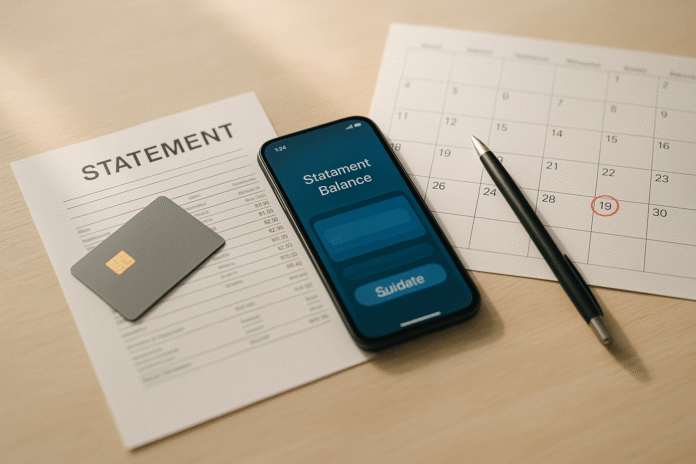
Credit cards can be powerful tools for everyday spending and building credit—if you know how they work. This guide is for beginners who want clear, practical explanations and guardrails to avoid unnecessary interest and fees. In short: a credit card lets you borrow up to a preset limit and repay later; if you pay on time and in full, you can usually avoid interest on purchases, but carrying a balance triggers interest calculated daily. What follows are 12 essentials—step-by-step, example-rich, and up-to-date (as of now)—to help you use credit confidently. This article is educational information, not financial advice.
1. Credit Limits & Utilization (Why Your Balance-to-Limit Ratio Matters)
Your credit limit is the maximum you can borrow on the card, and your utilization is how much of that limit you’re using. Keeping utilization low—ideally under 30% and even better in the 1–10% range—supports stronger credit scores and reduces the risk of penalty pricing. In practice, utilization is calculated per card and across all cards, so both your single-card ratio and your overall ratio matter. Because issuers and bureaus typically snapshot data around your statement closing date, a card that reports a high balance even if you pay in full later can still temporarily raise your utilization. The fix is simple: pay (or prepay) before the statement closes or spread purchases over multiple cards to keep each card’s ratio moderate. If you’re new to credit, starting limits may be modest; responsible use can lead to higher limits over time.
1.1 Numbers & guardrails
- Quick math: Utilization = balance ÷ limit. A $250 balance on a $1,000 limit = 25%.
- Aim for <30% at statement close; <10% is often ideal for score optimization.
- Watch per-card and overall utilization; both can impact your score.
- Big month coming? Prepay mid-cycle or ask for a credit limit increase (no guarantee).
- Avoid maxing out: 90–100% utilization can harm scores and may invite adverse actions.
1.2 Mini-example
- Limit: $3,000. Balances: Card A $600, Card B $0. Overall utilization: $600 ÷ $3,000 = 20%. If you instead put the same $600 on a card with a $1,000 limit, the per-card utilization is 60%—which can look riskier even if your total debt hasn’t changed.
Bottom line: Low utilization—especially at statement close—helps your score and gives you breathing room.
2. Billing Cycles & Closing Dates (The Timeline That Drives Your Bill)
A billing cycle is the period (often 28–31 days) during which your purchases, payments, and credits are recorded, ending on a statement closing date that snapshots what you owe. After closing, your issuer generates a statement and must send or deliver it well before the payment due date—in the U.S., issuers must have procedures to ensure the statement goes out at least 21 days before payment is due. Charges after closing appear on the next statement, which can make your “current balance” differ from your “statement balance.” The closing date also matters for utilization reporting to credit bureaus and for grace-period eligibility on purchases. If your statement ever arrives unusually late, you still have protections; contact your issuer right away.
2.1 How to work the calendar
- Mark three dates: transaction, closing, and due date.
- Pay before closing to lower the statement balance (and reported utilization).
- Expect the same due date each month (e.g., always the 15th), barring rare exceptions.
- Purchases right at closing may post next cycle if they’re still pending.
- If mail delivery is delayed, ask for electronic statements/alerts as a backup.
2.2 Mini timeline example
- Cycle: Aug 5–Sep 3 (closing Sep 3). Due date: Sep 28. Purchases Aug 20 and Sep 2 appear on the Sep 3 statement. A purchase on Sep 4 appears next cycle. Paying the statement balance by Sep 28 preserves purchase grace (see Section 4).
Bottom line: Know your closing and due dates; they drive reporting, grace periods, and cash-flow planning.
3. Statements, Balances & Due Dates (What to Pay—and When)
Your statement balance is what you owed at closing for that cycle; your current balance includes transactions after closing. Paying the statement balance by the due date typically prevents interest on purchase transactions if a grace period applies to your account. The statement also lists the minimum payment, fees, interest charges, and a standardized warning showing how long repayment takes if you only pay the minimum (plus an example showing what you’d pay monthly to clear the balance in 36 months). Confusing these balances can cost you: paying only part of the statement balance usually breaks the grace period on purchases, and paying the current balance when it’s higher than the statement balance is fine—but not required to avoid interest on purchases if grace conditions are met.
3.1 Read your statement like a pro
- Check transactions, fees, and interest line items for errors.
- Find the “minimum payment warning” and 36-month payoff example for perspective.
- Note all APRs (purchases, cash advances, balance transfers, penalty APR).
- Confirm the payment address/routing and cut-off time for same-day credit.
- If something looks wrong, dispute promptly (see Section 11).
3.2 Quick example
- Statement balance: $820; current balance: $940 (you bought $120 after closing). Pay $820 by the due date to preserve the purchase grace period. You can pay more, but you don’t have to pay the $120 yet to avoid interest on purchases—assuming you’re keeping grace (see specifics in Section 4).
Bottom line: Treat the statement balance as your target to avoid purchase interest, and audit statements monthly.
4. Grace Periods (Interest-Free Time—And How You Can Lose It)
A grace period is the window between your statement closing date and due date during which no interest is charged on purchases if you paid the prior cycle’s balance in full and pay the current statement balance by the due date. Issuers are not required to offer a grace period, but most do for purchases. Importantly, grace periods typically don’t apply to cash advances and often don’t apply to balance transfers—those can accrue interest immediately. If you carry any purchase balance past the due date, you usually lose the grace period on new purchases, meaning they accrue interest from the transaction date until you get back to paid-in-full status by a future due date.
4.1 Guardrails to keep grace
- Always pay on time and in full (statement balance) each cycle.
- Avoid mixing a 0% transfer with new purchases on the same card; purchases may accrue interest right away if grace is lost.
- Remember: cash advances generally have no grace and a higher APR.
- If you lost grace, restore it by paying the full statement balance on a subsequent cycle.
4.2 Mini timeline
- You paid July’s statement in full by Aug 25. Your Aug statement closes Aug 5; due date Aug 30. You pay the Aug statement balance by Aug 30—no purchase interest for that cycle. If you had underpaid July’s balance, your August purchases would likely accrue interest from the purchase date.
Bottom line: Grace is earned by paying your statement in full and on time—and it’s easy to forfeit if you carry a purchase balance.
5. APRs & Interest Calculation (Average Daily Balance, Daily Rate, and Prime)
The APR (annual percentage rate) is your yearly cost of borrowing, but interest is typically calculated daily using a daily periodic rate on your average daily balance. Most cards have variable APRs tied to an index like the prime rate, plus a fixed margin in your card agreement. When the prime rate changes, your variable APR usually changes in lockstep. For context, major U.S. banks lowered prime from 7.50% to 7.25% in mid-September 2025, and issuers update variable APRs accordingly. Cards often have multiple APRs: one for purchases, a higher one for cash advances, possibly a promo APR for transfers, and a penalty APR if you fall 60+ days late.
5.1 Numbers in action
- Daily periodic rate = APR ÷ 365. Example: 24% APR → 0.24/365 ≈ 0.000658 (0.0658% per day).
- Interest for one cycle ≈ (Average Daily Balance) × (Daily Rate) × (Days in cycle).
- Suppose your average daily balance is $1,200, APR 24%, cycle 30 days: interest ≈ 1,200 × 0.000658 × 30 ≈ $23.67.
- Variable APRs move with prime; your agreement discloses index + margin (e.g., Prime + 14.99%).
5.2 Mini-checklist
- Find your index (usually prime) and margin in your card agreement.
- Watch for promo APR durations (at least six months by rule for many offers).
- Avoid triggering a penalty APR (commonly high and sticky) by staying current.
- Pay early or mid-cycle if you’re carrying a balance—reduces the average daily balance and interest.
Bottom line: Daily math governs your interest; knowing your index, margin, and timing lets you actively shrink interest costs.
6. Minimum Payments & Payoff Math (Why “Minimum Only” Is Expensive)
The minimum payment keeps your account current, but it’s designed to be low—often a small percentage of your balance plus any interest and fees. Paying only the minimum dramatically lengthens repayment time and increases total interest paid. U.S. statements must show a minimum payment warning and a 36-month payoff example to illustrate the trade-off. Minimum formulas vary: some issuers use “1% of principal + interest + fees,” others “2% of total balance” (or a fixed dollar floor like $25). Whatever the formula, the smaller the principal portion, the slower your balance falls.
6.1 How to speed up payoff
- Round up beyond the minimum—set a fixed payment higher than last month’s minimum.
- Make a mid-cycle extra payment to cut the average daily balance (and interest).
- Consider a 0% balance transfer (see Section 9) if fees + runway pencil out.
- Use a payoff calculator and set an automatic overpayment each month.
- Focus on highest APR balances first if you carry debt across cards.
6.2 Numeric example
- Balance: $2,000 at 24% APR. If the minimum is “1% of principal + interest & fees,” month one’s interest is about $40, so your minimum might be around $60. Paying only the minimum will hardly dent principal at first, stretching repayment and total interest. Commit to $150–$200 per month instead, and the timeline/interest drop sharply.
Bottom line: The minimum protects your credit standing, not your wallet. Pay more—earlier and consistently—to slash interest and time.
7. Fees 101 (Annual, Foreign Transaction, Balance Transfer, Cash Advance, and Penalties)
Credit card pricing mixes interest with fees. Common ones include an annual fee (often tied to premium rewards), foreign transaction fee (some cards charge ~1–3% per foreign purchase; others charge none), balance transfer fee (often 3–5% of the amount transferred), and cash advance fee (e.g., $10 or 5%, whichever is greater). Penalty fees include late fees and returned-payment fees. Regulations also curb certain practices: inactivity fees are prohibited, and there are rules to prevent multiple fees for the same event or fees that exceed the dollar amount of the violation.
7.1 What changed with late fees?
- A 2024 federal rule attempted to cap large-issuer late fees at $8, but a federal court vacated that rule in April 2025. As of now, late fee amounts are set by issuers within existing law and disclosures—check your card’s pricing.
- Takeaway: don’t assume a universal $8 cap applies; read your statement’s Fee section.
7.2 Practical tips
- Traveling abroad? Consider a card with no foreign transaction fees.
- Balance transfer? Compare the fee versus the interest saved; run the math.
- Avoid cash advances: they typically have higher APR, no grace period, and cash-advance fees.
- Set autopay (Section 12) to avoid late fees entirely.
Bottom line: Fees are avoidable with the right card and habits—know your pricing schedule and pay on time.
8. Rewards & Redemptions (Value, Pitfalls, and Simple Strategies)
Rewards can be great—cash back, points, or miles on purchases—but the value depends on earn rates, redemption options, and whether you carry a balance. Interest charges can quickly erase rewards value. Many general-purpose cash-back cards effectively redeem at 1¢ per point (1% cash back = 1¢ per dollar), while travel programs vary widely by partner and redemption. Rotating categories, quarterly activations, and caps complicate things. Also note exclusions: interest, fees, cash advances, balance transfers, and certain money-equivalent purchases often don’t earn rewards.
8.1 Keep rewards simple
- If you carry a balance, focus on low APR or debt payoff—not maximizing rewards.
- Prefer flat-rate cash back if you want “set-and-forget” value.
- Use category cards only if you track caps/activations reliably.
- Avoid gift-card or cash-equivalent purchases that may be excluded from earning.
8.2 Mini-checklist
- Verify redemption rates (statement credit vs. travel partners).
- Watch for expiration or devaluation risks.
- Pay the statement balance monthly so rewards aren’t offset by interest.
- Consolidate points only if you understand transfer ratios and rules.
Bottom line: Rewards can add up—but only if you avoid interest and understand your program’s fine print.
9. Cash Advances & Balance Transfers (Immediate Interest vs 0% Windows)
Cash advances give you cash from your credit line but usually at a higher APR, with a cash-advance fee, and no grace period—interest accrues from the transaction date. They’re best reserved for true emergencies and paid off fast. Balance transfers move debt from one card to another, often with an introductory 0% APR for a set period and a transfer fee (commonly 3–5%). Transfers can save substantial interest if you avoid new purchases that might lose grace, and if you pay the transferred balance off before the promo ends.
9.1 Do the transfer math
- Calculate: Interest you’d otherwise pay vs. transfer fee + any annual fee.
- Ensure the promo lasts long enough (intro rates generally must last at least 6 months).
- Don’t swipe that transfer card for purchases unless you’re sure grace still applies.
- Set automatic payments to clear the transfer before the promo expires.
9.2 Mini scenario
- You owe $4,000 at 24% APR. A card offers 0% for 18 months with a 3% fee ($120). If you can pay ~$230/month, you’ll clear it inside the window and likely save hundreds in interest compared with staying at 24%—as long as you don’t add new purchases that accrue interest.
Bottom line: Cash advances are costly; balance transfers can be smart when the fee is lower than the interest you’d otherwise pay and you stick to a payoff plan.
10. Credit Scores & Reports (How Card Use Shapes Your Profile)
Credit cards influence your credit through payment history (on-time payments are critical) and utilization (Section 1). Paying on time and keeping balances low are two of the most effective ways to support your score. Opening a new card can add a hard inquiry and reduce your average age of accounts, which may cause a short-term dip even if it helps utilization by adding available credit. Over time, a long on-time history and prudent utilization tend to matter more than small, temporary fluctuations. If you’re trying to build or rebuild credit, consider a secured card or becoming an authorized user on a well-managed account.
10.1 Practical steps
- Autopay at least the statement balance (or minimum if cash is tight) to protect payment history.
- Keep utilization below 30% at statement close; lower is typically better.
- Check your credit reports (U.S.: you can access them free regularly) and dispute errors.
- Avoid applying for multiple new cards in quick succession.
10.2 Mini-example
- Your score dips after opening a new card due to a hard inquiry and lower average age, but your overall utilization improves from 45% to 18% thanks to the added limit. Within a few months of on-time payments, your score often recovers and can surpass the prior level.
Bottom line: On-time payments and low utilization are the heavy hitters; don’t chase points at the expense of these fundamentals.
11. Security, Fraud Protections & Disputes (Zero Liability and Chargebacks)
Credit cards offer robust protections for unauthorized transactions—major networks advertise zero liability for fraud if you report promptly. If you spot an error on your statement (wrong amount, goods not received), raise a billing dispute with your issuer quickly and follow up in writing when appropriate. Keep copies of receipts, emails, and delivery confirmations. If the issuer denies your dispute, you can often appeal and, in some regions, escalate to regulators or ombuds services. Outside the U.S., protections vary: the U.K.’s Section 75 can make the card provider jointly liable with the merchant on eligible purchases; many EU countries support chargeback frameworks through network rules and consumer directives.
11.1 Fast response checklist
- Lock your card in the app if you suspect compromise; request a replacement card.
- Report unauthorized charges immediately; monitor for credits/reversals.
- For billing errors, call first, then consider sending the issuer a written dispute with documentation.
- Save communications and track deadlines; escalate if needed (e.g., regulator/ombudsman).
11.2 Region notes
- U.S.: Broad zero-liability policies via card networks; formal dispute rights under federal law.
- U.K.: Section 75 (typically for £100–£30,000 purchases) may provide statutory recourse with the card provider.
- EU/EEA: Chargeback practices vary by country; many rely on card-network rules alongside consumer law.
Bottom line: Act quickly, document thoroughly, and know your rights; credit cards generally protect you better than debit for disputed purchases.
12. Smart Setup: Autopay, Alerts & Tools (Set It Once, Prevent Problems)
The easiest way to avoid late fees and interest is to automate good behavior. Set autopay to at least the statement balance (or the minimum if cash flow is variable) and layer alerts for due dates, large transactions, and international purchases. Many issuers let you change the payment due date to fit your paycheck schedule. Consider mid-cycle principal payments if you carry a balance—this reduces the average daily balance and interest. Finally, review your statement monthly even with autopay; automation prevents missed payments, but it doesn’t catch subscription creep or fraudulent charges.
12.1 Tools & tips
- Autopay options: minimum, statement balance, or fixed amount; choose what aligns with your cash flow.
- Alerts: due date reminders, utilization thresholds (e.g., when a card crosses 30%), and travel notifications.
- Budgeting: connect your card to a budgeting app or your bank’s tools; categorize and cap discretionary spend.
- Calendar: set recurring reminders a few days before closing and due dates.
12.2 Quick safety net
- Keep a small buffer in your checking account to cover autopay.
- If a payment hiccups, call immediately—issuers sometimes waive a first-time late fee as a courtesy.
- If money is tight, switch autopay to minimum temporarily to protect payment history, then add one-off extra payments when funds arrive.
Bottom line: Automation plus monthly review eliminates most avoidable mistakes—and helps you keep grace, avoid fees, and stay in control.
FAQs
1) What’s the simplest way to avoid credit card interest on purchases?
Pay the statement balance in full by the due date every month. That preserves the purchase grace period, so new purchases from the last cycle don’t accrue interest. If you’ve been carrying a purchase balance and lost grace, restore it by paying the full statement balance on a subsequent cycle. Remember: cash advances generally have no grace period, so they accrue interest immediately.
2) What’s the difference between the statement balance and current balance?
The statement balance is a snapshot at closing—what you owed for that cycle. The current balance includes transactions since closing. To avoid interest on purchases (assuming grace), prioritize paying the statement balance by the due date; you can pay the current balance if you want to stay closer to zero or reduce utilization further.
3) How are credit card interest charges calculated?
Most issuers use the average daily balance method. They compute a daily periodic rate (APR ÷ 365), multiply it by your balance each day, sum for the cycle, and charge that interest. Paying earlier in the cycle lowers the average daily balance, trimming interest. Variable APRs usually change when the prime rate changes.
4) Do balance transfers affect my grace period on purchases?
They can. If you carry any balance (including a 0% transfer) and don’t pay your statement balance in full, many cards treat new purchases as interest-bearing from the transaction date. A common strategy is to avoid new purchases on a transfer card until the transfer is paid off.
5) What late fee applies now—is it $8?
A 2024 rule to cap large-issuer late fees at $8 was vacated by a federal court in April 2025. As of now, issuers set late fee amounts within existing law and your agreement. The surest way to avoid any late fee is autopay plus alerts.
6) What utilization should I aim for?
For score health, keep under 30% at statement close; under 10% is often better when you’re actively seeking top scores. Utilization is measured per card and overall, so avoid maxing any single card even if your total utilization looks fine.
7) Why did my APR change even though I didn’t miss a payment?
Most cards have variable APRs tied to an index (commonly prime). When the index moves—up or down—your APR usually changes. Issuers disclose the index and your margin (e.g., Prime + 14.99%) in your agreement. Penalty APRs are a different story and can activate if you’re 60+ days late.
8) Are cash advances ever a good idea?
They’re generally costly: higher APR, no grace, and a cash-advance fee—plus some ATMs add surcharges. If unavoidable, borrow only what you need and repay immediately. Consider alternatives like a small personal loan, payment plan, or tapping savings.
9) How do payment allocations work if I pay more than the minimum?
Amounts above the minimum must generally be applied to the highest-APR balance first (e.g., cash advances ahead of purchases). This helps you pay down costlier debt faster. Your statement should show your balances by category and APR.
10) I’m outside the U.S.—do I have similar protections?
Protections vary. In the U.K., Section 75 can make the lender jointly liable with the merchant for eligible purchases (£100–£30,000). In many EU countries, chargeback systems and consumer directives provide dispute avenues, though details differ by nation and network. Always review your local rights and your card’s terms.
Conclusion
Mastering credit card basics comes down to understanding the calendar (closing and due dates), the math (APR → daily rate → interest), and the rules (grace periods, fees, and dispute rights). Keep utilization low, pay on time, and whenever possible pay the statement balance in full to preserve grace and avoid interest on purchases. If you carry a balance, attack it with mid-cycle payments and consider a 0% transfer only when the fee and runway make sense. Set autopay and alerts so life’s busyness doesn’t cost you money, and audit every statement for errors or fraud. With these 12 essentials in place, you’ll reduce costs, protect your credit, and make rewards a bonus—not a distraction.
CTA: Set autopay to the statement balance and put your closing date on your calendar today—future you will thank you.
References
- “What is a grace period for a credit card?” Consumer Financial Protection Bureau (CFPB), Sept 25, 2024. https://www.consumerfinance.gov/ask-cfpb/what-is-a-grace-period-for-a-credit-card-en-47/
- “What is a ‘daily periodic rate’ on a credit card?” CFPB, Sept 25, 2024. https://www.consumerfinance.gov/ask-cfpb/what-is-a-daily-periodic-rate-on-a-credit-card-en-46/
- “How does my credit card company calculate the amount of interest I owe?” CFPB, Jan 22, 2024. https://www.consumerfinance.gov/ask-cfpb/how-does-my-credit-card-company-calculate-the-amount-of-interest-i-owe-en-51/
- Regulation Z §1026.7 Periodic Statement (current), CFPB. https://www.consumerfinance.gov/rules-policy/regulations/1026/7
- Regulation Z §1026.5 General Disclosure Requirements (21-day statement timing) (current), CFPB. https://www.consumerfinance.gov/rules-policy/regulations/1026/5
- “Consumer Credit—G.19 (Current Release: July 2025),” Board of Governors of the Federal Reserve System, Sept 8, 2025. https://www.federalreserve.gov/releases/g19/current/
- “Using Credit Cards and Disputing Charges,” Federal Trade Commission (FTC), (updated, accessed Sept 2025). https://consumer.ftc.gov/articles/using-credit-cards-and-disputing-charges
- “Zero Liability,” Visa (accessed Sept 2025). https://usa.visa.com/supporting-info/zero-liability.html
- “Zero Liability Protection,” Mastercard (accessed Sept 2025). https://www.mastercard.com/us/en/personal/protection-and-security/zero-liability-protection.html
- “What is the difference between a fixed APR and a variable APR?” CFPB, Jan 22, 2025. https://www.consumerfinance.gov/ask-cfpb/what-is-the-difference-between-a-fixed-apr-and-a-variable-apr-en-45/
- “Will paying off my credit card balance every month improve my score?” CFPB, Jan 29, 2024. https://www.consumerfinance.gov/ask-cfpb/will-paying-off-my-credit-card-balance-every-month-improve-my-score-en-1293/
- “What Is a Credit Utilization Rate?” Experian, Nov 5, 2023. https://www.experian.com/blogs/ask-experian/credit-education/score-basics/credit-utilization-rate/
- Regulation Z §1026.53 Allocation of Payments (current), CFPB. https://www.consumerfinance.gov/rules-policy/regulations/1026/53
- “Judge scraps US rule capping credit card late fees at $8,” Reuters, Apr 15, 2025. https://www.reuters.com/business/finance/judge-scraps-us-rule-capping-credit-card-late-fees-8-2025-04-15/
- “Section 75: credit card payment protection,” MoneyHelper (UK), accessed Sept 2025. https://www.moneyhelper.org.uk/en/everyday-money/credit/how-youre-protected-when-you-pay-by-card
- “Chargeback in the EU/EEA,” European Consumer Centre Network (ECC-Net), Jan 11, 2023. https://www.eccnet.eu/publication/chargeback-eueea
- “Know Before You Owe: Credit cards,” CFPB, Dec 12, 2024. https://www.consumerfinance.gov/data-research/credit-card-data/know-you-owe-credit-cards/
- “Set Up Automatic Credit Card Payments,” NerdWallet, updated Sept 4, 2025. https://www.nerdwallet.com/article/credit-cards/how-to-set-up-automatic-credit-card-payments
- “Credit card contract definitions” (Average daily balance; grace period; fee placement), CFPB, Feb 10, 2023. https://www.consumerfinance.gov/data-research/credit-card-data/know-you-owe-credit-cards/credit-card-contract-definitions/
- “How long can I keep a low rate on a balance transfer or other introductory rate?” CFPB, Sept 25, 2024. https://www.consumerfinance.gov/ask-cfpb/how-long-can-i-keep-a-low-rate-on-a-balance-transfer-or-other-introductory-rate-en-15/