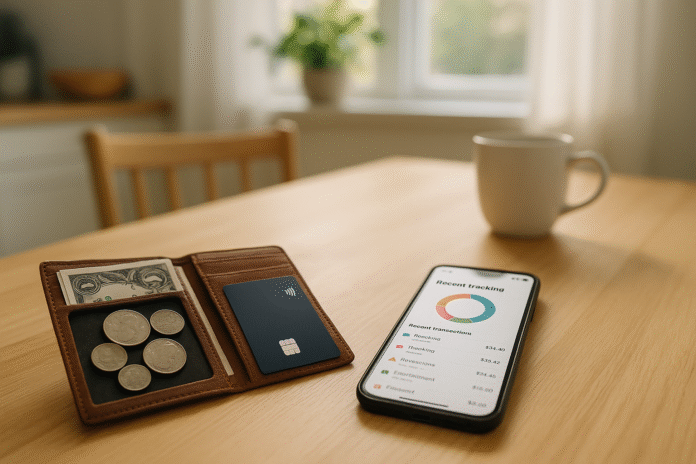
If your goal is easier, more reliable expense tracking, cards generally win because they create an automatic, searchable data trail that budgeting tools can categorize with minimal effort. Cash can still be the better choice for spending control and privacy, but it demands deliberate systems (receipts, envelopes, or immediate logging) to avoid gaps. Below, we compare cash vs card across nine decision factors—data capture, accuracy, protections, privacy, rewards and fees, convenience, international use, and hybrid setups—so you can pick the right method per category and situation. This guide is educational, not financial, tax, or legal advice.
A quick answer: Cards usually make expense tracking easier due to automatic transaction records and category rules in apps; cash can make self-control easier for impulse categories but requires more manual work (receipt scanning or immediate entry). As of now, cash continues to decline in share of U.S. payments, while digital card usage—and bank-connected budgeting—keeps growing, which matters for tool support and automation.
1. Data Trail & Categorization
Direct answer: Cards are easier for tracking because every transaction leaves a timestamped digital trail that apps can auto-import and categorize; cash needs manual entry or receipt scanning.
For most people, the single biggest friction reducer is automatic data flow. With cards (credit or debit), your transactions sync into tools like Monarch, YNAB, or your bank’s own budgeting view via secure connections (open banking in many regions). Those transactions arrive with merchant names, amounts, and dates—ideal for rules-based categorization and monthly reviews. Cash lacks this passive pipeline. Unless you log each spend on the spot or scan the receipt later, gaps will creep in. Over weeks and months, the difference compounds: automated card data saves time and produces cleaner, more complete reports. In short, if you want your budget to “run in the background,” card rails help by default. In parallel, note that as of 2024–2025, open banking infrastructure is maturing—especially in the UK—which further stabilizes and standardizes data flows for consumer tools.
1.1 Why it matters
- Fewer missed transactions (no “I’ll log it later” problem).
- Consistent merchant labels make rules (“groceries → 80% budget alert”) work.
- Faster month-end reconciliation; no shoebox of cash receipts.
- Better historical analytics (trends by merchant/category).
1.2 Tools/Examples
- Open banking connections: standardized APIs for secure transaction sharing in the UK; similar data-access rules are advancing in the U.S. for portability. Open Banking
- Envelope-style apps for cash: If you prefer cash, digital envelopes (e.g., Goodbudget) add structure—just remember you still must enter or scan. Goodbudget
Synthesis: If you want near-zero maintenance tracking, cards (credit or debit) plus a modern budgeting app beat cash by providing a durable, searchable stream of transactions.
2. Spending Control & Behavior (“Pain of Paying”)
Direct answer: Cash can be better for controlling impulse spend, while cards can enable higher willingness to pay; this behavioral edge is why some people purposely use cash for “at-risk” categories.
Behavioral studies show that people tend to spend more when paying with cards than with cash, partly because digital payments reduce the immediate pain of paying. In a well-known experiment, researchers found willingness to pay could be up to ~100% higher when credit cards were used versus cash. This doesn’t mean you will overspend with cards, but it is a risk factor to acknowledge. If your tracking goal includes spend reduction, cash envelopes for dining-out, treats, or discretionary shopping can impose helpful friction. Conversely, if your priority is effortless tracking, you can keep cards but add guardrails (alerts, category caps, weekly reviews) to mitigate overshoot.
2.1 Numbers & guardrails
- Guardrail 1: Set a weekly discretionary cap (e.g., $60). Auto-alert at 80%.
- Guardrail 2: Use a “fun” category on a separate card for visibility; pause it when you hit the limit.
- Guardrail 3: Add a 24-hour delay rule for nonessential purchases over $50.
2.2 Mini case
You move dining/coffee to a cash envelope with $120/week. By Thursday, only $18 remains—an immediate, tactile signal to slow down. Your other categories stay on card for clean data. Net effect: high-frequency impulses drop, tracking remains automated.
Synthesis: Cards streamline tracking; cash can streamline self-control. Use the medium that best addresses your biggest pain point—then add guardrails if you stick with cards.
3. Accuracy, Reconciliation & Auditability
Direct answer: Cards produce more complete and auditable records with timestamps, merchants, and amounts—ideal for reconciliation; cash accuracy depends on your discipline with receipts.
Card statements deliver standardized lines you can tie out each month. If a transaction looks unfamiliar, you can search, tag, split, or dispute. Cash requires you to preserve proof (receipts, notes) and log promptly; otherwise, totals drift. From a tax or business-expense standpoint, digital records are increasingly accepted (in the U.S., the IRS explicitly accepts electronic records if they’re legible, indexed, and retrievable), and general record-retention guidance runs three years for most individual tax records (longer in special cases). That makes scanned receipts, cloud backups, and consistent file naming worth your time—especially if you prefer cash.
3.1 Mini-checklist (monthly)
- Reconcile card feeds to statements (last day of month).
- Scan or photo any cash receipts; add date/amount/category in filename.
- Resolve uncategorized or “rule conflicts.”
- Export a monthly PDF/CSV archive to cloud + offline backup.
3.2 Region note (U.S.)
IRS Publication 583 and related guidance confirm electronic records are acceptable if they meet legibility, integrity, and retrieval standards—meaning scanned receipts are fine when properly stored and indexed. IRS
Synthesis: For audit-ready, low-friction reconciliation, cards plus disciplined monthly reviews beat cash; cash works if—and only if—you maintain a robust scan-and-store habit.
4. Protections, Disputes & Liability (Credit vs Debit vs Cash)
Direct answer: Credit cards generally offer the strongest dispute rights and limited fraud liability; debit has protections with stricter timelines; cash offers no recourse if lost or stolen.
Under the Fair Credit Billing Act (FCBA), your liability for unauthorized credit card charges is capped at $50, and many issuers go further with zero-liability policies. You also have formal procedures and timelines to dispute billing errors or undelivered goods. Debit card protections fall under Regulation E (Electronic Fund Transfer Act): you typically must report issues within 60 days of the statement date listing the unauthorized transfer, or your liability can escalate (in some cases to unlimited amounts for transactions after that window). Cash, of course, offers no built-in dispute process if money is lost or stolen. For expense tracking, strong dispute rights reduce the chance that fraud or errors contaminate your reports for long.
4.1 Key timelines (U.S.)
- Credit (FCBA): dispute rights; $50 liability cap on unauthorized use.
- Debit (Reg E): report within 60 days of statement to avoid significant liability for subsequent unauthorized EFTs. Consumer Financial Protection Bureau
4.2 Mini-checklist
- Set real-time transaction alerts on all cards.
- Review statements monthly; dispute promptly.
- Use separate cards for recurring bills vs. daily spend to spot errors faster.
Synthesis: From a risk-management and data-integrity perspective, credit cards are easiest to keep “clean,” debit requires vigilance, and cash offers no remediation path.
5. Privacy, Data Sharing & Control
Direct answer: Cash wins on privacy because it leaves no routine digital trail; cards trade privacy for automation and analytics. Decide how much data exhaust you’re comfortable creating.
Card transactions expose patterns (merchants, times, locations) to banks, processors, and any budgeting apps you authorize. In exchange, you get automatic categorization, search, and analytics. If data-minimization is a top value, cash (or prepaid/local-only methods) reduces your footprint—but you’ll give up automation. Policy trends can help: open banking frameworks (e.g., the UK) and evolving U.S. rules aim to improve customer control over who accesses your financial data, for what purpose, and for how long—supporting safer portability between providers and easier revocation. Still, your privacy posture should drive your method choice, and you should review any app’s data-use terms.
5.1 Mini-checklist
- Prefer apps that support data export and access revocation.
- Use read-only bank connections where possible.
- Review privacy policies and delete stale connections annually.
5.2 When to favor cash
- Sensitive/personal purchases you prefer not to log digitally.
- Situations where merchant names could reveal health, religion, or political data you’d rather keep offline.
Synthesis: Automation requires trust. If privacy is paramount, cash reduces exposure; otherwise, cards plus good data-governance habits are the practical middle.
6. Rewards, Fees & Total Cost of Tracking
Direct answer: Cards can pay you (1.5–2% flat, 3–5% in categories) and add purchase protections; cash has no rewards but can help you stay on budget. Factor in fees (FX, ATM) and interest risks.
For many households, the spreadsheet math favors cards if you never carry a balance: a flat 1.5–2% cash-back is common, and rotating/boosted categories often hit 5% (with caps and activation requirements). Those earnings easily exceed the “cost” of manual cash tracking time. But rewards can tempt overspending, and balances erase value via interest. Internationally, cards may add foreign transaction fees (often up to ~3%); cash withdrawals can carry ATM fees. Choose the medium that keeps you both on budget and net-positive after fees.
6.1 Numeric example
- Spend $2,000/month on a 2% card → $480/year in cash back.
- If the same spend in cash makes you overshoot by $50/month due to poor tracking, that’s $600/year lost—more than the rewards.
6.2 Mini-checklist
- Avoid carrying balances; automate full statement payments.
- Track FX and ATM fees when traveling; prefer no-FX cards.
- Don’t chase categories that don’t match your real spend.
Synthesis: Rewards can subsidize your tracking life—if you avoid interest and choose cards that fit your actual spending pattern.
7. Acceptance, Convenience & Speed
Direct answer: Cards are accepted almost everywhere (including online), generate instant records, and speed checkout; cash helps when cash discounts exist or for small/local vendors—but it slows tracking.
In day-to-day life, cards are faster and more universal, especially online and in-app. This ubiquity matters for tracking: the more places you can use a card, the fewer cash gaps you’ll have to log manually. Cash still shines for micro-vendors, street markets, or when merchants offer a small cash discount—though you’ll trade away automatic record-keeping. At the macro level, U.S. payment diaries show ongoing declines in cash share (from 16% in 2023 to 14% in 2024), reflecting a steady shift toward digital rails that budgeting apps support best.
7.1 Tips
- Keep one no-annual-fee card for wide acceptance and alerts.
- For cash-heavy events (fairs, festivals), pre-decide a fixed envelope.
- For local vendors, ask about card minimums or discounts before paying.
Synthesis: In a world that’s increasingly digital-first, cards minimize friction and missing data, while cash remains situationally useful.
8. International & Multi-Currency Use
Direct answer: For tracking across currencies, cards are easier: statements unify FX conversions and dates; cash requires juggling exchange rates, ATM slips, and receipts.
When abroad, card statements consolidate purchases into your home currency (or show the FX detail), which simplifies categorization and tax documentation. Many cards still charge foreign transaction fees (often up to ~3%), while some waive them; rotating-category cards may or may not reward travel or forex purchases. Cash means ATM planning, withdrawal fees, and manual entry—plus higher risk of lost slips. Trackers should disable dynamic currency conversion (DCC) when offered (pay in local currency) and prefer cards without FX fees. Keep a simple travel sheet to reconcile lodgings that post later and per diem cash spends.
8.1 Mini-checklist (travel)
- Use a no-FX-fee card; decline DCC.
- Log cash withdrawals as transfers to “Travel Cash” with fees.
- Save digital receipts for VAT refunds or per-diem claims.
Synthesis: For multi-currency tracking, cards win on clarity and consolidation; cash is viable but creates administrative overhead.
9. Best-Fit Hybrid: Match the Method to the Category
Direct answer: The easiest system for most people is hybrid—cards for bills and predictable categories (automation), cash for impulse-risk or privacy-sensitive categories (control).
You don’t have to pick one method globally. Use cards where you value automation (utilities, groceries, transit, subscriptions) and cash where friction helps (takeout treats, novelty shopping). Combine this with rules-based categorization, receipt scanning for cash, and a monthly reconciliation ritual. In the UK and several markets, open banking makes multi-account aggregation easier; in the U.S., evolving data-access rules improve portability and revocation, so you can safely test budgeting apps and switch later. The real win is fit: maintain the smallest system that you’ll actually keep using for 12 months straight.
9.1 Mini hybrid playbook
- Cards: all recurring bills, transit, fuel, groceries.
- Cash: cafes/treats, local markets, “fun money.”
- Both: travel (card primary; small local cash float).
9.2 Monthly close-out
- Export one CSV per card + a cash ledger total.
- Reconcile to statements; scan any straggler cash receipts.
- Review category overages; adjust next month’s envelopes or card rules.
Synthesis: Hybridizing lets you capture the automation gains of cards while preserving the behavioral benefits of cash—without bloating your workflow.
FAQs
1) Is cash or card better for expense tracking overall?
For most people, cards are better because they create a complete, searchable data trail that budgeting tools categorize automatically. Cash can help you spend less on discretionary items, but you’ll need to scan receipts or log transactions immediately to avoid gaps. Pick based on your main problem: if you forget to log, use cards; if you overspend, consider cash for “at-risk” categories.
2) Do people really spend more with cards than with cash?
Evidence suggests many do. Classic experiments found willingness to pay could be up to ~100% higher with credit cards than with cash. That doesn’t doom you to overspending; it simply highlights a risk. If you prefer card automation, add alerts, category caps, and weekly reviews to replicate cash’s friction without losing data integrity.
3) Which protects me more against fraud—credit, debit, or cash?
Credit cards generally provide the strongest dispute rights and a $50 liability cap for unauthorized charges under the FCBA; many issuers go further with zero-liability. Debit cards are protected by Reg E, but reporting windows are tighter (typically 60 days from the statement date for unauthorized transfers). Cash has no built-in recourse. For clean books and lower risk, credit wins.
4) If I use cash, will the IRS accept scanned receipts?
In the U.S., yes—electronic records are acceptable if they are legible, indexed, and retrievable; Publication 583 and related IRS pages explain electronic recordkeeping. Keep receipts ~3 years (longer for special cases), and ensure your storage system allows quick retrieval during an audit.
5) How do rewards and fees change the card vs cash decision?
If you pay in full, a 1.5–2% flat cash-back card (and 5% rotating categories with caps) can offset costs and “pay you” for using cards. If you carry balances, interest wipes out rewards. Also consider foreign transaction and ATM fees when traveling. Track the net after fees and interest rather than just the headline rewards rate.
6) Are debit cards a good compromise?
Debit provides automation like credit (easy imports and categorization) without credit-line risks. But dispute protections differ and timelines are stricter under Reg E, so enable alerts and check statements promptly. If you want automated tracking but avoid credit, debit can work—just be vigilant about the 60-day notice rule.
7) What’s the simplest setup if I’m overwhelmed?
Start with one no-annual-fee card for all everyday purchases, connect it to a budgeting app, set a weekly discretionary cap with alerts, and do a 30-minute reconciliation each month. Keep a small cash envelope for impulse categories (coffee, snacks) if self-control is the priority. This keeps your workflow light while covering both automation and behavior.
8) How does open banking change expense tracking?
Open banking (e.g., in the UK) standardizes and secures data sharing from banks to apps, improving reliability and making it easier to switch providers while controlling access. In the U.S., evolving rules similarly aim to strengthen consumer control and portability. That means fewer broken connections and safer revocation if you change apps.
9) Is cash becoming obsolete for everyday expenses?
Not obsolete—but less common. U.S. studies show cash’s share keeps shrinking (from 16% in 2023 to 14% in 2024). Many small vendors still accept and sometimes prefer cash, and some people find it better for limiting discretionary spend. Use it intentionally rather than by default.
10) What’s a practical hybrid rule of thumb?
Put recurring bills and routine purchases on a card (automation, rewards). Use cash envelopes for categories where you’re prone to overspend. Scan cash receipts weekly, reconcile monthly, and keep one “fun” card or envelope with a fixed cap. This mix balances control with convenience.
Conclusion
“Easier” expense tracking depends on where your current system breaks. If you routinely forget to log purchases or dread month-end clean-up, cards plus a budgeting app are the fastest path to clean, complete records. Automated feeds, rules-based categorization, and searchable histories make reconciliation a 30-minute task instead of a weekend chore. If your pain point is overspending, cash’s friction (and visual scarcity) can cut discretionary outflow even without complex rules. Most readers will get the best result from a hybrid: cards for predictable, high-volume categories (groceries, transit, utilities) and cash for impulse-prone or privacy-sensitive areas. Add monthly reconciliation, receipt scanning where needed, alerts on all cards, and a fixed “fun” cap. That’s a durable system you can actually keep for a year.
CTA: Pick one card to automate—and one envelope to discipline—then run the plan for 90 days.
References
- 2024 Findings from the Diary of Consumer Payment Choice, Federal Reserve Bank of Atlanta, 2024. Federal Reserve Bank of Atlanta
- Prelec, D. & Simester, D., “Always Leave Home Without It: A Further Investigation of the Credit-Card Effect on Willingness to Pay,” Marketing Letters, Feb 2001 (Springer). https://link.springer.com/article/10.1023/A:1008196717017 SpringerLink
- Using Credit Cards and Disputing Charges, Federal Trade Commission (FTC), last updated 2022. Consumer Advice
- Regulation E — 1005.6 Liability of consumer for unauthorized transfers, Consumer Financial Protection Bureau (CFPB), current regulation page. Consumer Financial Protection Bureau
- What kind of records should I keep? Internal Revenue Service (IRS), page last reviewed 2024–2025. IRS
- How long should I keep records? Internal Revenue Service (IRS), page last reviewed Jun 29, 2025. IRS
- Rev. Proc. 97-22 — Electronic Storage Systems Guidance, Internal Revenue Service (IRS). IRS
- Delivering the Roadmap — Open Banking (UK), Open Banking Limited, 2025. Open Banking
- Doctorow, C., “No Matter What the Bank Says, It’s YOUR Money, YOUR Data, and YOUR Choice,” Electronic Frontier Foundation, Oct 30, 2024. Electronic Frontier Foundation
- What Is the Standard Cash-Back Rate for Credit Cards? NerdWallet, May 2025. NerdWallet
- How Does Cash Back Work? Bankrate, May 2025. Bankrate
- Best 5% Cash Back Credit Cards, Bankrate, Jun 2025. Bankrate