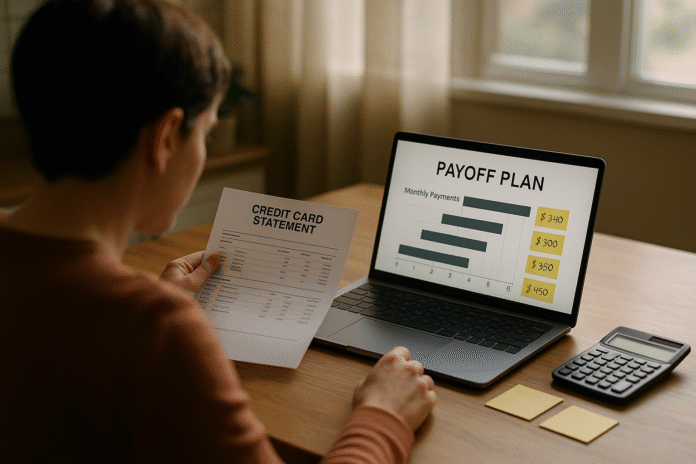
If you’re carrying high-interest credit card debt, a balance transfer credit card can give you a defined runway—often 12 to 21 months of 0% intro APR—to crush the balance without interest drag. This case study shows exactly how to plan, apply, transfer, and pay off a real balance using a disciplined, step-by-step strategy, including the math, timelines, and guardrails that matter. It’s written for anyone comparing payoff options and wanting a tested playbook that avoids gotchas like fees, grace-period traps, and promo rate forfeits. Brief disclaimer: this is educational information, not individualized financial advice—compare terms and consider your own circumstances.
Fast answer: A balance transfer lets you move an existing credit card balance to a new card, often at 0% intro APR for a limited time, typically with a 3%–5% transfer fee; the goal is to eliminate interest so more of every payment hits principal.
At-a-glance steps (used throughout this article):
- Audit your debts and confirm a balance transfer is the right fit.
- Choose a card with a long enough promo APR window and a low transfer fee.
- Do the math: fee, payoff timeline, and required monthly payment.
- Apply strategically and protect your credit profile.
- Initiate the transfer and set up autopay plus guardrails.
- Execute the plan—avoid new purchases and late payments.
- Exit cleanly before the promo ends; if needed, pivot to Plan B.
Our working case: $12,000 on an old card at ~24% APR (typical general-purpose card rates over 20% as of mid-2025), transferred to a 0% intro APR balance transfer card for 18 months with a 3% fee. That creates a payoff target of $12,360 ÷ 18 = $686.67/month.
1. Confirm a Balance Transfer Is the Right Tool for Your Debt
A balance transfer is best when you can qualify for a promotional 0% APR long enough to finish the job and you’re confident you can make on-time payments every month. In simple terms, you’re swapping high interest for a time-boxed, low- or zero-interest runway; the fee you pay up front should be much less than the interest you’d otherwise pay over the same period. It’s not a cure-all: if cash flow is unstable, or if you’re likely to add new charges or miss due dates, the tool can backfire by forfeiting the promo and exposing you to a high “go-to” APR. Start by reviewing your balances, interest rates, minimums, and monthly budget. If the plan requires heroic payments you can’t sustain, consider alternatives like a fixed-rate debt consolidation loan or a nonprofit debt management plan.
1.1 Why it matters
- If your old APR is ~20%–25% (common in 2025), every $10,000 costs ~$167–$208 in interest per month just to stand still. Eliminating that drag accelerates principal payoff.
- The transfer fee (often 3%–5%) is a one-time cost you can quantify up front and compare to expected interest savings.
- A balance transfer may temporarily dip your credit score via a hard inquiry and new account, but improved utilization after the transfer (and eventual payoff) can help over time.
1.2 Quick fit-checklist
- You can afford the monthly payment needed to finish before the promo ends.
- Your credit profile is competitive for approval (e.g., no recent delinquencies, utilization trending down).
- You can commit to no new purchases on the transfer card.
- You can set up autopay and calendar reminders.
Synthesis: Choose a balance transfer when the numbers show clear savings and your behavior supports on-time payments and no new debt; otherwise, opt for a safer alternative.
2. Pick the Right Balance Transfer Credit Card (Term, Fee, Limit)
The “right” card is the one whose promo length is long enough for your payoff schedule, whose transfer fee is as low as possible, and whose credit limit can accept the amount you plan to move. Many cards offer 0% intro APR on transferred balances for 12–21 months; shorter terms demand bigger payments to finish in time, while longer terms offer more cushion but sometimes at a higher fee. Verify whether the 0% applies to balance transfers only or to purchases as well—mixing purchases can trigger interest immediately if you’re carrying any balance. Finally, check any transfer window (e.g., “within 60 days of account opening”) and the minimum/maximum transfer amounts.
2.1 Numbers & guardrails (as of September 2025)
- Transfer fee: Typically 3%–5% (i.e., $30–$50 per $1,000 transferred). Lower is better, but weigh fee vs. interest you’d otherwise pay.
- Promo length: Commonly 12–21 months for transfers; confirm the exact term and eligible transfers window.
- Purchases vs. transfers: New purchases may accrue interest immediately when you carry a transfer balance—common grace-period trap.
2.2 Mini-checklist before applying
- Is the promo term ≥ your payoff timeline?
- What’s the transfer fee and is there a time-based fee step-up (e.g., 3% within 60 days, then 5%)? Yahoo Finance
- What’s the post-promo APR (“go-to rate”)?
- Does the issuer allow multiple transfers from different cards?
- Are there balance transfer exclusions (e.g., same-issuer cards)?
Synthesis: Map card features to your payoff math—prioritize a long promo period, the lowest practical fee, and clear rules about purchases and transfer timing.
3. Do the Math: Fee, Timeline, and Your Required Payment
Before you apply, build a precise payoff plan. Take the balance you’ll transfer, multiply by the transfer fee, add it to your starting balance on the new card, and divide by the number of promo months to get your minimum monthly target. In our case: $12,000 × 1.03 = $12,360; across 18 months, that’s $686.67/month. Compare that to the “do nothing” scenario: at 24% APR, the old card generates roughly $240 in monthly interest (24% ÷ 12 × $12,000). Eliminating that interest drag while paying ~$687/month reduces the balance far faster than making similar payments at a high APR.
3.1 How to do it (step-by-step)
- List balances & APRs: Old Card A: $12,000 at 24% APR; minimum ~3% may vary by issuer (check your statement).
- Pick a promo window: 18 months (example).
- Compute fee: 3% of $12,000 = $360.
- Set payment target: ($12,000 + $360) ÷ 18 = $686.67.
- Stress test: If income dips, can you still pay $700/month? If not, pick a longer promo or transfer less.
3.2 Tools & tips
- Use a balance transfer calculator to compare fee vs. interest saved and to model different terms.
- Benchmark “do nothing” costs against average card APRs in 2025 (many >20%) to understand savings potential.
- Plan to finish one month early as a buffer—set payments to 17 months instead of 18.
Synthesis: Lock your monthly payment to finish within the promo window; your math is the mission—everything else is execution discipline.
4. Apply Strategically and Protect Your Credit Profile
Timing and preparation improve approval odds and limit credit score turbulence. Applications create a hard inquiry, and opening a new account can temporarily lower your score by shortening average account age. You can mitigate this by submitting a clean, accurate application, keeping existing accounts current, and avoiding multiple, rapid-fire credit applications. Also check your credit utilization (balances ÷ limits); paying down other cards a bit before applying can help. Avoid closing old cards during this process—credit history length matters.
4.1 Before you click “apply”
- Pull your free credit reports; fix errors.
- Pay any balances that are close to their limits to reduce utilization.
- Pause other credit applications for a few months.
- Gather details for the transfer (old card issuer, account number, payoff amount).
4.2 Credit impact & recovery
- Hard inquiries stay on your report for two years and typically affect FICO for 12 months; the dip is usually modest if you pay on time and keep utilization low.
- After approval and transfer, your overall utilization may improve if your combined credit limits rise and you’re paying down the balance aggressively—helping score recovery over time.
Synthesis: Apply once, with intent—protect your profile, then let on-time payments and lower utilization do the repair work.
5. Execute the Transfer, Set Autopay, and Avoid Grace-Period Traps
Once approved, initiate the balance transfer right away, following the issuer’s instructions precisely. Transfers aren’t instant: expect ~5–7 days for many issuers, though some take 2–3 weeks—so keep paying the old card until the balance reads $0 to avoid late fees. Immediately set autopay for at least the required monthly amount, and schedule an extra fixed principal payment each payday to build momentum. Do not make new purchases on the transfer card unless the offer explicitly includes 0% on purchases and you fully understand how payments will be allocated.
5.1 Numbers & timing
- Typical completion time: ~5–7 days, with some issuers taking 14–21 days; plan accordingly and keep paying the old card until you see the transfer settle.
- Purchases may accrue interest immediately when you carry a transfer balance—grace period may not apply; safest move is to leave the transfer card for payoff only.
5.2 Payment allocation rules (why you should avoid mixing balances)
- Under the CARD Act, amounts above the minimum must be applied to the highest APR balance first—but minimums may be applied to lower APR balances, which can keep high-APR balances lingering. Don’t give interest a foothold.
- Some issuers’ disclosures echo or expand on allocation mechanics; when in doubt, keep purchases off the card until the transfer is gone. Consumer Financial Protection Bureau
Synthesis: Treat the transfer card like a sealed payoff bucket: autopay on, no purchases, and old-card payments continue until the transfer officially lands.
6. Stick to the Plan: On-Time Payments, Cash-Flow Tactics, and Pitfalls to Avoid
Your single point of failure is a late or missed payment—many issuers reserve the right to end your 0% promo early and revert you to a high APR if you’re late. Build redundancy: autopay for the statement minimum, a second calendar reminder for your extra payment, and a small checking cushion to avoid NSF issues. Keep your spending lean during the promo period; redirect temporary savings (e.g., unused subscriptions, lower discretionary spend) into the fixed monthly payoff target. If you must carry multiple cards, use a separate, low-limit daily-spend card and pay it in full each month to preserve a grace period there.
6.1 Common mistakes to avoid
- Missing a payment: may trigger loss of the 0% intro APR and expose you to a ~30% penalty or go-to APR—check your card’s terms.
- Mixing purchases on the transfer card: can cause immediate interest on those purchases while a transfer balance remains.
- Waiting to transfer: some offers require transfers within a set window after opening.
6.2 Mini case: stress-testing the plan
- Base target: $686.67/month for 18 months.
- Shock scenario: You can only pay $600 for two months—compensate by adding $175 extra in each of the next four months.
- If a larger shock hits, cut spend quickly (e.g., pause discretionary categories) and re-level to finish before the promo ends.
Synthesis: Reliability beats intensity—on-time, automated payments and clean separation of spending keep your 0% runway intact.
7. Exit Cleanly Before the Promo Ends (and What to Do If You’re Short)
Your mission is to hit $0 a full statement cycle before the promo clock runs out. Build a 30-day buffer: set your payoff schedule to 17 months on an 18-month promo. If you’re tracking behind three months from the end, you still have options: accelerate payments with short-term expense cuts or extra income; negotiate an APR reduction on any remaining old-card balances; or consider a Plan B such as a fixed-rate personal loan to lock in a stable payoff schedule. A second balance transfer can be a tool, but watch for diminishing returns—each new account adds another fee and hard inquiry, and offers may be less generous.
7.1 Exit checklist
- Month T-3: Confirm remaining balance vs. remaining promo months.
- Month T-2: If short, add a one-time lump-sum payment.
- Month T-1: Set a final payment to land before the statement cut so the promo balance closes on $0.
- After payoff: Keep the account open (if fee-free) to preserve utilization and credit history; don’t carry purchases unless you’ll pay in full each month.
7.2 If you’re short at the end
- Small remainder (<$1,000): Make a temporary, aggressive payment (e.g., sell unused items, overtime, side gig) to avoid high post-promo APR.
- Larger remainder: Compare a personal loan vs. another transfer; factor in fees, rate, impact on credit, and your ability to follow through.
Synthesis: Finish early, verify a zero balance, and only consider a second move if it’s clearly cheaper and operationally realistic.
FAQs
1) What exactly is a balance transfer and how does it save money?
It’s the act of moving debt from one credit card to another, typically to take advantage of a promotional 0% intro APR period. You pay a one-time fee (often 3%–5%) to avoid months of interest that might otherwise be over 20% APR on many cards as of 2025. The savings come from redirecting every dollar of payment to principal during the promo.
2) Are purchases also 0% during a balance transfer promotion?
Not necessarily. Many offers apply 0% only to transferred balances. If you carry a transfer balance, new purchases can accrue interest from the purchase date because the grace period may not apply while a balance rolls month to month. The cleanest approach is to avoid purchases on the transfer card until the balance hits $0.
3) How long do balance transfers take to post?
Often five to seven days, but some issuers take two to three weeks based on internal processes and mailing times if checks are involved. Keep paying the old card until the transfer is confirmed and the balance shows $0.
4) Will a balance transfer hurt my credit score?
You’ll see a hard inquiry (visible for two years, commonly affecting FICO for 12 months), plus a new account that may shorten average age. If you pay on time and lower overall utilization by paying down the balance, your score can recover and may improve over time.
5) What happens if I miss a payment during the promo?
You risk losing the 0% intro APR and being bumped to a high go-to or penalty APR, which can erase your savings quickly. Autopay for at least the minimum and add a second reminder for your extra payment.
6) How are my payments allocated if I have different APR balances on one card?
Under the CARD Act, amounts you pay above the minimum must go to the highest APR balance first. But the minimum itself may be applied differently, which is why mixing purchases during a transfer period can be costly.
7) Are there situations where a balance transfer is a bad idea?
Yes—if you can’t pay on time, expect to add new debt, or can’t afford the monthly target required to finish before the promo ends. In those cases, consider a nonprofit debt management plan or a fixed-rate loan instead of risking a promo loss. NerdWallet
8) How do I choose between a 12-month 3% fee and an 18-month 5% fee?
Run the math with a calculator: compute the fee cost and determine the payment needed to finish in each timeline. If you can afford the faster payoff, the lower fee may win; if you need breathing room to guarantee on-time completion, the longer term can be safer despite a higher fee.
9) Will I lose my old card’s grace period if I carry a transfer on the new card?
Your old card’s grace period is unaffected by activity on a different card. But if you carry a balance on a given card, new purchases on that card typically don’t get a grace period. That’s why it’s wise to keep a separate everyday-spend card that you pay in full each month.
10) What’s a realistic monthly target for my case?
Divide your (balance × (1 + fee%)) by the number of promo months. For example, $9,000 with a 3% fee and a 15-month promo → $9,270 ÷ 15 = $618/month. Round up and set autopay to finish a month early for buffer.
11) Are 0% intro APR offers still common in 2025?
Yes, but terms vary by issuer and market conditions. You’ll still find 0% balance transfer offers, often with windows from around 12 to 21 months and fees in the 3%–5% range. Always read the fine print and compare multiple issuers. Investopedia
12) What APRs am I avoiding by transferring?
Average variable APRs on credit card plans for all accounts were about 21% in mid-2025, with many general-purpose cards reflecting purchase APRs in the mid-20s. That’s why eliminating interest during payoff can be so powerful.
Conclusion
Paying off credit card debt with a balance transfer credit card works because it removes interest—your greatest adversary—long enough for a disciplined plan to extinguish the principal. The math is straightforward: calculate the one-time fee, divide by the exact promo months, and automate that payment. The execution is where most plans succeed or fail. The keys you’ve seen in this case study—no new purchases, on-time autopay for at least the minimum plus a second scheduled principal payment, and a 30-day buffer before promo end—protect you from the common pitfalls that erase savings. If you’re evaluating this move today, start by pricing your real numbers: current APR, transfer fee, required monthly target, and a realistic budget. If the plan pencils out and you can follow the rules without fail, a balance transfer can turn a chaotic, interest-heavy balance into a clean, time-bound payoff. Ready to act? Run your numbers, choose the right card, and set your payoff on autopilot—today.
CTA: Build your 18-month payoff plan and set autopay in the next 15 minutes.
References
- Credit cards: Key terms and definitions, Consumer Financial Protection Bureau (Dec 28, 2022). https://www.consumerfinance.gov/consumer-tools/credit-cards/answers/key-terms/
- What is a balance transfer fee? Can a balance transfer fee be charged on a zero percent interest rate offer?, Consumer Financial Protection Bureau (Sep 25, 2024). https://www.consumerfinance.gov/ask-cfpb/what-is-a-balance-transfer-fee-can-a-balance-transfer-fee-be-charged-on-a-zero-percent-interest-rate-offer-en-53/
- Do I pay interest on new purchases after I get a zero or low rate balance transfer?, Consumer Financial Protection Bureau (Feb 2, 2024). https://www.consumerfinance.gov/ask-cfpb/do-i-pay-interest-on-new-purchases-after-i-get-a-zero-or-low-rate-balance-transfer-en-49/
- How Does a Balance Transfer Affect Your Credit Score?, Experian (accessed Sep 2025). https://www.experian.com/blogs/ask-experian/how-a-balance-transfer-affects-your-credit-score/
- What Is a Hard Inquiry and How Does It Affect Credit?, Experian (Nov 8, 2024). https://www.experian.com/blogs/ask-experian/what-is-a-hard-inquiry/
- Credit Card Balance Transfer Calculator, NerdWallet (Mar 18, 2025). https://www.nerdwallet.com/article/credit-cards/balance-transfer-calculator
- How Long Do Balance Transfers Take?, Bankrate (Feb 12, 2025). https://www.bankrate.com/credit-cards/balance-transfer/how-long-do-balance-transfers-take/
- How Does My Credit Card Payment Get Allocated?, Bankrate (Nov 26, 2024). https://www.bankrate.com/credit-cards/advice/how-payments-get-allocated/
- Commercial Bank Interest Rate on Credit Card Plans, All Accounts (TERMCBCCALLNS), Federal Reserve Bank of St. Louis (Updated Jul 8, 2025). https://fred.stlouisfed.org/series/TERMCBCCALLNS
- Large Bank Credit Card and Mortgage Data: 2025 Q1, Federal Reserve Bank of Philadelphia (Jul 8, 2025). https://www.philadelphiafed.org/surveys-and-data/2025-q1-large-bank
- How Does a Balance Transfer Work?, Investopedia (overview; accessed Sep 2025). https://www.investopedia.com/credit-cards/balance-transfer-credit-card/
- Understanding Credit Card Balance Transfers, Investopedia (accessed Sep 2025). https://www.investopedia.com/articles/personal-finance/111414/understanding-credit-card-balance-transfers.asp