The year 2026 marks a definitive turning point in digital identity. We have officially moved past the “transitional” phase of passwordless security and entered an era where biometric authentication is the primary gatekeeper for our digital and physical lives. From the smartphones in our pockets to the steering wheels of our cars, biological signatures have replaced the alphanumeric strings we struggled to remember for decades.
As of March 2026, the global biometric market has surpassed $44 billion, driven by an urgent need to counter sophisticated AI-driven cyberattacks. Biometrics are no longer just about convenience; they are the bedrock of a Zero Trust security posture. By verifying who a user is, rather than just what they know, organizations have finally gained the upper hand against credential stuffing and phishing.
Key Takeaways for 2026
- Multimodal is Mandatory: Relying on a single biometric (like just a fingerprint) is considered a legacy risk. Modern systems combine face, voice, and behavioral cues.
- Liveness Detection is the New Firewall: With the rise of deepfakes, “active” and “passive” liveness checks are essential to ensure the biometric source is a real human, not a digital recreation.
- Privacy by Design: Regulations like the EU AI Act and updated GDPR frameworks have forced a shift toward decentralized, on-device biometric storage.
- The Rise of Behavioral AI: Your typing rhythm and gait are now as identifiable as your DNA, providing a layer of “continuous authentication.”
Who This Guide Is For
This article is designed for Chief Information Security Officers (CISOs), IT architects, and security-conscious business owners looking to implement or upgrade their authentication stacks. It also serves as a comprehensive resource for policy makers and privacy advocates navigating the ethical complexities of biological data in 2026.
The Modalities of 2026: Beyond the Fingerprint
While the 2010s were dominated by the capacitive fingerprint sensor, 2026 offers a diverse menu of biological keys. Each modality serves a specific purpose, balancing the “Triple Constraint” of biometrics: Accuracy, Speed, and User Friction.
1. Facial Recognition 3.0: 3D Mapping and Liveness
Facial recognition has evolved from simple 2D image matching to complex 3D volumetric mapping. In 2026, high-end smartphones and entry systems use Near-Infrared (NIR) light to project thousands of invisible dots, creating a depth map that is nearly impossible to spoof with a high-resolution photo or even a high-quality mask.
The real breakthrough in 2026, however, is Micro-Expression Liveness Detection. These systems use AI to detect involuntary muscle twitches and blood flow changes in the face (photoplethysmography), ensuring the subject is a living, breathing person.
2. Iris Scanning: The Gold Standard for High-Value Access
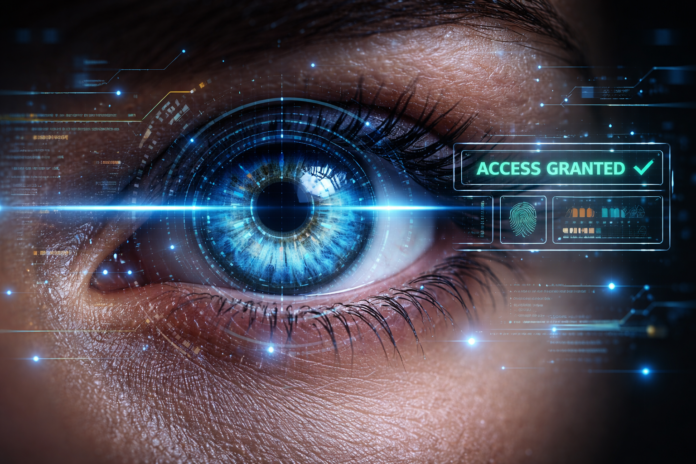
Iris scanning remains the most accurate non-invasive biometric. Because the patterns of the iris are set before birth and remain stable throughout a lifetime—unlike fingerprints which can wear down—they offer a False Accept Rate (FAR) of nearly 1 in 10 million. In 2026, iris scanning has moved from government bunkers to high-end corporate offices and luxury automotive interiors.
3. Palm Vein Recognition: The Contactless Dark Horse
Palm vein authentication has seen a massive surge in 2026, particularly in retail and healthcare. By using NIR light to capture the unique pattern of deoxygenated hemoglobin in a person’s veins, this modality offers a “hidden” biometric. You cannot “leave” your vein pattern on a glass table like you do a fingerprint. It is contactless, hygienic, and highly resistant to spoofing.
4. Behavioral Biometrics: “You Are How You Type”
The most significant shift in 2026 is the adoption of Behavioral Biometrics. Unlike “static” biometrics (face/finger), behavioral biometrics are “dynamic.” They monitor:
- Keystroke Dynamics: The timing between key presses.
- Gait Analysis: The specific rhythm of your walk, captured by smartphone accelerometers or CCTV.
- Mouse/Touch Movements: The pressure and arc of your finger on a screen.
This allows for Continuous Authentication. Instead of just checking your identity at login, the system constantly monitors these patterns. If the “rhythm” of the user suddenly changes, the system can trigger a re-authentication prompt or lock the session.
5. Voice Biometrics and the Deepfake Challenge
Voice biometrics are widely used in banking and call centers for “voice-as-a-password.” However, 2026 has brought the challenge of AI-generated voice clones. To counter this, modern voice biometrics utilize Anti-Spoofing Synthetic Detection, which looks for digital artifacts and frequencies that the human vocal tract cannot physically produce.
The Technology Stack: FIDO2, Passkeys, and the End of Passwords
In 2026, the backend of biometric authentication is powered by the FIDO2 (Fast Identity Online) standard and Passkeys. The era of storing “biometric templates” on a central server is over—a practice now considered a major security liability and often illegal under 2026 privacy laws.
How Passkeys Work in 2026
When you register for a service, your device (phone, laptop, or security key) generates a public-private key pair.
- The Public Key is sent to the service provider.
- The Private Key never leaves your device’s Secure Enclave or Trusted Execution Environment (TEE).
- To login, you simply verify your identity locally via biometrics. Your device then uses the private key to sign a “challenge” from the server.
This architecture ensures that even if a service provider (like a social media site or a bank) is hacked, the attackers gain nothing but useless public keys. They cannot “steal” your face or your fingerprint because the server never had them to begin with.
Biometrics in the Zero Trust Ecosystem
The “Castle and Moat” strategy of network security is dead. In 2026, we operate under Zero Trust Architecture (ZTA): Never Trust, Always Verify. Biometric authentication is the primary mechanism for this verification.
Identity as the New Perimeter
In a world of remote work and decentralized cloud apps, the “perimeter” is no longer the office firewall—it is the user’s identity.
- Risk-Based Authentication: In 2026, systems don’t just ask for a fingerprint. They look at the Contextual Risk. If you are logging in from a known device at your home IP, a simple face scan suffices. If you are accessing sensitive financial data from a new city at 3:00 AM, the system may demand a multimodal check (Face + Voice + Behavioral check).
- Micro-Segmentation: Biometrics allow for granular control. An employee might have access to general Slack channels via a simple login, but entering the “Production Server” zone requires a high-assurance iris or palm vein scan.
Protecting the Protectors: Combatting Deepfakes and Spoofing
As biometric sensors have improved, so have the tools used by hackers. In 2026, the primary threat to biometric security is no longer a “lifted fingerprint” but Injection Attacks and Generative AI Deepfakes.
The Injection Attack Threat
Hackers don’t always try to fool the sensor. Instead, they try to “inject” a digital stream of a fake face or voice directly into the software processing the biometric data.
- The Solution: In 2026, hardware manufacturers have implemented Attestation Protocols. This creates a cryptographically signed “handshake” between the biometric sensor and the CPU, ensuring that the data being processed came directly from the physical hardware and hasn’t been intercepted or replaced by a digital file.
Advanced Liveness: The Pulse of Security
To defeat deepfakes, 2026 systems look for biological “tells” that AI cannot yet mimic perfectly:
- Blood Oxygenation Levels: Sensors can detect the subtle change in skin color as the heart beats.
- Pupillary Response: Iris scanners may quickly change light levels to see if the pupil constricts and dilates in real-time.
- Challenge-Response: The system might ask the user to “blink twice” or “look left” to ensure it’s not a pre-recorded video.
Post-Quantum Biometrics: Securing the Biological Key
The specter of Quantum Computing looms large in 2026. While a cryptographically relevant quantum computer (CRQC) may still be a few years away, the “Harvest Now, Decrypt Later” threat is real. Attackers are currently stealing encrypted data in hopes of cracking it once quantum computers are viable.
Lattice-Based Algorithms
To protect biometric data for the next 50 years, 2026 systems have begun implementing Post-Quantum Cryptography (PQC). Specifically, Lattice-based algorithms (like ML-KEM) are being used to encrypt the communication between biometric sensors and the cloud. This ensures that even if a quantum computer captures the data today, it cannot reverse-engineer the biological template in the future.
Global Industry Use Cases
1. Finance: The Rise of the “Super-App”
In 2026, banking is invisible. “Super-apps” use continuous behavioral biometrics to authorize small transactions without any user input. For large transfers, a “Video KYC” session uses AI to verify the user’s identity against their government-issued digital ID in seconds.
2. Automotive: The In-Cabin Guardian
Modern vehicles in 2026 use cabin-facing cameras not just for security, but for safety. Driver Monitoring Systems (DMS) use facial biometrics to detect:
- Drowsiness: Eye-closure rates and head position.
- Distraction: Gaze tracking to ensure the driver is looking at the road.
- Impairment: Using voice and gait-like steering patterns to detect if a driver is under the influence.
3. Healthcare: Eliminating Patient Misidentification
Hospitals in 2026 use palm vein scanners at registration to ensure the right treatment is given to the right patient. This eliminates “Medical Identity Theft” and prevents dangerous errors caused by duplicate medical records.
4. Travel: The “OneID” Seamless Border
International travel has been transformed by the OneID initiative. In 2026, your “Face is your Boarding Pass.” From the bag drop to the lounge to the boarding gate, travelers move through “biometric corridors” without ever showing a physical passport or ticket.
Ethics, Privacy, and the Regulatory Landscape
The power of biometrics brings significant responsibility. In 2026, the legal landscape is more complex than ever.
The EU AI Act (August 2026 Enforcement)
The EU AI Act classifies certain biometric uses as “High Risk” or “Prohibited.”
- Prohibited: Real-time remote biometric identification in publicly accessible spaces for law enforcement (with very narrow exceptions).
- High Risk: Biometrics used for education, employment, or credit scoring. These systems must undergo rigorous auditing for Bias and Fairness.
The “Bias Gap” in 2026
A major ethical hurdle in 2026 remains the performance gap of facial recognition across different ethnicities and genders. “Human-first” companies now demand Inclusive Dataset Training and third-party audits (like those from NIST) to ensure their sensors don’t have higher False Reject Rates (FRR) for marginalized groups.
US State Laws: BIPA and Beyond
While the US still lacks a federal privacy law, state-level regulations like Illinois’ BIPA (Biometric Information Privacy Act) have become the de facto standard. Companies must obtain Explicit Written Consent before collecting any biometric data, and they face massive liquidated damages for every violation.
Implementation Roadmap for Enterprises
If your organization is planning a biometric rollout in 2026, follow this phased approach to ensure compliance and security.
Phase 1: The Audit
- Inventory your Data: Where is identity verified today? Are you still using passwords or SMS MFA? (Both are considered “low assurance” in 2026).
- Determine Sensitivity: High-risk data (financials, HR records) requires multimodal biometrics. General access can use single-factor (fingerprint/face).
Phase 2: Vendor Selection
- FIDO2 Certified: Only work with vendors that adhere to open standards.
- On-Device Processing: Prioritize solutions where the biometric data stays on the user’s hardware.
- Deepfake Protection: Ask vendors for their “Liveness Detection” certifications (ISO 30107-3).
Phase 3: The Pilot
- Start with Privileged Access: Roll out biometrics to IT admins and executives first.
- Test for Friction: Monitor your False Reject Rate (FRR). If employees are being locked out frequently, your lighting or sensor calibration may be wrong.
Phase 4: Full Deployment and Monitoring
- Continuous Monitoring: Use AI to watch for spikes in “Failed Liveness Checks,” which could indicate a coordinated deepfake attack.
- Update Policies: Ensure your “Right to be Forgotten” procedures include the deletion of any stored biometric templates.
Common Mistakes in Biometric Deployment
- Storing Raw Biometric Images: Never store an actual photo of a face or a fingerprint. Modern systems must only store a “template”—a mathematical hash that cannot be converted back into an image.
- Ignoring the “Backup” Factor: What happens if someone’s face is injured or their voice is lost to illness? You must have a secure, high-assurance “Step-up” recovery process that doesn’t revert to a weak password.
- Lack of Transparency: Users are often wary of “Big Brother.” Failing to clearly explain how data is stored and who has access to it is the fastest way to kill user adoption.
- Hardware Incompatibility: Assuming all employee devices have the necessary NPU (Neural Processing Unit) to handle on-device AI. 2026 systems require modern hardware to function securely.
- Centralized “Honeypots”: Building a giant database of biometric hashes. If that database is breached, the hashes can potentially be used in “replay attacks” if liveness detection is weak.
Conclusion
Biometric authentication in 2026 is no longer a futuristic luxury; it is the fundamental infrastructure of the digital world. We have moved from a “Password Culture” to a “Presence Culture.” The security of our global economy now rests on the ability to prove, with mathematical certainty, that the person behind the screen is who they claim to be.
However, as we embrace the convenience and security of biological keys, we must remain vigilant. The arms race between AI-driven spoofing and biometric liveness detection will continue. Privacy must remain a human right, and the “biological templates” that define us must be protected with the strongest encryption available—including post-quantum safeguards.
For businesses, the path is clear: The transition to multimodal, passwordless, and decentralized biometrics is the only way to survive the threat landscape of 2026. Those who cling to the alphanumeric past are not just outdated—they are vulnerable.
Next Steps:
- Review your current IAM (Identity and Access Management) strategy.
- Transition all high-value accounts to Passkeys by Q4 2026.
- Implement a liveness-detection audit for any existing facial recognition hardware.
FAQs (Schema-Style)
Q1: Is biometric data safer than a password?
A: Yes. Unlike passwords, biometrics cannot be easily guessed, phished, or shared. In 2026, when combined with on-device storage (Passkeys) and liveness detection, they offer a level of security that passwords simply cannot match.
Q2: What happens if someone steals my biometric data?
A: In a modern 2026 system, your actual biometric (face/finger) is never stored. Only a mathematical representation (a hash) is kept. If a hash is stolen, it cannot be “reversed” into your face. Furthermore, because liveness detection is required, a stolen hash or a 3D mask would fail the “human presence” check.
Q3: Can facial recognition see through a mask or sunglasses?
A: Yes. 2026 facial recognition uses 3D infrared mapping and AI that focuses on the periocular region (around the eyes) and other “uncovered” landmarks, making it effective even when the user is wearing a mask or glasses.
Q4: Are biometrics legal under GDPR in 2026?
A: Biometric data is considered “Special Category Data” under GDPR. It is legal only if you have a valid legal basis, such as explicit consent or substantial public interest, and you must conduct a Data Protection Impact Assessment (DPIA).
Q5: Can biometrics be used to track me without my knowledge?
A: Technologically, yes (e.g., CCTV with facial recognition). However, in 2026, regulations like the EU AI Act strictly prohibit this type of “Remote Biometric Identification” for general surveillance, requiring strict warrants and oversight.
Q6: What is “Behavioral Biometrics”?
A: It is a type of authentication that identifies you based on your unique patterns of interaction with technology, such as the rhythm of your typing, the angle at which you hold your phone, and the way you move your mouse.
References
- FIDO Alliance (2025). The State of Passwordless Authentication: 2026 Global Report. (Official Standards Documentation).
- NIST (National Institute of Standards and Technology). Special Publication 800-63-4: Digital Identity Guidelines. (Academic/Regulatory).
- European Commission. The EU Artificial Intelligence Act: Full Enforcement Guidelines for 2026. (Official EU Law).
- Gartner Research (2026). Top Strategic Technology Trends: The Rise of Cybersecurity Mesh and Biometric Identity. (Industry Analysis).
- IEEE Xplore (2025). Advancements in Photoplethysmography for Liveness Detection in Facial Recognition. (Peer-Reviewed Journal).
- CISA (Cybersecurity & Infrastructure Security Agency). Zero Trust Maturity Model Version 3.0 (2026 Update). (Official US Govt Doc).
- Journal of Cryptology. Lattice-Based Cryptography in Biometric Template Protection. (Academic Research).
- World Bank ID4D. Principles on Identification for Sustainable Development in a Digital Age (2025 Revision). (Global Policy).