Financial Safety Disclaimer: The information provided in this article is for educational purposes only and does not constitute professional financial, investment, or legal advice. Always consult with a certified financial planner or advisor before making significant changes to your savings or investment strategy.
The intersection of behavioral economics and artificial intelligence is reshaping how humanity interacts with money. For decades, the primary challenge in personal finance wasn’t a lack of information—it was a lack of willpower. We knew we should save, yet we spent. We understood compound interest, yet we succumbed to instant gratification.
Behavioral nudges in AI savings represent the technological solution to these ancient human fallibilities. By definition, a “nudge” is any aspect of choice architecture that alters people’s behavior in a predictable way without forbidding any options or significantly changing their economic incentives. When powered by AI, these nudges become hyper-personalized, invisible, and incredibly effective. As of March 2026, the integration of Large Language Models (LLMs) and predictive analytics into banking apps has moved beyond simple “round-ups” to complex emotional and cognitive interventions that guide users toward long-term solvency.
Key Takeaways
- Automation is the New Discipline: AI removes the cognitive load of decision-making by automating transfers based on spending capacity.
- Personalization Drives Retention: Unlike static reminders, AI nudges adapt to your specific psychological triggers and financial flow.
- Bias Mitigation: AI tools are specifically designed to counter “present bias” and “loss aversion,” two of the biggest hurdles to saving.
- Ethical Vigilance Required: As AI becomes more persuasive, the line between helpful “nudging” and manipulative “sludging” must be monitored.
Who This Is For
This guide is designed for everyday savers looking to optimize their wealth, FinTech developers aiming to build more empathetic products, and financial educators seeking to understand the next frontier of behavioral intervention. Whether you are struggling to build an emergency fund or looking to refine a high-net-worth portfolio, understanding the mechanics of AI-driven nudges is essential in the modern economy.
The Psychology of Money: Why We Need a Digital Shove
To understand how AI helps us save, we must first understand why we are naturally bad at it. Human evolution did not prepare us for 401(k)s or high-yield savings accounts; it prepared us for immediate survival.
The Cognitive Barriers to Saving
- Present Bias (Hyperbolic Discounting): This is the tendency to choose smaller, immediate rewards over larger, delayed rewards. Your brain treats your “Future Self” like a stranger. AI bridges this gap by making the “Future Self” more tangible through visualization and immediate feedback.
- Inertia and the Status Quo Bias: Most people intend to save but never get around to opening the account or setting up the transfer. AI utilizes “Opt-out” architectures, where saving is the default setting.
- The Ostrich Effect: When financial situations become stressful, people tend to stop checking their balances. AI nudges provide “gentle transparency,” delivering bite-sized, non-threatening updates that keep users engaged without triggering anxiety.
- Loss Aversion: We feel the pain of losing $100 twice as much as the joy of gaining $100. AI frames savings not as “taking money away” from your spending, but as “winning” towards a goal.
How AI Powers the Modern Nudge
Traditional banking apps were reactive; they showed you what you did. AI-powered savings apps are proactive; they show you what you can do. This shift is powered by three core technological pillars.
1. Predictive Analytics and Cash Flow Modeling
AI doesn’t just look at your current balance. It analyzes years of transaction data to predict your “safe to save” amount. It knows that your electric bill spikes in July and that you tend to spend more on weekends. By identifying these patterns, the AI can “nudge” $12.43 into your savings account on a Tuesday morning because it knows you won’t miss it before Friday’s paycheck.
2. Hyper-Personalized Sentiment Analysis
As of March 2026, advanced AI assistants use natural language processing (NLP) to understand your relationship with money. If you tell your banking bot, “I’m feeling stressed about my vacation budget,” the AI doesn’t just give you a spreadsheet. It adjusts its nudging tone to be more encouraging and restrictive, perhaps blocking non-essential shopping notifications for the next 48 hours.
3. Choice Architecture Optimization
This is the “nudge” in its purest form. AI experiments with different UI/UX elements to see what triggers a positive response in you specifically. Does a progress bar motivate you? Or do you prefer a notification that compares your savings rate to “people like you” (social proof)? The AI learns and iterates in real-time.
The Core Types of AI Savings Nudges
To maximize your financial growth, you should look for apps that utilize these specific AI-driven mechanisms.
Micro-Savings and the “Invisible” Transfer
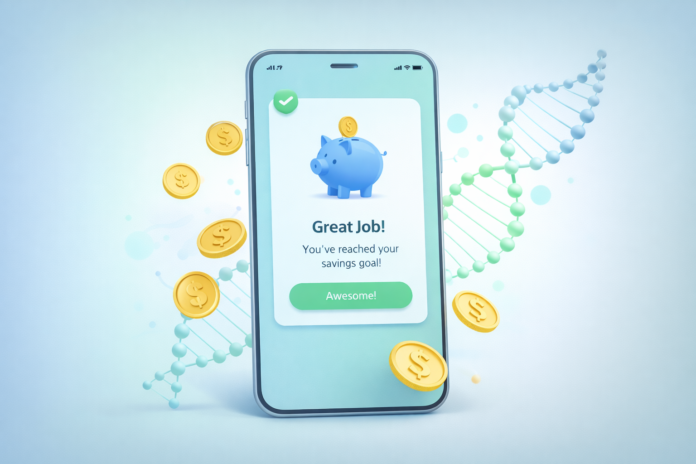
The most common nudge is the “round-up,” but AI takes this further. Instead of just rounding to the nearest dollar, AI calculates “micro-moments.” If you skip your usual $5 latte, the AI might detect the lack of a transaction and send a push notification: “Notice you skipped your coffee today! Want to put that $5 into your ‘Dream House’ fund?” This reinforces positive behavior in real-time.
Gamification and Reward Loops
AI uses the same psychological tactics as social media to make saving addictive.
- Streaks: Much like Duolingo, AI savings apps track how many weeks in a row you’ve hit your goal. The “nudge” here is the fear of breaking the streak.
- Visual Evolution: Some apps use “digital pets” or growing trees that only thrive when you save. AI adjusts the difficulty of these games to ensure they remain challenging but achievable.
Social Proof and Peer Benchmarking
Humans are social creatures. If we see our peers are saving 15% of their income, we are more likely to do the same. AI filters data to show you anonymous, relevant benchmarks.
- Example: “Other teachers in Chicago saved an average of $400 this month. You’re at $350. Want to bridge the gap?”
Smart Goal Chunking
Large goals ($50,000 for a down payment) are cognitively overwhelming and lead to paralysis. AI nudges break these down into “Atomic Goals.” Instead of showing you the $50,000 deficit, the AI nudges you to complete a “Daily $10 Challenge.”
Practical Examples of AI Nudging in Action
Scenario A: The Compulsive Spender
Sarah struggles with late-night online shopping. Her AI-enabled credit card detects a pattern of high-velocity spending between 11:00 PM and 1:00 AM.
- The Nudge: At 10:30 PM, the app sends a soft-focus notification: “Hey Sarah, you’ve stayed within your budget for 5 days! If you make it through tonight, you’ll hit your weekly bonus goal. Want me to ‘lock’ the shopping category until morning?”
- The Result: Sarah is reminded of her goals at her moment of highest vulnerability.
Scenario B: The Variable Income Freelancer
Mark is a graphic designer whose income fluctuates wildly. He finds it impossible to set a fixed monthly transfer.
- The Nudge: The AI monitors Mark’s incoming invoices. When a larger-than-average payment hits, the AI doesn’t wait for Mark to decide. It immediately prompts: “Big win! We’ve identified $200 of this payment that isn’t needed for upcoming bills. Move to ‘Tax Reserve’?”
- The Result: Saving happens before the money can be “absorbed” into general spending (Mental Accounting).
Common Mistakes When Using AI Savings Tools
While AI is a powerful ally, users often fall into these traps:
- “Set it and Forget it” Apathy: While automation is great, losing touch with your finances entirely can lead to “subscription creep” or missed errors in your statements.
- Over-Reliance on Micro-Savings: Round-ups are a great start, but they are rarely enough for retirement. Many users feel a false sense of security, thinking their $30/month in round-ups is sufficient.
- Ignoring the “Nudge Fatigue”: If an app pings you too often, you will eventually habituate to it and start ignoring the notifications (the “Alarm Fatigue” effect).
- Privacy Trade-offs: To provide the best nudges, AI needs deep access to your data. Users often fail to audit what data is being shared and with whom.
The Ethics of Nudging: Nudge vs. Sludge
As we move deeper into 2026, the ethical conversation around AI in finance has intensified. There is a fine line between a Nudge (helping you achieve your goals) and a Sludge (using psychology to achieve the bank’s goals).
What is Sludge?
- Hidden Fees: Using AI to find the maximum amount of “convenience fees” a user will tolerate without leaving.
- Difficulty to Cancel: Using “dark patterns” in the UI to make it easy to opt-into a high-interest product but difficult to opt-out.
- Artificial Urgency: Creating fake “limited time offers” to pressure users into credit products.
The Human-First Standard
Ethical AI savings tools should be transparent about their algorithms. Users should be able to see why a nudge was sent and have the ability to adjust the “assertiveness” of the AI.
How to Implement an AI-Nudge Strategy Today
If you want to leverage these tools, follow this step-by-step framework:
- Audit Your Current App: Does your bank offer predictive insights? If not, consider a third-party AI aggregator (like Rocket Money, YNAB, or newer 2026 entrants like Aura Finance).
- Define Your “Why”: AI works best when it has a specific target. Don’t just save “for the future.” Label your buckets: “European Summer 2027,” “Emergency Safety Net,” “Tesla Fund.”
- Start with “Safe-to-Save” Levels: Enable the feature that allows the AI to move small amounts automatically. Monitor it for 30 days to ensure it aligns with your comfort level.
- Check for “Surplus Nudges”: Look for features that identify “found money,” such as cancelled subscriptions or lowered utility bills, and redirect those amounts immediately to savings.
The Future: Generative AI and Conversational Finance
The next phase of behavioral nudges is Conversational Finance. Instead of a push notification, you will have a continuous dialogue with your money.
As of early 2026, we are seeing the rise of “Financial Co-Pilots” that can perform complex reasoning. You might ask, “Can I afford the new iPhone?” The AI won’t just look at your balance; it will run a simulation: “If you buy it now, you will have to reduce your vacation savings by $50 for the next 10 months. However, your current phone trade-in value is at its peak this week. Would you like me to find a refurbished model that saves you $300?”
This is the ultimate nudge: providing the right information, in the right context, to facilitate a better decision.
Conclusion: Embracing the Digital Nudge
Behavioral nudges in AI savings are not about taking control away from the individual; they are about giving the individual control over their own biological impulses. We live in a world designed to make us spend. Every advertisement, every “one-click” checkout, and every personalized recommendation is a nudge toward consumption. Without a digital counter-weight, the average person is at a psychological disadvantage.
AI provides that counter-weight. By automating the mundane, highlighting the invisible, and gamifying the difficult, AI turns the “chore” of saving into a seamless background process of your life. However, the human element remains paramount. The AI is the engine, but you are the navigator. You must define the destination.
Next Steps for the Reader:
- Review your “defaults”: Go into your primary banking app today and see if “Auto-Save” or “Round-ups” are enabled. If not, turn them on.
- Goal Labeling: Rename at least one savings account from “General Savings” to something emotionally resonant.
- Trial an AI FinTech: Download one AI-first financial app and use it for one month. Pay close attention to the notifications—are they helpful nudges or annoying interruptions? Adjust your settings accordingly to find your personal “sweet spot” for financial growth.
FAQs
What exactly is a “behavioral nudge” in a banking app?
A behavioral nudge is a small design feature or notification that gently encourages you to make a better financial decision without forcing you. Examples include “rounding up” your change to the nearest dollar or receiving a notification when you have “extra” money in your checking account that could be earning interest in savings.
Is AI savings safe? Does the app have too much control?
Most reputable AI savings apps use “read-only” access to analyze your data and require your explicit permission to move money. Furthermore, as of 2026, standard banking security (256-bit encryption and multi-factor authentication) is mandatory. You always retain the ability to move your money back or turn off the AI features instantly.
Can AI nudges help people with low incomes?
Yes, often more so than traditional methods. Because AI focuses on “micro-savings” (sometimes as little as $0.50), it helps build the habit of saving without requiring a large lump sum. This builds financial resilience over time by creating a “buffer” that helps avoid high-interest payday loans during emergencies.
How do I distinguish between a helpful nudge and an annoying notification?
A helpful nudge is timely, actionable, and aligned with your goals. If a notification tells you to save when you are already overdrawn, it is poorly calibrated. If it suggests a way to save $5 right after you’ve received a bonus, it is a high-value nudge. Most apps allow you to “train” the AI by dismissing unhelpful tips.
Does using AI for savings cost money?
Many AI savings features are now integrated into free banking tiers. However, specialized apps may charge a monthly subscription (typically $3–$10). You should calculate if the amount the AI helps you save (plus the interest earned) exceeds the cost of the subscription.
References
- Thaler, R. H., & Sunstein, C. R. (2008/Revised 2021). Nudge: The Final Edition. Yale University Press.
- National Bureau of Economic Research (NBER). The Impact of Automation on Household Savings Behavior. [nber.org]
- Consumer Financial Protection Bureau (CFPB). Special Report on Artificial Intelligence in Consumer Finance (Updated 2025). [consumerfinance.gov]
- OECD. Personal Finance in the Digital Age: Behavioral Interventions and Financial Literacy. [oecd.org]
- Journal of Behavioral Economics. Algorithmic Nudging: A New Frontier in Choice Architecture. [Academic Search]
- Federal Reserve Board. Economic Well-Being of U.S. Households in 2024. [federalreserve.gov]
- World Economic Forum (WEF). The Future of Financial Services: AI and Ethical Nudging. [weforum.org]
- FDIC. Consumer News: Understanding Fintech and Automated Savings. [fdic.gov]