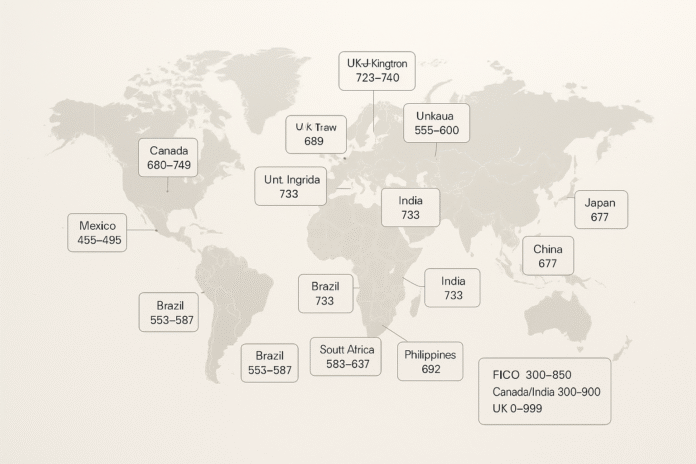
Credit scoring is global—but not standardized. Systems, ranges, and data disclosure differ widely, which makes cross-country comparisons tricky. Here’s the short answer: the average U.S. FICO® Score sits around 715 (April 2025), Canada’s national average is reported near 760, and other markets publish either country-level averages (e.g., Brazil at 548 on a 0–1000 scale) or only ranges without a single national mean. Use the 12 benchmarks below to see where major countries and regions sit and how to translate between scales.
Friendly reminder: This article is educational, not personal financial advice. Credit decisions depend on a lender’s model, local regulations, and your full profile.
1. United States — Average FICO® Score ~715 (300–850 scale)
The U.S. publishes a clear national benchmark: the average FICO Score was about 715 in April 2025, down slightly from 717 a year earlier. On a 300–850 scale, that lands in the “good” range for many lenders and reflects recent headwinds like higher utilization and more delinquencies. For day-to-day lending, the U.S. relies heavily on FICO, while VantageScore is also used for consumer monitoring and some underwriting.
1.1 Why it matters
Knowing the U.S. average helps you interpret your own number: a 715 FICO puts you right around the national mean; 740+ often improves pricing; 800+ is typically “excellent,” though exact thresholds vary by lender and loan type.
1.2 Numbers & guardrails
- Average (Apr 2025): 715 FICO.
- Common underwriting tiers (FICO 8/9 context): ~670–739 “good,” 740–799 “very good,” 800+ “exceptional.”
- Drivers of the recent dip: higher utilization, rising balances, and delinquency mix.
Bottom line: Use 715 as a U.S. yardstick in 2025, but price quotes depend on the product, model version, and your full file.
2. Canada — Reported Average Around 760 (300–900 scale)
Canada’s consumer scores typically range 300–900. As of late 2024, FICO reported the average Canadian credit score at about 760, which sits firmly in “good to very good” territory. Canadian lenders also use bureau-specific models from Equifax and TransUnion alongside FICO; cutoffs vary by product (mortgage vs. credit card) and by lender risk appetite.
2.1 How to compare across borders
A Canadian 760/900 roughly maps to a high-700s FICO on a 300–850 U.S. scale—i.e., strong, though direct conversion is imperfect because models and inputs differ.
2.2 Quick checklist
- Know your scale (300–900).
- Mind utilization (keep revolving balances well below limits).
- Loan mix & age matter in most models.
- Pull reports from both major bureaus (Equifax/TransUnion).
Bottom line: Canada’s average is high versus many markets; if you’re around 760, you’re likely competitive for prime pricing, subject to full underwriting.
3. United Kingdom — Average Experian Score ~790 (0–999 scale)
In the U.K., each bureau uses its own scale: Experian 0–999, Equifax 0–1000, TransUnion 0–710. Experian publicly notes the average Experian Credit Score is ~790, which they class as a healthy level. Because lenders rely on internal rules and may weight bureau data differently, a “good” score on one scale doesn’t always equal the same decision elsewhere.
3.1 Numbers & guardrails
- Average (Experian): ~790/999.
- Typical Experian bands referenced by U.K. lenders: Fair 721–880, Good 881–960, Excellent 961–999 (banding examples). Barclaycard
3.2 Practical tips
- Check all three U.K. bureau views if possible.
- Focus on timely payments and modest utilization—universal factors across models.
- Avoid unnecessary hard searches in short windows.
Bottom line: Use ~790 (Experian) as the U.K. average reference point, but remember scales differ across bureaus.
4. Australia — Equifax National Average ~861 (0–1200 scale)
Australia’s comprehensive credit reporting environment has matured, and Equifax reports a 2024 national average of ~861 on its 0–1200 scale—an “excellent” category score. Other local bureaus (illion, Experian AU) also operate, with similar behavioral drivers (payment history, utilization, applications). Lenders translate these scores differently by product type (e.g., mortgage vs. auto).
4.1 Why it matters
An 861/1200 average means many borrowers sit well into prime territory; rate improvements often appear above ~850–900 on this scale (lender-specific).
4.2 Quick list: improve or stay above average
- Pay on time; missed payments weigh heavily.
- Keep utilization low on revolving products.
- Space credit applications to limit hard inquiries.
- Maintain older accounts for depth.
Bottom line: Australia’s average is high; if you’re below the mid-800s, you may be paying more than the best-qualified peers.
5. New Zealand — “Average” Depends on the Sample (Common Scales: 0–1000 or 0–1200)
New Zealand has multiple bureaus with different scales: Centrix and illion often use 0–1000; Equifax NZ uses 0–1200. A single population-wide average isn’t routinely published, but Centrix’s monthly Credit Indicator shows useful benchmarks. For example, May 2025 data placed the average score for new credit applications at ~738 (Centrix scale), while other Centrix snapshots show sub-group averages (e.g., first-home-buyer cohorts). Treat application-pool averages as higher-risk-screened subsets rather than national means.
5.1 Tools/Examples
- Centrix Credit Indicator (monthly): trends in arrears and segment-level scores.
- Typical local scales: 0–1000 (Centrix/illion), 0–1200 (Equifax).
5.2 Mini-checklist
- Know your bureau and your scale.
- Benchmark against the latest Centrix cohort relevant to you (e.g., new credit applicants).
- Interpret cohort “averages” with caution—they’re not whole-population means.
Bottom line: There’s no single NZ national average published; use Centrix monthly indicators and bureau scales as your compass. platinummortgages.co.nz
6. Brazil — Serasa “Mapa do Score” Average ~548 (0–1000 scale)
Brazil offers a clear published national average via Serasa’s Mapa do Score: the average Brazilian score was ~548 in early 2025, on a 0–1000 scale where 501–700 is classified as “bom” (good) and 701+ “excelente.” Serasa updates this indicator twice a year with cuts by age, state, and region, making Brazil one of the more transparent large markets for credit-score benchmarking.
6.1 Numbers & guardrails
- Average (1H 2025): ~548/1000.
- Classification example: 501–700 “good,” 701+ “excellent.” Serasa
6.2 How lenders use it
Brazilian lenders mix bureau scores (Serasa, SPC, Boa Vista, Quod) with product criteria; open banking data may supplement risk assessments. jia.sipa.columbia.edu
Bottom line: A mid-500s national average signals room to improve; climbing into the 600s–700s can materially improve access and pricing.
7. India — Typical Averages Cluster in the 700s on CIBIL (300–900 scale)
India’s most widely used consumer score is TransUnion CIBIL on a 300–900 scale. While a single official population average isn’t routinely published, recent reporting based on TU CIBIL shows self-monitoring consumers averaging ~729 and non-monitoring consumers ~712, giving a practical “typical” band in the low-to-mid 700s. Lenders often view 700+ as competitive for mainstream products, subject to full underwriting.
7.1 Why it matters
A 720–730 CIBIL puts you near the observed monitoring cohort mean; moving from 680s to 720s can change approval odds and pricing.
7.2 Mini-checklist
- Pull your CIBIL report and dispute errors.
- Pay on time; delinquencies are heavily weighted.
- Manage utilization; keep it low on revolving accounts.
Bottom line: Use ~720–730 as a practical benchmark; 700+ is generally “good,” but lender cutoffs vary by product and profile.
8. Malaysia — CTOS Average ~678 (300–850 scale)
Malaysia’s major consumer scores include CTOS (300–850) and Experian i-SCORE. A joint Monash University Malaysia & CTOS report places the average CTOS Score at ~678 (2022 data; latest public figure), with over half of consumers in “good” territory (≥697). This gives Malaysians a tangible benchmark and shows gradual improvement despite post-pandemic headwinds.
8.1 Numbers & guardrails
- Average CTOS Score: ~678.
- CTOS bands: CTOS discloses a 300–850 scale; typical “good” thresholds around high-600s to 700s. CTOS
8.2 Practical notes
- CCRIS is a factual report; CTOS provides the score—lenders use both.
- Keep inquiries spaced out; maintain on-time payments and low utilization. StashAway Malaysia
Bottom line: Around 678 is a realistic national reference; pushing into the 700s improves access and pricing. Malaysia
9. Singapore — No Public “Average,” but Clear Ranges (1000–2000, AA–HH)
Credit Bureau Singapore (CBS) uses a 1000–2000 score tied to risk grades AA–HH, with AA corresponding to the lowest default probability (≤0.27%). CBS does not publish a population-wide average score; instead, lenders and consumers benchmark via risk grades and associated default probabilities. Many banks overlay internal scorecards on top of the CBS grade.
9.1 Numbers & guardrails
- Scale: 1000–2000 (AA best, HH highest risk).
- Example PD mapping: 1911–2000 (AA) ≈ 0.00–0.27% PD; 1844–1910 (BB) ≈ 0.27–0.67% PD, and so on.
9.2 How to use it
- Treat your risk grade as the primary benchmark (e.g., AA–BB often secures the best terms).
- Keep card utilization modest; CBS reports capture delinquency and usage patterns.
Bottom line: No single average is published; use the AA–HH risk grade ladder to gauge where you stand.
10. Mexico — Recalibrated “Mi Score” Ranges; No Official National Average
Mexico’s Buró de Crédito “Mi Score” was recalibrated in 2024. The current bands broadly classify 413–586 as higher risk, 587–667 regular, 668–700 good, and 701–754 top tier on the updated scale. Mexico’s other major bureau, Círculo de Crédito, provides FICO-based scores for many lenders. A single national average isn’t publicly disclosed; use the new banding as your benchmark.
10.1 Numbers & guardrails
- Scale (Buró “Mi Score”): ~413–754 after July 2024 recalibration, with 701–754 considered the best risk band.
- Alternative ecosystem: Círculo de Crédito uses FICO-based scores across many products. FICO
10.2 Practical tips
- Keep card utilization under control; avoid multiple recent hard checks.
- Build positive history with on-time payments; aging helps.
Bottom line: Benchmark against Mi Score bands; there’s no public “average” to cite nationwide.
11. South Africa — Typical Bands; “Average Risk” ~611–628 on Experian Scale
South Africa’s market features several score providers (Experian SA, TransUnion, XDS), each with its own range (e.g., Experian 0–740; TransUnion up to 999). A commonly referenced Experian band labels 611–628 as “average risk,” 629–659 “low risk,” and 660–750 “minimum risk (good)”. Public national “average” figures are sparse; use these bands and bureau-specific scales as your benchmark.
11.1 Numbers & guardrails
- Experian scale: 0–740; 660–750 often seen as “good/minimum risk.”
- Market trend references: TransUnion SA’s quarterly Industry Insights and CCI give context on credit health (not a single mean score). transunion.co.za
11.2 Mini-checklist
- Pull reports from multiple bureaus to see different ranges.
- Keep utilization moderate; avoid payment misses.
- Be mindful that not all lenders weight the same factors.
Bottom line: Treat 611–628 as “average-risk” on Experian’s 0–740; aim for 660+ to be viewed as lower risk in many decisions.
12. European Union (Overview) — No Single Score or Average; Country Systems Vary
There is no EU-wide consumer credit score or public regional “average.” Member states rely on national bureaus and idiosyncratic scales: e.g., Germany’s SCHUFA Basisscore is expressed as a 0–100% probability (higher is better) with tiers such as >97.5% (very low risk), 95–97.5% (low to manageable risk), 90–95% (normal to slightly increased). Other countries (e.g., France) emphasize negative registers or bank-internal models rather than a single consumer-facing score. If you need a benchmark, use the local bureau’s scale and tiers, not a cross-border “average.”
12.1 Numbers & guardrails
- Germany example (SCHUFA): 0–100% with published risk classes; >97.5% denotes the strongest tier.
- Practical point: lenders use internal criteria even when a consumer score exists.
12.2 Practical tips
- Identify the local bureau and its scale.
- Map your score to the local risk classes when comparing offers.
- Expect limited portability of scores across borders.
Bottom line: In the EU, think “local scale, local average”—and translate your score using the country’s own risk ladder.
FAQs
1) What’s the global “average credit score”?
There isn’t one. Countries use different bureaus and scales (300–850; 300–900; 0–999; 1000–2000; 0–100%). Some publish national averages (e.g., U.S. ~715 FICO; Brazil ~548 Serasa), while others disclose only bands or nothing at all. Use country-specific references from bureaus and central sources where available.
2) How do I compare a 760/900 (Canada) to a 715/850 (U.S.)?
You can’t convert perfectly, but you can approximate. A 760/900 in Canada typically signals strong credit—similar to a high-700s FICO in the U.S.—because risk factors (payment history, utilization, depth) are conceptually similar. Always defer to the lender’s model.
3) Why did the U.S. average dip from 717 to 715?
FICO attributes the decline to rising utilization and higher delinquencies following inflation and rate pressure; student-loan dynamics also played a role. Even a small average movement can affect marginal pricing for some borrowers.
4) Do emerging markets publish averages?
Some do. Brazil publishes a semiannual national mean via Serasa’s Mapa do Score (548 in 1H 2025). India’s TU CIBIL publishes extensive analytics; while a single national “average” isn’t always stated, recent reporting shows monitoring consumers averaging ~729.
5) In the U.K., which score should I quote—Experian, Equifax, or TransUnion?
Quote the bureau the lender uses, but for a general “average,” Experian’s consumer page lists ~790/999. Remember that a “good” score on one bureau might not map directly to another.
6) Why doesn’t Singapore publish an average?
CBS focuses on risk grades (AA–HH) tied to default probabilities rather than promoting a single population mean. Lenders combine CBS risk grades with internal models. Benchmark against the grade ladder, not a national “average.”
7) What counts more: score or income/debts?
Both. Scores summarize risk history; income, DTI, assets, and loan-to-value determine capacity and collateral. Many lenders price or approve using both a minimum score and hard caps on DTI/LTV.
8) Are “free” scores the same lenders use?
Not always. Consumer-facing scores (including educational versions) can differ from the model/version a lender uses. Directionally, good habits raise all scores, but don’t expect identical numbers across apps. myFICO
9) Can I quickly add 50 points?
There’s no guaranteed shortcut. The fastest wins usually come from paying past-due accounts current, lowering revolving utilization (often under ~10–30%), and removing verified errors. Time (seasoning) also helps.
10) What’s the single best way to benchmark myself internationally?
Don’t force a cross-country conversion. Instead, identify (1) your country’s bureau and scale, (2) the most recent national average or risk band, and (3) the lender’s published tiers. Use those three to judge where you stand relative to peers.
Conclusion
No two countries score consumers exactly the same way. The U.S. anchors its consumer market on a 300–850 FICO with a current average around 715; Canada reports an average closer to 760 on a 300–900 scale; the U.K. cites an Experian mean near 790 on a 0–999 scale; Australia’s Equifax average is a high ~861 on 0–1200; and Brazil posts an official 548 on Serasa’s 0–1000 ladder. Elsewhere, meaningful reference points come from risk bands rather than a single mean (Singapore, South Africa, Mexico after recalibration), or from cohort-level indicators and bureau-specific scales (New Zealand, India). The throughline is simple: know your local scale, find a credible local benchmark, and track your movement relative to the tier that unlocks the pricing you want. From there, focus relentlessly on on-time payments, low utilization, and steady account age—habits that travel well across borders even when the scoring math does not.
Ready to act? Pull your local bureau report today, note your scale and tier, and set one concrete 90-day goal (e.g., cut utilization to <20%). Then retest.
References
- Credit Scores Are Down—The Biggest One-Year Drop Since the Financial Crisis, Investopedia, Sep. 2025. Investopedia
- The Average Experian Credit Score (UK), Experian UK (consumer page). experian.co.uk
- Equifax reveals Australia’s national average credit score is an ‘excellent’ 861 in 2024, Equifax Australia Newsroom, Nov. 2024. https://www.equifax.com.au/news-media/equifax-reveals-australias-national-average-credit-score-is-an-excellent-861-in-2024 Equifax Personal
- Mapa do Score do Brasil: média nacional 548 (2025), Serasa, May–Jun. 2025. and coverage (InfoMoney). https://www.infomoney.com.br/minhas-financas/score-medio-do-brasileiro-e-de-548-e-indica-bom-perfil-de-credito-diz-serasa/ Serasa
- More than 100 million Indians monitored their CIBIL score (press/data) and Moneycontrol coverage (729 vs. 712), TransUnion CIBIL newsroom (Aug. 29, 2024) and Moneycontrol, Feb. 28, 2025. ; https://www.moneycontrol.com/news/business/personal-finance/what-is-the-average-credit-score-in-india-and-how-to-improve-your-credit-score-12835533.html newsroom.transunioncibil.com
- Credit Indicator (New Zealand) — cohort averages & arrears trends, Centrix, May 2025 report and Jan. 2024 report. https://www.centrix.co.nz/credit-indicator-report-may-2025/ ; centrix.co.nz
- Credit scores in Singapore (1000–2000; AA–HH), Credit Bureau Singapore — Credit Report Explanation & PD mapping, accessed Sep. 2025. ; https://www.creditmaster.sg/how-to-check-credit-score-singapore/ creditbureau.com.sg
- Buró de Crédito “Mi Score” recalibration (2024), Forbes México & El País, Jul. 2024. ; https://elpais.com/mexico/2024-07-17/el-buro-de-credito-recalibra-mi-score-con-nuevos-puntajes-y-beneficios-para-el-historial-crediticio.html Forbes México
- South Africa credit-score ranges (Experian bands), Meerkat explainer referencing Experian SA, Jun. 5, 2025. meerkat.co.za
- Germany SCHUFA Basisscore classes (0–100%), Schuldner-Insolvenz-Centrum explainer; SCHUFA resources. https://www.schuldner-insolvenz-centrum.de/en/pages/schufa-score-tabelle ; https://www.schufa.de/en/newsroom/creditworthiness/schufa-score-simulator-15-questions-answers/ SIC Schuldner-Insolvenz-Centrum e.V.
- Average credit score in Canada (760), NerdWallet Canada (citing FICO), updated Nov. 2024. https://www.nerdwallet.com/ca/credit-score/whats-the-average-credit-score-in-canada NerdWallet
- What is a good credit score? (Model ranges context), Experian US Learn Center. Experian