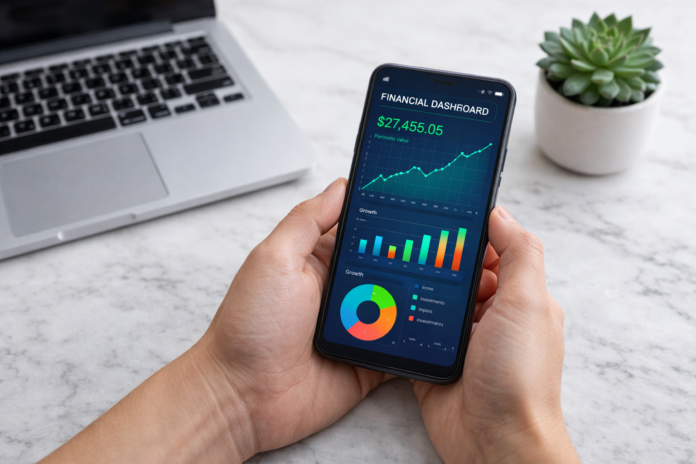
Managing money used to be a chore involving shoeboxes full of receipts, complex Excel spreadsheets, and hours of manual data entry. In the modern era, that approach is not just outdated—it’s inefficient. To automate your budget means to leverage technology to handle the heavy lifting of tracking, categorizing, and moving your money so that your financial goals happen by default rather than by effort.
As of February 2026, the fintech landscape has evolved into an ecosystem of interconnected apps that use Artificial Intelligence (AI) and Open Banking protocols to predict your spending habits and optimize your savings in real-time. This guide will walk you through the transition from manual tracking to a fully automated financial engine.
Key Takeaways
- Efficiency: Reduce the time spent on monthly finances from hours to minutes.
- Consistency: Automation removes the “human error” factor, ensuring bills are paid and savings are funded every single month.
- Real-time Insights: Fintech tools provide immediate feedback on your financial health, allowing for quicker pivots.
- Psychological Ease: By removing the friction of decision-making, you reduce “decision fatigue” regarding your spending.
Who This Is For
This guide is designed for anyone looking to reclaim their time while improving their financial standing. Whether you are a busy professional trying to maximize your 401(k) contributions, a freelancer managing irregular income, or a student trying to stay within a strict limit, these automation strategies can be tailored to your specific needs.
Financial Safety Disclaimer: This article is for informational purposes only and does not constitute professional financial advice. Always perform your own due diligence when linking bank accounts to third-party applications. Ensure any tool you use employs bank-level encryption (AES-256) and multi-factor authentication (MFA).
The Philosophy of Automated Budgeting
Before we dive into the “how,” we must understand the “why.” Traditional budgeting is reactive—you look at what you spent last month and feel guilty. Automated budgeting is proactive. It is built on the principle of “Paying Yourself First.”
In an automated system, your income is distributed the moment it hits your account. It flows into predetermined “buckets” for bills, savings, and investments before you even have a chance to see it as “spendable” cash. This creates an environment where you can spend your remaining balance with zero guilt, knowing that your future self is already taken care of.
Step 1: Auditing Your Current Cash Flow
You cannot automate what you do not understand. Before selecting fintech apps, you need a baseline of your financial movement.
Tracking the “Fixed” vs. “Variable”
Start by listing your non-negotiables: rent/mortgage, utilities, insurance, and minimum debt payments. These are the easiest to automate because they are predictable. Next, look at your variable expenses: groceries, dining out, and entertainment. Modern budgeting software can analyze the last three months of your bank statements to give you an average for these categories.
Identifying the Leaks
Look for “ghost subscriptions”—those $9.99 charges for streaming services or gym memberships you no longer use. Many fintech tools now include a “subscription manager” feature that flags these automatically. Use this audit phase to trim the fat so your automated system isn’t wasting money on things that don’t bring you value.
Step 2: Choosing Your Fintech Stack
The core of your automation is the software you choose. As of early 2026, the market has moved beyond simple tracking toward “autonomous finance.”
The Aggregators (The “Big Picture” Tools)
Tools like Copilot, Monarch Money, or Empower act as a command center. They connect to all your accounts—checking, savings, credit cards, and investments—to give you a single “net worth” view.
- Best for: People who have multiple accounts across different banks and want a bird’s-eye view.
- Automation feature: They use AI to auto-categorize transactions with 95% accuracy, requiring you only to verify the outliers.
The Envelope System 2.0
Apps like YNAB (You Need A Budget) or PocketSmith follow a “zero-based budgeting” philosophy. Every dollar is given a job.
- Best for: Those who want granular control and are working toward specific goals like debt payoff or a house down payment.
- Automation feature: These apps can sync with your bank to automatically deduct spending from specific “envelopes,” alerting you when a category is running low.
The Neobanks
If you’re willing to switch banks, Neobanks (digital-only banks) like Ally, SoFi, or Varo often have budgeting features built directly into the core banking experience.
- “Buckets” and “Vaults”: These allow you to split your single savings account into digital sub-accounts for “Vacation,” “Emergency Fund,” or “New Car.”
- Rounding Up: Many of these platforms offer a “round-up” feature where every purchase is rounded to the nearest dollar, and the change is automatically sent to savings.
Step 3: Setting Up Direct Deposit Splits
The most powerful tool to automate your budget isn’t an app—it’s your employer’s payroll system.
Most modern payroll providers (like Gusto or ADP) allow you to split your paycheck into multiple bank accounts by percentage or dollar amount. This is the ultimate “set it and forget it” move.
The “Pro” Setup:
- Account A (Bills): Calculate your total monthly fixed costs and add a 10% buffer. Have this amount sent directly to a dedicated checking account used only for bills.
- Account B (Savings/Investments): Set a percentage (e.g., 15%) to go straight to your high-yield savings or brokerage account.
- Account C (Spending): The remainder goes into your primary checking account. This is your “allowance” for the month.
By splitting the money at the payroll level, you never “see” the money intended for bills or savings in your daily spending account, which drastically reduces the urge to overspend.
Step 4: Automating Fixed Expenses and Debt
Once your money is in the right accounts, you need to ensure it leaves those accounts at the right time.
Bill Pay Automation
Most service providers (utilities, internet, phone) offer a discount if you sign up for “Auto-pay.” Link these to your Account A (Bills). For providers that don’t offer auto-pay, use your bank’s internal “Bill Pay” feature to schedule recurring checks or electronic transfers.
The Debt Avalanche/Snowball
If you are carrying credit card debt or student loans, use fintech tools like Tally or specific features within your banking app to schedule payments that are higher than the minimum.
- Common Mistake: Only paying the minimum.
- The Fix: Set an automated “extra” payment for the day after your paycheck hits. Even an extra $50 a month, automated, can shave years off a loan.
Step 5: Utilizing AI and “Sweeper” Rules
As we move deeper into 2026, AI expense tracking has become highly sophisticated. Apps like Digit or Qapital use algorithms to “sweep” small amounts of money from your checking to your savings based on your spending patterns.
How “Sweeping” Works
If the AI detects that you have an extra $23.40 in your account that isn’t needed for upcoming bills, it will silently move that money to a goal-specific vault. If your balance gets too low, the AI pauses the transfers to prevent overdrafts. This is “micro-savings” at its finest, often resulting in thousands of dollars saved per year without the user ever feeling the “pinch.”
Step 6: Monitoring and Monthly Maintenance
“Automated” does not mean “ignored.” A healthy financial system still requires a “pilot” to monitor the instruments.
The 15-Minute Weekly Check-In
Once a week, open your aggregator app (like Monarch or Copilot).
- Review categorized transactions.
- Check for any unrecognized subscriptions.
- Ensure your “Bill Account” has a sufficient balance for the upcoming week.
The Quarterly Re-Balance
Every three months, evaluate if your goals have changed. Did you get a raise? Increase your savings percentage. Did a utility bill go up? Adjust your direct deposit split.
Common Mistakes in Budget Automation
1. Over-Automation Without a Buffer
The biggest risk of automation is the “NSF” (Non-Sufficient Funds) fee. If you automate your rent payment for the 1st of the month, but your paycheck occasionally clears on the 2nd, you’re headed for trouble.
- The Solution: Always maintain a “buffer” in your bill-pay account equal to one month of your smallest recurring bill.
2. The “Set It and Forget It” Trap
If you automate your savings but forget to check your credit card balance, you might be saving 5% in a bank account while paying 24% interest on a growing debt. Automation must be holistic.
3. Ignoring Inflation and Lifestyle Creep
As prices for groceries or insurance rise, your automated transfers may no longer cover the costs. If you don’t adjust your financial planning tools annually, you may find yourself dipping into savings to cover “fixed” costs.
The Role of Security in Fintech
When you automate your budget, you are essentially creating a digital map of your entire financial life. Security is paramount.
- Use a Password Manager: Never reuse passwords across financial apps.
- Enable Biometrics: Use FaceID or fingerprint scanning for all mobile fintech apps.
- Monitor App Permissions: Regularly check which apps have “Read/Write” access to your bank accounts via portals like Plaid or Finicity. If you stop using an app, revoke its access immediately.
Conclusion
Automating your budget is the single most effective way to align your daily actions with your long-term financial aspirations. By moving from a manual, high-friction system to a streamlined fintech stack, you transform money management from a stressful burden into a background process that runs quietly while you live your life.
The tools available in 2026—ranging from AI-driven “sweepers” to sophisticated aggregators—make it easier than ever to build wealth. However, remember that technology is only the vehicle; you are still the driver. Start small: automate one bill and one savings transfer this week. As you gain confidence in the system, continue to layer in more complex automations until your entire cash flow moves with precision and purpose.
Would you like me to create a specific “Fintech Stack” recommendation list based on whether you are an Apple or Android user?
FAQs
1. Is it safe to link my bank account to budgeting apps?
Generally, yes. Most reputable fintech tools use Plaid or similar services to connect to your bank, meaning they never actually see or store your login credentials. They receive a “tokenized” read-only version of your data. Always ensure the app uses AES-256 encryption.
2. Can I automate my budget if I have an irregular income (like freelancing)?
Absolutely. In fact, automation is more important for freelancers. You can use tools like Lance or Found which automatically set aside a percentage of every incoming payment for taxes and profit before sending the rest to your personal account.
3. Which is better: YNAB or a spreadsheet?
For automation, YNAB or a similar app is far superior because it syncs in real-time. Spreadsheets require manual entry or CSV uploads, which creates friction. If you enjoy the data-crunching of a spreadsheet, look into Tiller, which automatically pushes your bank data into Google Sheets.
4. Will automating my bills hurt my credit score?
No, it usually helps it! Payment history is the largest factor in your credit score (35%). By automating your bills, you ensure you never have a late payment, which keeps your score healthy and robust.
5. Do these fintech tools cost money?
Many of the best tools (YNAB, Monarch, Copilot) are subscription-based, typically ranging from $8 to $15 per month. While there are free versions (like Empower), the “paid” versions often provide better privacy (they don’t sell your data) and more robust automation features.
References
- Consumer Financial Protection Bureau (CFPB): Official guidelines on electronic fund transfers and consumer rights. cfpb.gov
- Federal Deposit Insurance Corporation (FDIC): Understanding insurance limits for Neobanks and fintech partners. fdic.gov
- Investopedia: Comprehensive definitions of “Zero-Based Budgeting” and “Pay Yourself First” strategies. investopedia.com
- Journal of Financial Planning: Academic research on the psychological benefits of financial automation. fpajournal.org
- National Endowment for Financial Education (NEFE): Statistics on the efficacy of automated savings vs. manual savings. nefe.org
- Plaid Inc. Security Whitepapers: Technical documentation on how bank-linking technology secures user data. plaid.com
- Vanguard Research: Reports on the long-term impact of automated investment contributions on retirement outcomes. vanguard.com
- The Federal Reserve: Annual reports on the “Economic Well-Being of U.S. Households” regarding digital banking adoption. federalreserve.gov