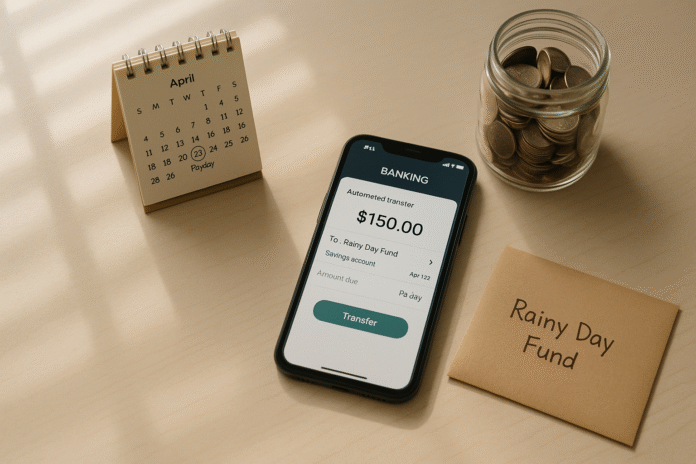
A rainy day fund is a small, liquid cash cushion for life’s minor surprises—think a flat tire, co-pay, or urgent home repair. Automating this fund means setting up scheduled, rules-based, or event-driven money moves so cash flows into savings without you having to remember. Below you’ll learn exactly how to “set and forget” your contributions, the best tools to use, and guardrails that keep automation safe. This guide is for anyone who wants calm instead of chaos when the unexpected hits.
Quick-start snapshot:
- Set a specific target (e.g., one month of essential bills or a fixed dollar goal).
- Open a separate high-yield savings account (HYSA) with no monthly fee.
- Automate a payday transfer or payroll split.
- Name the account “Rainy Day Fund” and turn on alerts.
- Review once per quarter; increase the rate when income rises.
Friendly note: This article offers educational information—not individualized financial, legal, or tax advice. Consider your circumstances and local regulations.
1. Automate a Payday Bank Transfer (The “Set-and-Forget” Backbone)
The most reliable way to build your rainy day fund is a fixed, recurring transfer on payday from checking to a separate savings account. This puts your savings on the same schedule as your income, so you’re never waiting for “leftovers.” In practice, you’ll pick an amount that’s meaningful but painless—enough to make weekly or biweekly progress without risking overdrafts. For most people, this is the anchor automation: it’s simple, universal, and supported by nearly every bank. Start with a number you can keep for 90 days; you can always step it up later. If you get paid irregularly, align transfers with deposit notifications or pick a weekly “money day” that follows your most common income day.
1.1 How to do it
- Open or designate a separate savings account titled “Rainy Day Fund.”
- In your bank app, schedule a recurring transfer for the morning of payday (or the day after to avoid timing mismatches).
- Choose a starting amount (for example, 3–10% of take-home pay or a flat sum like $25–$100 per paycheck).
- Turn on notifications for successful transfers and low checking balances.
- Revisit the number after two pay cycles; adjust up if it felt easy.
1.2 Numbers & guardrails
- Timing: If payroll hits late at night, set the transfer for the next morning to avoid pre-fund timing issues.
- Amount: A small, consistent $40 per week grows to ~$2,080 in a year—before any interest.
- Overdraft protection: Keep a “checking floor” (e.g., $300) you never cross; we’ll automate this later.
Bottom line: A fixed payday transfer is your dependable engine—quiet, boring, and incredibly effective.
2. Split Your Paycheck at the Source (Payroll Direct Deposit)
When your employer splits your paycheck across multiple accounts, your rainy day fund grows before the money ever hits checking. This “out of sight, out of mind” approach removes the temptation to spend and reduces the chance of canceling transfers during tight weeks. It’s especially powerful if you’re paid by direct deposit and your payroll system supports multiple destinations. Because the allocation happens upstream, it works even if you later change banks or cards; you simply update account details in one place.
2.1 How to do it
- Log in to your employer’s payroll portal (or ask HR) to enable multiple direct deposit accounts.
- Add your rainy day HYSA routing and account numbers.
- Choose either a fixed dollar amount (e.g., $50 per paycheck) or a percentage (e.g., 5%).
- Give the savings account a nickname so you recognize it on pay stubs.
- Verify after one pay cycle that the split posted correctly.
2.2 Common mistakes
- All-or-nothing thinking: You don’t need to start big. Even $20 per paycheck builds the “automation habit.”
- Using the same bank for both: A separate bank adds friction to withdraw, which helps you stay disciplined.
- Ignoring pay changes: After a raise or bonus, revisit percentages so your savings grows with your income.
Bottom line: Payroll splitting is the gold standard—if it’s available to you, use it. It’s the least breakable automation because it happens before the money reaches you.
3. Save a Percentage, Then Auto-Increase It (The “Raise Rule”)
Automating a percentage instead of a flat dollar amount keeps contributions aligned with your income and lifestyle changes. This is helpful if your earnings are variable or if you expect periodic raises. Layer an auto-increase—say, a 1–2 percentage-point bump every quarter or after any raise—so savings steadily accelerates without feeling like a cut. The psychology matters: people tend to tolerate increases that show up only when pay goes up. Over a year or two, this creates a powerful savings glidepath.
3.1 How to do it
- Start with a baseline percentage you can live with across light and heavy months (e.g., 3–5% of net pay).
- In your payroll system (preferred) or bank app, set the rainy day transfer to a percentage or translate it to an average amount.
- Add a recurring reminder to raise the rate after a raise or every 90 days.
- Track progress in your bank’s goals dashboard or a spreadsheet.
3.2 Mini case
- Month 1–3: 4% of a $3,000 net paycheck = $120/month to savings.
- Month 4–6: Raise to 5% after a $100/month raise → $150/month.
- Month 7–12: Bump to 6% → $180/month.
- Result: ~$1,770 saved in a year with painless, timed nudges—before interest.
Bottom line: A small percentage with planned step-ups compounds quietly. You’ll barely notice the increases, but your rainy day fund will.
4. Turn On Round-Ups and “Spare Change” Sweeps
Round-up tools add tiny amounts to savings every time you spend, typically rounding card purchases up to the next whole dollar and sweeping the difference to savings. On their own, round-ups won’t fund your entire goal quickly, but they’re a fantastic “always on” supplement that captures dollars you’d never miss. This is especially useful if your spending is steady; the more swipes, the more micro-contributions. Consider pairing round-ups with a weekly top-up so the balance grows meaningfully.
4.1 How to do it
- Check your bank app for “round-ups,” “spare change,” or “purchase round-ups.”
- Link the feature to your rainy day HYSA or a savings “vault.”
- Enable a multiplier (e.g., 2× or 3×) if offered to speed things up.
- Add a weekly $10–$25 top-up automation to smooth slow weeks.
4.2 Numbers & expectations
- If you average 50 card transactions per month and round up an average of $0.50, that’s ~$25/month—or $300/year—before multipliers.
- With a 3× multiplier, the same pattern becomes ~$900/year (less than $3/day).
Bottom line: Round-ups are set-and-forget momentum. They won’t replace a payday transfer, but they’ll quietly turbocharge it.
5. Use Rules-Based Savings (Trigger-and-Action Automations)
Rules-based savings moves money when certain conditions are met—like saving $5 every time you take a rideshare, or $20 when you get paid. Think of it as IFTTT (“if this, then that”) for your money. Many modern banks and budgeting apps let you build triggers based on transaction types, categories, or merchant names. This method creates a personalized “nudge architecture” that aligns with your habits—so everyday life funds your rainy day account automatically.
5.1 Useful rules to try
- Income trigger: “When payroll deposit posts, move 5% to rainy day fund.”
- Category trigger: “For every $100 spent on dining out, save $10.”
- Milestone trigger: “Save $15 each time my steps exceed 10,000 (via connected fitness app).”
- Merchant trigger: “Save $5 when I place an online order—digital cart tax.”
- Streak trigger: “Every 7 alcohol-free days, add $20 to savings.”
5.2 Setup checklist
- Pick a bank/app that supports rules or integrations.
- Connect your checking, savings, and card accounts securely.
- Start with two or three rules; monitor for a month.
- Cap per-day or per-week transfers to avoid over-saving into overdrafts.
- Review quarterly; retire rules that annoy you.
Bottom line: Rules turn your habits into savings fuel. Tie the actions you already take to automatic, bite-size deposits.
6. Build Sinking Funds So Emergencies Don’t Raid Savings
One reason rainy day funds stall is “leakage”: you dip into them for predictable but irregular expenses—like car maintenance, vet bills, gifts, or annual subscriptions. Sinking funds fix this by pre-saving for known costs in dedicated sub-accounts. By automating tiny, earmarked contributions, you protect your rainy day fund for true surprises while eliminating bill-shock when those lumpy expenses arrive.
6.1 How to do it
- List 4–8 irregular categories (insurance premiums, travel, vehicle service, medical co-pays, gifts).
- Estimate annual amounts and divide by 12 (or 26 for biweekly).
- Create labeled goals or “buckets” inside your HYSA (many banks support this).
- Automate monthly or payday transfers into each bucket.
- Pay the expense from its bucket—not from your rainy day fund.
6.2 Example
- Car maintenance: $600/year → $50/month.
- Health co-pays: $240/year → $20/month.
- Gifts: $360/year → $30/month.
- Three automations, total $100/month → no surprises, no rainy day raids.
Bottom line: Sinking funds are shock absorbers. They keep your rainy day fund intact and your stress low.
7. Route Windfalls Automatically (Refunds, Rewards, and Cash Back)
Windfalls are perfect for accelerating your rainy day fund because they don’t disrupt your normal budget. With a little setup, you can funnel refunds, cash-back, and seasonal income directly to savings—automatically and consistently. You’ll feel the boost without the willpower battle. This is also the moment to grab “free” incentives like bank bonuses or employer wellness rewards and send them straight to your rainy day account.
7.1 Windfalls to automate
- Tax refunds: Use direct deposit to your HYSA; if you split refunds, pre-assign a percentage to rainy day.
- Credit card rewards: Where possible, redeem as statement credit and schedule an equal transfer to savings the same day.
- Cash-back shopping: Link payout to your rainy day account, not PayPal or checking.
- Rebates/claims: Save the reimbursement and leave spending unchanged.
- Employer perks: Route stipends, wellness points, or referral bonuses to savings.
7.2 Mini case
- A $900 refund with a 60% earmark drops $540 into your rainy day fund in one shot.
- Add a quarterly $50 credit-card cash-back sweep → $200/year more.
- Result: over $700 added annually, with no pain.
Bottom line: Automate windfalls so “extra” money becomes future peace of mind—by design.
8. Use a Two-Bank Setup (Friction That Works in Your Favor)
Keeping your rainy day fund at a different bank than your everyday checking adds a healthy speed bump. Transfers take an extra day or two, which reduces impulse withdrawals but keeps the cash accessible for real needs. This separation also simplifies tracking; you’ll see the fund as its own balance with its own goal. Many online banks offer fee-free HYSAs, sub-accounts, and robust automation, making them a natural home for your safety net.
8.1 How to do it
- Open an online HYSA at a reputable, insured bank or credit union.
- Link your primary checking via the new bank’s external transfer tool (verify trial deposits).
- Schedule pull transfers from the HYSA bank (pulling is often more reliable than pushing from checking).
- Disable debit cards/ATMs tied to the HYSA to reduce temptation.
- Turn on balance and goal-progress alerts.
8.2 Region & safety notes
- In the U.S., FDIC (banks) or NCUA (credit unions) insurance typically covers up to $250,000 per depositor, per institution—well above a typical rainy day goal.
- If you’re outside the U.S., check your local deposit insurance scheme (e.g., FSCS in the UK, CDIC in Canada).
- Keep your HYSA fee-free; avoid accounts that require minimums or charge withdrawal fees for standard EFTs.
Bottom line: A second bank creates purposeful friction: easy to fund, just slow enough to protect.
9. Sweep Excess Above a Checking “Floor”
A floor-and-sweep system keeps your checking account healthy while automatically moving surplus to savings. You choose a minimum “floor” balance for checking—say, $500 or an amount equal to a week of bills. On a schedule (nightly, weekly, or after each paycheck), any balance above that floor is swept to the rainy day fund. This captures drift from quiet weeks and prevents idle cash from tempting impulse spending.
9.1 How to do it
- Pick your floor (often $300–$1,000 depending on your bill cycle).
- In your bank app, set a recurring sweep for the day after major bills hit.
- Some banks allow threshold rules; if not, approximate with a fixed sweep that you periodically adjust.
- Combine with alerts: “Checking below floor” and “Savings deposit posted.”
- Review the floor when your rent, mortgage, or utilities change.
9.2 Example & tuning
- If your average end-of-month checking balance is $1,200 and your floor is $700, a $500 sweep each month adds $6,000/year to your rainy day fund.
- If you see occasional overdraft risk, raise the floor by $100 and monitor for two months.
Bottom line: Floors and sweeps turn “extra” checking dollars into progress—automatically and safely.
10. Calendar Top-Ups for Known Crunches (Bill Smoothing)
Even with great automation, certain months run hot: insurance renewals, holidays, school fees, travel. Pre-programmed top-ups smooth these crunches so your rainy day fund doesn’t stall or backslide. The idea is simple—add a temporary contribution for a few weeks leading up to the crunch, then let it expire. You can schedule these in your bank, your calendar, or your budgeting app, and tie them to reminders so you never miss the ramp-up.
10.1 How to do it
- Identify three “crunch windows” over the next 12 months (e.g., back-to-school, December holidays, annual premiums).
- Schedule a temporary boost—for example, +$25/week for eight weeks—into your rainy day fund.
- Add a calendar reminder titled “Top-up ends; review rate.”
- If your bank doesn’t support scheduled end dates, set a second reminder to cancel or adjust.
10.2 Numbers & planning
- A +$25/week top-up over eight weeks adds $200 before the crunch hits.
- Do this three times a year and you’ve added $600 on top of your baseline automation.
- If a crunch is bigger than expected, pair this with a one-time windfall sweep (see Section 7).
Bottom line: Time-boxed top-ups keep your automation resilient through expensive seasons—no surprises, no panic.
FAQs
1) What’s the difference between a rainy day fund and an emergency fund?
A rainy day fund covers small, short-term surprises—think $100–$1,000 expenses—so you don’t reach for high-interest debt. An emergency fund is larger (often several months of essential expenses) and meant for job loss, medical events, or major repairs. Many people build the rainy day fund first because it’s faster and prevents small issues from becoming big, expensive ones.
2) How much should I keep in a rainy day fund?
There’s no one magic number, but a practical approach is to aim for one month of essential bills or a fixed target like $1,000–$2,500, then reassess. Consider your job stability, insurance deductibles, and typical “oh-no” costs (car tires, vet visits, appliances). Set a starter goal you can hit within 3–6 months; momentum matters more than perfection.
3) Where should I keep the fund?
Use a separate, insured savings account—ideally a fee-free high-yield savings account (HYSA). It should be easy to transfer from, but not so easy you’re tempted to tap it for everyday wants. Avoid investment accounts for this purpose; market risk and withdrawal times can work against you when you need cash quickly.
4) Will automation cause overdrafts?
Not if you set sensible amounts and timing. Schedule transfers for the day after payday, maintain a checking “floor,” and enable low-balance alerts. Start small for two pay cycles, then increase. If your pay is irregular, consider rules triggered by actual deposits rather than fixed calendar dates.
5) My income is variable—what’s the best automation for me?
Use a percentage-based rule tied to when deposits land, plus a small weekly floor-and-sweep. Layer on round-ups for micro-progress. During lean months, your percentage contribution naturally shrinks; during strong months, it scales up. Review your percentages every quarter and after big income changes.
6) Do round-ups really make a difference?
Yes, as a supplement. They capture small amounts you won’t miss and convert frequent spending into frequent saving. Increase the multiplier if your bank offers it, and combine with a weekly top-up. Over a year, micro-deposits snowball more than most people expect, especially when paired with a fixed payday transfer.
7) Is a second bank necessary?
Not required—but helpful. A two-bank setup adds friction to withdrawals, making your savings “quiet.” It also gives you better visibility into goal progress. If you prefer one bank, use sub-accounts or labeled buckets and disable instant transfer features that make raiding your savings too easy.
8) How do I keep myself from turning off the automation during tight months?
Lower the default amount instead of canceling it, and set a short “pause” rule with an automatic restart date. You can also switch to percentage-based contributions temporarily. The aim is to keep the habit alive—even $5 per week maintains momentum and identity as “someone who saves.”
9) What if my bank doesn’t support rules-based triggers?
Consider a budgeting app or a bank that offers automations, or approximate rules with calendar-based top-ups and manual caps. Many institutions now provide goal features and scheduled transfers; if yours doesn’t, moving your rainy day fund to an automation-friendly HYSA is an easy win.
10) Should I invest my rainy day fund to earn more?
Generally, no. Rainy day money prioritizes liquidity and principal safety over yield. A HYSA or similar insured account is appropriate. Investments introduce volatility and withdrawal delays, which can undermine the purpose of having quick, dependable cash.
11) Can I automate windfalls like tax refunds and cash-back?
Absolutely. Use direct deposit for refunds (and pre-assign a percentage to savings), and redeem cash-back on a schedule accompanied by a matching transfer to your rainy day fund. You’ll supercharge progress without touching your monthly budget.
12) How often should I review my automations?
Quarterly is plenty for most people. Check that transfers posted, confirm your checking floor still fits your bill cycle, and bump your percentage after raises. During life changes—new job, move, new family member—do a quick mid-cycle check and adjust amounts accordingly.
Conclusion
Automation turns saving from a willpower challenge into a background process that just works. By anchoring your rainy day fund to payday, splitting your direct deposit, and layering percentage rules, round-ups, and well-timed top-ups, you create a resilient system that grows in good times and stays alive during tight ones. A two-bank setup and floor-and-sweep add simple guardrails, while sinking funds keep predictable expenses from raiding your safety net. The real magic isn’t any single trick—it’s how these mechanisms reinforce each other: payday funding, micro-deposits, and windfall captures add up to steady, low-stress progress. Start small, stay consistent, and let the system do the heavy lifting.
Next step: Open (or rename) your rainy day account, set a $25 payday automation, and schedule a five-minute check-in 30 days from now.
References
- Building Your Savings, Consumer Financial Protection Bureau, 2024. https://www.consumerfinance.gov/consumer-tools/saving-to-build-wealth/building-your-savings/
- Deposit Insurance at a Glance, Federal Deposit Insurance Corporation (FDIC). https://www.fdic.gov/resources/deposit-insurance/
- Share Insurance Toolkit, National Credit Union Administration (NCUA). https://ncua.gov/support-services/share-insurance-fund
- Get Your Refund Faster: Tell IRS to Direct Deposit Your Refund, Internal Revenue Service. https://www.irs.gov/refunds/direct-deposit
- About Form 8888, Allocation of Refund, Internal Revenue Service. https://www.irs.gov/forms-pubs/about-form-8888
- Emergency Funds: How Much Is Enough?, FINRA Investor Education Foundation, 2023. https://www.finra.org/investors/insights/emergency-fund
- High-Yield Savings Account (HYSA) Definition, Investopedia. https://www.investopedia.com/terms/h/high-yield-savings-account.asp