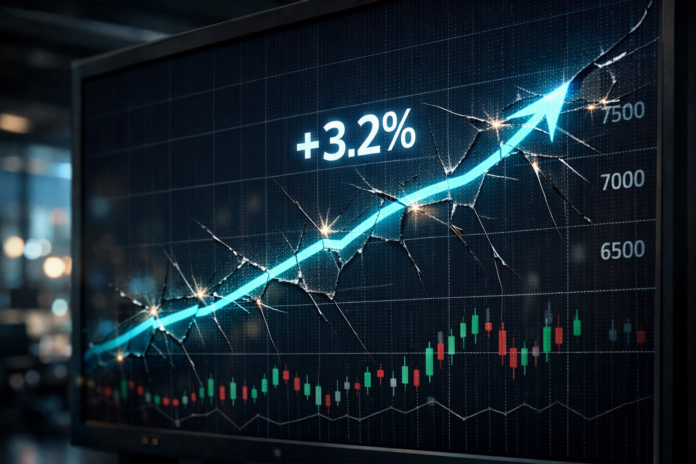
As of March 2026, the global economy finds itself at a peculiar crossroads. If you look at the headline figures from the International Monetary Fund (IMF) and the World Bank, there is a sense of hard-won stability. After years of post-pandemic volatility, energy shocks, and aggressive interest rate hikes, the world has settled into what experts are calling the 3.2% Global Growth Trap.
On the surface, 3.2% real GDP growth is a respectable number. It suggests a “soft landing” has been achieved, inflation is finally nearing target levels in most advanced economies, and the “Great Tightening” of central bank policy has ended without a global recession. However, the term “trap” is used because this stability is deceptively thin. Beneath the 3.2% veneer lies a world of extreme divergence, where a few tech-driven sectors and regions are pulling the weight for a much larger, stagnating whole.
Key Takeaways
- Deceptive Stability: The 3.2% growth rate masks a “two-speed” world where the U.S. and India thrive while Europe and China face structural cooling.
- The AI Multiplier: Artificial Intelligence investment is currently the primary tailwind, but a “productivity disappointment” remains a top-tier risk for 2026.
- Geopolitics as a Tax: Trade fragmentation and “friend-shoring” have become a permanent drag on global efficiency, acting as a hidden tax on growth.
- Fiscal Fatigue: Most nations have exhausted their “rainy day” funds, leaving them vulnerable if the 3.2% baseline slips.
Who This Article Is For
This deep dive is designed for institutional investors, policy analysts, business owners, and economics students who need to look beyond the headline numbers. Whether you are managing a global supply chain or a retirement portfolio, understanding why “steady” might actually mean “fragile” is essential for navigating the remainder of 2026.
Financial Disclaimer: The following analysis is for informational purposes only and does not constitute financial, investment, or legal advice. Economic conditions are subject to rapid change. Always consult with a certified financial advisor before making significant capital allocations.
1. The Mechanics of the 3.2% Paradox: Why Growth is Stalling at the Ceiling
To understand the “trap,” we first have to look at the math. The global growth formula is essentially a balance between productivity, labor force growth, and capital investment. In 2026, all three of these cylinders are misfiring in different ways.
The Ceiling of Productivity
In the decade leading up to 2020, global productivity growth averaged roughly 1.1%. To sustain a 3.2% global growth rate when populations are aging in the West and East Asia, productivity must do the heavy lifting. The equation for total output growth is often represented as:
$$Y = A \cdot K^\alpha \cdot L^{1-\alpha}$$
Where:
- $Y$ is Total Output (GDP).
- $A$ is Total Factor Productivity (TFP).
- $K$ is Capital Input.
- $L$ is Labor Input.
- $\alpha$ is the output elasticity of capital.
As of March 2026, $L$ (Labor) is shrinking in major economies like Italy, Japan, and China. Meanwhile, $K$ (Capital) has become more expensive due to the higher “neutral” interest rates that have persisted following the 2023-2024 inflation surge. This leaves $A$ (Productivity) as the only variable that can break the trap. While we are seeing a massive surge in AI-related capital expenditure, the “lag time” between buying a GPU and seeing a measurable increase in GDP per hour worked is proving longer than the 2025 hype suggested.
The Inflation “Long Tail”
While headline inflation has dropped to an average of 3.8% globally (down from the double digits of 2022), the “last mile” of disinflation has been grueling. Services inflation—driven by tight labor markets and rising housing costs—remains “sticky.” This has created a floor for interest rates, preventing the kind of cheap-money stimulus that usually powers an escape from a 3% growth rut.
Common Mistakes in Interpretation
Many analysts look at 3.2% and assume the “business cycle” has simply normalized. This is a mistake for two reasons:
- Ignoring the Base Effect: We are comparing 2026 growth against a period of massive government spending that is now being withdrawn.
- Overestimating Resilience: The “resilience” of 2025 was largely driven by consumers spending down their final pandemic-era savings. In 2026, those cushions are gone.
2. Regional Fragility: The “Two-Speed” World of 2026
The most dangerous aspect of the 3.2% trap is that it is an average that almost no one is actually experiencing. The world has split into three distinct camps: the Accelerators, the Stagnators, and the Vulnerables.
The Accelerators: U.S. and India
The United States continues to defy gravity, with a projected growth of 2.4% for 2026. This is largely due to the “AI Gold Rush” centered in Silicon Valley and a robust energy sector. However, this comes at the cost of a massive fiscal deficit, with the U.S. debt-to-GDP ratio hovering near 125%.
India remains the world’s brightest spot, with growth projected at 6.6% for 2026. The “Make in India” initiative has successfully captured supply chains exiting China, and a young demographic provides the labor input $(L)$ that the rest of the world lacks.
The Stagnators: China and the Eurozone
China’s “structural cooling” is the single biggest weight on the global 3.2% average. With a property sector still in the doldrums and a shrinking workforce, China’s growth has stabilized around 4.5%—a figure that would have been considered a crisis a decade ago but is now the “new normal.”
The Eurozone is the “fragile” part of the steady-state narrative. Growth in Germany and France is expected to limp along at 1.3% in 2026. High energy costs (a lingering effect of the geopolitical pivot away from Russia) and a lack of domestic tech giants mean Europe is failing to capture the AI productivity gains seen in North America.
The Vulnerables: Emerging Markets and the “Debt Wall”
For many developing nations, 3.2% global growth is actually a recession in per-capita terms. As of March 2026, over 60% of low-income countries are in or at high risk of debt distress. With the U.S. Dollar remaining strong, the cost of servicing dollar-denominated debt is eating up as much as 40% of government revenue in parts of Sub-Saharan Africa.
| Region | 2026 Growth Forecast | Primary Risk |
| United States | 2.4% | Fiscal Deficit / High Interest Rates |
| China | 4.5% | Demographic Collapse / Debt-Deflation |
| Eurozone | 1.3% | Energy Insecurity / Lack of Innovation |
| India | 6.6% | Infrastructure Bottlenecks |
| Global Average | 3.2% | Geopolitical Fragmentation |
The “Friend-Shoring” Tax
A significant contributor to the 3.2% trap is the reorganization of global trade. In 2026, we no longer talk about “Globalization” but rather “Regionalization.” The shift toward “friend-shoring”—trading only with political allies—has added an estimated 0.5% to 1.0% to the cost of global goods. While this increases “national security,” it is a direct drag on the 3.2% growth figure.
3. Breaking the Trap: Strategic Pathways and Common Pitfalls
If 3.2% is a trap, how do we escape it without triggering a massive inflationary spike or a financial collapse? The answer lies in a combination of technological breakthrough and fiscal discipline.
Pathway 1: The AI Productivity Harvest
For the 3.2% figure to turn into 4.0% (the pre-2008 average), AI must move from the “investment phase” to the “utility phase.” In 2026, we are seeing the first real signs of this in white-collar industries. Coding, legal research, and medical diagnostics are seeing efficiency gains of 20–30%. If these gains can be scaled to the broader service economy, it could counteract the “demographic drag” of an aging world.
Pathway 2: Rebuilding Fiscal Buffers
One of the “common mistakes” of the last two years was governments continuing to spend as if interest rates were still at 0%. In March 2026, the cost of debt is the #1 priority. Countries that are successfully “breaking the trap” are those implementing credible fiscal rules.
The goal is to bring the primary balance (revenue minus spending, excluding interest) into a surplus. This is represented as:
$$PB = T – G > 0$$
Where $T$ is tax revenue and $G$ is government spending. Without this, a small shock to the 3.2% growth rate could turn into a sovereign debt crisis.
Pathway 3: Energy Transition 2.0
The initial phase of the “Green Transition” was inflationary—it required massive capital for solar and wind while fossil fuel prices spiked. In 2026, we are entering a more mature phase where the marginal cost of energy is beginning to fall in regions with advanced grids. Lower energy costs are a classic “trap breaker,” as they act as a universal tax cut for both businesses and households.
Common Mistakes to Avoid in 2026
- The “Rates Will Drop Soon” Myth: Many businesses are still operating on the assumption that central banks will return to 2% interest rates. As of March 2026, the “neutral rate” (r-star) has likely shifted higher. Planning for “higher for longer” is the only safe strategy.
- Over-Reliance on Single-Sourcing: The 3.2% world is one of “shocks.” Whether it is a maritime bottleneck in the Red Sea or a sudden tariff hike, firms with a single-source supply chain are the most fragile.
- Ignoring the “Silver Economy”: With the world aging, businesses that aren’t pivoting to serve the over-65 demographic are missing the only growing consumer segment in the West and China.
Conclusion: Steady on the Surface, Fragile by Design
The “3.2% Global Growth Trap” of March 2026 is a testament to the resilience of the global economy, but it is not a reason for complacency. We have successfully avoided a “Great Depression 2.0,” yet we have entered a “Great Stagnation” characterized by high debt, high interest rates, and geopolitical tension.
The growth we see is “steady” only because the massive tailwinds of AI and U.S. fiscal spending are currently offsetting the massive headwinds of aging and trade wars. If the AI bubble bursts, or if a major geopolitical conflict escalates further, the 3.2% figure will evaporate quickly.
Next Steps for Stakeholders:
- For Investors: Diversify away from “growth at any cost” and move toward companies with strong cash flows and low debt-to-equity ratios. The “3.2% world” does not reward high-leverage gambles.
- For Policymakers: Prioritize structural reforms that boost labor participation (e.g., childcare support, elder-care integration) and streamline the deployment of AI in public services.
- For Individuals: Focus on “skill-stacking”—combining your human expertise with AI tools. In a slow-growth world, personal productivity is your best hedge against economic stagnation.
The world isn’t falling apart, but it isn’t taking off either. Navigating 2026 requires a steady hand, a skeptical eye toward headline stats, and a deep focus on the structural shifts that define our new era.
FAQs
1. Why is 3.2% growth called a “trap”?
It is called a trap because while it seems like a healthy “middle ground,” it is actually the maximum growth the world can currently achieve without reigniting inflation. It isn’t fast enough to solve the global debt crisis, nor is it slow enough to force the radical structural reforms needed for a new era of prosperity. It is a state of “low-altitude stability” that leaves no room for error.
2. Is a global recession likely in the remainder of 2026?
The consensus from the IMF and World Bank is that a global recession is unlikely, with a probability of about 15–20%. However, certain regions—particularly in Northern Europe and parts of Latin America—are already experiencing “technical recessions” (two consecutive quarters of negative growth). The global average remains positive largely due to the U.S., India, and Southeast Asia.
3. How do current interest rates impact this growth trap?
Interest rates are the “anchor” holding the trap in place. Because rates are significantly higher than they were in the 2010s, capital that used to flow into risky startups and emerging markets is now staying in “safe” government bonds. This starves the real economy of the investment needed to break out of the 3.2% range.
4. What role does the U.S. election/political cycle play in 2026?
By March 2026, the policies of the administration that took office in January 2025 are in full swing. The return of significant tariffs and the emphasis on “America First” manufacturing have created a localized boom in the U.S. but have increased costs for global trade partners, contributing to the “fragmentation” that keeps global growth capped at 3.2%.
5. Will AI eventually push growth above 4%?
It is possible, but not in 2026. History shows that “General Purpose Technologies” (like the steam engine or the internet) take decades to show up in GDP stats. We are currently in the “installation phase” of AI. The “deployment phase,” where growth truly accelerates, is likely a 2030s story.
References
- International Monetary Fund (IMF). (January 2026). World Economic Outlook Update: Steady amid Divergent Forces. [Official Doc]
- World Bank Group. (January 2026). Global Economic Prospects: The Great Stagnation? [World Bank Open Knowledge]
- OECD. (February 2026). Interim Economic Outlook: Navigating the Last Mile of Disinflation. [OECD iLibrary]
- United Nations DESA. (January 2026). World Economic Situation and Prospects 2026. [UN Publications]
- Bank for International Settlements (BIS). (2025). Annual Economic Report: Structural Reforms in a High-Rate Environment.
- Morgan Stanley Research. (November 2025). 2026 Global Outlook: The AI Productivity Divide.
- Goldman Sachs Global Investment Research. (January 2026). The New Neutral: Interest Rates and the 2026 Horizon.
- World Trade Organization (WTO). (2025). World Trade Report: The Cost of Fragmenting Chains.
- European Central Bank (ECB). (March 2026). Macroeconomic Projections for the Euro Area.
- Federal Reserve Board. (January 2026). Monetary Policy Report to Congress.
- Reserve Bank of India. (2026). State of the Economy Report: March Edition.
- Journal of Economic Perspectives. (Winter 2026). Total Factor Productivity in the Age of Generative AI. [Academic Journal]