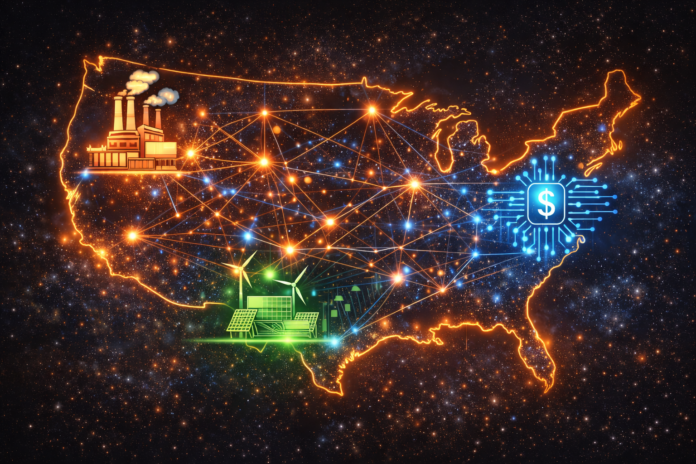
As of March 2026, the United States economy finds itself at a pivotal crossroads. For decades, economists have debated the “Productivity Paradox”—the idea that despite massive investments in digital technology, measurable output per hour remained stubbornly stagnant. However, the data from the first quarter of 2026 suggests that the paradox has finally been shattered. Artificial Intelligence (AI) has moved from the realm of speculative “chatbots” to becoming the primary engine of US economic resilience.
In a global landscape marked by fluctuating trade policies, labor shortages, and energy transitions, AI is the stabilizing force that allows American firms to maintain a competitive edge. It is no longer just a tool for Silicon Valley; it is the backbone of the “Smart Factory” in the Midwest, the “Digital Clinic” in rural Appalachia, and the “Autonomous Supply Chain” that keeps goods flowing through coastal ports.
Key Takeaways
- Productivity Surge: AI adoption has contributed to a projected 2.8% GDP growth for 2026, significantly outperforming previous decade averages.
- The Reshoring Catalyst: 74% of US manufacturers are now utilizing AI-driven automation to bring production back to American soil, reducing dependency on volatile global supply chains.
- Labor Market Evolution: While AI has displaced approximately 11% of traditional roles, it has spurred a 18% increase in new, high-value positions, leading to a net positive job growth in the US.
- Infrastructure Synergy: The CHIPS Act and private investment in AI data centers (expected to reach $432 billion in 2026) are creating a robust domestic ecosystem for innovation.
Who This Is For
This deep dive is designed for policymakers, business leaders, and economic analysts who need to understand the structural shifts occurring in the US economy. It is also for the modern professional seeking to navigate a labor market where “AI literacy” is no longer optional but a fundamental requirement for career resilience.
1. The Productivity Frontier: Breaking the Stagnation
For the better part of the 21st century, US labor productivity hovered around a 1.2% annual growth rate. As of March 2026, non-farm labor productivity has accelerated to a 2.5% annualized rate. This shift represents a generational leap in how value is created.
From Generative to Agentic AI
In 2023 and 2024, the focus was on “Generative AI”—tools that could write emails or create images. In 2026, the economy has shifted toward Agentic AI. These are autonomous systems capable of reasoning, planning, and executing complex workflows with minimal human oversight.
Economic Insight: Agentic AI doesn’t just “help” a worker; it manages entire administrative loops. In the financial sector, AI agents now handle 85% of routine compliance audits, allowing human auditors to focus on high-stakes risk strategy.
The GDP Multiplier Effect
Recent reports from the Council of Economic Advisers suggest that AI investment is not just a tech bubble but a structural tailwind. By automating “unstructured” tasks—those millions of hours spent on data entry, scheduling, and document processing—AI is reclaiming lost economic time.
| Sector | Productivity Gain (YoY 2026) | Primary Driver |
| Healthcare | 12.3% | AI-assisted diagnosis & Admin automation |
| Manufacturing | 11.5% | Agentic supply chain orchestration |
| Finance | 10.6% | Real-time risk modeling & Fraud detection |
| Retail | 9.8% | Hyper-localized inventory prediction |
2. Manufacturing and the Great Reshoring
One of the most visible pillars of US economic resilience is the return of manufacturing. For years, “reshoring” was a buzzword with limited action. In 2026, AI has made domestic production cost-competitive with overseas labor.
The “Living” Supply Chain
Static supply chains are a liability. The 2026 manufacturing model uses “Living Supply Chains”—AI systems that sense global disruptions (like a port strike or a regional conflict) in real-time and autonomously reroute components.
- Case Study: A major US automotive manufacturer recently utilized AI to diversify its supplier base for 15 new components. Historically, this onboarding would take 7 years; with AI-automated documentation and compliance, it was completed in 8 months.
- Digital Transformation Spending: Industrial firms are projected to spend $224.7 billion on digital transformation in 2026, a 13.8% increase over last year.
Smart Factories and Physical AI
The integration of AI with robotics (Physical AI) has allowed factories to operate with a “lights-out” capability for routine shifts. This doesn’t mean humans are gone; rather, the ratio of humans to machines has shifted. A factory that once required 500 manual laborers now employs 150 high-skilled “Robot Orchestrators” and “Maintenance Technicians,” with higher wages and safer working conditions.
3. The Labor Market Pivot: Reskilling the American Workforce
The most common fear regarding AI—mass unemployment—has not materialized in the way many predicted. Instead, we are seeing a “low-hire, low-fire” environment characterized by extreme internal churn.
Displacement vs. Creation
As of March 2026, roughly 4.2% of all US job postings explicitly require AI skills. While entry-level administrative roles have declined, demand for “AI Integration Specialists” and “Data Ethicists” has skyrocketed.
Common Mistakes in Workforce Management:
- Failing to provide internal reskilling: Companies that “fire and hire” to get AI talent are losing institutional knowledge. The most resilient firms are those training their existing 2–10 year veterans to use AI.
- Over-relying on “Black Box” solutions: Businesses that implement AI without human-in-the-loop (HITL) oversight often face “technical debt” when the AI models drift.
The “Human-First” Resilience Model
To protect the middle class, public-private partnerships have launched “National Reskilling Initiatives.” These programs focus on “AI Complementarity”—teaching workers how to use AI to amplify their unique human traits: empathy, complex problem solving, and ethical judgment.
4. Healthcare: Efficiency as a Defensive Asset
In 2026, the US healthcare system is using AI to combat the twin crises of rising costs and practitioner burnout. AI is no longer a “future possibility”; it is the administrative backbone of the modern hospital.
Drug Discovery and Clinical Trials
AI models have reduced the time for “Lead Optimization” in drug discovery from 18 months to 3 months. This acceleration is vital for economic resilience, as it allows for faster responses to public health threats and reduces the long-term cost burden of chronic diseases on the federal budget.
Administrative Recovery
- Documentation: AI scribes now handle 90% of clinical charting.
- Billing: AI-driven revenue cycle management has reduced “billing leakage” by 15%, keeping rural hospitals financially solvent.
- Diagnostics: AI radiology assistants are catching early-stage cancers with 20% higher accuracy than human-only reviews, leading to cheaper, more effective early-intervention treatments.
5. The Policy Landscape: CHIPS Act and Geopolitics
Economic resilience is inextricably linked to national security. The CHIPS and Science Act, now in its fourth year of implementation, has successfully “derisked” the US technology stack.
Semiconductor Sovereignty
As of early 2026, the US has added roughly 15,000 new jobs in semiconductor fabrication. Advanced AI chips, such as the latest iterations of NVIDIA’s Blackwell architecture, are increasingly manufactured—or at least packaged—within US borders or allied “friend-shored” nations.
The AI Arms Race
The Council of Economic Advisers’ January 2026 report, Artificial Intelligence and the Great Divergence, highlights that the US is outspending its nearest competitors in private AI investment by a factor of 2:1. This lead in “Compute Power” (FLOPs) is a primary driver of the dollar’s continued strength in global markets.
Regulatory Note: New 2026 tariffs (25% on certain non-US AI chips) have accelerated the push for domestic silicon production, though they have also increased short-term hardware costs for some startups.
6. Energy and Infrastructure: The Power Behind the Engine
AI’s hunger for electricity is the “silent” challenge to US economic resilience. Data center energy consumption is expected to double by 2030.
The Smart Grid Revolution
Paradoxically, AI is the solution to its own energy problem. AI-driven Smart Grids are now managing the intermittency of renewable energy (solar and wind) with 30% greater efficiency than manual load balancing. This allows for the rapid expansion of data centers without collapsing local power grids.
Modular Nuclear and AI
Small Modular Reactors (SMRs) are seeing their first commercial deployments in 2026, often co-located with large-scale AI “inference farms.” This synergy ensures that the “Engine of Resilience” is powered by a reliable, carbon-neutral source.
7. Risks and Challenges: The Friction of Progress
No technological revolution is without its downsides. To maintain resilience, the US must address several critical “friction points”:
- Algorithmic Bias: If AI models used in lending or hiring are biased, they risk disenfranchising large segments of the population, undermining social and economic stability.
- Technical Debt: Rapid AI adoption often leads to “spaghetti code” and poorly integrated systems that are difficult to patch or upgrade.
- Concentration of Power: A handful of “Hyper-scalers” (Amazon, Microsoft, Google, Meta) control the majority of the AI infrastructure. Ensuring SMEs (Small and Medium Enterprises) have “AI Equity” is a major legislative focus for 2026.
Conclusion: The Path to 2030
The United States economy in 2026 is significantly more “shock-proof” than it was in 2020. By integrating AI into the physical and digital foundations of the country, the US has created a buffer against global volatility. We have moved from an economy that “reacts” to one that “anticipates.”
However, resilience is not a static achievement; it is a continuous process. The gains in productivity must be shared broadly to ensure long-term political and social stability. The “Next Step” for the US is not just more AI, but Better AI Integration—moving from the experimental phase to a standardized, ethical, and human-centric infrastructure.
Next Step for You: Would you like me to create a custom AI adoption roadmap for your specific industry or business size to help you capitalize on these 2026 trends?
FAQs
1. How has AI impacted the average US worker’s salary in 2026?
As of March 2026, workers in “AI-enhanced” roles have seen an average wage increase of 7.5%, significantly outpacing inflation. However, workers in roles with high automation exposure and low AI-upskilling have seen stagnant or slightly declining real wages.
2. Is the US at risk of a “Jobless Recovery” because of AI?
While the 2025-2026 period has seen strong GDP growth with only modest job growth, it is not “jobless.” Instead, it is a “job-transformation” recovery. Hiring is concentrated in specialized sectors, while “generalist” administrative hiring has slowed.
3. Does the CHIPS Act actually make the economy more resilient?
Yes. By subsidizing domestic fabrication (fabs), the US has reduced the “single point of failure” risk associated with Taiwan-based manufacturing. As of 2026, domestic chip supply is sufficient to meet 40% of critical infrastructure needs, up from less than 10% in 2021.
4. What are the biggest risks of using AI in manufacturing?
The primary risks are cybersecurity (AI-driven factories are more susceptible to sophisticated ransomware) and operational rigidity if the AI is not trained on diverse enough data to handle “black swan” events.
5. Can small businesses benefit from AI as much as large corporations?
In 2026, “AI-as-a-Service” (AIaaS) has leveled the playing field. While large firms build their own models, small businesses use “Agentic Plugins” to automate their bookkeeping, customer service, and local SEO, seeing productivity gains of up to 15% with minimal capital investment.
References
- US Council of Economic Advisers (2026). Artificial Intelligence and the Great Divergence: 2026 Annual Report. [Official Gov Doc]
- Goldman Sachs Research (January 2026). US GDP Outlook: The AI Productivity Boost. [Economic Analysis]
- National Association of Manufacturers (2026). The State of Smart Manufacturing and Reshoring. [Industry Report]
- Bureau of Labor Statistics (March 2026). Employment Situation Summary: Impact of Automation on Knowledge Work. [Official Statistics]
- Morgan Stanley Insights (February 2026). AI Adoption Surges: Productivity Gains and Job Shifts. [Financial Analysis]
- MIT Task Force on the Work of the Future (2025). Building AI Resilience in the American Middle Class. [Academic Paper]
- Department of Energy (2026). Smart Grids and the Future of AI Data Center Power Management. [Official Doc]
- Brookings Institution (2025). The CHIPS Act at Year Three: Measuring Economic Impact. [Policy Review]
- Indeed Hiring Lab (2026). January 2026 Labor Market Update: AI Skills and Divergent Trends. [Labor Data]
- Deloitte Insights (2026). 2026 Manufacturing Industry Outlook. [Consulting Report]
- World Bank (2026). World Development Report: Artificial Intelligence for Development. [International Report]
- SEMI (2026). 2026 U.S. Policy Strategy for the Semiconductor Ecosystem. [Trade Association Doc]