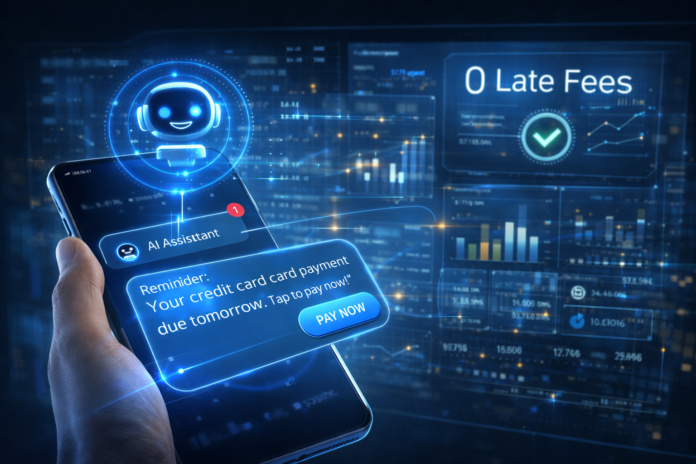
For decades, late fees have been the silent “tax” on the financially vulnerable, acting as a multi-billion dollar revenue stream for banks and a source of constant anxiety for consumers. However, as of March 2026, a paradigm shift is occurring. Artificial intelligence is moving beyond back-office automation to the front lines of consumer finance, raising a provocative question: Are we witnessing the end of late fees?
AI in debt management refers to the use of machine learning algorithms, predictive analytics, and natural language processing (NLP) to identify at-risk borrowers before they miss a payment, personalize repayment schedules, and automate empathetic outreach. Unlike traditional systems that wait for a default to trigger a penalty, AI-driven platforms prioritize prevention over punishment.
Key Takeaways
- Proactive Prevention: AI models now predict delinquency up to 60 days in advance with over 85% accuracy.
- Hyper-Personalization: Instead of generic “Past Due” notices, AI delivers nudges via preferred channels (SMS, WhatsApp, Email) at the time a borrower is most likely to engage.
- Regulatory Flux: While the CFPB’s $8 late fee cap faced legal hurdles in 2025, AI is achieving similar cost reductions for consumers through automated fee waivers and better budgeting.
- Human-Centric Tech: The most successful 2026 implementations combine AI speed with human empathy for complex hardship cases.
Who This Is For
This guide is designed for financial technology (Fintech) leaders, banking executives, policy makers, and consumers who want to understand the mechanics of the “AI Debt Revolution.” Whether you are looking to implement AI in a collections department or are a borrower curious about how your bank’s new “smart alerts” work, this deep dive provides the technical and ethical roadmap for the road ahead.
Disclaimer: This article is for informational purposes only and does not constitute financial, legal, or professional advice. Debt management involves significant financial risk. Always consult with a certified financial planner or legal counsel regarding your specific situation.
The Historical Burden: Why Late Fees Persisted
Before we can understand how AI is ending late fees, we must acknowledge why they existed in the first place. Historically, late fees served two purposes: deterrence and cost recovery. Banks argued that the threat of a $35 fee encouraged punctual payments, and when payments were late, the fee covered the manual labor of “dunning” (the process of demanding payment).
However, traditional dunning was a “blunt force” instrument. It relied on:
- Static Rules: If Day > 30, then send Letter A.
- Cold Calling: High-volume, low-success phone banks that often harassed consumers.
- Data Silos: A lack of real-time insight into why a customer was late (e.g., a medical emergency vs. simple forgetfulness).
This manual approach was expensive and inefficient. By the time a human collector got involved, the consumer was often already in a cycle of mounting debt. AI changes this by replacing “reactive” rules with “predictive” intelligence.
1. Predictive Analytics: Stopping the “Slip” Before It Happens
The core of AI’s role in debt is its ability to see the future. As of 2026, leading financial institutions use Recurrent Neural Networks (RNNs) and Gradient Boosting Machines (GBMs) to analyze “signal” data that humans would miss.
The “Pre-Delinquency” Signal
AI doesn’t just look at your credit score. It monitors:
- Velocity of Spend: Is the user suddenly spending more on essentials like groceries while cutting back on discretionary items?
- Transaction Timing: Has the user’s paycheck deposit shifted by 48 hours, suggesting a change in employment or payroll issues?
- App Engagement: Is the user checking their balance more frequently (anxiety) or avoiding the app entirely (denial)?
When these signals align, the AI triggers a proactive intervention. Instead of waiting for the due date to pass, the system might offer a one-time “payment skip” or a “flex-payment” option two weeks before the deadline. This prevents the late fee from ever being generated, saving the consumer money and keeping the bank’s “Days Sales Outstanding” (DSO) low.
2. Behavioral Science and Personalized Nudges
One of the greatest advancements in 2026 is the marriage of AI and behavioral economics. AI systems now categorize borrowers into Psychological Archetypes:
| Archetype | Behavior | AI Strategy |
| The Forgetful Professional | High income, high spend, but disorganized. | Frictionless “One-Tap” SMS reminders 2 hours before the due date. |
| The Struggling Sustainer | Living paycheck-to-paycheck; sensitive to timing. | Alignment of payment dates with actual payroll deposits. |
| The Avoidant Borrower | Fearful of checking balances; ignores traditional mail. | Low-pressure, empathetic AI chatbot interactions that focus on “help” rather than “debt.” |
The Power of the “Nudge”
Using Natural Language Generation (NLG), AI can test thousands of variations of a message to see which resonates. A 2025 study found that a message saying, “We noticed your deposit was a bit late—would you like to move your payment to Friday?” had a 40% higher success rate than “Your payment is due today. Avoid a $30 late fee.”
3. Conversational AI: The 24/7 Empathetic Collector
In the past, negotiating a debt required calling a center during business hours and talking to a stranger. It was shameful and time-consuming.
In 2026, Generative AI Chatbots (like those powered by advanced Large Language Models) handle up to 75% of initial debt inquiries. These bots are trained on vast datasets of successful negotiations and are programmed with strict empathy guardrails.
- Self-Service Negotiation: Users can type, “I can’t pay the full $500 this month, but I can do $100,” and the AI can instantly run a risk-assessment and approve a custom repayment plan.
- Multilingual Support: AI eliminates the language barrier, providing complex financial advice in over 100 languages instantly.
- Sentiment Analysis: If the AI detects high levels of distress or mentions of “suicide,” “job loss,” or “disability,” it immediately escalates the case to a specialized human “Hardship Officer.”
4. The Regulatory Landscape: CFPB and “Junk Fees”
The push toward ending late fees isn’t just technological; it’s political. Throughout 2024 and 2025, the Consumer Financial Protection Bureau (CFPB) waged a war on “junk fees.”
The $8 Rule Status (As of March 2026)
In 2024, the CFPB issued a rule to cap credit card late fees at $8 for large issuers. However, this rule was tied up in federal courts for much of 2025. As of today, many banks have preemptively adopted lower fee structures—not necessarily because they were forced to by law, but because AI has made the cost of collection so low that a $35 fee is no longer “reasonable and proportional.”
AI allows banks to remain profitable while charging lower fees because:
- Operational costs are down 40%: Fewer humans are needed for routine dunning.
- Recovery rates are up 25%: People pay more when they aren’t buried under punitive penalties.
5. Automated Repayment Plans (ARP)
The most significant tech feature of 2026 is the Automated Repayment Plan. When the AI identifies a customer in financial distress, it doesn’t just send a reminder; it creates a dynamic “workout” plan.
These plans use Dynamic Interest Rates. For example, if a borrower agrees to a 6-month AI-managed plan, the system might automatically drop the interest rate to 0% and waive all late fees, provided the borrower maintains a “good faith” micro-payment schedule. The AI monitors the borrower’s bank account (via Open Banking APIs) and only pulls funds when it is safe to do so, preventing overdraft fees—another form of late-payment penalty.
6. Common Mistakes in AI Debt Implementation
Despite the promise, the transition hasn’t been perfect. Both companies and consumers face pitfalls:
For Financial Institutions:
- The “Cold Robot” Syndrome: Using Gen-AI that sounds too clinical or, conversely, too “buddy-buddy,” which can feel manipulative.
- Data Over-Reliance: Ignoring qualitative data. If an AI sees a “drop in income” but doesn’t know it’s because the borrower is on a planned sabbatical, it might trigger unnecessary hardship interventions.
- Regulatory Non-Compliance: AI systems must still follow the Fair Debt Collection Practices Act (FDCPA). Sending too many “friendly” SMS messages can be legally classified as harassment.
For Consumers:
- Setting and Forgetting: Assuming the AI will “fix” everything. Users must still verify that the AI’s proposed budget is realistic for their lifestyle.
- Privacy Paranoia: Being hesitant to link bank accounts via Open Banking, which prevents the AI from being able to offer proactive fee waivers.
7. Ethical Challenges: Bias and Transparency
The biggest hurdle for AI in debt is algorithmic bias. If the training data shows that a certain zip code is “high risk,” the AI might unfairly deny fee waivers to residents of that area, reinforcing systemic inequalities.
Explainable AI (XAI) is the solution of 2026. Regulators now require banks to be able to explain exactly why an AI made a specific decision. If a late fee waiver was denied, the system must provide a transparent reason (e.g., “three consecutive broken promises to pay”) rather than a “black box” score.
8. Case Study: The “Fee-Free” Fintech Revolution
Consider the 2025 rollout of “NeoTrust Bank.” By using an AI-first debt model, they eliminated late fees entirely.
The Result:
- Customer Loyalty: Their Net Promoter Score (NPS) is 3x higher than traditional banks.
- Lower Default Rates: By proactively moving due dates to align with “Gig Economy” pay cycles, NeoTrust saw a 15% reduction in total defaults compared to the industry average.
- Profitability: They made up for lost fee revenue through increased “Interchange Fees” because their customers kept their accounts active and healthy instead of closing them in frustration.
Conclusion: A Future Without Friction
The “End of Late Fees” is not just a marketing slogan; it is a technological inevitability. As we have seen throughout 2026, the cost of punishing a customer is becoming higher than the cost of helping them. AI provides the “eyes” to see trouble coming and the “voice” to offer a hand up.
For the consumer, this means a shift from anxiety-based finance to assistance-based finance. No longer will a forgotten bill or a late paycheck lead to a cascading cycle of $35 penalties and credit score damage. For the lender, it means moving from a transactional relationship to a relational one, where AI ensures that the bank and the borrower are on the same team.
However, this transition requires vigilance. We must ensure that AI remains a tool for inclusion rather than a new, invisible barrier. Transparency, human oversight, and a commitment to ethical data use are the only ways to ensure that the “Role of AI in Debt” is a positive one.
Next Step: Check your banking app today. See if you can opt-in to “Smart Payment Alignment” or “Predictive Reminders.” Taking ten minutes to link your accounts and authorize AI-driven alerts could be the last time you ever have to worry about a late fee.
FAQs
1. Does AI in debt management mean I’ll never pay a late fee again?
While we are moving toward a “fee-free” world, late fees haven’t vanished entirely for all banks. However, if your bank uses AI for debt management, you are far less likely to be charged if you engage with their proactive alerts. The AI’s goal is to find a solution before the fee is triggered.
2. Is it safe to let AI see my bank transactions for debt management?
In 2026, most AI integrations use Open Banking standards, which are highly regulated and encrypted. The AI only looks for specific patterns (like income timing and balance levels) to help you avoid fees. You can usually control exactly what data the AI can see and revoke access at any time.
3. Can I negotiate with an AI if I’m having a financial emergency?
Yes. Most modern AI chatbots are programmed to recognize “hardship” keywords. Unlike traditional automated systems that just repeat “Payment Required,” 2026 AI can offer actual settlement options, payment holidays, or interest rate reductions based on your specific situation.
4. What if the AI makes a mistake and charges me anyway?
“Hallucinations” or errors in AI are rare but possible. Most jurisdictions now require a “Human-in-the-loop” for fee disputes. If you believe an AI-driven late fee was charged in error, you have a legal right to a human review under the updated 2025 consumer protection guidelines.
5. How does AI help with “Financial Inclusion”?
By looking at “Alternative Data” (like utility bill payments or rent), AI can help people with no credit history get debt management support. This allows millions of “unbanked” or “underbanked” individuals to access fair credit without the fear of predatory late fees.
References
- Consumer Financial Protection Bureau (CFPB): 2024 Report on Credit Card Late Fees and Junk Fee Prohibitions. (Official Government Document)
- Yale School of Management: The Impact of AI on Debt Recovery Rates: A Longitudinal Study (2023-2025). (Academic Paper)
- Gartner Research: Predictive Analytics in Retail Banking: 2026 Industry Outlook. (Market Analysis)
- Federal Register: Regulation Z (Truth in Lending) – Amendments to Penalty Fee Safe Harbors. (Legal Documentation)
- McKinsey & Company: The Generative AI Revolution in Financial Services. (Global Consulting Report)
- FDCPA (Fair Debt Collection Practices Act): 2025 Digital Communication Amendments. (Legislative Text)
- International Monetary Fund (IMF): AI and the Future of Financial Inclusion in Emerging Markets. (Policy Paper)
- IBM Newsroom: Watsonx.governance and the Rise of Explainable AI in Finance. (Corporate Whitepaper)
- Journal of Behavioral Economics: Nudging Toward Solvency: AI’s Role in Consumer Repayment. (Peer-reviewed Journal)
- The Kaplan Group: The AI-Driven Transformation of Global Debt Collection (Feb 2025). (Industry Study)