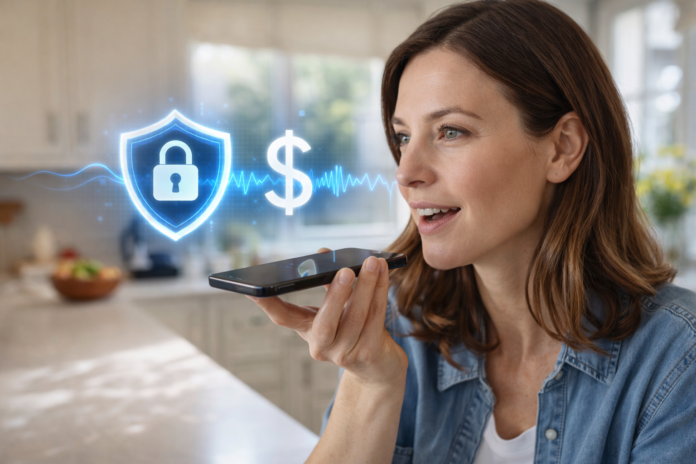
As of March 2026, the way we interact with our finances has shifted from the tactile to the audible. We no longer just “tap to pay”; we speak to pay. Voice-based payments—the process of initiating and authorizing financial transactions using voice commands through smart speakers, smartphones, or connected vehicles—have moved from a futuristic novelty to a multi-billion-dollar industry. With the global voice commerce market estimated to reach $72.8 billion this year, the convenience of saying “Hey Google, pay my utility bill” or “Alexa, reorder my vitamins” is undeniable.
However, as the technology matures, so do the methods used by bad actors. The rise of sophisticated AI voice cloning and deepfake technology has cast a shadow over the “voice-first” revolution. This has led many consumers and businesses to ask: Is my voice truly my password, or am I leaving my bank account door wide open?
Key Takeaways
- Voice Biometrics vs. Voice Commands: Simple voice commands are convenient, but true security relies on voice biometrics (your unique “voiceprint”).
- The AI Threat: In 2026, AI can clone a voice with as little as three seconds of audio, making “voice-only” authentication risky without secondary factors.
- Layered Security: The most secure voice systems use a combination of tokenization, encryption, and multi-factor authentication (MFA).
- Regulatory Shield: PCI DSS 4.0 and evolving consumer protection laws provide a safety net, but user vigilance remains the first line of defense.
Who This Is For
This guide is designed for everyday consumers curious about the safety of their smart home devices, small business owners looking to implement voice-activated checkouts, and tech enthusiasts wanting to understand the technical “handshake” between their vocal cords and their bank accounts. Whether you are a skeptic or an early adopter, understanding the friction between convenience and security is essential for navigating the modern financial landscape.
Safety & Financial Disclaimer: This article is for informational purposes only and does not constitute financial or legal advice. Always consult with your financial institution regarding their specific fraud protection policies. Never share PINs or passwords aloud in public spaces.
How Voice-Based Payments Work: The Tech Behind the Talk
To understand if your voice is secure, you must first understand what happens when you speak to a device. Voice-based payments aren’t just a simple recording being sent to a bank; they involve a complex stack of technologies working in milliseconds.
1. Automatic Speech Recognition (ASR)
The journey begins with ASR, which converts your spoken words into text. In 2026, ASR systems have reached an impressive 95–98% accuracy in quiet environments. The system filters out background noise—like a humming refrigerator or a passing car—to isolate your specific command.
2. Natural Language Processing (NLP)
Once the device “hears” the text, NLP kicks in to understand the intent. If you say, “Send fifty bucks to Sarah,” the NLP must determine which “Sarah” in your contacts you mean and which “fifty” (USD, EUR, etc.) applies.
3. Voice Biometrics (The Security Core)
This is where the “Secure” part of the equation lives. Unlike a simple password, a voiceprint is a mathematical model of your vocal tract. It analyzes over 100 physical and behavioral characteristics, including:
- Pitch and Tone: The frequency of your voice.
- Cadence: Your speaking rhythm and speed.
- Harmonic Patterns: The unique shape of your throat and mouth.
4. The API Handshake and Tokenization
Once your identity is verified, the voice assistant doesn’t send your credit card number over the air. Instead, it uses tokenization. The system generates a “token”—a random string of characters—that represents your payment info. If a hacker intercepts this token, it is useless to them because it only works for that specific transaction and that specific merchant.
The “Secure” Argument: Why You Can Trust the Tech
Proponents of voice commerce argue that it is actually more secure than traditional card-present transactions in many ways. Here is why the “Secure” side of the debate has strong legs in 2026.
Biometric Uniqueness
While someone can steal your wallet or phish your password, they cannot easily replicate the physical dimensions of your vocal cords. Modern voice biometrics are sophisticated enough to distinguish between a live human and a high-quality recording (liveness detection).
Encrypted Communication
Every major voice platform—Amazon Alexa, Google Assistant, and Apple’s Siri—uses high-level encryption (typically AES-256). This ensures that the data traveling from your smart speaker to the cloud is unreadable to anyone else on your Wi-Fi network.
Multi-Factor Requirements
Most financial institutions now require “Voice + 1.” This means even after you give a voice command, you might receive a push notification on your phone asking you to “Tap to Confirm” or enter a 4-digit PIN. This layered approach, known as Multi-Factor Authentication (MFA), is the gold standard for preventing unauthorized purchases.
The “Scammable” Argument: The Dark Side of Voice AI
Despite the technical safeguards, the “Scammable” side of the debate is fueled by the rapid advancement of Generative AI. Fraudsters in 2026 are no longer just “guessing” passwords; they are engineering voices.
1. AI Voice Cloning and Deepfakes
This is the most significant threat of the current year. Using “vishing” (voice phishing) techniques, a scammer can call you, record a few seconds of your voice, and use AI to create a perfect clone. They can then call your voice-activated bank system or use your smart speaker to authorize transfers.
- The Risk: Recent studies show that 1 in 4 people have already encountered an AI voice scam.
- The Vulnerability: Some older or lower-end voice recognition systems cannot tell the difference between a real voice and an AI-generated clone.
2. “Ghost” Commands and Eavesdropping
There have been documented cases of “ultrasonic” attacks, where commands are sent at frequencies humans can’t hear but microphones can. A hacker within range of your window could theoretically “whisper” a silent command to your Alexa to “Open the front door” or “Buy a $1,000 gift card.”
3. The “Always-On” Privacy Concern
While not a direct scam, the fact that these devices are always listening for a “wake word” creates a privacy risk. If the device’s software is compromised, a hacker could listen to private conversations to gather “social engineering” data—like your mother’s maiden name or where you went to school—to bypass other security questions.
Comparing the Giants: Alexa vs. Google vs. Siri (2026 Edition)
Each platform handles security differently. Depending on which ecosystem you live in, your risk profile changes.
| Feature | Amazon Alexa | Google Assistant | Apple Siri |
| Primary Security | Voice Profile + Optional PIN | Voice Match + Google Account | FaceID/TouchID on Phone |
| Transaction Method | Amazon Pay (Tokenized) | Google Pay | Apple Pay (Secure Element) |
| Privacy Focus | Moderate (Cloud-heavy) | Moderate (Data-driven) | High (On-device processing) |
| MFA Support | High (App confirmation) | High (Phone prompt) | Very High (Biometric required) |
Amazon Alexa
Alexa is the leader in “V-commerce” volume. Its security relies heavily on “Voice Profiles.” If Alexa doesn’t recognize your specific voiceprint, it will refuse to make a purchase. However, it is the most targeted platform for “accidental” purchases (e.g., kids ordering toys) because of its deep integration with the Amazon storefront.
Google Assistant
Google uses “Voice Match” to distinguish between family members. In 2026, Google has integrated “Deepfake Detection” into its cloud processing, which analyzes the “digital artifacts” in a voice to see if it was generated by an AI.
Apple Siri
Siri remains the most conservative. For most payments, Siri won’t just “take your word for it”; it requires you to physically confirm the transaction on your iPhone using FaceID or TouchID. This makes it the most “Secure” but the least “Hands-Free.”
Common Mistakes: How Users Accidentally Open the Door
Even the best security fails if the user makes these common errors. Are you guilty of any of these?
- Disabling the Voice PIN: Most devices allow you to set a 4-digit code for purchases. Many users turn this off for “convenience,” which is the #1 way unauthorized purchases happen.
- Using a “Weak” Voice PIN: Using “1221” or “1111” is as bad as having no PIN at all.
- Public Voice Commands: If you are at a coffee shop and say, “Hey Siri, pay my landlord three thousand dollars,” you are broadcasting your financial intentions and potentially your PIN to everyone around you.
- Not Updating Firmware: Security patches for voice assistants are released almost weekly. If you haven’t updated your smart speaker’s software lately, you are missing out on the latest anti-spoofing protections.
The Regulatory Landscape: Who Protects You?
As of March 2026, several legal and technical frameworks are in place to ensure that if you do get scammed, you aren’t left high and dry.
PCI DSS 4.0
The Payment Card Industry Data Security Standard (PCI DSS) version 4.0 is the global benchmark for payment security. Any company processing voice payments must comply with strict rules regarding how voice data is stored and encrypted. If a company fails to protect your voice data, they face massive fines and the loss of their ability to process payments.
Regulation E (Electronic Fund Transfer Act)
In the United States, Regulation E protects consumers against unauthorized electronic transfers. If you report a fraudulent voice-based transaction within two business days of discovering it, your liability is typically limited to $50.
The EU’s AI Act
The European Union has implemented strict regulations on “Biometric Categorization.” This forces companies to be transparent about how they use your voiceprint and gives you the “Right to be Forgotten,” meaning you can demand they delete your voice data at any time.
5 Practical Tips to Secure Your Voice Payments Today
If you want the convenience of voice commerce without the anxiety of a scam, follow this 2026 security checklist:
- Set Up a Unique Voice PIN: Never reuse a PIN from your bank card or phone. Make it a random sequence of four numbers.
- Enable “Push-to-Confirm”: Configure your settings so that every voice purchase requires a final tap on your smartphone. This creates a “physical bridge” that a remote hacker cannot cross.
- Use a “Verbal Codeword”: For person-to-person (P2P) transfers, establish a secret word with your family. If “Grandma” calls asking for money, she must say the codeword. If she doesn’t, it’s a deepfake.
- Mute the Mic When Not in Use: Most smart speakers have a physical mute button. If you aren’t planning on using the device for a few hours, hit the button.
- Review Transaction History Weekly: Check your Amazon, Google, or Apple transaction history at least once a week. Scammers often start with small, $1.00 “test” charges to see if you’re paying attention.
The Future of V-Commerce: What’s Next?
Looking toward 2027 and beyond, we expect to see “Multimodal Authentication” become the norm. This means your smart speaker might use its camera to verify your face while you speak, or your smartwatch might check your heart rate to ensure a live human is making the request.
We are also seeing the rise of “Agentic Commerce,” where AI agents don’t just execute your commands but proactively manage your finances. While this adds another layer of complexity, it also adds a layer of defense: an AI “Financial Guard Dog” that can spot unusual spending patterns in real-time and block them before they clear.
Conclusion: Is It Secure or Scammable?
So, back to our original question: Secure or Scammable? The answer is: It is secure by design, but scammable by exploitation. The underlying technology—the encryption, the tokenization, and the biometric modeling—is incredibly robust. In a vacuum, voice-based payments are arguably safer than carrying a physical credit card that can be skimmed or stolen. However, the human element remains the weakest link. As long as users prioritize convenience over security (by disabling PINs or ignoring MFA), and as long as AI continues to make voice cloning “child’s play,” scams will persist.
The key to thriving in a voice-first world is cautious adoption. Use the technology for low-risk tasks like reordering groceries or paying routine utility bills, but keep the “human-in-the-loop” for large transfers and new merchants. By treating your voice with the same level of protection you give your physical keys, you can enjoy the magic of 2026 technology without the nightmare of a drained bank account.
Would you like me to help you draft a step-by-step security audit for your specific smart home device to ensure your voice payments are fully protected?
FAQs (Schema-Style)
Q: Can a recording of my voice be used to make a payment?
A: Most modern systems (as of 2026) use “liveness detection” and spectral analysis to distinguish between a live human voice and a recording. However, high-fidelity AI clones can sometimes bypass basic systems, which is why a secondary PIN is always recommended.
Q: What should I do if I see an unauthorized voice purchase?
A: Immediately contact your bank or credit card issuer to dispute the charge. Most voice platforms also have a “Report Fraud” section in their app settings. Under Regulation E, your liability is limited if you report it quickly.
: Does Alexa or Google keep a recording of everything I say?
A: They “listen” for the wake word locally on the device. Once the wake word is detected, the subsequent command is sent to the cloud. You can view and delete these recordings in your privacy settings at any time.
Q: Is voice-based payment safe for kids to use?
A: It is only safe if you have “Kids’ Mode” enabled or have a strict PIN requirement for purchases. Without these, accidental purchases are common.
Q: Can a neighbor shout through my window to make a purchase?
A: This is highly unlikely with “Voice Match” technology, as the device is trained to only respond to authorized users. However, keeping your device away from open windows is a common-sense safety tip.
References
- FBI Internet Crime Complaint Center (IC3): 2024 State of Cybercrime Report
- PCI Security Standards Council: Official PCI DSS 4.0 Resource Guide
- Federal Trade Commission (FTC): Consumer Advice on AI Voice Cloning Scams
- Amazon Alexa Privacy Hub: Understanding Voice Profiles and Security
- Google Safety Center: How Google Assistant Protects Your Identity
- Apple Support: Apple Pay Security and Privacy Overview
- Juniper Research: Voice Commerce Market Trends and Forecasts 2022-2027
- NIST (National Institute of Standards and Technology): Digital Identity Guidelines for Biometrics
- Mastercard Newsroom: The Future of Digital Identity and Biometric Payments 2026
- European Commission: The Artificial Intelligence Act – Biometrics Protections