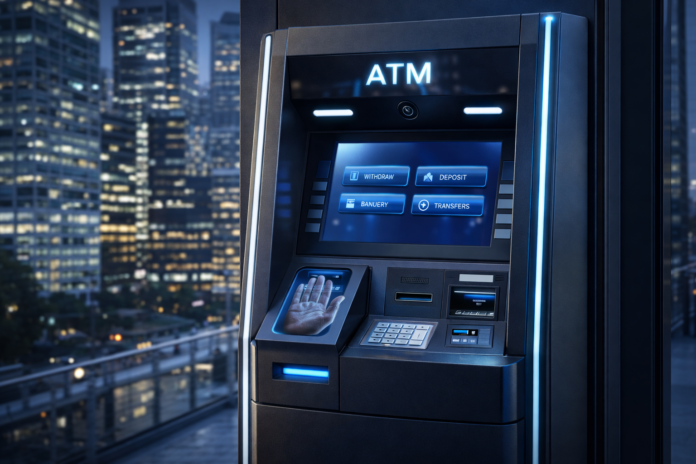
As of March 2026, the global banking landscape is undergoing its most significant hardware transformation since the introduction of the first cash machine in 1967. The “Automated Teller Machine” (ATM) is no longer a simple cash dispenser; it has evolved into a sophisticated, multi-functional financial hub. Driven by the convergence of biometric authentication, artificial intelligence (AI), and the “phygital” (physical-digital) needs of modern consumers, the ATM is being reimagined as a cardless, identity-first portal.
Key Takeaways
- Biometric Dominance: By 2026, biometric authentication is deployed in approximately 16% of ATMs worldwide, with palm vein and facial recognition leading the charge.
- ITM Expansion: Interactive Teller Machines (ITMs) are replacing traditional bank branches in rural areas, offering video-assisted services that replicate in-person banking.
- The Crypto Pivot: Cryptocurrency integration has become a mainstream revenue stream, with standard retail ATMs now “layering” Bitcoin and stablecoin services via software updates.
- Security Evolution: Logical attacks like “jackpotting” are being countered by AI-driven anti-fraud systems and Post-Quantum Cryptography (PQC).
- Sustainability: Solar-powered and eco-friendly ATMs are expanding financial inclusion in off-grid regions of Africa and South Asia.
Who This Is For
This guide is designed for financial institution (FI) leaders, FinTech developers, and retail banking strategists seeking to understand the 2026-2030 roadmap for self-service banking. It also serves as a comprehensive resource for security professionals and regulatory compliance officers navigating the complex intersection of biometric data and privacy laws.
The Current State of the ATM (2026)
Despite the rapid rise of mobile peer-to-peer (P2P) apps like Zelle and Venmo, which have reduced Gen Z’s ATM visits by roughly 22%, the global ATM market remains resilient. Current data shows approximately 2.91 million ATMs in operation worldwide. However, the nature of these installations is shifting. Over half of global ATMs are now placed “off-site”—in convenience stores, airports, and malls—rather than inside traditional bank branches.
Banks are increasingly adopting ATM-as-a-Service (AaaS), outsourcing the hardware maintenance and cash logistics to third-party providers. This allows banks to focus on the software experience and “Relationship Banking,” while the physical machine becomes a hyper-efficient, self-healing vault.
1. The Biometric Revolution: Your Body as the Card
The most visible change in 2026 is the disappearance of the plastic debit card. Biometrics have moved from high-security bank vaults to the street corner, offering a friction-free experience where “you are your credential.”
Palm Vein Recognition
Palm vein scanning has emerged as the gold standard for ATM security. Unlike fingerprints, which can be smudged or “lifted,” palm vein patterns are internal and virtually impossible to forge.
- How it works: An infrared light maps the unique pattern of deoxidized hemoglobin in a user’s veins.
- The Benefit: It is contactless (highly hygienic) and works even if the user has surface-level scars or dirt on their hands.
3.D. Facial Recognition and Deepfake Defense
Facial recognition is the fastest-growing modality in the Asian and Middle Eastern markets. In 2026, modern ATMs use Active Liveness Detection to prevent fraud from high-resolution photos or deepfake video projections.
- 3D Mapping: Sensors project thousands of invisible dots to create a topographical map of the face.
- Security Note: To comply with privacy laws like BIPA and GDPR, many banks are moving toward decentralized biometrics, where the facial template is stored on the user’s smartphone and only verified by the ATM via an encrypted handshake.
Iris Scanning: The Non-Intrusive Alternative
Iris recognition offers the lowest False Acceptance Rate (FAR) in the industry. As hardware costs for iris sensors dropped in late 2025, we are seeing wider adoption in high-traffic transit hubs where speed and accuracy are paramount.
2. The Rise of Interactive Teller Machines (ITMs)
As banks continue to optimize their physical branch footprints, the Interactive Teller Machine (ITM) has become the “bridge” to the future.
What Defines an ITM?
Unlike a standard ATM, an ITM features high-definition video conferencing capabilities. A remote teller, often located in a centralized call center, can take control of the machine to assist with complex tasks:
- Cashing checks to the penny.
- Processing loan payments.
- Opening new accounts or issuing replacement cards instantly.
- Updating personal information (KYC updates).
The Economics of Video Banking
In 2026, a single video teller can manage up to 20 ITM terminals simultaneously. This reduces the cost per transaction from approximately $4.50 (in-branch) to under $0.70. For financial institutions, this means maintaining a “human” presence in rural or underserved markets without the overhead of a full brick-and-mortar staff.
3. Contactless and Mobile-First Integration
The smartphone has become the “remote control” for the ATM. In 2026, over 60% of new ATM installations are fully contactless-ready.
NFC and QR Code Withdrawals
Users now “stage” their transactions on their banking app before even reaching the machine.
- Selection: The user selects “Withdraw $100” on their phone.
- Authentication: The phone uses FaceID or a fingerprint to verify the user.
- The Tap: Upon reaching the ATM, the user taps their phone (NFC) or scans a dynamic QR code.
- Dispense: The cash is dispensed in under 10 seconds, compared to the traditional 45-second card-and-PIN cycle.
The Death of the Magnetic Stripe
As of March 2026, many European and North American banks have begun phasing out magnetic stripe readers entirely, favoring EMV chips and NFC. This move is a direct response to the persistent threat of shimming—a more advanced form of skimming that targets chip cards.
4. Artificial Intelligence and Predictive Banking
AI is the “silent engine” driving ATM efficiency in 2026. It operates across three main pillars: Maintenance, Personalization, and Fraud.
Self-Healing Machines
Predictive maintenance algorithms analyze hardware sensors to detect a potential bill jam or card-reader failure before it happens.
- Example: If a sensor detects increased friction in the cash-dispensing belt, the AI automatically dispatches a technician with the specific part needed, ensuring 99.9% uptime.
Hyper-Personalization
When a loyal customer approaches an AI-enabled ATM, the interface adapts. If the customer typically withdraws $60 every Friday, the “Quick Cash” button will prioritize that specific amount. If they have a pre-approved loan offer, a subtle, non-intrusive notification appears, allowing them to initiate the application via a video teller instantly.
Real-Time Fraud Intelligence
AI monitors transaction patterns across the entire network. If an ATM in a specific zip code experiences a sudden surge in unusual withdrawal patterns, the system can autonomously implement “Step-Up Authentication,” requiring a secondary biometric or mobile push notification for all users in that area.
5. Cryptocurrency and Multi-Asset ATMs
In 2026, the distinction between a “Bitcoin ATM” and a “Bank ATM” is blurring. Major ATM manufacturers like Diebold Nixdorf and NCR (Voyix) have released software layers that allow traditional retail ATMs to handle digital assets.
Cash-to-Crypto Bridges
Millions of “underbanked” individuals now use ATMs to convert physical cash into Stablecoins (USDC/USDT) or Bitcoin. This is particularly prevalent in the gig economy, where workers use ATMs as entry points for decentralized finance (DeFi) platforms.
Central Bank Digital Currencies (CBDCs)
With several nations piloting CBDCs in 2026, modern ATMs are being equipped with “Digital Vaults.” These machines allow users to exchange physical cash for their government-issued digital currency, which is then transferred directly to a secure hardware wallet or banking app.
6. Security in the Post-Quantum Era
As computing power increases, so do the tactics of cybercriminals. The ATM industry is currently locked in a technological arms race.
The Threat of “Jackpotting”
Jackpotting (or logical attacks) involves a criminal physically accessing the ATM’s internal “top box” and connecting a laptop or mobile device to bypass the software and force a cash dispense.
- 2026 Defense: Modern machines utilize End-to-End Encryption (E2EE) between the PC core and the dispenser. If the connection is severed or tampered with, the dispenser enters a “brick” mode, rendering it useless.
White-Box Cryptography
To protect against malware, banks are implementing white-box cryptography, which ensures that even if a criminal gains access to the ATM’s software environment, the encryption keys remain hidden within the code itself, obfuscated and constantly changing.
7. Sustainability and Financial Inclusion
The “Green ATM” is a major trend in 2026, especially as banks face pressure to meet ESG (Environmental, Social, and Governance) targets.
Solar-Powered Banking
In regions like Sub-Saharan Africa and Southeast Asia, solar-powered ATMs are bridging the financial gap. These machines are designed for low power consumption, using high-efficiency e-ink displays and optimized bill dispensers to run entirely on renewable energy.
Cash Recycling Technology
Traditional ATMs are “cash-out” only, requiring armored trucks to replenish them frequently. Cash Recyclers accept deposits, validate the bills, and then “recycle” them for the next customer’s withdrawal. This reduces “Cash-in-Transit” (CIT) visits by up to 30%, significantly lowering the carbon footprint of the banking network.
8. Regulatory Compliance and Privacy Laws
The shift toward biometrics has triggered a new wave of legislation. In 2026, navigating these laws is the biggest hurdle for ATM operators.
GDPR and the “Right to be Forgotten”
In the EU, biometric templates must be handled with extreme care. Banks must provide clear “Opt-In” mechanisms and ensure that if a customer leaves the bank, their biometric data is purged across all ATM endpoints.
The EU AI Act
Enforced as of 2026, the EU AI Act classifies facial recognition in public spaces as “High Risk.” This requires banks to perform rigorous Fundamental Rights Impact Assessments (FRIA) before deploying facial-recognition-enabled ATMs in European city centers.
BIPA (Illinois) and the U.S. Patchwork
In the United States, Illinois’ Biometric Information Privacy Act (BIPA) continues to serve as a cautionary tale. Banks must obtain written consent before collecting a fingerprint or palm scan, or face statutory damages of up to $5,000 per intentional violation.
9. Global Trends: A Regional Comparison
The future of the ATM looks different depending on where you stand.
| Region | Primary Trend | Driving Force |
| Asia-Pacific | Facial Recognition & Super-Apps | Deep integration with WeChat/Alipay; tech-forward population. |
| North America | ITMs and Branch Transformation | Cost-cutting and the need to maintain rural service. |
| Europe | Contactless & Privacy Compliance | Strong NFC adoption and strict GDPR/AI Act regulations. |
| Latin America | Biometrics for Fraud Prevention | High rates of card skimming driving the need for palm/fingerprint. |
| Africa | Solar-Powered & Mobile Integration | Financial inclusion and lack of stable power infrastructure. |
10. Common Implementation Mistakes
Despite the promise of new technology, many financial institutions stumble during the transition.
1. Over-Complicating the User Interface (UI)
The biggest mistake is adding too many features at once. A customer wanting a quick $40 withdrawal should not have to navigate through three screens of cryptocurrency offers.
- Solution: Use AI to hide “advanced” features for users who only perform basic transactions.
2. Ignoring Hardware Backwards-Compatibility
While biometrics are the future, a significant portion of the population (especially seniors) still relies on physical cards and PINs.
- Mistake: Removing card readers entirely before the market is ready.
- Solution: Implement “Hybrid” machines that support both legacy cards and modern biometrics.
3. Neglecting Localized Privacy Disclosures
In 2026, privacy is a branding issue. Failing to clearly explain how biometric data is encrypted leads to “Creep Factor” and low adoption.
- Mistake: Burying biometric consent in a 50-page Terms and Conditions document.
- Solution: Use on-screen animations to show that data is being “hashed” and not stored as an actual image of the face or palm.
Conclusion
The future of the ATM is not its disappearance, but its total transformation into an intelligent, secure, and inclusive “phygital” portal. In March 2026, we see a world where the plastic card is a relic of the past, replaced by the unique biological signatures of our own bodies. Biometrics have solved the age-old problem of card skimming, while Interactive Teller Machines (ITMs) have ensured that the human element of banking remains accessible, even as physical branches vanish.
For financial institutions, the path forward is clear: Embrace the Hybrid. Invest in cash recycling to lower operational costs, integrate mobile-first staging to satisfy Gen Z, and prioritize decentralized biometric storage to win the trust of a privacy-conscious public. The ATM is no longer a “dumb” machine on a wall—it is the front line of your digital strategy.
Next Step for You: Would you like me to draft a strategic implementation checklist for transitioning your existing fleet to Biometric and ITM-capable hardware?
FAQs
1. Is biometric data stored on the ATM itself?
No. In 2026, most secure systems use Biometric Hashing. The ATM scans your palm or face, converts it into a unique mathematical string (a hash), and compares that hash to one stored in a secure, encrypted cloud or on your personal mobile device. The actual image of your face or palm is never stored on the machine.
2. Can someone “spoof” a biometric ATM with a photo or 3D mask?
Modern ATMs use Liveness Detection. This includes infrared sensors to detect blood flow (in the case of palm veins) and 3D depth sensors to ensure the face is a living, three-dimensional human and not a 2D image or a high-quality silicone mask.
3. Will ATMs eventually stop giving out physical cash?
While digital payments are rising, cash remains essential for privacy, emergency preparedness, and the unbanked. ATMs are evolving into “Cash Recyclers” and “Multi-Asset Hubs” rather than disappearing. They will continue to provide cash, but also digital assets like CBDCs and stablecoins.
4. What happens if the biometric scanner fails to recognize me?
All modern ATMs feature Multi-Factor Authentication (MFA). If a biometric scan fails (perhaps due to an injury), the system will default to a secondary method, such as a mobile push notification, a QR code scan, or a traditional PIN.
5. Are crypto-enabled ATMs safe for non-tech users?
Yes. The 2026 generation of crypto-ATMs uses a highly simplified UI. Buying Bitcoin at an ATM is now as simple as selecting an amount and scanning a wallet address, with the ATM handling all the complex backend blockchain “gas fees” and exchanges.
References
- Diebold Nixdorf (2025). The DN Series 300: Revolutionizing Self-Service Banking. Official Product Documentation.
- ATM Marketplace (2026). Global ATM Market Report 2026-2032: The Biometric Surge.
- European Banking Authority (EBA) (2025). Guidelines on the Use of Biometrics in Financial Services under PSD3.
- Federal Trade Commission (FTC) (2026). Consumer Privacy in the Age of AI and Biometric Authentication.
- KAL ATM Software (2026). Top 2026 ATM Trends: The Rise of the Phygital Branch.
- Journal of Financial Transformation (2025). The Impact of Cash Recyclers on Operational Efficiency and Carbon Footprints.
- World Bank (2026). Financial Inclusion Through Solar-Powered Infrastructure in Emerging Markets.
- International Biometrics + Identity Association (IBIA) (2025). Standards for Liveness Detection in Unattended Terminals.
- NCR Voyix (2026). Digital-to-Physical: Bridging the Gap with Multi-Asset ATMs.
- Gartner (2025). Top Strategic Technology Trends 2026: Identity-First Security.