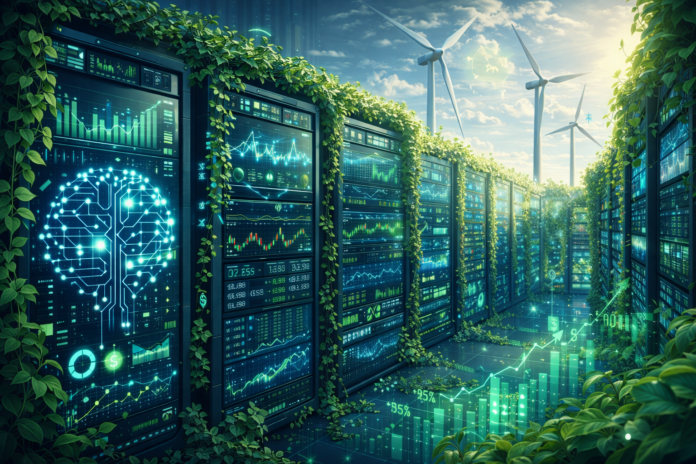
As of March 2026, the financial services industry has reached a tipping point. Artificial Intelligence (AI) is no longer a “nice-to-have” experimental tool; it is the central nervous system of global markets. From high-frequency trading (HFT) and automated risk assessment to personalized wealth management and fraud detection, AI drives trillions of dollars in transactions every day. However, this digital revolution comes with a physical price: massive energy consumption.
The term Sustainable AI in finance refers to the practice of developing, deploying, and maintaining financial algorithms and infrastructure in a way that minimizes environmental impact while maximizing social and economic value. It is the intersection of “Green IT” and “Sustainable Finance,” aiming to ensure that the pursuit of “alpha” (market-beating returns) doesn’t result in an unsustainable carbon footprint.
Key Takeaways
- Energy Intensity: Training a single large-scale financial model can emit as much carbon as five cars over their entire lifetimes.
- Regulatory Pressure: New laws in 2025 and 2026 require financial institutions to disclose “Scope 3” emissions, which include the carbon footprint of their third-party cloud and AI providers.
- Efficiency as a Metric: Success is shifting from “highest accuracy at any cost” to “optimal accuracy per watt-hour.”
- Infrastructure Shift: Transitioning to carbon-aware scheduling and liquid-cooled data centers is becoming a standard for Tier 1 banks.
Who This Is For
This guide is designed for Chief Technology Officers (CTOs), ESG (Environmental, Social, and Governance) officers, fintech developers, and financial analysts who are navigating the complex transition toward a net-zero financial system. Whether you are building a small-scale credit scoring model or managing a massive quantitative trading floor, understanding the energy cost of your compute is now a fiduciary and ethical necessity.
The Invisible Engine: Why AI in Finance Consumes So Much Power
To understand the energy cost, we must look at what happens behind the screen. AI, particularly Deep Learning and Large Language Models (LLMs) used for sentiment analysis in markets, relies on billions of mathematical operations performed every second.
Training vs. Inference
The energy cost of AI is divided into two primary phases:
- Training: This is the “education” phase where a model learns to recognize patterns from historical market data. This process can take weeks or months, utilizing thousands of GPUs (Graphics Processing Units) simultaneously. For a major bank developing a proprietary “FinanceGPT,” the training phase can consume hundreds of megawatt-hours (MWh) of electricity.
- Inference: This is the “working” phase where the model is actually used to make predictions or decisions. While a single inference (e.g., checking a transaction for fraud) uses very little power, these models run millions of times per hour. In the long run, inference often accounts for up to 80-90% of a model’s total lifetime energy consumption.
The Hardware Factor
In 2026, the industry has moved toward specialized hardware like H100s and Blackwell architectures. While these chips are more “efficient” per operation, the sheer volume of data being processed in finance—tick-by-tick market data, alternative data like satellite imagery, and social media feeds—means that total energy demand continues to climb.
The Environmental Impact of Different Financial AI Use Cases
Not all AI applications are created equal when it comes to their carbon footprint. Understanding the variance allows firms to prioritize their green initiatives.
1. High-Frequency Trading (HFT)
HFT is perhaps the most energy-intensive sector of finance relative to its physical output. To gain a microsecond advantage, HFT firms use “overclocked” processors and maintain massive server arrays in “co-location” centers physically close to stock exchange servers. These servers run at maximum capacity 24/7, requiring intense cooling systems.
- The Sustainability Challenge: The competitive nature of HFT leads to a “red queen” race where firms constantly upgrade hardware, leading to high levels of e-waste and energy waste for marginal gains.
2. Risk Management and Stress Testing
Banks are required by regulators to run complex simulations (like Monte Carlo simulations) to ensure they can survive economic crashes. Transitioning these to AI-driven models has made them faster but significantly increased the compute load.
- The Opportunity: By using “Pruned” models (removing unnecessary neurons from a neural network), banks can achieve the same risk oversight with 40% less energy.
3. Customer Service and Sentiment Analysis
The rise of generative AI in retail banking (chatbots) has replaced traditional FAQs. Every time a customer asks a bot about their balance or a loan product, an LLM is triggered.
- The Reality: A generative AI query consumes approximately 10 to 15 times more electricity than a traditional Google search.
Measuring Success: The “Green” Metrics for Financial AI
Financial institutions have long been experts at measuring ROI (Return on Investment). Now, they must master ROEI (Return on Energy Invested).
PUE (Power Usage Effectiveness)
PUE is the ratio of the total energy used by a data center to the energy delivered to the computing equipment. A PUE of 1.0 is the “perfect” score.
- Traditional Data Centers: Often have a PUE of 1.6 to 2.0.
- Modern Green Data Centers: Use liquid cooling and AI-optimized airflow to achieve PUEs as low as 1.1.
Carbon Intensity of Compute
Not all electricity is equal. A model trained in a region powered by coal has a vastly different impact than one trained in a region powered by hydroelectricity.
- Carbon-Aware Scheduling: Modern financial firms are now “scheduling” their non-urgent training tasks (like weekly model re-trains) to run at night or during times when renewable energy production (wind/solar) is at its peak on the grid.
Strategies for Achieving Sustainable AI in Finance
Moving toward sustainability requires a multi-layered approach, involving software, hardware, and corporate policy.
1. Algorithmic Efficiency and “Small Data”
The “bigger is better” era of AI is being challenged by “Efficient AI.” Instead of using a 175-billion parameter model for a simple credit check, firms are using Distilled Models.
- Knowledge Distillation: A process where a large “teacher” model trains a smaller, more efficient “student” model. The student model retains 95% of the accuracy but uses only 10% of the energy.
- Quantization: Reducing the precision of the numbers used in AI calculations (e.g., from 32-bit to 8-bit). This drastically reduces the memory and energy required for inference.
2. Choosing Green Cloud Providers
As of 2026, the major cloud providers (AWS, Google Cloud, Azure) offer “Carbon Footprint Dashboards.” Financial firms must move beyond simply buying “carbon offsets” and instead select “carbon-free” regions for their AI workloads.
- Real-time monitoring: Integrating cloud billing with carbon metrics allows developers to see the CO2 impact of their code in real-time.
3. Hardware Lifecycle Management
Sustainable AI isn’t just about electricity; it’s about the “embodied carbon” in the chips themselves.
- Circular Economy: Leading fintechs are partnering with hardware vendors who offer “buy-back” programs, ensuring that old GPUs are recycled or refurbished rather than ending up in landfills.
The Role of Regulation: The “E” in ESG
The regulatory landscape has shifted from voluntary “Green Promises” to mandatory disclosures.
The EU AI Act and Sustainability
The European Union’s AI Act now includes provisions regarding the environmental impact of high-risk AI systems. Financial institutions operating in the EU must document the energy consumption and environmental impact of their models.
SEC Climate Disclosure Rules (2026 Update)
In the United States, the SEC has tightened rules regarding climate-related disclosures. Large financial institutions are now required to report on their Scope 3 emissions. Since most of a bank’s digital footprint comes from its AI and cloud usage, this has made “Sustainable AI” a boardroom priority.
Safety & Financial Disclaimer: While AI can optimize financial returns and energy usage, algorithmic trading and financial modeling involve significant market risk. Sustainability metrics do not guarantee financial performance. Always consult with a certified financial advisor and risk management professional before implementing new trading strategies.
Common Mistakes in Sustainable AI Implementation
- Greenwashing with Offsets: Relying on carbon offsets (like planting trees) rather than actually reducing the energy consumption of code. Offsets are a secondary tool, not a primary solution.
- Over-provisioning: Keeping massive GPU clusters running “just in case” they are needed. This “zombie compute” is a leading cause of energy waste in banking.
- Ignoring the Data Pipeline: Focusing only on the AI model while ignoring the massive, energy-hungry databases that feed it. A clean model on a “dirty” data architecture is not sustainable.
- Chasing Diminishing Returns: Spending 500% more energy to increase a model’s accuracy from 98.1% to 98.2%. In most financial contexts, that 0.1% gain does not justify the environmental cost.
Practical Example: The “Green” Fraud Detection System
Consider a mid-sized bank processing 10 million transactions a day.
- The Old Way: Every transaction is sent to a massive, general-purpose LLM in the cloud to check for fraud. Energy cost: High. Latency: Moderate.
- The Sustainable Way: * Tier 1: A tiny, locally-hosted “Random Forest” model (very low energy) filters out 99% of obviously safe transactions.
- Tier 2: Only the suspicious 1% are sent to a more complex, “Quantized” neural network.
- Tier 3: Only the most complex cases (0.1%) reach the heavy-duty LLM.
- Result: The bank reduces its AI energy consumption by over 85% while maintaining the same level of security.
The Future of Finance: Carbon-Neutral Intelligence
Looking toward the end of the decade, we expect to see the rise of Neuromorphic Computing—chips that mimic the human brain’s efficiency. The human brain is the most advanced “AI” in existence, yet it runs on about 20 watts of power (less than a dim lightbulb).
Financial institutions that master Sustainable AI today will have a significant competitive advantage. They will have lower operational costs, better compliance standing, and a brand that resonates with the increasingly eco-conscious “Gen Alpha” and Millennial investor base.
Conclusion
The marriage of AI and Finance is one of the most powerful economic engines of our time. However, as we have seen, this engine requires an enormous amount of “fuel” in the form of electricity. As of March 2026, the industry is moving away from the “move fast and break things” mentality toward a more mature “move fast and sustain things” approach.
Sustainable AI in finance is not about slowing down innovation; it is about making innovation smarter. By focusing on algorithmic efficiency, choosing green infrastructure, and adhering to transparent reporting, financial institutions can ensure that the “intelligence” they create does not come at the expense of the planet.
Next Steps for Your Organization:
- Audit: Use a tool like CodeCarbon or cloud-native dashboards to measure the current CO2 footprint of your AI models.
- Optimize: Identify your most energy-intensive models and explore “pruning” or “distillation” techniques.
- Govern: Update your internal ESG policy to include specific targets for AI energy efficiency.
- Procure: When renewing cloud contracts, prioritize providers who offer 24/7 carbon-free energy matching.
Would you like me to help you draft a specific “Sustainable AI Policy” template for your firm?
FAQs
1. Does “Green AI” mean my models will be less accurate?
Not necessarily. Many techniques, such as knowledge distillation and quantization, can maintain high levels of accuracy while significantly reducing energy use. In some cases, streamlining a model can actually improve its generalization and performance on new data.
2. Is it more sustainable to run AI on-premise or in the cloud?
Generally, major cloud providers are more sustainable due to their “economies of scale.” They have higher utilization rates and access to more efficient cooling and renewable energy sources than most private corporate data centers.
3. How do I report AI energy costs for ESG compliance?
Most frameworks (like TCFD or GRI) now require reporting on Scope 3 emissions. You should request “Carbon Footprint Reports” from your cloud provider and use software-based energy trackers for your local development environments.
4. What is the most energy-efficient AI language for finance?
While Python is the standard for AI development, languages like C++, Rust, and Julia are significantly more energy-efficient for the actual execution (inference) of models because they offer better memory management and lower-level hardware access.
5. Can AI itself help reduce the energy cost of finance?
Yes. AI is being used to optimize data center cooling, manage smart grids for renewable energy, and even “compress” other AI models. This creates a “virtuous cycle” where AI helps solve the problems it partially created.
References
- International Energy Agency (IEA): Data Centers and Data Transmission Networks Report (2025) – Official statistics on global compute energy trends.
- Financial Stability Board (FSB): The Impact of AI on Financial Markets and Sustainability (2025) – Regulatory guidance for global banks.
- Strubell et al. (University of Massachusetts): Energy and Policy Considerations for Deep Learning in NLP – The foundational academic paper on AI carbon footprints.
- Google Sustainability: 24/7 Carbon-Free Energy by 2030 – Technical documentation on carbon-aware computing.
- European Parliament: The EU AI Act – Environmental Impact Obligations – Official legislative text.
- Stanford Institute for Human-Centered AI (HAI): 2025 AI Index Report – Chapter on AI and the Environment.
- Green Software Foundation: Carbon Aware SDK Documentation – Technical resources for developers.
- NVIDIA Corporate Sustainability: Energy Efficiency in Blackwell Architectures – Hardware efficiency benchmarks.