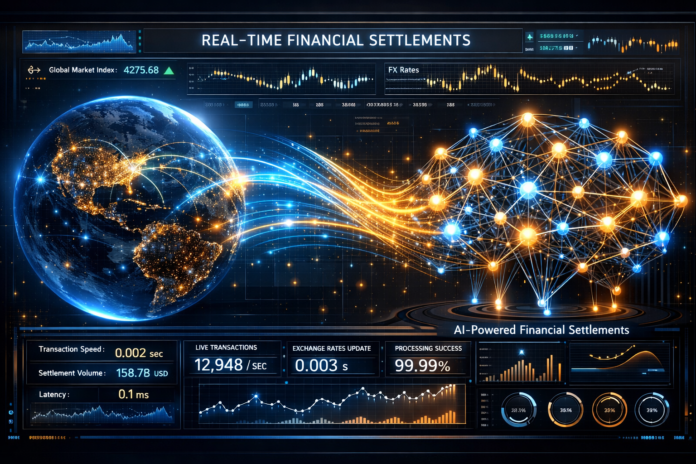
The global financial landscape is currently undergoing its most significant structural shift since the move from physical paper certificates to electronic bookkeeping. This shift is known as the T+0 settlement revolution. For decades, the “standard” for settling a stock trade—the time it takes for the buyer to receive their shares and the seller to receive their cash—was T+2 (trade date plus two business days). As of March 2026, we have witnessed an aggressive global push toward T+0, or “same-day” settlement, fueled almost entirely by advancements in Artificial Intelligence (AI) and machine learning.
Definition: T+0 settlement refers to a transaction environment where securities and funds are transferred on the same day the trade is executed. In its most advanced form, this becomes “atomic settlement,” where the exchange happens near-instantaneously.
Key Takeaways
- Reduced Risk: Eliminating the multi-day waiting period slashes counterparty and systemic risk.
- Liquidity Boost: Investors gain immediate access to their capital, allowing for faster reinvestment and compounding.
- AI Integration: AI is the primary engine behind T+0, managing complex tasks like predictive liquidity, automated reconciliation, and fraud detection that humans cannot perform at “instant” speeds.
- Global Variance: While some markets (like India) have pioneered optional T+0, others (like the U.S. and EU) are navigating the transition from T+1 to T+0 through 2025 and 2026.
Who This Is For
This guide is designed for individual retail investors looking to understand why their cash isn’t immediately available, institutional traders navigating the tech stack of the future, and fintech enthusiasts curious about how AI is rewriting the rules of Wall Street. Whether you are a casual trader or a financial professional, understanding the T+0 revolution is essential for navigating the markets of 2026.
Disclaimer: This article is for informational purposes only and does not constitute financial, legal, or investment advice. Trading in financial markets involves significant risk. Always consult with a certified financial advisor before making investment decisions.
The Historical Context: From Weeks to Seconds
To understand the magnitude of the T+0 settlement revolution, we must look at where we started. In the mid-20th century, stock trading was a manual, paper-intensive process. Runners literally carried physical certificates across Wall Street.
The Paperwork Crisis
In the late 1960s, the New York Stock Exchange (NYSE) faced a “paperwork crisis.” Trading volume grew so fast that firms couldn’t keep up with the physical delivery of certificates. This led to the creation of the Depository Trust Company (DTC) and the move toward “book-entry” systems. At that time, settlement took five business days (T+5).
The Slow March to Speed
- 1995: The U.S. moved from T+5 to T+3.
- 2017: The shift from T+3 to T+2 occurred, reflecting better electronic infrastructure.
- 2024: The U.S. (SEC) and Canada moved to T+1.
- 2025–2026: The global focus shifted to T+0, with India’s SEBI leading the charge by introducing optional same-day settlement for specific scrips.
Each reduction in time requires a massive leap in technology. Moving from T+1 to T+0 is not just a “small step”; it is a total overhaul. In T+1, you have a full night to fix errors. In T+0, you have minutes. This is where AI becomes mandatory.
How AI Facilitates the T+0 Settlement Revolution
The primary reason T+0 remained a “dream” for so long was the sheer complexity of the “post-trade” environment. When you click “buy” on an app, a dozen things happen behind the scenes: clearing, netting, risk assessment, and legal verification. AI simplifies these in three critical ways.
1. Predictive Liquidity Management
In a T+2 or T+1 world, banks and brokerages have time to move money around to cover trades. In T+0, the money must be there now. AI models analyze historical trading patterns, market volatility, and individual user behavior to predict how much cash a firm will need at any given second. By forecasting liquidity needs, AI prevents “settlement fails”—where a trade collapses because the cash or shares weren’t in the right place at the right time.
2. Automated Exception Handling (The “Error-Fixer”)
In legacy systems, if a trade had a data mismatch (e.g., a wrong account number or a slight price discrepancy), a human would manually investigate and fix it the next day. In 2026, AI-powered Natural Language Processing (NLP) and machine learning algorithms identify these “exceptions” in real-time. The AI can automatically cross-reference data across different ledgers, correct the error, and push the trade through in milliseconds, ensuring the T+0 window is met.
3. Real-Time Fraud and Risk Detection
Shortening the settlement cycle gives bad actors less time to be caught—unless the “police” are also automated. AI monitors millions of transactions per second, looking for patterns of market manipulation, “fat-finger” trades, or money laundering. It provides an instant “Go/No-Go” signal to the clearinghouse.
The Mechanics of T+0: How It Works Today
As of March 2026, the implementation of T+0 generally follows two distinct paths: Continuous Real-Time Settlement and Batch-Based Same-Day Settlement.
Continuous Real-Time (Atomic) Settlement
This is the “Gold Standard.” It uses Distributed Ledger Technology (DLT) or highly advanced centralized AI engines.
- The Process: The moment the trade is matched on the exchange, the buyer’s digital wallet is debited, and the seller’s securities account is credited simultaneously.
- The AI Role: The AI acts as the “Valuation Engine,” ensuring that the assets being traded are priced correctly against real-time global feeds.
Batch-Based Same-Day Settlement
This is what most markets are currently adopting as a transition phase.
- The Process: Trades are collected in “batches” throughout the day (e.g., every hour). At the end of the window, the clearinghouse nets all the trades and settles them by 6:00 PM the same day.
- The AI Role: The AI manages the “Netting Optimization.” It calculates the most efficient way to settle thousands of trades with the least amount of actual cash movement, reducing the strain on the banking system.
Global Landscape: Who is Winning the Race?
The T+0 settlement revolution is not uniform across the globe. Different regulatory environments and legacy infrastructures have created a tiered adoption rate.
India: The Pioneer
As of 2024 and through 2026, India’s Securities and Exchange Board (SEBI) has been the global leader. They launched an optional T+0 settlement cycle for a subset of stocks, allowing investors to choose between the standard T+1 and the faster T+0.
- Result: This dual-track system allowed the market to test AI-driven clearing without crashing the entire system. By early 2026, India began moving more large-cap stocks into the mandatory T+0 category.
The United States: The Cautious Giant
The U.S. moved to T+1 in May 2024. Throughout 2025, the SEC and the DTCC (Depository Trust & Clearing Corporation) focused on “compressing” the settlement window further.
- The 2026 Status: The U.S. is currently in a “Technological Hardening” phase. While not yet mandatory T+0 for all retail trades, institutional “Dark Pools” and private exchanges are increasingly using AI-driven atomic settlement for high-frequency transactions.
European Union and the UK: The Fragmentation Challenge
The EU faces a harder path due to the fragmentation of different national clearinghouses (CSDs). However, the move toward a “Capital Markets Union” (CMU) has accelerated AI adoption to bridge the gaps between different countries’ settlement speeds.
Benefits of T+0 for the Average Investor
Why should you care if your trade settles in two days or two seconds? The T+0 settlement revolution offers tangible benefits to the “human” side of finance.
1. Instant Reinvestment
Imagine you sell $5,000 worth of Stock A to buy Stock B because it’s dipping. In a T+2 world, you might have to wait for that cash to clear or use a “margin” account (and pay interest). In T+0, that money is available instantly. You can catch market opportunities in real-time.
2. Elimination of “Frozen” Capital
For the broader economy, T+0 releases billions of dollars that are currently “stuck” in the clearing system. When money moves faster, the velocity of capital increases, which can lead to more vibrant and liquid markets.
3. Lower Margin Requirements
Brokerages often require you to keep a certain amount of “buffer” cash to cover the risks of T+2. With T+0, that risk disappears, potentially lowering the fees and collateral requirements for retail traders.
The Hidden Challenges and Risks of T+0
No revolution comes without “growing pains.” Moving to T+0 introduces specific risks that AI must manage.
1. The Death of the “Grace Period”
In T+2, if you made a mistake (like selling shares you didn’t actually own), you had 48 hours to fix it or borrow the shares. In T+0, there is no “oops” window. If the shares aren’t there at 4:00 PM, the trade fails, and you may face heavy fines.
2. Market Volatility Amplification
Speed can be a double-edged sword. If a market panic starts, T+0 means the panic translates into actual cash outflows instantly. Without the “buffer” of a day or two, flash crashes could theoretically be more severe. AI “Circuit Breakers” are being redesigned in 2026 to handle this increased velocity.
3. Increased Operational Costs for Small Firms
While AI helps, it isn’t free. Large banks like JPMorgan or Goldman Sachs can afford billion-dollar AI upgrades. Smaller, boutique brokerages might struggle to keep up with the real-time tech requirements, potentially leading to market consolidation.
Common Mistakes in the T+0 Environment
As we transition into this new era, investors and firms often fall into the same traps.
Mistake 1: Ignoring “Funding Readiness”
In a T+0 world, “Trade then Fund” is dead. You must “Fund then Trade.” Investors who attempt to buy stocks without settled cash in their accounts will find their orders rejected or their accounts flagged much faster than in the past.
Mistake 2: Over-Reliance on “Manual” Checks
Firms that still rely on humans to “approve” trades before they settle will fail in a T+0 environment. The volume and speed require an “AI-First” approach. Human oversight must move from approving trades to auditing the AI that does the approving.
Mistake 3: Underestimating Interoperability
If you trade on a T+0 exchange but your bank still operates on a legacy “slow” system, you’ll face a mismatch. Always ensure your entire “financial stack”—from your bank to your broker—is T+0 compatible.
Technical Deep Dive: The “AI-DLT” Synergy
The most robust versions of T+0 in 2026 rely on a combination of Artificial Intelligence and Distributed Ledger Technology (DLT).
- DLT (The Ledger): Provides a single “Source of Truth” that all parties (buyer, seller, bank, regulator) can see simultaneously. This eliminates the need for “reconciliation” because there are no conflicting records.
- AI (The Brain): While DLT stores the data, AI makes the decisions. It manages the “Smart Contracts” that execute the trade. If the AI detects a weird price spike or a suspicious account, it can “pause” the Smart Contract before it executes.
This synergy is what finally made T+0 viable. DLT provides the transparency, and AI provides the intelligence at scale.
The Regulatory Perspective: Safety First
Regulators like the SEC (USA), SEBI (India), and ESMA (EU) are walking a tightrope. They want the efficiency of T+0, but they fear systemic instability.
New “Real-Time” Compliance
In 2026, regulatory reporting has also gone T+0. Instead of sending a report to the government at the end of the month, AI-driven systems at brokerages stream trade data to regulators in real-time. This allows for “active supervision,” where regulators can spot a market bubble or a fraud scheme as it is happening.
Cybersecurity Mandates
With T+0, a cyberattack on a clearinghouse could be catastrophic. Regulators are now mandating “AI-Defensive” systems—security AI that specifically looks for “adversarial machine learning” attacks intended to disrupt the settlement cycle.
The Road Ahead: Beyond T+0 (Atomic Settlement)
While the T+0 settlement revolution is the current focus of 2026, the industry is already looking toward “T-Instant” or Atomic Settlement.
In an atomic world, the trade and settlement are the same event. There is no “cycle” at all. This would require every asset—stocks, bonds, real estate—to be tokenized on a global blockchain. We aren’t there yet for the entire market, but for certain asset classes like digital bonds, atomic settlement is already a reality.
The move to T+0 is the essential “proving ground” for this future. If we can successfully manage the risks of same-day settlement using AI, the leap to instant settlement becomes much shorter.
Conclusion: Embracing the Instant Era
The T+0 settlement revolution is more than just a technical upgrade; it is a fundamental shift in how value moves through the world. By integrating AI into the very core of the trade lifecycle, the financial industry has managed to do what was once thought impossible: making the stock market as fast and as seamless as a Venmo transaction or a credit card swipe.
For the investor, this means more control, more liquidity, and less “dead time” for their money. For the financial institution, it means a massive shift toward automation and a relentless focus on tech infrastructure.
As we move through 2026, the gap between “slow” markets and “fast” markets will widen. Those who understand and embrace the AI-driven T+0 model will have a significant advantage in terms of capital efficiency and risk management. The days of “the check is in the mail” are over. In the world of modern finance, if it hasn’t happened yet, it’s already too late.
Next Steps for You:
- Check with your broker: Ask if they support T+0 settlement and if there are specific requirements for your account to participate.
- Review your liquidity: Ensure you have “cleared funds” ready before trading to avoid settlement fails in the faster cycle.
- Stay Informed: Monitor updates from your national securities regulator (e.g., SEC or SEBI) as more stocks are moved into the T+0 window.
FAQs
What is the difference between T+1 and T+0?
T+1 means the trade settles on the next business day. T+0 means the trade settles on the same day it was executed. In T+0, if you sell a stock at 10:00 AM, the cash should be in your account by the time the market closes that afternoon.
Does T+0 settlement mean I get my money instantly?
Not necessarily “instantly” like a digital payment, but “same-day.” While some systems (Atomic) are instant, most T+0 systems in 2026 use afternoon batches to finalize the transfer of funds and shares.
Will T+0 make stock market crashes worse?
There is a theoretical risk that increased speed could accelerate a sell-off. However, AI-driven circuit breakers and real-time risk monitoring are specifically designed to counteract this by pausing the market if volatility exceeds safe parameters.
Do I need to pay extra for T+0 settlement?
In many markets, T+0 is currently optional or reserved for specific “liquid” stocks. Some brokers may charge a premium for the service, but as AI makes the process more efficient, it is expected to become the free, standard practice.
Is AI really necessary for T+0?
Yes. Humans cannot process the volume of data required to reconcile trades, check for fraud, and manage liquidity in the minutes or seconds required for a T+0 cycle without causing massive backlogs or errors.
References
- Securities and Exchange Board of India (SEBI): Consultation Paper on Introduction of Optional T+0 Settlement Cycle. (Official Regulatory Doc).
- U.S. Securities and Exchange Commission (SEC): Final Rule: Shortening the Securities Transaction Settlement Cycle. (SEC.gov).
- Depository Trust & Clearing Corporation (DTCC): Moving to T+1 and Beyond: The Future of Post-Trade Automation. (Industry Whitepaper).
- Bank for International Settlements (BIS): Artificial Intelligence in Financial Markets: Implications for Settlement Risk. (Academic/Policy Paper).
- World Economic Forum (WEF): The Impact of DLT and AI on Global Capital Markets. (2025 Report).
- Journal of Financial Technology: Predictive Liquidity: How Machine Learning Prevents Settlement Fails. (Peer-reviewed Study).
- Financial Conduct Authority (UK): T+1 and T+0: A Path Toward Efficiency in the UK Markets. (Official Publication).
- International Organization of Securities Commissions (IOSCO): Principles for Financial Market Infrastructures in the Age of AI. (Global Standards Doc).