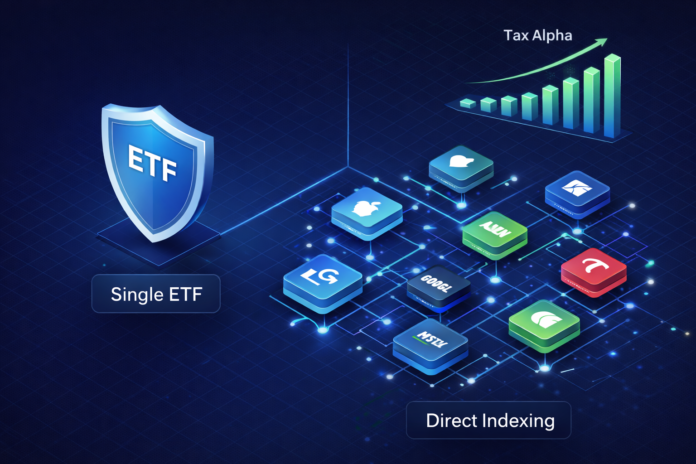
In the world of sophisticated investing, the “sticker price” of an investment—its expense ratio—is often a distraction from the number that actually matters: your after-tax return. As of February 2026, the battle for tax efficiency has moved beyond simple low-cost funds and into the realm of Direct Indexing. While Exchange-Traded Funds (ETFs) have long been the gold standard for tax efficiency due to their unique “in-kind” redemption process, Direct Indexing is rapidly becoming the preferred choice for high-net-worth individuals looking to maximize tax-loss harvesting (TLH).
Definition and Core Concepts
Tax-loss harvesting is the practice of selling an investment that has declined in value to “realize” a capital loss. This loss can then be used to offset capital gains elsewhere in your portfolio, potentially reducing your total tax bill.
- ETFs (Exchange-Traded Funds): These are pooled investment vehicles. When you buy an ETF, you own a share of a fund that owns hundreds of stocks. To harvest a loss, the entire fund must be trading below your purchase price.
- Direct Indexing: Instead of buying the fund, you buy the individual stocks that make up the index (e.g., the S&P 500) directly in your own account. This allows you to harvest losses on a stock-by-stock basis, even if the overall market is up.
Key Takeaways
- Granularity: Direct Indexing offers significantly more opportunities for tax-loss harvesting because it looks at hundreds of individual “tax lots” rather than one single fund price.
- Tax Alpha: Investors using Direct Indexing can potentially generate an additional 0.20% to over 1.00% in annualized after-tax returns, often referred to as “Tax Alpha.”
- Cost vs. Benefit: Direct Indexing typically carries higher management fees (0.20%–0.40%) compared to ultra-low-cost ETFs (0.03%), meaning the tax benefits must outweigh the added costs.
- Automation: Modern platforms now automate the daily scanning of portfolios for harvesting opportunities, making Direct Indexing accessible to those with as little as $5,000, though it remains most effective for those with $100,000 or more.
Who This Is For
This comparison is designed for:
- High-Income Earners: Individuals in the 32%, 35%, or 37% federal tax brackets who feel the heavy weight of capital gains taxes.
- Investors with Concentrated Positions: People with large amounts of company stock who need to diversify without triggering a massive tax bill.
- Values-Based Investors: Those who want the performance of an index but wish to exclude specific sectors (like tobacco or fossil fuels) for ESG reasons.
Safety Disclaimer: The following information is for educational purposes only and does not constitute financial or tax advice. Tax laws are subject to change, and the effectiveness of tax-loss harvesting depends on your individual financial situation. Always consult with a qualified tax professional or financial advisor before making significant changes to your investment strategy.
The Mechanics of Tax-Loss Harvesting: Why it Matters
To understand why Direct Indexing is gaining ground, we must first look at the math of the “Tax-Loss Harvest.” When you sell a security at a loss, the IRS allows you to use that loss to cancel out an equivalent amount of capital gains. If your losses exceed your gains, you can even use up to $3,000 to offset your ordinary income (like your salary).
The power of this strategy lies in Tax Deferral and Tax Bracket Arbitrage. By realizing a loss today, you keep more of your money working in the market.
The Mathematical Formula for Tax Alpha
The benefit of harvesting can be expressed as the “Tax Alpha” or the incremental return gained through tax savings. In a simplified form, the tax savings in a given year is:
$$Tax Savings = (L_h \times T_r)$$
Where:
- $L_h$ = Total losses harvested
- $T_r$ = The investor’s marginal tax rate for capital gains
If you reinvest those savings, the compounding effect over 20 years can significantly outperform a standard buy-and-hold ETF strategy.
ETFs: The Reliable Workhorse of Tax Efficiency
For the vast majority of investors, ETFs are incredibly tax-efficient. They are far superior to mutual funds because of the “in-kind” creation and redemption process. When an ETF manager needs to rebalance the fund, they don’t sell stocks for cash (which would trigger capital gains). Instead, they swap the stocks with “authorized participants” for shares of the ETF itself.
The Limitation of ETF Tax-Loss Harvesting
The primary drawback of an ETF for tax-loss harvesting is homogeneity. When you own the Vanguard S&P 500 ETF (VOO), you have one single “cost basis.”
Example:
Imagine you invested $100,000 into an S&P 500 ETF. Over the year, the index goes up by 10%. However, within that index, 150 of the 500 stocks actually lost value.
- With the ETF: Your position is worth $110,000. You have an unrealized gain. You cannot harvest any losses because the fund as a whole is up.
- The “Wait and See” Problem: You can only harvest a loss on an ETF if the entire market (or that specific sector) crashes below the price you paid for it.
Direct Indexing: The Granular Revolution
Direct Indexing flips the script. Instead of owning the ETF, you own the 500 individual stocks. Using software and fractional shares, your broker manages these 500 positions to mirror the S&P 500.
The “Sub-Index” Opportunity
In the same scenario where the S&P 500 is up 10%, a Direct Indexing algorithm will look at those 150 stocks that are down. It will sell the losers to capture the tax loss and immediately buy “highly correlated” (but not substantially identical) stocks to maintain the index’s performance.
Common Mistake: Investors often think they have to wait for a “bad year” to harvest losses. With Direct Indexing, almost every year has harvesting opportunities because individual stocks are volatile even when the broad index is stable.
Calculating the Direct Indexing Advantage
Research from major providers like Vanguard and BlackRock suggests that the “harvesting yield” of direct indexing can be significantly higher than ETFs.
| Feature | ETF Strategy | Direct Indexing |
| Ownership | Shares of a fund | Individual securities |
| Harvesting Frequency | Rarely (Market must be down) | Frequent (Daily/Weekly scans) |
| Customization | Low (Take it as it is) | High (Exclude specific stocks) |
| Estimated Tax Alpha | 0.0% – 0.20% | 0.20% – 1.00%+ |
| Minimum Investment | $1 (Fractional shares) | $5,000 – $250,000 |
| Management Fee | 0.03% – 0.09% | 0.20% – 0.40% |
The Wash Sale Rule: The Investor’s Greatest Hurdle
Whether you choose ETFs or Direct Indexing, the IRS Wash Sale Rule (Section 1091) is the most important regulation to follow. As of February 2026, the rule remains a strict 60-day window (30 days before and 30 days after the sale).
The Rule: You cannot claim a loss on a sale if you buy “substantially identical” stock or securities within the 30-day window.
How Direct Indexing Navigates the Wash Sale
Direct Indexing platforms use sophisticated algorithms to avoid wash sales. If the algorithm sells Apple (AAPL) at a loss, it won’t buy Apple back for at least 31 days. Instead, it might temporarily increase your position in Microsoft (MSFT) or a technology sector ETF to ensure your portfolio doesn’t “drift” away from the index’s performance.
Common Mistake: Many DIY investors try to harvest losses by selling an S&P 500 ETF from Vanguard (VOO) and immediately buying an S&P 500 ETF from Schwab (SCHW). The IRS may consider these “substantially identical” because they track the exact same index. Direct Indexing avoids this by using individual stocks, which are easier to substitute (e.g., selling Pepsi to buy Coca-Cola).
When Does Direct Indexing “Win”?
Direct Indexing is not a “slam dunk” for everyone. Because it carries higher management fees, the tax savings must be greater than the fee “drag.”
1. High Marginal Tax Rates
If you are in the 10% or 12% tax bracket, your capital gains rate may be 0%. In this case, tax-loss harvesting has zero value. Direct Indexing “wins” when your capital gains tax rate is 15%, 20%, or higher (including the 3.8% Net Investment Income Tax).
2. Significant Recurring Capital Gains
If you regularly sell assets for a profit—perhaps you are a real estate flipper, a business owner, or a frequent trader—you have a constant “appetite” for losses. Direct Indexing provides a steady stream of these losses to offset your gains.
3. Transitioning Concentrated Wealth
If you hold $500,000 in a single stock (like Amazon) with a cost basis of $10, you cannot sell it without a massive tax hit. A Direct Indexing strategy can help you “transition” into a diversified portfolio by using losses harvested from other stocks to offset the gains from selling pieces of your Amazon position.
Implementation: The 2026 Landscape
As of early 2026, the barrier to entry for Direct Indexing has collapsed. Five years ago, you needed $1 million to access these strategies. Today, technology has democratized the process.
- Fidelity Managed FidFolios: Offers direct indexing with a minimum of just $5,000 and a 0.40% fee.
- Schwab Personalized Indexing: Requires a $100,000 minimum and offers a tiered fee structure starting at 0.40%.
- Vanguard Personalized Indexing: Aimed at the higher end with a $250,000 minimum but a lower 0.20% fee.
- Wealthfront: Integrates “Stock-level Tax-Loss Harvesting” into their automated portfolios for accounts over $100,000.
AI Integration in 2026
Recent advancements in AI-driven portfolio management have allowed these platforms to reduce “tracking error”—the risk that your direct index performs differently than the actual index. AI can now predict which stocks are most likely to provide harvesting opportunities while keeping the portfolio’s risk profile perfectly aligned with the benchmark.
Conclusion: Making the Choice
The choice between Direct Indexing vs. ETFs comes down to a simple trade-off: Simplicity vs. Optimization.
For the average investor contributing to a 401(k) or a small brokerage account, ETFs are the winner. The low costs (approaching 0.00% in some cases) and extreme simplicity make them the most efficient way to build wealth. The “Tax Alpha” from Direct Indexing is unlikely to overcome the higher management fees on a smaller balance.
However, for the affluent investor with a taxable brokerage account exceeding $100,000, Direct Indexing is the clear winner for tax optimization. The ability to harvest losses in “up” markets, customize your holdings, and systematically offset high-bracket capital gains creates a level of efficiency that a pooled ETF simply cannot match.
Next Steps:
- Review your tax bracket: If you are in the 32% bracket or higher, Direct Indexing deserves a look.
- Audit your capital gains: Look at your 1099-B from last year. If you paid significant capital gains taxes, calculate if a 0.50% “Tax Alpha” would have saved you more than the management fee.
- Consult your advisor: Ask specifically about “Separately Managed Accounts” (SMAs) or “Personalized Indexing” options.
FAQs (Schema-Style)
Does direct indexing replace the need for ETFs?
No. Direct indexing is typically used for the “core” of a portfolio (like U.S. Large Cap stocks). Many investors still use ETFs for International, Emerging Markets, or Fixed Income sectors where direct ownership is more complex and expensive.
Can I do direct indexing in an IRA or 401(k)?
You can, but it is generally a bad idea. Since IRAs and 401(k)s are tax-advantaged, there is no benefit to tax-loss harvesting. In these accounts, the lower fees of an ETF make it the superior choice.
What is “tracking error” in direct indexing?
Tracking error is the difference in performance between your direct index and the actual index (like the S&P 500). Because you are selling stocks to harvest losses and holding “substitutes,” your returns might be slightly higher or lower than the benchmark.
How many stocks do I need to own for direct indexing to work?
Most platforms use “representative sampling.” For an S&P 500 direct index, the platform might buy 250 to 300 of the most influential stocks to keep the portfolio manageable while still capturing the vast majority of harvesting opportunities.
Is tax-loss harvesting just “kicking the can down the road”?
In a way, yes. When you sell a stock at a loss and buy a substitute, you lower your “cost basis.” This means you might owe more in taxes when you eventually sell the whole portfolio decades from now. However, most investors prefer to pay taxes later (in potentially lower brackets) and keep their money compounding in the meantime.
References
- Internal Revenue Service (IRS): Instructions for Form 1099-B (2026) – Official rules on wash sales and cost basis reporting.
- Vanguard: The Case for Direct Indexing – Whitepaper on tax alpha and tracking error.
- Charles Schwab: Personalized Indexing for Modern Portfolios – Service details and fee structures.
- Fidelity Investments: Understanding Tax-Loss Harvesting – Core mechanics of TLH.
- BlackRock/Aperio: The Evolution of Direct Indexing – Institutional research on the growth of SMAs.
- Morningstar: ETFs vs. Direct Indexing: A Cost Comparison – Analysis of fee drag vs. tax benefits.
- Wealthfront: Value of Automated Tax-Loss Harvesting – Data on harvesting yields over long periods.
- Morgan Stanley: Direct Indexing: What It Is and Its Benefits – Overview for high-net-worth planning.
- Journal of Financial Planning: “Tax Alpha: The Next Frontier” (2024 Academic Study).
- MIT Sloan Management Review: “The Impact of Personalized Indexing on Market Liquidity” (2025).