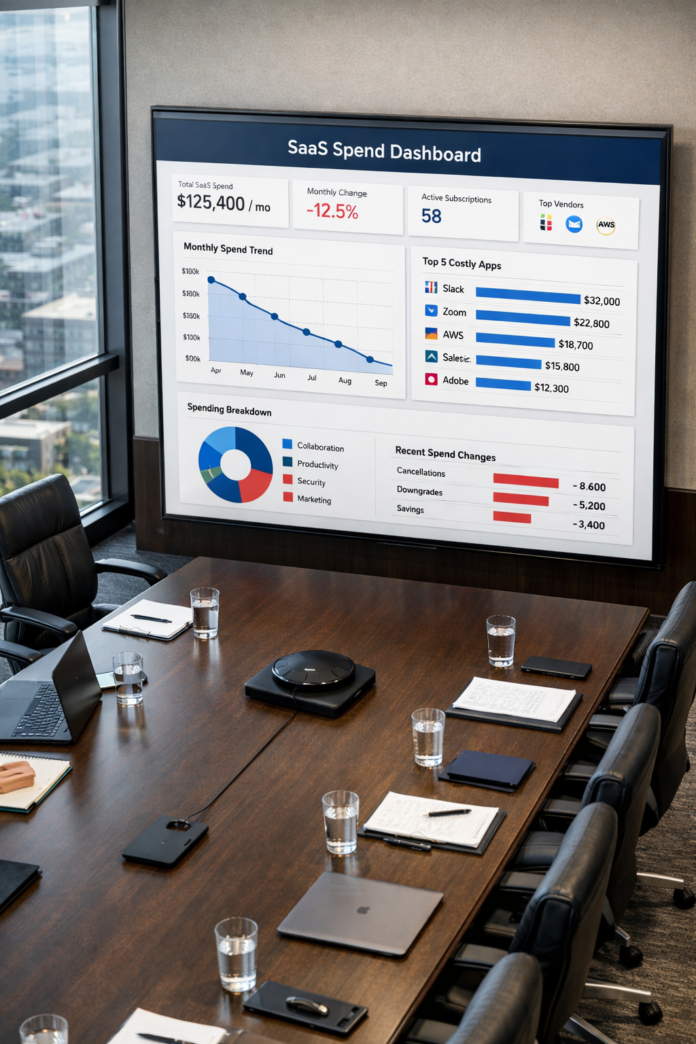
As of February 2026, the average large enterprise is grappling with a paradox: while software portfolios have technically stabilized at roughly 300–310 core applications, total SaaS spending has surged by over 8% year-over-year. This financial pressure isn’t coming from a lack of discipline; it is driven by a fundamental shift in how software is priced, consumed, and integrated—most notably through the explosion of AI-native tools and “agentic” workflows.
To navigate this complexity, forward-thinking CFOs and CIOs are abandoning the traditional “incremental” budgeting model—where last year’s spend plus 5% becomes the new baseline—in favor of Zero-Based Budgeting (ZBB). ZBB for enterprise SaaS is a strategic financial framework that requires every single software subscription to be justified from a “zero” baseline at the start of each fiscal period.
Key Takeaways
- Total Visibility: You cannot manage what you cannot see. ZBB begins with a 100% audit of the stack, including “Shadow AI.”
- Outcome Over Ownership: Success is measured by “Agent Value Multiples” rather than simple seat counts.
- Governance as a Service: Real-time monitoring replaces quarterly audits to prevent sprawl from returning.
- Strategic Reallocation: ZBB isn’t just about cutting; it’s about moving capital from legacy “bloatware” to high-impact AI infrastructure.
Who This Is For
This guide is designed for Chief Financial Officers (CFOs), Chief Information Officers (CIOs), and IT Procurement Directors managing annual software budgets exceeding $10 million. If your organization is struggling with “Shadow IT,” unpredictable usage-based billing, or overlapping AI feature tiers, this framework provides the roadmap to financial clarity.
Disclaimer: The following information is for educational and strategic purposes only. It does not constitute formal financial, legal, or investment advice. Organizations should consult with their internal compliance and accounting teams before implementing significant changes to budgeting methodologies.
The 2026 SaaS Landscape: Why Incrementalism is Dead
The traditional budgeting method—looking at what you spent last year and adjusting for inflation or growth—has become a liability in 2026. The reasons are rooted in three specific market shifts:
1. The Rise of “Invisible Workers” (AI Agents)
In 2026, we have moved beyond simple chatbots. Enterprises now employ “agentic AI” that performs autonomous workflows—handling everything from customer support triaging to automated code refactoring. Unlike human employees, these agents don’t use a single “seat.” They consume tokens, credits, and API calls. Traditional budgets that track “per-seat” costs are completely blind to this high-volatility consumption.
2. The Persistence of “Shadow AI”
While IT teams in 2024 were worried about employees using unauthorized project management tools, the 2026 threat is Shadow AI. Recent data shows that large enterprises often believe they use fewer than 50 apps, while the reality is closer to 600+. Employees are frequently “swiping cards” for micro-SaaS tools that promise to automate 15 minutes of their day but introduce massive security and financial debt when scaled across a global workforce.
3. Pricing Model Volatility
Vendors have largely abandoned flat-rate pricing. Today, 60% of enterprise SaaS vendors use hybrid models: a base subscription fee plus variable usage charges for AI processing. Without a zero-based approach, these variable costs “leak” into the budget, often resulting in 20% overages that aren’t caught until the end of the quarter.
The 4-Phase Framework for ZBB in Enterprise SaaS
Implementing Zero-Based Budgeting isn’t an overnight task. It requires a cultural shift from “owning” software to “justifying” outcomes.
Phase 1: Deep Discovery and Visibility
You cannot build from zero if you don’t know where you currently stand. In the enterprise, this means looking beyond the Single Sign-On (SSO) logs.
- Financial Feed Analysis: Sync with accounts payable and expense management platforms (like Ramp or Brex) to find every single recurring charge.
- Browser-Level Tracking: Use SaaS Management Platforms (SMPs) that utilize lightweight browser extensions to detect tools that don’t use SSO—this is where 80% of Shadow AI hides.
- Categorization: Group every tool into functional buckets (e.g., “Customer Data Platforms,” “AI Productivity,” “Security Infrastructure”).
Phase 2: Building “Decision Packages”
In ZBB, a “Decision Package” is the mini-business case for why a specific tool deserves to exist. Every department head must submit these for their stack.
- The Baseline (Zero): What happens if we do not fund this tool? (e.g., “The sales team will lose 40 hours of prospecting time per week”).
- The Optimized Level: What is the minimum number of licenses or credits needed to maintain operations?
- The Growth Level: How many additional credits are needed for planned 2026 expansion?
- Feature Justification: In 2026, we specifically look for Feature Overlap. If your CRM now has an AI writing assistant, why are you still paying for a standalone AI writing tool?
Phase 3: The Prioritization Matrix
Once the packages are submitted, the executive committee (CIO/CFO) ranks them.
- Tier 1: Mission Critical. (Security, ERP, Core Communication).
- Tier 2: High ROI. (Tools with a proven “Agent Value Multiple” or measurable productivity gain).
- Tier 3: Experimental/Duplicate. (New AI tools that haven’t proven ROI or tools that overlap with Tier 1 suites).
Phase 4: Implementation and Real-Time Governance
ZBB isn’t just a “once-a-year” event. To prevent sprawl from creeping back, enterprises must implement “Continuous ZBB.”
- Automated License Reclamation: If a user hasn’t logged into a Tier 1 tool (like Salesforce or Microsoft 365) in 30 days, the license is automatically “harvested” and put back into the pool.
- Approval Guardrails: Any new SaaS purchase under $5,000—the “swipe-card” range—must still be mapped to an existing Decision Package category.
Comparative Table: Traditional vs. Zero-Based Budgeting
| Feature | Traditional Budgeting (Incremental) | Zero-Based Budgeting (ZBB) |
| Starting Point | Previous year’s actual spend | $0.00 (Blank Slate) |
| Focus | How much more do we need? | Why do we need this at all? |
| Visibility | Centralized IT-only view | Cross-functional (IT, Finance, Dept) |
| Handling Waste | Typically carried over | Identified and eliminated immediately |
| AI Costs | Often ignored until overage | Modeled via Decision Packages |
| Incentive | “Use it or lose it” mindset | Efficient resource allocation |
Taming the Sprawl: Practical Examples
Case Study A: The “Duplicate Dashboard” Syndrome
A global logistics firm found they were paying for three separate project management tools: Jira (Engineering), Asana (Marketing), and Monday.com (Operations).
- Traditional Approach: Renew all three with a 5% increase.
- ZBB Approach: Forced a consolidation review. The firm moved all departments to a single platform with customized views.
- Result: $1.2M saved annually in license fees and $400k saved in cross-departmental “integration friction.”
Case Study B: The “Zombie Agent” Problem
A fintech company implemented several AI agents for customer service in 2025. By 2026, many of those workflows were redundant due to a core platform update.
- Traditional Approach: The “tokens” were pre-purchased in a bulk contract and left to expire.
- ZBB Approach: The department had to justify the token spend. When they couldn’t show the volume of tickets resolved, the funding was reallocated to the Data Engineering team to improve the core platform.
- Result: 22% reduction in variable “usage-based” waste.
Common Mistakes to Avoid in 2026
1. The “Set It and Forget It” Trap
Many organizations treat ZBB as a budgeting exercise that ends when the fiscal year starts. In the 2026 SaaS world, tools evolve too fast for this. A tool that was “Mission Critical” in January might be redundant by July due to a competitor’s AI update.
- Solution: Conduct “Micro-ZBB” reviews every 90 days for your top 10% highest-spend categories.
2. Over-Automating the Human Element
While SaaS Management Platforms are essential, they cannot replace the “Justification” conversation. If IT unilaterally cuts a tool based on low login data, they might break a critical, low-frequency workflow (e.g., year-end tax reporting software).
- Solution: Always allow department heads to “rebut” a cut if they can provide a qualitative Decision Package.
3. Ignoring “Contractual Anchors”
ZBB assumes you can start from zero, but multi-year enterprise agreements (EAs) often prevent immediate cuts.
- Solution: Use ZBB to plan your Renewal Strategy. Start the ZBB process six months before a major Microsoft or Salesforce renewal so you have the data to negotiate from a position of strength.
Key Performance Indicators (KPIs) for SaaS ZBB
To measure the success of your ZBB initiative, track these four metrics:
- SaaS Spend as a % of Revenue: In a successful ZBB environment, this should stabilize even as headcount grows, thanks to AI efficiency.
- License Utilization Rate: The percentage of paid seats that are active. Target: >95%.
- App-to-Employee Ratio: In 2026, a high ratio (e.g., 20 apps per employee) is a red flag for sprawl.
- Shadow AI Discovery Rate: The volume of “unmanaged” spend discovered during the audit phase.
Conclusion: The Path Forward
The “software sprawl” of 2026 is fundamentally different from the sprawl of a decade ago. It is more invisible, more autonomous, and more expensive. Continuing to use 20th-century budgeting tactics for 21st-century agentic software is a recipe for margin erosion.
Zero-based budgeting offers a way out of the chaos. By forcing every dollar to “earn its keep,” enterprises can finally stop paying for the ghosts of software past and start investing in the AI-driven future. This isn’t just about cost-cutting; it’s about capital agility. Every million dollars saved from redundant project management tools is a million dollars that can be invested into the custom AI models that will define your competitive edge in the next decade.
Would you like me to draft a sample “Decision Package” template that your department heads can use to justify their 2026 software requests?
FAQs
Q1: Is ZBB too time-consuming for a large enterprise?
While the first cycle of ZBB takes significantly more effort (often 2–3x longer than incremental budgeting), the subsequent cycles are much faster. Modern SaaS Management Platforms automate the “discovery” and “usage” data, meaning managers only need to focus on the qualitative justification.
Q2: How does ZBB handle “Usage-Based” or token pricing?
Instead of budgeting for a flat fee, ZBB requires departments to forecast “Outcome Units” (e.g., number of support tickets resolved by AI). They then build a budget based on the token cost required to achieve those units, creating a much more accurate forecast for variable costs.
Q3: What happens if a department misses a critical tool in their “Zero” build?
Most enterprises maintain a “Strategic Contingency Fund” (typically 3–5% of the total IT budget) to handle unforeseen needs or “catch-up” funding for missed critical apps during the first year of ZBB implementation.
Q4: Can we use ZBB for only part of our budget?
Yes. Many enterprises use a “Hybrid ZBB” model where they apply zero-based principles to highly volatile categories like SaaS and Marketing Spend, while using traditional methods for fixed costs like physical real estate or long-term hardware leases.
Q5: Does ZBB hurt employee morale?
It can if it’s framed as “stripping tools away.” However, when framed as “removing the friction of too many apps” and “reinvesting in better AI,” it is often viewed positively by employees who are frustrated by having to switch between too many different platforms.
References
- BetterCloud (2025): “Smart SaaS Budgeting: Refine Your Spend Strategy for 2026.” [Official Report]
- Zylo (2026): “2026 SaaS Management Index: How AI is Reshaping SaaS Costs.” [Industry Benchmark]
- IBM Think (2025): “The Strategic Shift: Why Zero-Based Budgeting is Returning to the Enterprise.” [Technical Whitepaper]
- Microsoft for Startups (2026): “2026 Enterprise Trends: What Founders and CFOs Should Prepare For.” [Trend Analysis]
- CIO.com (2026): “The $100M Leak: How Shadow IT and Digital Inefficiencies Drained 2025 Profits.” [Operational Study]
- Gartner (2025 Forecast): “Enterprise Software Spending Shifts: From Seats to Tokens.” [Market Intelligence]
- Stitchflow (2026): “Overcoming Business Sprawl: The New Essentials for SaaS Governance.” [Technical Guide]
- Ramp Financial (2025): “Zero-Based Budgeting Implementation for High-Growth Organizations.” [Financial Framework]