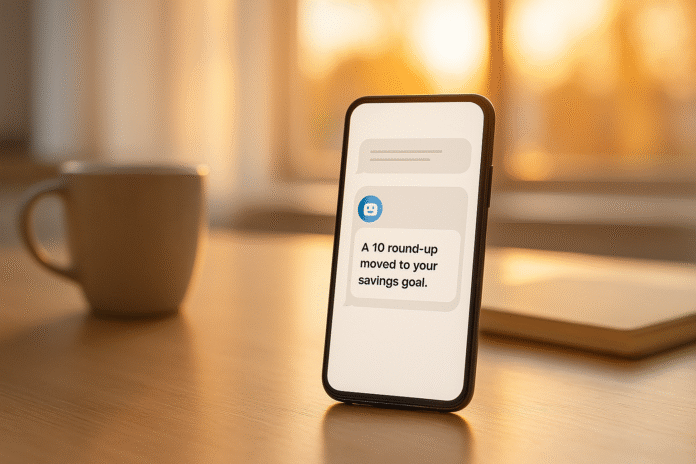
Saving money shouldn’t require iron willpower or spreadsheets that guilt-trip you. Savings bots and chatbots are simple automations that nudge you at the right moment—or move small amounts of cash for you—based on rules, schedules, and your habits. In practice, they turn good intentions into consistent deposits without demanding daily effort. If you’ve ever thought, “I’ll save what’s left at the end of the month,” these tools flip the script so your savings comes first, not last. This guide breaks down how to pick and tune automations that fit your life, whether you want painless round-ups, paycheck rules, or chat-based nudges that keep your goals front and center. It’s written for busy humans who want results, not more apps to babysit.
Quick definition: Savings bots and chatbots are AI-aided rules and reminders that automatically trigger transfers into savings based on spending, paydays, goals, or events. They aim to make saving default, not optional.
Fast-start checklist (10 minutes):
- Choose one trusted bank/app with round-ups or rules.
- Name a single goal and target date (e.g., “$1,500 emergency by May 2026”).
- Turn on round-ups or a $10 weekly auto-transfer.
- Split your next paycheck 5–10% to savings automatically.
- Add one chat nudge for bill week or weekend spending.
Friendly disclaimer: This is general education, not financial advice. Consider your risk tolerance, local regulations, and fees before enabling any automation.
1. Round-Ups That Skim Your Digital Spare Change
Round-ups save small amounts every time you spend, turning spare change into momentum without you noticing. The core idea is easy: if your coffee is $3.65, a round-up rule moves $0.35 to savings, either instantly or when your round-up total reaches a threshold (like $5). This is ideal if you’re starting from zero, or if you’ve tried “transfer $300/month” and found it too rigid. Round-ups build a consistent cadence tied to your real life; more transactions generally mean more micro-savings. Many banks and apps pair round-ups with “multipliers” (e.g., 2×, 3×) for faster progress, which is helpful when you have a short timeline or a modest monthly transaction count.
1.1 How it works
- You enable round-ups on a debit card or spending account.
- Each card purchase triggers an automatic transfer to a linked savings pot.
- Some tools batch the pennies and move them in chunks (e.g., when the total hits $5).
- Optional boosters: multipliers (e.g., 2×) or weekly “top-ups” ($5–$20) to accelerate progress.
- Visibility: a progress bar shows how pennies accumulate toward your named goal.
1.2 Numbers & guardrails
- Typical round-ups average $0.25–$0.60 per purchase; with ~40 purchases/month, that’s roughly $10–$24/month without thinking.
- Add a $5 weekly top-up and you’re at ~$30–$44/month; over a year, $360–$528 plus any interest.
- If cash flow is tight, cap total round-ups per week (e.g., max $10/week) so you don’t surprise yourself.
1.3 Tools & examples
- Bank-native round-ups (“spare change” features) or dedicated apps that connect to your card.
- “Accelerators” that multiply the round-up or tack on a tiny flat amount per purchase.
- Goal-based visualizations (“New Laptop,” “Emergency Fund”) to keep motivation high.
Mini case: Maya averages 35 card payments/month at a $0.32 average round-up ($11.20/month). She sets a $10 weekly top-up. That’s ~$51/month (~$612/year). In 18 months she stocks an $900 cushion—without a single manual transfer. The synthesis: pennies plus a tiny weekly rule compound into a meaningful buffer.
2. Paycheck-First Transfers and Split Deposits
The most reliable savings habit is paying yourself first—before bills and impulse buys get a turn. “Paycheck-first” automation moves a fixed amount or percentage to savings on payday, or uses a split-deposit instruction at your employer so part of your paycheck lands directly in savings. This flips the usual “I’ll save what’s left” trap and shields your future self from today’s temptations. If your pay is predictable, this is the highest-bang-for-effort rule to lock in.
2.1 Why it matters
- Anchors saving to a stable event (payday), not mood or leftover cash.
- Reduces decision fatigue; after one setup, it just happens.
- Plays well with all other bots (round-ups, goal jars, cash sweeps).
- Builds an early monthly cushion that prevents overdrafts later in the cycle.
2.2 How to do it (step-by-step)
- Pick a number: Start at 5–10% of take-home pay or a flat dollar amount you won’t miss ($100–$300).
- Choose the destination: A high-yield savings or goal “bucket” with a clear name and target date.
- Automate at the source: If possible, set a split deposit with payroll (e.g., 90% checking, 10% savings).
- Date-align: If you can’t split at payroll, schedule a transfer for the morning your paycheck clears.
- Add guardrails: Allow a minimum checking balance (e.g., never drop below $500) to reduce overdraft risk.
2.3 Common mistakes
- Setting a number so high you cancel it after one tight month.
- Forgetting to adjust after a raise or changing pay cadence (weekly/biweekly/monthly).
- Leaving funds in low-interest accounts when a higher-yield option is available.
Numeric example: Net pay is $3,200/month. A 10% rule moves $320 to savings on payday. Combine with $20/week top-ups and you’re at ~$400/month, or ~$4,800/year—not counting interest. Bottom line: “pay yourself first” is the engine; everything else is a turbocharger.
3. Goal Jars with Smart Targets (Pots, Buckets & Envelopes)
A pile of cash with no story is easy to raid. Goal jars—sometimes called pots, buckets, or envelopes—give every dollar a job and a name. The bot’s role is to keep each jar nudged toward its target with small, periodic contributions and smart suggestions when you’re ahead or behind pace. This approach turns vague wish-lists into actionable mini-budgets: emergency fund, travel, car maintenance, gifts. Because each jar has its own visual progress and deadline, the dopamine from watching them fill keeps you engaged longer than a single bland “savings” balance.
3.1 Setup steps
- Name 2–4 jars to start: “Emergency ($1,500), Travel ($800 by June), Car Service ($400 by March).”
- Pick target dates: Let the app compute weekly or monthly contributions to stay on track.
- Layer automations: Round-ups feed “Emergency,” a $15 weekly rule feeds “Travel,” and a $10/paycheck rule feeds “Car.”
- Add milestones: When a jar hits 25%, 50%, 75%, the chatbot celebrates and asks if you want to boost the pace.
- Freeze the jar: For longer-term goals, require a 24-hour hold before withdrawals so impulse raids cool off.
3.2 Tools & examples
- Bank buckets/pots that segment a single savings account into labeled goals.
- App-level “envelopes” that show per-goal progress bars and pace vs. target.
- Chat prompts like: “You’re $30 behind on Travel; boost weekly rule by $5 to land on time?”
3.3 Mini case & guardrails
- Case: Jordan wants $1,500 for emergencies, $600 for travel in eight months, and $300 for car maintenance in four months. The app suggests $47/month, $75/month, and $75/month respectively, plus round-ups to bridge variability. At month three, the bot spots a surplus and shifts $15 from car to emergency, preserving deadlines.
- Guardrails: Avoid too many jars at once (decision fatigue). Lock jars with “cool-off” timers. Review targets quarterly to reflect real life.
The synthesis: jars give clarity, the bot keeps pace, and together they transform “someday” into scheduled progress.
4. Contextual Nudges via Chat (SMS, WhatsApp & App Push)
Not every reminder should move money; sometimes a well-timed nudge is the difference between saving and splurging. Chat-based nudges—delivered via SMS, WhatsApp, or push—meet you in the flow of your day with short, specific prompts. The smartest ones time messages around your pay cycle, weekend habits, or known bill weeks, and they include one-tap actions (“Snooze,” “Save $10 now,” “Boost transfer this payday”). The key is relevance over volume: fewer, better prompts that feel like a helpful teammate, not a nag.
4.1 What good nudge design looks like
- Right moment: Payday morning, 24 hours after a large discretionary purchase, or the Sunday before bill week.
- Right ask: “Top up $10 to hit your goal by Friday?” instead of generic “Don’t forget to save.”
- Right control: Easy snooze, quiet hours, and frequency caps.
- Right context: “You’re 80% to your Emergency Fund. One $15 boost gets you there two weeks early.”
4.2 Privacy & controls
- Opt into data-driven nudges (spending insights) only if you’re comfortable.
- Keep sensitive messages minimal and avoid financial details on lock-screen previews.
- Set a do-not-disturb window (e.g., 9 p.m.–8 a.m.).
- Export or delete your chat history if/when you switch providers.
4.3 Mini example
- The bot sees you typically dine out Fridays. At 5 p.m., it offers: “Skip dessert, save $8 to Travel?” You tap once. Over 12 Fridays, that tiny choice funds two nights in a budget hotel. The synthesis: the best nudges are timely, specific, and optional—and they add up.
5. If-This-Then-Save Rules for Everyday Triggers
Trigger-action savings turns your routines into money moves. You pick a trigger—something that already happens—and the bot responds with a small transfer. This method works because it tethers saving to moments you recognize: a coffee run, a gym check-in, a no-spend day, or even weather events (“rainy-day savings”). The psychology is elegant: “When X, then save Y,” repeated enough times, makes saving feel as normal as tapping your card.
5.1 Starter rules you can copy
- Coffee Counter: Every time you buy coffee, save $1–$3 to your “Treats Guilt-Free” jar.
- Move & Save: After each gym visit (tracked by location or check-in), save $2–$5 to “Health Wins.”
- No-Spend Days: If you spend $0 on discretionary categories Mon–Thu, save $5 on Friday morning.
- Ride-Share Governor: Each $50 you spend on ride-shares in a month triggers a $10 transfer to “Transit Pass.”
- Rainy-Day Rule: On any day the forecast predicts rain, save $2 to “Home Comforts.”
5.2 Guardrails & tips
- Keep transfer sizes small ($1–$5) so triggers feel fun, not punitive.
- Cap daily/weekly totals to protect cash flow (e.g., max $10/day or $25/week).
- Review triggers monthly; keep the ones you notice and kill the rest.
- Combine with your jars so every trigger feeds a purpose.
5.3 Mini case
- Luis sets: $2 for every gym check-in (avg. 8/month), $1 per coffee (avg. 12/month), and $5 each no-spend day (avg. 6/month). That’s roughly $44/month, or ~$528/year, before interest—funding new running shoes and a race fee. The synthesis: small, playful triggers compound into real money when you cap them smartly.
6. Bill Prediction, Buffers, and Subscription Clean-Up
Bills aren’t surprises, but the calendar still manages to ambush us. A good savings bot forecasts your recurring bills, flags when you’re entering “bill week,” and helps you build a lightweight buffer so due dates don’t collide with grocery runs. Pair that with a subscription audit—identifying trials you forgot about and price hikes—and you’ve got an automation that protects cash flow and redirects waste into goals.
6.1 How to set it up
- Connect your primary spending account so the app can map fixed bills (rent, utilities, phone).
- Create a Bill Reserve jar equal to 1–1.5× your monthly fixed bills.
- Turn on “bill week” nudges (e.g., three days before big auto-pays).
- Automate top-ups: Schedule $10–$30 weekly into Bill Reserve until it meets your target.
- Run a subscription scan: Cancel what you don’t use; lower tiers or annual plans for the rest if they’re truly valuable.
6.2 Common pitfalls
- Confusing “fixed” and “variable” bills—keep variable categories (groceries, gas) outside the bill ledger.
- Letting the reserve dip to near-zero after a single heavy month; top up gradually.
- Treating refunds and credits as “free money” rather than replenishing the reserve.
6.3 Numbers & example
- If fixed bills total $1,200/month, aim for a $1,200–$1,800 Bill Reserve. If that’s daunting, start with $300 and add $25–$40 weekly.
- Case: After canceling three unused subscriptions ($13, $9, $5), Nora redirects $27/month to her reserve and reaches $900 in ~8 months (plus a $15/week kicker). The synthesis: predict, prepare, and prune—then funnel the savings into buffers and goals.
7. Rate-Hunting Sweeps and Cash-Parking Automation
Once your system hums, make your idle cash work harder. Rate-hunting sweeps move excess checking balances into a high-yield savings account (or short-term vehicles like CDs or T-bills) while keeping enough in checking to pay bills. The bot checks your balance daily or weekly, skims anything above your chosen floor (e.g., $1,000), and parks it where it can earn more. You still control liquidity: define a minimum balance, a maximum sweep per day/week, and a “don’t sweep during bill week” rule.
7.1 What to compare
- APY vs. access: Higher APY is great, but only if transfers are fast and withdrawal limits fit your needs.
- Fees & minimums: Prefer no-fee accounts with no required minimums for the swept balance.
- Protection: Confirm deposit insurance coverage (e.g., FDIC/NCUA in the U.S.; FSCS in the U.K.) and per-bank limits.
- Transfer speed: Ideally instant or ≤1 business day for peace of mind.
7.2 Risk & safety notes
- Rates change; don’t chase pennies if it breaks your workflow. Re-check quarterly.
- Avoid sweeping funds needed for near-term bills; maintain a clear checking floor.
- If exploring T-bills or money market funds, understand settlement times and potential price movement.
7.3 Example sweep
- You set a $1,200 checking floor and a $500/day sweep limit. On the 3rd of each month, your balance often jumps to $2,100 after payday; the bot sweeps $900 over two days into high-yield savings. Over a year, those regular sweeps can add meaningful interest with zero extra effort. The synthesis: automate the “where” so your cash quietly earns more while staying accessible.
FAQs
1) Are savings bots and chatbots safe to use with my bank accounts?
Most mainstream tools use secure connections and industry-standard encryption, and many rely on regulated open-banking APIs where available. Safety depends on the provider’s practices and your own hygiene: enable two-factor authentication, use strong unique passwords, and limit permissions to only the accounts you need. Always verify deposit insurance and watch for fees.
2) Will automations cause overdrafts?
They shouldn’t if you set sensible floors and caps. Use a minimum checking balance (e.g., “Never transfer if balance < $500”) and per-day/weekly caps for rules like round-ups or triggers. Schedule paycheck-first transfers the morning the deposit clears, and consider pausing rules during “bill week” if your cash flow is tight.
3) What’s a realistic starting amount for paycheck-first saving?
Start where you won’t notice it—often 5–10% of take-home pay or a flat $50–$150 per paycheck. After a month, review your comfort level and adjust. Many people find they can nudge the rate up after seeing that bills still clear and life goes on.
4) Should I prioritize an emergency fund before other goals?
Yes. A basic emergency fund (often 1–3 months of essential expenses) reduces the chance you’ll use high-interest credit when surprises hit. You can still fund a small “fun” jar to keep motivation, but let the bot channel most automation to the emergency goal first.
5) How do round-ups compare to a simple weekly transfer?
Round-ups are variable and psychologically easy; a weekly transfer is predictable and usually larger. The best approach is both: pennies from round-ups build momentum, while a fixed weekly or payday transfer drives the bulk of progress.
6) Can chatbots actually change my behavior, or are they just spammy?
When done well—timely, contextual, and actionable—nudges improve follow-through without feeling noisy. Look for tools that let you set quiet hours, cap frequency, and tailor prompts to goals. If a bot feels spammy or vague, dial it down or switch providers.
7) How often should I review or tweak my rules?
Monthly is plenty for most people. Scan your jars’ pace, make small adjustments (±$5–$20), and prune triggers you didn’t notice. Quarterly, review interest rates and consider raising your paycheck split if life allows.
8) Are there fees for using savings bots?
Some banks include round-ups and buckets for free, while certain standalone apps may charge a subscription. Balance convenience against cost: if the bot helps you save $40/month but costs $5, you’re still ahead. Always read fee disclosures before connecting accounts.
9) What happens if I change banks or cards?
Export your rules, jars, and history if possible, then reconnect the new account and re-enable automations. Expect a short “re-training” period while the bot learns your paydays and bills. Keep manual transfers paused until everything is mapped correctly.
10) Can I use savings bots for shared goals with a partner or roommate?
Absolutely. Create a shared jar (vacation, deposit, emergency), agree on small rules (e.g., each of you adds $10/week), and enable transparent activity feeds. Chat-based nudges can check in weekly and celebrate milestones so everyone stays aligned.
Conclusion
Saving gets easier when you offload the hard parts—timing, willpower, and memory—to systems that never forget. Round-ups turn spare change into progress. Paycheck-first rules guarantee you prioritize your future. Goal jars add meaning to every dollar, while chat-based nudges make smart choices timely and painless. Trigger-action savings converts your routines into money moves, bill prediction cushions the calendar’s spikes, and cash sweeps ensure your idle funds quietly earn more. The result isn’t perfection; it’s reliable, repeatable progress that survives even when life is busy.
Start simple: enable round-ups, split your next paycheck 5–10%, and name two jars. Add one contextual nudge for your spendiest day and one trigger-action rule that makes you smile. In a month, review and dial each up or down by $5–$20. In a year, you’ll look back at a fatter cushion that didn’t ask for daily discipline—just a few smart automations and the willingness to let them work.
Ready to go? Turn on one automation today and watch your savings run on autopilot.
References
- “Deposit Insurance FAQs,” Federal Deposit Insurance Corporation (FDIC), updated 2024, https://www.fdic.gov/resources/deposit-insurance/faq/
- “Automatic savings can help you reach your goals,” Consumer Financial Protection Bureau (CFPB), 2023, https://www.consumerfinance.gov/consumer-tools/save-automatically/
- “What is Open Banking?,” Open Banking Limited (OBIE), 2024, https://www.openbanking.org.uk/what-is-open-banking/
- “How Round-Ups Work,” Acorns Learn, 2024, https://www.acorns.com/learn/how-round-ups-work/
- “Round up your spending into a pot,” Monzo Help, 2024, https://monzo.com/help/saving/roundups/
- “Savings Buckets,” Ally Bank Help Center, 2024, https://www.ally.com/bank/online-savings-account/
- “Rules—Save money your way,” Qapital Support, 2024, https://support.qapital.com/hc/en-us/articles/115004216087-Rules-Save-money-your-way
- “How IFTTT Works,” IFTTT Guide, 2024, https://ifttt.com/explore/how-it-works
- “Emergency savings: How much is enough?,” FINRA Investor Education Foundation, 2023, https://www.finra.org/investors/insights/emergency-fund
- “Behavioral Insights and ‘Nudging’,” OECD Better Policies, 2020, https://www.oecd.org/gov/regulatory-policy/behavioural-insights.htm