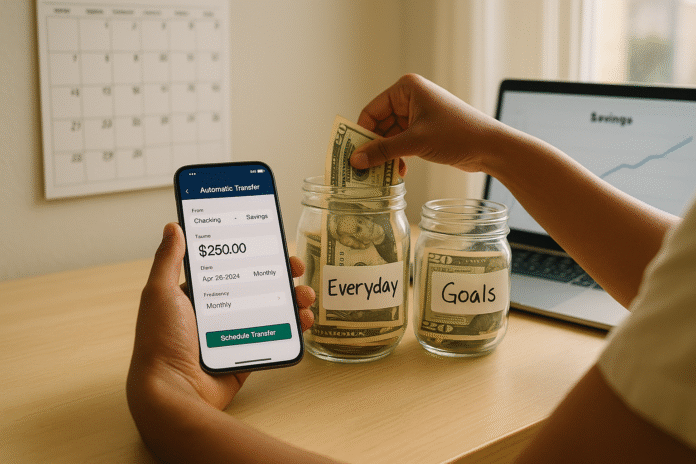
If you’re ready to save twice your usual amount—without burning out—this Double-Your-Savings Challenge gives you a clear, time-boxed plan. You’ll set an ambitious but achievable target, automate “double deposits,” trim spending where it actually matters, and reroute windfalls to build momentum fast. This guide is for anyone who wants a practical, evidence-aware system they can start today and sustain for the long haul. This is educational information, not personal financial advice; adjust for your situation and local rules.
Quick answer: The Double-Your-Savings Challenge is a 4–12-week sprint to save 2× your typical amount by (1) locking a baseline and target, (2) automating a doubled transfer on payday, (3) trimming your top spend categories, and (4) channeling windfalls into a high-yield, insured account. Done right, you’ll finish with both more money and better habits.
At a glance — the 9 steps: Baseline & target • Payday automation (“double deposit”) • Category trims • Bonus saving sweeps • Sinking funds buffer • Windfalls & raises commitment • Rate optimization • Tracking & accountability • Lock-in plan.
1. Lock Your Baseline and Set a 2× Target (With a Clear Time Window)
Start by defining exactly what “double” means for you, then choose a sprint window (commonly 8 weeks) so you can focus. Calculate your baseline savings by averaging the last 8–12 weeks (or 2–3 months) of actual deposits to savings, including transfers, automatic round-ups, and any extra debt prepayments you treat as “savings.” If you currently save $100 per week, your 2× target is $200 per week during the challenge. Commit to a window that fits your cash-flow rhythm: 4 weeks for a quick win, 8–12 weeks for deeper behavior change. Use conservative assumptions for irregular income—target a median paycheck, not your best one. Finally, decide where the money will land (ideally a high-yield, insured account) and set a single, visible scoreboard so you’ll know—at a glance—whether you’re on track each week. (For definitions of household saving rate and context, see OECD methodology.)
1.1 How to do it
- Pull the last 8–12 weeks of statements; sum actual savings-related movements.
- Divide by the number of weeks to get your baseline; multiply by 2 for the challenge target.
- Pick a start date that matches a payday; choose a 4, 8, or 12-week window.
- Name the goal (“2× in 8 Weeks”) and write the exact weekly target.
- Create a simple tracker (spreadsheet or app) with weekly check-ins.
1.2 Numbers & guardrails
- If your income fluctuates, compute your baseline from median weekly savings, not the mean.
- Keep at least a minimal emergency buffer accessible during the sprint so you’re not forced to reverse transfers if a bill pops up.
Bottom line: Specific math + a fixed window turns “save more” into an actionable scoreboard that keeps you honest and motivated.
2. Automate a “Double Deposit” on Payday—Then Leave It Alone
The single most reliable way to hit 2× is to automate the deposit before you can talk yourself out of it. Schedule a recurring transfer on payday for your doubled amount and route it to a separate savings or money market account you don’t spend from day-to-day. Automation creates positive friction: the money moves out of checking and your “new normal” is living on what remains. Behavioral research shows that pre-commitment and automation raise saving rates, and programs like “Save More Tomorrow” demonstrate how committing today to future increases works because it sidesteps willpower battles. Pair this with alerts only when a transfer fails—no constant balance pings—which reduces anxiety without removing accountability. (See Thaler & Benartzi on pre-commitment and later studies on automation.)
2.1 How to set it up
- Schedule the transfer to hit the same day you’re paid.
- Use “double deposit” naming in your bank rules so it’s visible in your history.
- If cash flow is tight, split across two smaller transfers per pay period.
- Set one failure alert (insufficient funds) and a monthly success recap.
2.2 Mini case
If your baseline is $100/week, set an automated $200/week transfer for 8 weeks. After week 8, you’ll have $1,600 versus $800—without weekly decisions.
Bottom line: Making the default a doubled transfer removes decision fatigue and builds momentum you don’t have to recreate every week.
3. Trim the Top Three Spending Buckets by ~20–30% During the Sprint
You don’t need to slash everything—just focus on your biggest line items for 4–12 weeks. Typical culprits are food (groceries + dining out), transport (fuel, ride-hailing), and subscriptions. Create temporary rules: meal-plan with two bulk-cook nights, carpool twice a week, and freeze or downgrade nonessential subscriptions. If you’re new to budgeting, a simple 50/30/20 framework is a good sense-check: aim for necessities (≈50%), wants (≈30%), and savings (≈20%) in normal times; during the challenge, you’re intentionally pushing that savings line higher for a short period. Zero-based budgeting can add precision: give every dollar a job so “extra” doesn’t leak. (Background on 50/30/20 and zero-based budgeting.)
3.1 Quick wins checklist
- Food: Plan 10 meals, shop once weekly, batch-cook proteins, and pack lunches 3–4 days.
- Transport: Combine errands, use transit on short hops, split rides.
- Subscriptions: Audit, cancel, or pause anything with near-zero usage.
- Wants: Choose one weekly treat and cut the rest for the sprint.
3.2 Numbers & guardrails
- Target 20–30% reductions in the top three categories only; leave essentials intact.
- Use a separate card or envelope for variable categories to avoid over-spend.
Bottom line: Focused, temporary trims supply the extra cash flow that feeds your double deposits—without turning your life upside down.
4. Run “Bonus Saving” Sweeps to Capture Found Money Fast
Beyond your doubled transfer, add weekly “bonus saving” sweeps. This means capturing every refund, rebate, cashback payout, marketplace sale, or small windfall and immediately moving it to your challenge account. Treat it like a game: list five things to sell, file outstanding reimbursements, and cash in any unused gift cards you’re comfortable liquidating. If your bank or app supports round-ups, keep them on during the sprint; they won’t make you rich, but they do add visible progress that reinforces the habit loop. Once a week, reconcile the sweep and log the total so you can see the compounding effect of many tiny wins.
4.1 Sweep ideas (pick 3–5)
- Sell two items you haven’t used in 6 months.
- Request missing reimbursements (work travel, shared bills).
- Redeem cashback; switch to one high-value card if you’re paying in full.
- Cancel an unused subscription and sweep the refund.
- Bank any $5–$50 overage left in checking the day before payday.
4.2 Mini example
Sell an old monitor for $60, cash out $25 in rewards, and recoup a $15 duplicate charge: $100 swept this week. Over 8 weeks, that’s an “extra” $800.
Bottom line: Bonus sweeps are the accelerator—small, frequent deposits that make your challenge graph climb even when your week is chaotic.
5. Build “Sinking Funds” and a Micro-Buffer So Emergencies Don’t Derail You
Nothing kills a savings sprint faster than a surprise bill. A tiny buffer plus category-specific sinking funds make your doubled transfers stick. Keep a micro-buffer (e.g., $100–$300) in checking to absorb timing hiccups and start 2–3 sinking funds for predictable but irregular costs—car maintenance, gifts, medical co-pays. These aren’t rainy-day fantasies; they’re scheduled realities. Setting aside a small amount each week prevents crisis spending and keeps you from reversing transfers. If you’re starting from zero, aim to build an emergency fund over time (often 1–3 months of expenses as a first milestone) and keep it in an accessible, insured account. (See definitions and guidance on emergency savings and sinking funds.)
5.1 How to do it
- Pick 2–3 annual or quarterly costs and divide by the weeks left until due.
- Set a tiny, automatic weekly transfer into each sinking fund.
- Keep a $100–$300 micro-buffer in checking strictly for timing issues.
- Record every use and top back up the following week.
5.2 Common mistakes
- Treating every expense as an “emergency.”
- Under-funding car/home maintenance, then paying penalties later.
- Ignoring known events (holidays, travel) until the last minute.
Bottom line: Sinking funds and a small buffer keep the challenge on track by pre-funding the known surprises that otherwise blow up your plan.
6. Pre-Commit Windfalls and Raises (The “Save More Tomorrow” Move)
Lock in a rule right now: Save 50–100% of any windfall during the challenge (tax refunds, bonuses, gifts, marketplace sales, overtime) and at least a fixed slice of any raise going forward. This “commit today for later” move leverages the psychology that makes future-dated decisions easier. The Save More Tomorrow model showed that when people commit to increasing savings automatically (often aligned with raises), participation and saving rates climb and stay higher—because it avoids the pain of an immediate lifestyle cut. Apply that idea personally: set a standing instruction that half of any irregular inflow routes to savings on arrival; revisit the percentage after the sprint ends. (Background on Save More Tomorrow.)
6.1 Mini checklist
- Create a one-liner rule (“50% of every windfall goes to savings”).
- If your employer allows split direct deposit, route a percentage to savings.
- Add a note on your phone: when a windfall hits, transfer the pledged share immediately.
- Review quarterly; keep the rule if it’s painless.
6.2 Example
$800 bonus arrives → $400 to savings the same day. Combined with your doubled transfers, that one decision could equal two extra challenge weeks.
Bottom line: Committing now for “future you” turns windfalls into reliable fuel instead of just more spending.
7. Optimize Where Your Cash Sits (High-Yield, Insured, and Maybe a Short CD)
Earn interest while you sprint. Move challenge funds to a high-yield savings or money market account with deposit insurance (FDIC in the U.S., or your country’s equivalent) and no monthly fees. As of now, national average savings yields in the U.S. are still under 1% while top high-yield accounts advertise rates around 4%–5% APY; money market accounts and short CDs can be competitive, though details vary. For a sprint under 3 months, prioritize liquidity; for goals 6–12 months out, a no-penalty CD ladder can lock a rate while keeping access. Always verify coverage limits and account category rules if you have large balances or use multiple banks. (See FDIC coverage rules and current rate snapshots.)
7.1 Guardrails (U.S. context; check your country’s scheme)
- Confirm the bank is FDIC-insured (or NCUA for credit unions).
- Remember the standard $250,000 coverage per depositor, per bank, per ownership category; structure accordingly.
- Separate “emergency fund” from “challenge fund” for clarity.
7.2 Example
Move $2,000 of challenge cash from a 0.62% APY account to a 4.25% APY account for 12 months; that’s ≈$72 vs ≈$12 interest—an easy, safe boost. (Illustrative; check current rates.)
Bottom line: Parking cash wisely adds painless dollars to your total while keeping your savings accessible and protected.
8. Track Like an Athlete: Scoreboard, Mini-Milestones, and a Weekly Retro
What gets measured gets improved. Create a simple scoreboard: target vs. actual, week by week, plus a running total. Celebrate mini-milestones (first $200, first $1,000) and do a 10-minute weekly retro: what worked, what didn’t, and one tweak for next week. If you prefer structure, use a zero-based budget for the sprint so every dollar has a job; if you prefer flexibility, keep one variable “spend jar” and lower it by 10–20% each week until you hit your target. The goal isn’t perfection; it’s trend. If you miss a week, don’t chase—just double down on the process. (Zero-based budgeting background and adoption trend.)
8.1 Tools & options
- Spreadsheet with a simple line chart and conditional formatting.
- Budget apps with envelope/zero-based modes.
- Bank “vaults” or spaces to separate savings goals visually.
- Calendar reminders for weekly retros and transfer confirmations.
8.2 Common mistakes
- Too many categories → complexity fatigue.
- No visible score → lost motivation.
- Overreacting to one off-plan purchase.
Bottom line: A visible score and short weekly debrief keep your brain engaged and turn the challenge into a game you can win.
9. Lock In Your New Normal After the Sprint (Sustainable 2×—or Close)
A sprint is the start, not the finish. In the final week, decide what percentage of your double deposit you’ll keep permanently—many people settle at 1.3×–1.6× their old baseline without pain. Convert your challenge rules into standing rules: automated payday transfer (now at the steady rate), a modest buffer, and sinking funds for recurring costs. Consider a light version of the 52-week or “1% more” challenge next: small, periodic increases keep your saving rate inching up with little friction. Keep your cash in an insured, reasonably high-yield account; review rates quarterly and consolidate where helpful. The aim is a sustainable habit stack that funds emergencies, medium-term goals, and investments in turn. (52-week challenge primers and high-yield snapshots.)
9.1 Mini-checklist to graduate the sprint
- Pick a permanent automated transfer (≥130% of your old baseline).
- Keep 2–3 sinking funds that mattered most.
- Schedule a quarterly rate check and a 15-minute budget tune-up.
- Add one tiny growth rule (e.g., +$5 to the transfer each month).
Bottom line: Translate your sprint into a simple, boring money system that keeps working while you live your life.
FAQs
1) What exactly is the Double-Your-Savings Challenge?
It’s a 4–12-week plan to save twice your usual amount by combining a pre-scheduled double deposit on payday with targeted spending trims, bonus saving sweeps, and a high-yield home for the cash. The short window makes it psychologically easier to sustain; you then “graduate” into a permanent, slightly elevated saving rate that still feels livable.
2) Is doubling realistic if my income varies?
Yes—use a median-based baseline from the past 8–12 weeks and set a weekly transfer that fits your leaner paychecks. For wide swings, split your “double deposit” across two dates or use a percent-of-pay rule (e.g., 15%) with a minimum dollar floor. Keep a micro-buffer in checking so timing hiccups don’t reverse transfers.
3) Should I build an emergency fund before this challenge?
If you have no cushion, prioritize a starter emergency fund (often 1–3 months of expenses over time) while you do a lighter version of the challenge. The goal is to avoid expensive debt when something breaks. Keep those funds in an insured, liquid account you can access quickly.
4) Where should I keep the money during the sprint?
Use an insured high-yield savings or money market account with no monthly fees and simple transfers. In the U.S., confirm FDIC/NCUA insurance and understand coverage limits by ownership category; in other countries, look for the equivalent scheme. For 6–12-month goals, consider a no-penalty CD ladder. FDIC
5) What if a surprise bill arrives—do I cancel the transfer?
First, pay genuine emergencies. But prevent the spiral by running small sinking funds for predictable irregular costs (car service, gifts) and keeping a $100–$300 checking buffer. Replace the used amount with your next bonus sweep or add an extra $25–$50 to the next two transfers to catch up.
6) Is the 50/30/20 rule still useful if I’m doubling savings?
Yes—as a starting benchmark. During the sprint you’ll temporarily push savings above 20% to hit your goal; afterward, decide on a sustainable level. If you need precision, add zero-based budgeting for a few months until the new pattern feels automatic.
7) Do small round-ups and cashback even matter?
On their own, small boosts won’t double your savings. But during a short sprint they add visible progress and reinforce the habit loop—especially when you sweep them weekly. Treat them as “bonus saving,” not the main engine. (Cashback rates and features change; verify your card’s terms.)
8) Can I borrow to fund the challenge?
No. New debt undermines the whole point and adds interest costs. If cash is tight, shorten the sprint window or trim fewer categories by a slightly larger percentage. The challenge is about redirecting existing cash flow—not creating liabilities.
9) What’s the 52-week challenge and should I use it here?
It’s a year-long pattern of saving $1 in week 1, $2 in week 2, and so on—ending around $1,378. It’s great for habit-building. For doubling quickly, use it as a follow-on “maintenance plan” after this sprint or invert it (start big, taper down) if your motivation peaks early.
10) How do I keep from sliding back after the sprint?
Before the sprint ends, pick a permanent transfer (e.g., 130%–160% of your old baseline), keep 2–3 sinking funds, and schedule quarterly rate and budget tune-ups. The aim is a low-effort “new normal,” not a forever bootcamp.
11) Are high-yield rates still worth it now?
As of now, headline high-yield savings APYs around ~4%–5% remain materially higher than national averages under 1% in the U.S. Exact numbers vary by bank and country, but the gap typically justifies moving. Always verify current rates before switching.
12) How do deposit insurance limits work if I have multiple accounts?
In the U.S., the standard limit is $250,000 per depositor, per bank, per ownership category (e.g., single, joint, certain retirement). The limit applies separately at different insured banks. Read the category rules if you hold large balances or trusts.
Conclusion
Doubling your savings isn’t about deprivation; it’s about design. When you fix a clear baseline and time window, automate a doubled payday transfer, and trim only the categories that actually move the needle, you’ve already done the heavy lifting. Bonus saving sweeps, sinking funds, and a simple scoreboard keep the machine humming even when life gets messy. And by optimizing where your cash lives—insured and reasonably high-yield—you let your money work quietly in the background. The real win arrives in the final week: translating a sprint into a sustainable “new normal” that funds emergencies, near-term goals, and long-term investments. Start with one step today—schedule that first doubled transfer—and let the rest follow.
CTA: Start your Double-Your-Savings Challenge now: automate next payday’s “double deposit” and log Week 1 on your scoreboard.
References
- An essential guide to building an emergency fund, Consumer Financial Protection Bureau, Dec 12, 2024. https://www.consumerfinance.gov/an-essential-guide-to-building-an-emergency-fund/
- Savings Plan Tool, Consumer Financial Protection Bureau, Nov 2018. https://files.consumerfinance.gov/f/documents/cfpb_your-money-your-goals_savings_plan_tool_2018-11_ADA.pdf
- Thaler, R.H., & Benartzi, S. Save More Tomorrow: Using Behavioral Economics to Increase Employee Saving, Journal of Political Economy, 2004. https://www.jstor.org/stable/10.1086/380085
- Thaler, R.H., & Benartzi, S. Using Behavioral Economics to Increase Employee Saving, 2001 (white paper). https://independent401kadvisors.com/library_articles/savemoretomorrow.pdf
- 52-week money challenge guide, Fidelity, 2024. https://www.fidelity.com/learning-center/smart-money/52-week-money-challenge
- How to Do the 52-Week Money Challenge, Experian, Dec 19, 2024. https://www.experian.com/blogs/ask-experian/how-to-do-52-week-money-challenge/
- The 50/30/20 Budget Rule Explained With Examples, Investopedia, 2016 (updated). https://www.investopedia.com/ask/answers/022916/what-502030-budget-rule.asp
- Zero-Based Budgeting: What It Is and How to Use It, Investopedia, 2003 (updated). https://www.investopedia.com/terms/z/zbb.asp
- Household savings (indicator), OECD Data. https://www.oecd.org/en/data/indicators/household-savings.html
- Deposit Insurance | Understanding Your Coverage, FDIC, Apr 1, 2024. https://www.fdic.gov/resources/deposit-insurance/understanding-deposit-insurance
- Average Savings Account Interest Rate. https://www.bankrate.com/banking/savings/average-savings-interest-rates/
- Best High-Yield Savings Accounts. https://www.bankrate.com/banking/savings/best-high-yield-interests-savings-accounts/
- Best Money Market Account Rates. https://www.bankrate.com/banking/money-market/rates/
- Deposit Insurance FAQs, FDIC, Apr 1, 2024. https://www.fdic.gov/resources/deposit-insurance/faq
- Every penny has a purpose: the rise of zero-based budgeting, The Guardian, Apr 20, 2024. https://www.theguardian.com/money/2024/apr/20/every-penny-has-a-purpose-the-rise-of-zero-based-budgeting