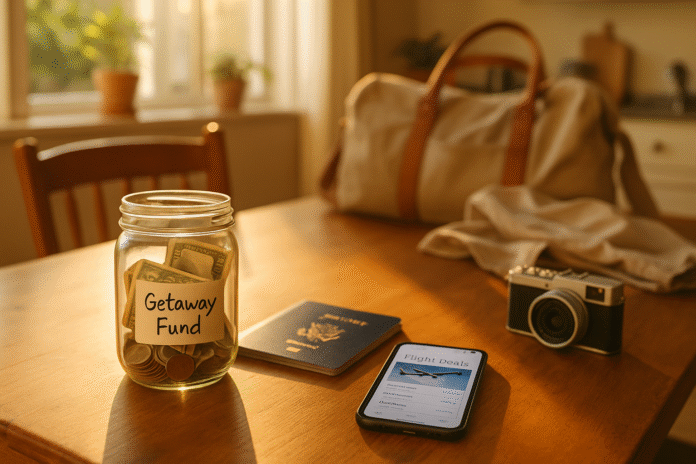
If you’re craving more quick breaks without wrecking your budget, a quick getaway fund is your simple, repeatable system for financing weekend trips and mini-vacations. Think of it as a small, always-ready “sinking fund” dedicated to 48–72-hour escapes—funded automatically, parked in the right account, and protected by a few guardrails. Below you’ll learn exactly how to size your weekend budget, where to keep the money, how much to transfer each payday, and the booking and packing moves that stretch every dollar. This guide is for busy travelers who want more spontaneity with less money stress.
What is a quick getaway fund (in one line)? It’s a designated savings pot—separate from your emergency fund—built with small, consistent contributions to cover short trips without debt.
Fast path (the whole play in nine moves):
1) Price your ideal weekend, 2) Choose a high-yield parking spot, 3) Automate contributions, 4) Trim & re-route small spends, 5) Add micro-income, 6) Use price alerts & deal tools, 7) Pack smart to dodge fees, 8) Standardize a 48–72-hour itinerary, 9) Protect the pot and track progress.
Friendly disclaimer: This is educational—not financial advice. Confirm rates, fees, and policies for your country/airline/bank, and adapt numbers to your situation.
1. Define Your Weekend Trip Target and Budget (So You Know the Number)
Start by deciding what you’re funding and how much it costs, because clarity here prevents under-saving and overspending. Choose a weekend “trip archetype” (e.g., road-trip within 300 km/200 mi, budget flight to a nearby city, or a local cabin stay) and build a realistic total including transport, lodging, food, activities, and a small contingency. A typical two-night, close-to-home weekend often sits in the $250–$600 range per person depending on transport and lodging tier; anchoring on that range gives you a clear monthly target. Once you have a number, your fund becomes tangible—“two weekends per quarter at $400 each” is easier to plan for than a vague “travel sometime this year.” Finally, pick a planning horizon (e.g., one trip every 6–8 weeks) to translate the cost into a monthly savings amount that fits your cash flow.
1.1 What to include (don’t guess—estimate)
- Transport (fuel or economy airfare + local transit/parking/tolls)
- Lodging (2 nights; compare hotel vs. short-term rental vs. hostel/private room)
- Food & coffee (3 days of meals + 1 treat)
- Activities & tickets (museum, trail fees, bike rental, show)
- Contingency buffer (10–15%)
1.2 Numbers & guardrails (example)
- Target: Two-night city hop, economy flight: $120 airfare + $180 lodging + $120 food + $40 activities + $40 buffer = $500.
- If you want this every 8 weeks, contribute $250/month to your fund.
Synthesis: A concrete weekend price and cadence turn your getaway dream into a solvable math problem; everything else in this guide flows from this number.
2. Pick the Right Parking Spot: Where Your Fund Should Live
Keep your quick getaway fund in a high-yield savings account (HYSA) or money market account (MMA) that pays competitive interest while staying liquid. As of now, top HYSAs and MMAs commonly pay around 4% APY (sometimes a bit higher), while the U.S. FDIC national average for basic savings is roughly 0.40%, so parking your cash in a HYSA meaningfully out-earns a big-bank savings account without sacrificing access. Look for FDIC/NCUA insurance, no monthly fees, and the ability to create named sub-accounts or “vaults” so your getaway pot stays visible and separate. If your bank supports buckets or goals, label one “Quick Getaway Fund” and keep it psychologically fenced off from everyday spending. If your main bank is stingy on interest, open a separate online HYSA and connect it to your checking for seamless transfers.
2.1 How to choose (5-minute checklist)
- APY near current market leaders (compare monthly; avoid teaser rates)
- No monthly fees or minimums you can’t maintain
- Fast transfers to checking (same-day or next-day)
- Sub-accounts/goals labeling to avoid mingling funds
- Mobile app with reliable automation tools
2.2 Mini case
You keep $600 in a big-bank savings at 0.01% APY vs. a HYSA at ~4.3% APY. Over a year, that’s ~$0.06 vs. ~$25. While the dollar gap is modest at small balances, the higher yield compounds as your fund grows toward multi-trip reserves—free money for your next brunch or museum pass.
Synthesis: The right account keeps your fund liquid and growing, making every future weekend a little cheaper.
3. Automate Contributions With a Simple Rule (And Make It Effortless)
Set a fixed automatic transfer each payday into your quick getaway fund so you never rely on willpower. A popular rule of thumb is the 50/30/20 budget, allocating roughly 20% of after-tax income toward savings/debt; even if you can’t hit 20% overall, earmark a small, consistent slice (e.g., $25–$75 per paycheck) for the getaway pot. The goal is frictionless momentum: automation reduces missed months and decision fatigue. If you’re paid biweekly, align the transfer the morning after payday. If cash flow is tight, start at a token amount ($10) and use step-ups: increase by $5 every month until you reach your target. Budgeting apps like YNAB (great for “sinking funds”) or Rocket Money (useful for spotting subscription cuts) can help you find and route dollars without manual tracking.
3.1 How to do it (quick setup)
- Pick a contribution aligned to your trip cadence (e.g., $250/month for a $500 weekend every 8 weeks)
- Create a recurring transfer from checking → HYSA the day after payday
- Add a calendar reminder for quarterly tune-ups (adjust up/down 10–20%)
- Enable bank “round-up” features, if available, as a small booster
3.2 Common mistakes
- Waiting to transfer “leftovers”—automation beats intention
- Parking the fund in your main checking—too tempting to spend
- Setting an amount that’s too high—better to start small and raise steadily
Synthesis: Automate once and forget it; your fund grows quietly in the background while you plan the fun parts.
4. Trim and Re-Route Small Spends (So the Fund Fills Faster)
The fastest way to build a quick getaway fund is to reclaim tiny leaks—the under-$10 purchases you never miss. Identify one or two low-joy categories (delivery fees, idle subscriptions, vending-machine snacks) and set temporary caps for 30–60 days. Use your bank’s analytics or an app to spot the easy wins; for many people, canceling or downgrading two subscriptions plus one weekly delivery habit frees up $40–$80/month, which is half a weekend hotel night in many cities. Rocket Money is particularly helpful for finding and canceling subscriptions you’ve forgotten about; combine that with a price-tracking habit for flights and you’ll see momentum quickly.
4.1 Quick reallocation ideas (pick 3)
- Pause 1–2 subscriptions and redirect the exact amount to your HYSA
- Swap one delivery per week for a grocery run; transfer the saved fees/tips
- Implement “$20 cash cap” for impulse snacks/coffee on weekdays
- Sell two unused items each month and auto-transfer proceeds
- Check loyalty points—cash out small balances to the fund if possible
4.2 Mini checklist
- Visibility: Review last 30–90 days of transactions
- Action: Cancel/downgrade, then immediately transfer the “found money”
- Guardrail: Keep the change until your next trip, then reassess joy vs. cost
Synthesis: You don’t need austerity—just a few deliberate cuts and the discipline to redirect the savings immediately.
5. Add a Dash of Extra Income (Micro-Earnings That Don’t Burn You Out)
If your timeline is aggressive, stack small, time-boxed side earnings: a weekend pet-sit, selling two closet items, a short freelance task. Even $50–$150/month accelerates your first or next mini-vacation. Choose low-friction gigs that fit your schedule and energy. Pro tip: set a separate “Getaway” payout destination in gig apps or auto-transfer marketplace proceeds the day they land, so you never feel richer in checking and poorer in the fund. Keep this seasonal: push harder the month before an anniversary or friend’s birthday trip; throttle back afterward.
5.1 Practical examples
- Host a one-hour skills session (music lesson, language tutor)
- Flip unused gift cards or tech (factory-reset old devices first)
- Trade time with friends: you watch their dog; they pay your gas on the trip
- Add a “tips” jar IRL for a hobby (busking/market stall) if local rules allow
5.2 Guardrails
- Cap total side-gig hours (e.g., ≤4 hrs/week)
- Pre-select where the cash goes (100% → HYSA sub-account)
- Celebrate micro-milestones (each $50 = one activity paid for)
Synthesis: Tiny, directed earnings compound fast when every dollar has a weekend attached to it.
6. Use Smarter Booking Tactics: Alerts, Explore Maps, and Guarantees
Let prices come to you. Set price alerts on Google Flights or Skyscanner for your favorite weekend routes, then pounce when fares dip. Use KAYAK Explore to map destinations within a budget, perfect for spontaneous, price-first weekends. On Google Flights, some itineraries display a Price Guarantee badge—if a price drops after booking, Google refunds the difference (limits apply and availability varies by market and airline). Pair alerts with flexible date ranges (Fri–Sun vs. Sat–Mon) to swing fares in your favor, and consider nearby airports when sensible. For hotels, watch HotelTonight for last-minute discounts in major cities. These tools together make your fund feel bigger without saving a cent more.
6.1 Quick setup (10 minutes)
- Save 3–5 routes in Google Flights and toggle tracking emails
- Create Skyscanner alerts for alternate weekends
- Open KAYAK Explore and set your round-trip budget (e.g., $120)
- For hotels, check HotelTonight the week of travel (Tue–Thu often good)
6.2 Numbers & guardrails
- Price Guarantee refunds are usually capped at $500 per year per Google account and require a $5+ drop; availability limited to select itineraries and markets. Always verify the badge and terms before booking.
Synthesis: Automated alerts and explore tools shift the work from you to the platforms, turning your fixed fund into more trip for the money.
7. Pack Light and Plan Smart to Avoid Fees (Keep Dollars for Fun)
Travel light to dodge baggage fees and speed through airports. A single carry-on plus personal item is the sweet spot for weekenders; it reduces both cost and friction. Know the 3-1-1 liquids rule for security (one quart-size bag of 100 ml/3.4 oz containers) and aim for versatile layers so you can handle weather shifts. While carry-on size rules vary by airline, the IATA general guide suggests a common cabin size around 56 × 45 × 25 cm (22 × 18 × 10 in)—always confirm your carrier’s limits. Pack a mini-pharmacy (bandages, meds, pain relief), a compact battery pack, and a refillable bottle to avoid airport markups. For road trips, advance-plan snacks and a cooler to slice food costs by 20–30% over the weekend.
7.1 Mini carry-on checklist
- 1 pair comfortable shoes + 1 “dress-up” layer
- 2 tops, 1 bottom, 1 sleep set, 3 pairs of socks/underwear
- Toiletries in 100 ml/3.4 oz containers within a quart-size bag
- Lightweight rain shell; compact power bank; water bottle
- Printed/phone copies of bookings; transit card/app
7.2 Common mistakes
- Overpacking “just in case” (plan one laundry sink-wash if needed)
- Ignoring airline-specific carry-on limits
- Buying airport water/snacks (bring an empty bottle + snacks)
Synthesis: Packing discipline is free money—every avoided fee lands directly in your experience budget.
8. Standardize a 48–72-Hour Weekend Template (Your Repeatable Playbook)
Create a reusable weekend template so you spend less time planning and more time enjoying. For a two-night trip, think Day 1 arrival + neighborhood walk and casual dinner, Day 2 anchor activity + signature meal, Day 3 slow morning + scenic exit. Build a short list of “any-city” activities you love—markets, a museum wing, a hike/bike loop, a coffee crawl—so you never start from zero. Pre-save Google Maps lists by theme (bakeries, bookstores, viewpoints) and group them in 15–20-minute walking clusters to reduce transit costs. Include free or low-cost experiences (parks, public art, galleries) and time-box paid splurges. Standardizing structure shrinks decision fatigue and keeps spending aligned to your fund.
8.1 Sample 2-night city template
- Fri: Arrive by 6 pm → neighborhood walk → casual dinner + gelato
- Sat: Morning market + museum (2–3 hours) → coffee crawl → sunset viewpoint → special dinner (reservation)
- Sun: Brunch → scenic stroll → depart by 3 pm
8.2 Tools & tactics
- Save a “Weekends” map with 10–15 pins per city
- Preload transit passes or city cards if they actually save money
- Use HotelTonight only when you’re flexible and the math beats pre-booking
Synthesis: A light, repeatable framework removes planning overhead and anchors your spend to what you actually value.
9. Protect the Fund and Measure Progress (Rules That Keep It Working)
Treat your quick getaway fund as a sinking fund with rules: money flows in automatically, and you spend only for short-term travel—not emergencies or gadgets. Track your balance monthly and set thresholds: for example, the fund should cover at least one full weekend at any time, and you’ll rebuild to 2× the weekend target before booking flights again. If you share finances, agree on contribution amounts and a simple veto rule for date changes. In tools like YNAB, assign a dedicated category; in any budget app, label transfers so history is clear. Finally, review your account choice twice a year to confirm your APY remains competitive. The result is a durable habit that funds joy on schedule.
9.1 Mini policy menu
- Use: weekend trips (transport, lodging, food, activities)
- Don’t use: emergencies (that’s a separate fund), big-ticket gear, gifts
- Rebuild: after each trip, auto-boost contributions by +10% for 1–2 months
- Review: APY and fees every 6 months; switch if your rate lags leaders
9.2 Scoreboard & motivation
- Display your “Trips Funded” count somewhere visible
- Celebrate balance milestones with no-cost rituals (sunset walk, movie night)
- After 3 trips, audit what gave the most joy per dollar and reprioritize
Synthesis: Clear rules + a visible scoreboard turn a pile of cash into a reliable engine for future memories.
FAQs
1) How much should I put into a quick getaway fund each month?
Work backward from your target weekend cost and cadence. If your ideal two-night trip is $500 and you want one every 8 weeks, that’s ~$250/month. If money’s tight, start at $25–$50/month and increase by $5 monthly until you hit target. Align transfers with payday so cash flow stays smooth, and consider “round-ups” for small boosts. The point is consistency over heroics.
2) Where should I keep the money—HYSA, MMA, or checking?
Use a high-yield savings account or money market account so your cash earns interest while staying liquid. As of now, many reputable HYSAs/MMAs pay ~4% APY, far above basic savings averages. Ensure your account is FDIC/NCUA-insured, has no monthly fee, and allows easy transfers to checking. Re-evaluate twice a year to stay near the leaders.
3) Is the 50/30/20 budget rule still relevant?
Yes—as a starting framework. It allocates 50% to needs, 30% to wants, and 20% to savings/debt. If housing or childcare pushes you beyond 50%, adjust the percentages but keep the structure, automating a small, fixed transfer to the fund each payday. The magic is in the automation, not perfection.
4) How do flight price alerts work?
On Google Flights and Skyscanner, you can save routes and dates to get emails or app notifications when prices change. Google also shows a Price Guarantee badge on select itineraries—if the fare drops after you book, you may be refunded the difference (caps and terms apply). Combine alerts with flexible departure days to widen opportunities.
5) What’s the cheapest way to pick a destination?
Use KAYAK Explore to map destinations within a set budget and time window. It’s a fast way to see “where” your current fund balance can take you, especially for spontaneous weekends. Pair that with a short list of cities you enjoy so you can move fast when a price dips.
6) Any packing rules to avoid airport pain and fees?
Pack to carry-on only for weekends. Remember the TSA 3-1-1 liquids rule for U.S. travel, and aim to meet common carry-on size guidance (around 56 × 45 × 25 cm / 22 × 18 × 10 in) while checking your airline’s specific limits. A compact power bank and refillable bottle save money and time. TSA
7) Are last-minute hotels actually cheaper?
Sometimes—especially in cities with high supply. Apps like HotelTonight surface discounted, same-week inventory. However, big events can push prices up, so compare against refundable rates you booked earlier; cancel and rebook only when savings are clear.
8) Should I use a travel card like Wise or Revolut for weekend trips abroad?
Multi-currency cards can reduce foreign transaction fees and offer good exchange rates, but fees vary by plan and timing. For example, some services charge weekend exchange markups unless you’re on premium tiers; always check current fee tables and your destination’s ATM costs before you go. If you travel a few times a year, run the math on plan fees vs. savings. Wise
9) How big should my quick getaway fund be overall?
Aim to keep 1–2 full weekends funded at all times so you can say “yes” without waiting. If you travel with a partner or friends, scale the target per person (e.g., $400 per person per trip). After each trip, rebuild to your minimum threshold before booking again.
10) How do I keep this from competing with my emergency fund?
Separate accounts/categories and naming conventions help. Treat the quick getaway fund as a sinking fund in your budget app and keep your emergency fund in a different account. If an emergency occurs, pause transfers to the getaway pot—but don’t raid it unless you must. Resume contributions once you’re stable.
11) What if my income is irregular?
Use a percentage-based transfer (e.g., 3–5% of each payout) instead of a fixed dollar amount. When income spikes, your fund benefits; when it dips, you avoid overdrafts. Keep a small cushion in checking to smooth timing.
12) How do I avoid overspending on food?
Set a per-day food cap (e.g., $40–$60) and pre-decide one “splurge meal.” Fill the rest with breakfast kits (yogurt, fruit, pastries), picnics, or market snacks. In cities, map two affordable spots per neighborhood before you arrive; it kills both indecision and random overspends.
Conclusion
A quick getaway fund isn’t just a jar of cash—it’s a system that makes short trips feel easy and frequent. You defined your ideal weekend and its true cost, parked the money in a higher-yield home, and put contributions on autopilot. You found painless savings in your daily routine, layered on small bursts of extra income, and let smart tools (price alerts, explore maps, last-minute apps) stretch the fund further. Packing light, templating your weekend, and adding clear rules keep the habit resilient through busy seasons and shifting prices. The result is more real rest and connection, on purpose, multiple times a year—without credit-card hangovers.
Next step: set your monthly transfer, create one flight alert, and name your sub-account “Quick Getaway Fund” before today ends.
References
- Best High-Yield Savings Accounts: Up to 4.51%, NerdWallet, Oct 3, 2025. NerdWallet
- National Rates and Rate Caps – September 2025, FDIC, Sep 15, 2025. FDIC
- Best Money Market Accounts – October 2025, Kiplinger, Oct 2025. Kiplinger
- Best No-Fee High-Yield Savings Rates, Kiplinger, Oct 2025. Kiplinger
- Got $30,000 in Savings? This Common Misstep Could Cost You Thousands, Investopedia, Sep 2025. Investopedia
- The 50/30/20 Budget Rule Explained With Examples, Investopedia, 2024. Investopedia
- Track Flights & Prices, Google Travel Help, current help page. https://support.google.com/travel/answer/6235879 Google Help
- About Price Guarantee on Google Flights, Google Travel Help, current help page. https://support.google.com/travel/answer/9430556 Google Help
- How to Find Cheap Flights with Explore, KAYAK News/Guide, Sep 23, 2025. KAYAK
- How Do I Set Up Email Price Alerts?, Skyscanner Help, Oct 17, 2024 & Jul 2, 2025 guide. and https://www.skyscanner.com/tips-and-inspiration/deals/new-daily-cheapest-flights-deals Skyscanner
- Liquids, Aerosols, and Gels Rule, TSA, current page. TSA
- Passenger Baggage Rules (Carry-On Guide), IATA, current page. IATA
- HotelTonight FAQ, HotelTonight, current page. HotelTonight
- What Is a Sinking Fund & How To Set One Up, YNAB Blog, Apr 11, 2023. YNAB
- How to Assign Your Savings (YNAB Support), YNAB Help, current page. YNAB Support
- Rocket Money: Find & Cancel Subscriptions, Rocket Money, current site. Rocket Money