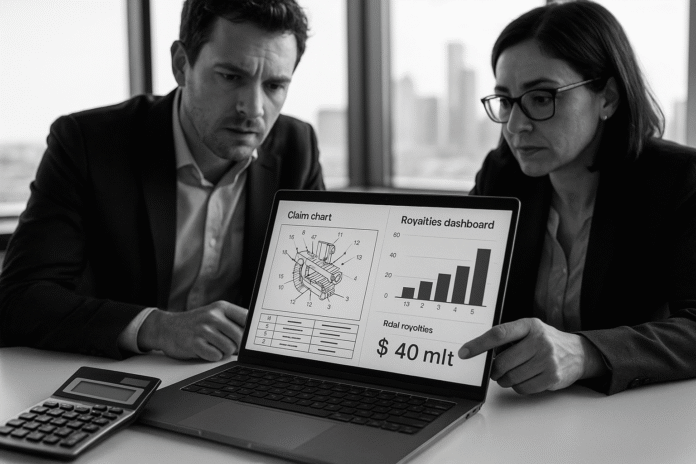
Patent licensing turns protected inventions into recurring revenue by letting others use your patented technology in exchange for royalties while you retain ownership. In plain language, a license is permission to use your IP for value; an assignment sells it. Licensing is flexible—you can limit it by territory, field-of-use, and term, and pair lump sums with ongoing royalties. That’s the core engine behind Passive Income from Intellectual Property.
Quick definition: A patent license is a contract granting specified rights to practice a patented invention under agreed terms (e.g., royalty rate, territory, exclusivity), without transferring ownership.
Disclaimer: This guide is informational and does not constitute legal, financial, or tax advice. Work with qualified counsel and advisors on your situation.
The steps at a glance
1) verify what you own; 2) map use-cases and markets; 3) check patent strength and the competitive landscape; 4) value the asset and choose a royalty approach; 5) pick a licensing model; 6) prepare evidence and collateral; 7) find and qualify licensees; 8) negotiate a term sheet; 9) paper the agreement; 10) manage, audit, and enforce.
1. Confirm What You Own (and Can License)
Start by confirming the exact patents, claims, and jurisdictions you control, because you can only license rights you actually own or have authority to grant. This means gathering patent numbers, jurisdictions, current status (granted vs. pending), maintenance fee posture, and any encumbrances (prior assignments, liens, co-ownership, grant-back obligations). If co-owned, check whether your law allows licensing without the other owner’s consent; if rights are assigned to a company, ensure the company—not the individual inventor—will sign. Also verify that you’re not confusing an exclusive license (strong rights but still not ownership) with an assignment (a transfer of title). Getting this foundation right prevents costly renegotiations later and protects the “passive” nature of your revenue stream.
How to do it
- Pull an asset register listing each patent family, grant status, next annuity, and prosecution counsel.
- Retrieve original assignment documents and any prior license agreements to spot conflicting grants.
- Review claims to ensure what you plan to license is actually covered (and enabled) by the issued or pending claims.
- Clarify who signs: owner of record or an authorized affiliate.
- Note territorial limits: patents are jurisdiction-specific; there’s no “worldwide patent.”
Numbers & guardrails
- Ownership test: list every patent family once; for each, count jurisdictions. If any expected market lacks coverage (count = 0), price accordingly or restrict the license.
- Annuit ies: if a patent’s next maintenance deadline is within one reporting cycle, set a calendared condition precedent to keep it in force.
Close by documenting a clean, searchable IP register so later diligence goes fast and doesn’t derail deals.
2. Map Use-Cases and Markets That Value the Patent
Licensing thrives where a patent’s claims line up with real, monetizable use-cases. Translate each independent claim into plain-English capabilities, then brainstorm product categories, sub-segments, and adjacent industries. Focus on where your claims are blocking (a competitor can’t ship without practicing) or enabling (your tech lowers cost or boosts performance). Tie each use-case to concrete buyers and a go-to-market motion—OEM integration, component suppliers, contract manufacturers, or platform ecosystems. This mapping steers your outreach list and informs royalty mechanics (per-unit vs. revenue-based vs. hybrid).
Mini-checklist
- Convert claims → features → benefits → customer segments.
- Score markets by addressable volume, ease of measurement, and likelihood of infringement.
- Identify field-of-use splits (e.g., automotive vs. medical devices) to multiply licensing options without channel conflict.
- Flag standard-driven spaces (Wi-Fi, cellular, codecs) where FRAND norms may apply.
Numeric mini case
Suppose your claim improves battery charging efficiency by 3–5%. In wearables (10 million annual units), a $0.15 per-unit royalty could yield $1.5 million annually; in grid-scale storage (fewer units but high ASP), a 0.25% running royalty on $400 million sales yields $1 million. Different fields justify different structures.
Wrap up by shortlisting 3–5 fields with distinct license packages you can pitch separately.
3. Check Patent Strength and the Landscape
Before quoting rates, test the enforceability and relevance of your patent. “Strength” spans legal validity (novelty, non-obviousness, sufficiency), claim clarity, and freedom-to-operate (FTO) constraints from others’ patents. Map competitors’ portfolios, identify work-arounds, and compile claim charts aligning your claims to a target product’s public documentation or teardowns. If you plan truly passive income, you want high-confidence coverage that minimizes disputes.
Why it matters
- Clear, enforceable claims increase negotiating leverage and justify better terms.
- Exclusive licenses can be carved by territory or field; clarity on scope prevents overlap and future conflicts.
How to do it
- Commission a landscape search; rank top ten potentially blocking third-party patents.
- Build at least one element-by-element claim chart for a priority target.
- Note standards-essential potential; if applicable, understand FRAND expectations and dispute pathways.
Numbers & guardrails
- Aim for ≥2 independent claims mapping cleanly to target features.
- If a credible work-around costs a licensee <1% of BOM, expect pressure on rates; if >3%, your leverage improves.
Conclude with a go/no-go matrix: if strength is middling, pivot to non-exclusive licenses or broader bundles.
4. Value the Patent and Choose a Royalty Approach
Valuation doesn’t need to be fancy, but it must be defensible. Blend income, market, and cost methods. In practice, licensors often peg running royalties to the incremental value enabled by the invention and cross-check with comparables. WIPO highlights market comparables and income approaches (discounted royalty streams) as common ways to triangulate fair royalty ranges.
Options you’ll consider
- Per-unit royalty (e.g., $0.10 per device).
- % of net sales (e.g., 1–5%, defined carefully).
- Tiered rates tied to volume or milestones.
- Upfront + running hybrid to balance risk.
- Minimum guarantees to protect cash-flow predictability.
Numbers & guardrails
- Build three cases: conservative/base/upside. For example, 2% royalty on $50 million net sales yields $1 million; at 1.25%, $625,000; at 2.75%, $1.375 million.
- Use rate caps/floors and most-favored-rate clauses sparingly and knowingly; they can ripple across deals.
Finish by documenting a “valuation memo” summarizing logic, comps, and sensitivities—you’ll rely on it in negotiations.
5. Pick the Licensing Model and Deal Architecture
Your model determines how passive (and scalable) the income is. The big forks: exclusive vs. non-exclusive, field-of-use splits, territory limits, term, sublicensing rights, and—when relevant—pool or cross-license structures. An exclusive license can command higher upfront fees but concentrates counterparty risk; non-exclusive can compound across many licensees. Remember: even an exclusive license is still not an assignment of title.
Tools/Examples
- Field-of-use exclusivity: Exclusive in automotive; non-exclusive elsewhere.
- Territorial splits: License Region A to Distributor X; Region B to OEM Y.
- Patent pool: Efficient when many implementers need a bundle (e.g., codecs); consider FRAND contexts.
- Cross-license: Useful when both sides have blocking portfolios; reduces litigation risk and opens channels.
Mini-checklist
- Will you allow sublicensing? If yes, define revenue share and audit trail.
- Do you need a “have-made” right for contract manufacturers?
- Align grant scope with your valuation memo and map from Section 2.
Conclude by drafting a one-page model summary for internal alignment before you approach targets.
6. Prepare Licensing Collateral That Sells Itself
Great licensing is pre-sold with evidence. Assemble a concise licensing pack: a non-confidential overview, target-specific claim charts, performance data, a simple ROI model, and a red-lined term sheet template. Include a clear description of what’s licensed (claims, know-how, software, data) and what’s not. Where applicable, prepare standards-mapping (e.g., which sections of the technical spec your claims read on) to ease FRAND-style discussions.
What to include
- One-pager that describes the invention’s commercial benefit in plain English.
- Claim charts with citations to public materials.
- Demo or reference design showing integrability.
- ROI calculator the prospect can tweak.
- Draft term sheet with blanks for rates, territory, and exclusivity.
Numeric mini case
If your feature saves $0.30 per unit in materials, a $0.10 per-unit royalty still leaves $0.20 net savings, a simple story that closes deals.
End by rehearsing a 10-minute pitch tailored to each vertical’s language.
7. Prospect and Qualify Licensees
Target companies who are both motivated and capable of paying. Use your market map to list OEMs, contract manufacturers, module suppliers, and platforms. For each, identify the product lines that likely practice your claims and the executives who own P&L or IP strategy. Qualify on three axes: fit (do they use the feature), scale (sales volume/ASP), and attitude (collaborative vs. avoidant). Keep FRAND contexts in mind for standards ecosystems, where good-faith negotiation frameworks exist to streamline talks.
Steps
- Build a target spreadsheet with decision-makers, SKUs, and timing.
- Start with a non-assertion tone emphasizing win-win outcomes; lead with ROI, not threats.
- Offer a narrow evaluation license under NDA to test integration quickly.
Numbers & guardrails
- Use a simple BANT-style score (Budget, Authority, Need, Timing) on a 1–5 scale; pursue ≥14/20.
- Expect a hit rate of roughly 10–20% from qualified outreach to term-sheet stage if the claim fit is strong (rule of thumb, not a promise).
Close with a clean CRM cadence and a standard data room to accelerate diligence.
8. Negotiate the Term Sheet Like a Pro
The term sheet aligns on economics and scope before lawyers draft long-form contracts. Keep it concise: grant (scope/field/territory), exclusivity, term, royalty base, rate, minimum guarantees, reporting cadence, audit rights, IP marking/attribution, improvements, sublicensing, indemnities, termination, and dispute resolution. Licensing bodies consistently emphasize preparation, clarity on scope, and thoughtful economics—do the hard thinking now to keep passive income truly passive later.
Compact cheat-table (for scannability)
| Clause | What it governs | Quick guardrail |
|---|---|---|
| Grant of rights | What can be made/used/sold | Tie to claim language; include “have-made” if needed |
| Royalty base | Sales or units counted | Define net sales precisely; exclude taxes, freight |
| Rate & tiers | % or per-unit | Link tiers to audited volume brackets |
| Minimums | Cash-flow floor | Set quarterly minima; true-up annually |
| Audit rights | Verification | Reimbursement if ≥5% underpayment found |
| Sublicensing | Downstream rights & rev-share | Require pass-through terms and reports |
Numbers & guardrails
- Minimum guarantees: Target 25–40% of base-case forecast to protect downside without choking adoption.
- Report cadence: quarterly works well; align with your finance cycle.
- Audit trigger: require reimbursement of audit costs above a material under-reporting threshold, a common practice in licensing.
End the term sheet with a short exclusivity sunset if diligence milestones aren’t met—so the asset doesn’t sit idle.
9. Paper the Agreement Carefully (Without Over-Lawyering)
With aligned terms, move to a balanced license agreement. WIPO’s practical manuals stress the importance of defining scope, territory, and rights to improvements, and tailoring terms to the business reality. Draft clear definitions, a tightly written grant, and tested boilerplate for confidentiality, assignment, force majeure, and governing law. In standards-heavy sectors, add FRAND-appropriate language and escalation paths. In all cases, remember the difference between a license (permission) and an assignment (transfer)—your goal here is passive income, not giving up ownership.
Common mistakes to avoid
- Vague “net sales.” Spell out deductions: returns, rebates, freight, taxes—nothing else.
- Forgetting “improvements.” Decide whether licensee improvements are included, shared, or separately licensable.
- Missing “have-made.” If you expect contract manufacturing, grant it explicitly.
- Audit clause too weak. Specify records, look-back period, and cure timelines; include reimbursement threshold.
Numbers & guardrails
- Payment terms: 30–45 days after quarter end is typical; late fees should mirror commercial norms.
- Look-back: 2–3 years for audits is common; longer can be contentious.
Conclude by running the agreement through a red-flag checklist and a brief business-owner read—if they can’t explain it, it’s not clear enough.
10. Manage, Audit, and Enforce Without Losing Sleep
Passive income is never totally hands-off—you still manage reports, verify payments, refresh pricing tiers, and enforce rights. Set up a simple license-ops rhythm: calendar reminders for reports and payments, a template invoice, and a friendly follow-up script. Establish a periodic royalty audit plan; industry guidance recommends having reimbursement triggers and well-defined procedures to maximize recoveries and minimize disputes. Where standards are involved, understand neutral dispute options and FRAND-style determinations that can steer parties back to agreement without protracted litigation.
Mini-checklist
- Reconcile reported sales/units to expected volumes per SKU.
- Compare actuals vs. tiers; issue credits/debits for missed thresholds.
- Run variance analytics; if discrepancies exceed your trigger, initiate an audit per contract.
- Maintain patent marking where applicable; keep maintenance fees current.
- Track improvement disclosures and related IP filings.
Numeric mini case
If reported royalties total $870,000 but variance analysis flags a 6.2% under-reporting, and your agreement reimburses audit costs above 5%, you can recover the $53,940 shortfall plus audit fees under the cost-recovery clause.
End with a quarterly review to adjust strategy, identify cross-sell opportunities, and keep the flywheel turning.
FAQs
How is patent licensing different from selling a patent?
Licensing grants permission to practice a patent under set terms while you retain ownership; an assignment transfers ownership entirely. Licensing enables recurring royalties and flexible scoping (territory, field-of-use) that align with passive income goals.
What’s a realistic royalty rate?
Rates vary widely by industry, margins, and contribution—some deals are per-unit cents, others low single-digit percentages of net sales. Use income and market methods to triangulate a range, then test with sensitivities and comparables rather than copying a headline rate.
Do I need a patent pool or FRAND license?
Only if your technology is essential to a technical standard or you operate in a standards ecosystem. In those contexts, FRAND frameworks and neutral determinations can help settle on terms and avoid litigation.
What does “exclusive” really mean?
An exclusive license prevents you (and others) from licensing the same rights within the defined scope—by territory, time, or field—but it’s still not a transfer of ownership. Draft the scope precisely to avoid overlaps.
How are royalties calculated and paid?
Most agreements define a clear royalty base (units or net sales), apply a rate or tiered rates, set quarterly reporting, and require records for audits. Upfront fees, milestones, and minimum guarantees are common add-ons to balance risk and ensure traction.
What is a claim chart and why do I need one?
It’s an element-by-element mapping of your patent claims to a product or standard. Strong charts increase leverage and shorten negotiations by showing how the target practices your claims. USPTO
Can I license pending patents?
Yes—but expect conservative terms or contingencies until grant. You can license know-how and related rights now and step up rates post-grant. Make sure your grant language anticipates status changes.
How often should I audit a licensee?
Plan periodic audits (e.g., every one to two years) or triggered audits if discrepancies pass a set threshold. Include audit-cost reimbursement if material under-reporting is found to encourage accuracy.
What if the licensee makes improvements?
Decide upfront: are improvements included, cross-licensed back, or separately licensable? Clear improvement clauses prevent disputes and help you capture upside from downstream innovation.
Does licensing require global patents?
No. Patents are territorial. You license where you have rights and price other regions accordingly or exclude them from the grant.
Conclusion
Building Passive Income from Intellectual Property with patent licensing isn’t about a perfect rate—it’s about a repeatable system. Confirm what you own, map use-cases that need your invention, test patent strength, and price value with simple models. Choose a deal architecture that matches your risk tolerance, prepare compelling collateral, and prospect methodically. When you reach the table, negotiate a clear term sheet, then document tight definitions and guardrails so the agreement operates smoothly. Finally, manage reporting with a light but consistent touch, audit when signals warrant, and keep your portfolio healthy. Follow these ten steps and you create a licensing flywheel that compounds across fields, geographies, and product lines with minimal extra lift. Ready to monetize your patent? Draft your term sheet and send the first outreach email today.
References
- “IP Assignment and Licensing,” World Intellectual Property Organization (WIPO), https://www.wipo.int/en/web/business/assignment-licensing
- “Managing a Patent,” United States Patent and Trademark Office (USPTO), https://www.uspto.gov/patents/basics/manage
- “MPEP – Chapter 0300: Ownership and Assignment,” USPTO, https://www.uspto.gov/web/offices/pac/mpep/mpep-0300.pdf
- Successful Technology Licensing, WIPO Publication No. 903, https://www.wipo.int/edocs/pubdocs/en/licensing/903/wipo_pub_903.pdf
- “Valuing Intellectual Property Assets,” WIPO, https://www.wipo.int/en/web/business/ip-valuation
- “Standard Essential Patents,” European Commission – Single Market, https://single-market-economy.ec.europa.eu/industry/strategy/intellectual-property/patent-protection-eu/standard-essential-patents_en
- “Licensing of IP Rights and Competition Law – Note by the United States,” OECD, https://one.oecd.org/document/DAF/COMP/WD%282019%2958/en/pdf
- “Key Financial Building Blocks of Licensing Agreements to Maximize Revenue and Protect Intellectual Properties,” Licensing Executives Society International (LESI), https://lesi.org/article-of-the-month/key-financial-building-blocks-of-licensing-agreements-to-maximize-revenue-and-protect-intellectual-properties/
- “Royalty Audit Checklist,” AmiCOUR IP, https://amicourip.com/publications/Les_Nouvelles_Royalty_Audit_Checklist.pdf
- “Basics of Patent Protection,” USPTO (presentation), https://www.uspto.gov/sites/default/files/about/offices/ous/Cooper_Union_20130604.pdf