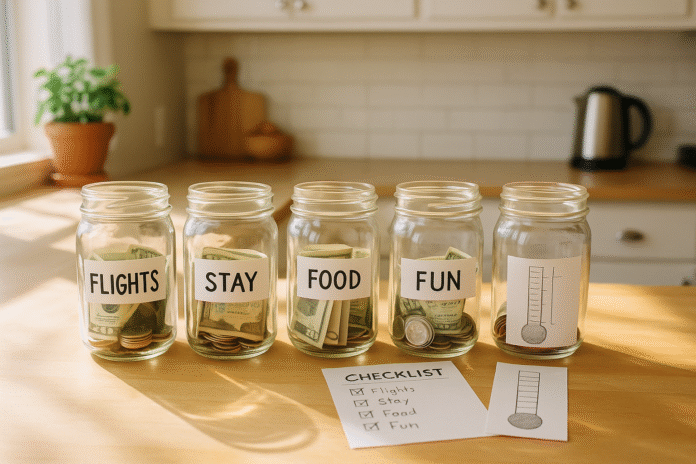
A savings jar for vacation is a simple, visual system: label physical jars for each travel goal, put cash in consistently, and watch progress grow in plain sight. The visibility turns vague intentions into concrete momentum, which is why it works for many households. Below you’ll find a complete, practical guide to set up jars that actually move you toward your trip—without complicated spreadsheets or apps. This is general education, not personal financial advice; consider talking with a qualified pro if you need guidance tailored to your situation.
Quick path to action:
- Pick a total trip target and split it into 4–6 jar categories.
- Choose clear jars, label them, and place them where you’ll see them daily.
- Set a weekly deposit rule tied to routines you already do.
- Track progress with tick marks or a simple “thermometer” card.
- Cash out on a set date and immediately book what’s funded.
When you’re done, you’ll have a visual, family-friendly system that helps you save faster, avoid overspending categories, and feel confident booking your getaway.
1. Set a Concrete Trip Target and Split It by Category
Start with the one number that matters: how much the trip will cost end-to-end. The most effective jar systems begin by defining a total, then splitting that total into categories like flights, lodging, food, experiences, and a small buffer. This prevents the classic “we saved something, but not enough for the big items” problem. Your opening move is a rough but honest budget, not perfection. Estimating up front makes every deposit feel purposeful because you’re funding specific pieces of the trip rather than a vague pot of money. It also lets you book earlier since you can fund high-priority items first (e.g., flights often need to be secured before other expenses). Aim for four to six jars—enough to focus attention, not so many that you dilute effort.
Mini table: Sample 5-day city break budget
| Category | Estimate |
|---|---|
| Flights | 45% |
| Lodging | 30% |
| Food | 12% |
| Experiences | 8% |
| Buffer | 5% |
Numbers & guardrails
- A common split for air travel: Flights 40–50%, Lodging 25–35%, Food 10–15%, Experiences 5–10%, Buffer 3–7%.
- If your destination is driveable, shift Flights → Transport 10–20% and push more to lodging or experiences.
How to do it
- Write your total on a sticky note, then multiply by the percentages above to set jar targets.
- Round targets to the nearest 5 or 10 for easier cash handling.
- Put each jar’s target on the label so you always see where you’re heading.
Close the loop by committing to these category targets now; future choices (like waiting for a fare sale) become simpler when you already know the caps.
2. Choose the Right Jar Count and Labels for Clarity
Your jar labels should make decisions effortless: you want to know instantly where every new dollar belongs. Four to six jars is a sweet spot because it balances clarity with simplicity. Go with plain-English labels you can picture: Flights, Stay, Food, Fun, Buffer, Transport. If you’re traveling as a group or family, a dedicated Kids/Activities jar steers optional spending and keeps peace on the ground. Resist the urge to create ten micro-jars; it becomes fiddly, and momentum stalls. The visual cue of a partly full clear jar with a specific label tells your brain, “Keep going, you’re funding ‘Flights’,” which taps motivation more reliably than a single catch-all.
Numbers & guardrails
- If your total is $1,800, a balanced 5-jar plan might target: Flights $810, Stay $540, Food $216, Fun $144, Buffer $90.
- For road trips, replace Flights with Transport $180–$360 for fuel, tolls, and parking.
Tools/Examples
- Use painter’s tape and a marker for labels—cheap and removable.
- Add each jar’s target (e.g., “Target: $540”) under the label.
- If you want subcategories, use index cards inside the main jar instead of creating more jars.
Ending with clear, minimal labels helps every deposit feel like you’re snapping a puzzle piece into place—no second-guessing or relabeling later.
3. Pick Clear, Durable Containers and Put Them Where You’ll See Them
Visibility is the engine of this method. Choose clear glass or plastic jars so progress is obvious from across the room. Size them to your target: a small jar fills quickly for “Fun,” while a larger one suits “Flights.” Lids matter if you have pets or curious hands, and a shallow wide-mouth jar is easier for counting and sorting bills. Placement is strategic: somewhere you pass daily but not in direct view of visitors, like a kitchen shelf, office bookcase, or bedroom dresser. You want frequent, positive reminders without turning your living room into a vault. If security is a concern, keep the jars inside a locking cabinet or use dummy jars on display with the “real” cash secured elsewhere and reconciled weekly.
How to do it
- Do a quick home walk-through to pick a high-traffic shelf you see every morning.
- Assign jar sizes: Large (Flights/Stay), Medium (Food/Transport), Small (Fun/Buffer).
- Add a discreet note or color dot per jar to avoid mix-ups when counting.
Common mistakes
- Opaque containers (kill motivation), overly heavy jars (hard to handle), and cluttered placements (visual noise).
- Stashing jars out of sight “for safety” and then forgetting to deposit.
Place your jars intentionally and you’ll get dozens of micro-reminders each week—each glance nudging you to drop in a bill or two.
4. Lock a Weekly Deposit Rule You’ll Actually Keep
Consistency beats intensity. The best jar systems run on a weekly rule tied to an existing routine: payday, grocery day, or Sunday evening reset. Decide on a base deposit for each jar and a trigger for bonus deposits, like tossing in leftover cash from errands. This habit-stacking approach means you don’t rely on willpower; the routine does the heavy lifting. If your income varies, use percentage deposits instead of fixed amounts. The more automatic your rule, the less you negotiate with yourself in the moment—and the faster those jars fill.
Numbers & guardrails
- Fixed-income example: $60/week total split as Flights $30, Stay $15, Food $7, Fun $5, Buffer $3 → roughly $3,120 across a full year.
- Variable-income example: deposit 5–10% of each paycheck + all coin change weekly.
How to do it
- Write the rule on a sticky next to the jars: “Every Friday: $30 Flights, $15 Stay…”
- Use an envelope in your wallet labeled “Jars” to corral cash until jar night.
- Add one “stretch” week per month with a small bump (e.g., +$10 to Flights).
Lock a rule that survives a busy week and you’ll watch compounding small wins push you to book sooner.
5. Use Denominations and Change Strategy to Your Advantage
Bills matter psychologically. Smaller denominations create more frequent “wins” because you’re physically adding cash more often, which reinforces the habit. Keep a stack of $1s and $5s for daily or midweek top-ups, and break larger bills at the grocery checkout when possible. Coins can bulk up a Buffer or Food jar quickly—especially if you empty pockets daily. Designate a small dish to pre-sort coins before transferring them to jars. If you often use cards, keep a token-to-cash routine: drop tokens (paper chits or poker chips) into jars during the week and convert to real cash at your scheduled jar time.
How to do it
- Ask for $20 in $1s and $5s when you get cash back.
- Sort coins by jar once a week to avoid jar clutter.
- Keep a mini ledger card per jar to record larger deposits from broken bills.
Common mistakes
- Waiting for “perfect” denominations (you’ll delay deposits).
- Dumping large mixed coin piles straight into the jar (hard to count later).
A smart denomination plan increases the rhythm of progress signals without changing your total savings effort.
6. Make Progress Impossible to Ignore with Visual Trackers
A simple progress tracker can double motivation. Add a narrow “thermometer” card to each jar with tick marks at 10% increments; every time you cross a mark, color it in. You’re building a staircase of micro-goals that keeps momentum high, especially when the jar looks half empty but your card shows you’re right on pace. For category jars, mark key milestones (e.g., flight price thresholds). Visuals anchor you to the plan when you’re tempted by other spending and make it easier to involve kids or partners—they can see exactly what the next step is.
Numbers & guardrails
- Put tick marks at 10% intervals; add a star at 50% and double line at 80% to signal booking readiness.
- If a jar stalls for 4 weeks, move 5–10% from lower-priority jars to re-ignite progress.
How to do it
- Cut index cards to fit each jar; write the target at the top and 10% marks down the side.
- Use a single color per jar so changes are obvious.
- Tape the card inside the jar facing outward.
Close by celebrating milestones—snap a quick photo at 50% and 80%. Recognition fuels the next deposit.
7. Gamify with Challenges that Fit Your Lifestyle
Gamification converts saving into a series of small, fun wins. Popular options include a 52-step challenge (deposit an increment each week), no-spend days (move the skipped amount to a jar), or round-up rules (after paying cash, round the change into the jar). Pick one challenge per month so it stays fresh. Tie the challenge to a specific jar to avoid diluting effort; for example, direct all challenge deposits to Flights until it hits 80%, then shift to Stay. Make it visible with a calendar or a simple grid you check off.
Numbers & guardrails
- A $1–$12 weekly ladder (start at $1, add $1 each week up to $12, then loop) adds $78 per 12-week cycle. Do four cycles and you’ve added $312 to one jar.
- Three no-spend days a week at $5 average per day redirect $15/week, or about $780 across a full year.
How to do it
- Print a one-page grid with 12 boxes; each box = a weekly ladder.
- Post the grid near your jars; when you fill a box, deposit the total and color it in.
- If you miss a week, split the missed amount over the next two weeks rather than quitting.
The right challenge adds novelty and predictability—the winning combo that keeps jars filling even when motivation dips.
8. Involve Your Household with Clear Roles and Rules
Shared jars can be a joy or a headache. Set simple rules so everyone contributes without conflict. Decide who deposits what and when; for example, adults handle base weekly deposits while kids contribute from chores or found money. Create a visible “team rule” card: respectful handling, counting together, and agreeing on cash-out timing. Encourage participation with small rewards when a jar hits 50% (choose a movie night at home) so the big trip doesn’t feel like the only payoff. If housemates have different incomes, use percentages rather than equal dollars to keep it fair.
Mini-checklist
- Define roles: who labels, who counts, who logs.
- Set privacy: jars visible but totals not publicly shared beyond the home.
- Schedule a jar night: same day/time weekly.
- Agree on tie-breakers: if two jars compete, fund whichever is closest to a booking threshold.
Common mistakes
- Treating jars like punishment (“no fun until…”) rather than a shared project.
- Mixing personal spending with jar cash—keep boundaries so the jars stay sacred.
Household buy-in turns jars into a light, positive ritual, and the shared visibility prevents misunderstandings later.
9. Pair Physical Jars with Digital Sinking Funds
Physical jars shine for motivation, while digital accounts shine for security. Combine them: keep visual momentum at home, then deposit the cash into a dedicated sinking fund or sub-account at set intervals (weekly or monthly). Mirror your jar labels with named digital buckets, so every dollar keeps its category identity. This hybrid approach lets you book online easily while maintaining the psychological boost of seeing jars fill. For cashless households, use paper tokens in jars and transfer actual dollars digitally on schedule.
Numbers & guardrails
- Sweep jar cash into the bank every 2–4 weeks.
- Keep no more than 1–2 weeks of deposits in the house if security is a concern.
- If your bank allows it, set automatic transfers matching your weekly jar rule.
How to do it
- Name bank sub-accounts “Flights,” “Stay,” etc., and record transfers on each jar’s card.
- After depositing, reset the jar with a fresh progress card showing “banked” amount at the top.
- Use a low-fee coin machine or roll coins yourself before deposit.
This pairing keeps the visual engine humming while giving you the convenience and safety of digital money.
10. Capture Windfalls and Redirect Frictionless Savings
Your jars thrive when you have a plan for unexpected cash. Pre-decide that a percentage of windfalls—refunds, gifts, marketplace sales—go straight into a specific jar, ideally the one closest to unlocking a booking. You can also harvest frictionless savings: whenever you pay less than expected (discounts, coupons), drop the difference in a jar. The rule matters more than the amount; the power is in turning sporadic surprises into reliable jar fuel. Keep a sticky note that says “Windfalls → Flights until booked; then → Stay.”
How to do it
- Set a default allocation: 50% of windfalls to jars, 50% to other priorities.
- Keep a small pouch near the jars labeled “Sale Savings” for the difference you saved.
- After a cash-heavy event (yard sale), count and split immediately before it gets absorbed elsewhere.
Common mistakes
- Treating windfalls as “free spend” and starving the jars.
- Waiting days to count; delay increases the odds the cash leaks away.
A simple windfall policy can shave weeks off your timeline and turn good luck into booked tickets.
11. Manage Security, Safety, and Practical Handling
Cash in the house deserves a few practical safeguards. Keep jars out of direct windows and away from heat or moisture. Use lidded containers if you have pets or toddlers, and avoid overly tall jars that tip. If you prefer minimal home cash, display “dummy jars” with a few bills while storing the rest in a secure place between deposit days; reconcile amounts weekly so the visual still reflects reality. For coin-heavy jars, pre-sort into rolls to simplify deposits and avoid heavy, unstable jars. Finally, agree on who can open jars and when, and log every opening on the jar’s card.
Mini-checklist
- Placement: high shelf, not visible from outside.
- Lids: screw-on or clamp for stability.
- Reconciliation: weekly count and log per jar.
- Dummy option: tokens in view, cash stored securely.
Common mistakes
- Leaving jars near electronics or heaters (warped plastic, condensation).
- Letting jars accumulate mixed coins and bills until counting becomes daunting.
With a few safeguards, you’ll keep the motivational benefits without inviting headaches.
12. Cash Out Strategically and Book with Confidence
The point of jars is to book. Decide cash-out thresholds for each category—often 80% is the “go” signal for high-priority items like flights. Cash out on a set weekday, count together, and deposit to your bank the same day. Then purchase the matching item immediately so money doesn’t drift to other uses. For categories you’ll pay in person (like street food or tips), convert part of that jar to the denominations you’ll need and keep it in a labeled travel envelope ready for departure.
Numbers & guardrails
- Example: Flights target $800. At $640 (80%), start fare-watching and be ready to buy; finish the last $160 with a short challenge.
- Keep at least 10% of the total trip as a Buffer in cash or instant-access funds through the return date.
How to do it
- Schedule a “Book It” night as soon as any jar hits its threshold.
- For foreign trips, decide whether to hold local currency or a fee-free card; avoid stashing large foreign cash far in advance.
- After booking, reset the jar’s card to show “BOOKED” and reassign new deposits to the next priority.
Closing with decisive bookings turns jar momentum into real memories—and it frees your attention to enjoy the countdown.
FAQs
How much should I put in a savings jar for vacation each week?
Pick a baseline that you can sustain without stress, then automate around it. Many people choose a fixed weekly total split across jars, while others use a percentage of income so contributions flex naturally. The key is linking deposits to a routine you already do. If your number feels tight, reduce it slightly and add a challenge once a month to accelerate without burnout.
Are jars better than a single vacation fund?
For most travelers, category jars work better because they make trade-offs visible. A single fund hides the fact that flights are underfunded while restaurant spending is overfunded. With jars, you can see lopsided progress and redirect deposits quickly. The only time a single jar may make sense is for ultra-short trips with minimal categories, but even then a Buffer jar helps.
What if I mostly pay with a card and rarely carry cash?
Use a hybrid system. Drop tokens or notes into jars during the week to maintain the visual habit, then move the exact amounts digitally into named sub-accounts on your jar night. You get the motivation of seeing jars fill while keeping the convenience of online payments when it’s time to book.
How many jars should I use?
Most households do well with four to six jars. That’s enough to capture the big pieces—Flights, Stay, Food, Fun, Buffer—without fragmenting effort. If you find yourself hesitating over which jar to fund, you’ve probably added too many. Simplify until every deposit decision takes only a few seconds.
Where should I put the jars for maximum motivation?
Place them along your natural path at home: a kitchen shelf, a dresser, or an office bookcase. You want frequent, positive glances without broadcasting the jars to visitors or windows. If security is a concern, use display jars with tokens and keep larger sums stored securely, reconciling weekly so the visuals match your totals.
How do I involve kids without turning it into pressure?
Give kids a specific, fun jar like Souvenirs and let them color the progress card at each 10% step. Tie contributions to achievable tasks or found money rather than demands. Celebrate milestones with small family rewards so the trip feels like a shared adventure, not a chore.
What happens if I fall behind my plan?
First, shorten the feedback loop: review weekly. Shift 5–10% from lower-priority jars to the lagging one, add a short challenge, and make one small cut (e.g., one takeout you redirect to Flights). If the total target is unrealistic, reduce scope (fewer nights or closer destination) rather than quietly abandoning the jars.
Should I keep cash at home or deposit frequently?
Do both in a rhythm. Keep small amounts to maintain the visual habit, then deposit every two to four weeks or whenever a jar reaches a booking threshold. Mirror jars with digital sinking funds so you can book online quickly and keep household cash light.
Can I use envelopes instead of jars?
Yes. Envelopes offer the same category clarity with easier storage and transport. The downside is reduced visibility, which can weaken motivation. If you love envelopes, add a small progress tracker card and place them in a clear upright holder to regain the visual boost.
What if prices change after I’ve set targets?
Targets are not handcuffs—they’re guardrails. Adjust your category splits when new information arrives, but keep total scope in mind. If flights jump, shift temporarily from Fun or Food, add a one-off challenge, and watch for deals. The jar system gives you the agility to re-weight without losing sight of the trip.
Conclusion
A physical savings jar for vacation turns a distant dream into a daily, visible project. By defining a total, splitting it into clear jar categories, and tying deposits to routines, you build a system that steadily unlocks bookings without guesswork. Visual trackers, simple challenges, and household participation keep momentum high, while a hybrid approach with digital sinking funds adds convenience and security. Even modest weekly deposits compound into real progress when you can see each step. Start with four to six jars, make small deposits automatic, and celebrate milestones as you go. When your first jar hits its threshold, book the matching piece and let that win fuel the next one.
Ready to begin? Label your first jar, set a weekly deposit, and take the first visible step toward your trip today.
References
- “Sinking Funds: Set Aside Money for Goals,” Consumer Financial Protection Bureau — https://www.consumerfinance.gov/consumer-tools/budgeting/savings/sinking-funds/
- “Envelope Budgeting,” Investopedia — https://www.investopedia.com/terms/e/envelope-budgeting.asp
- “Mental Accounting Matters,” Journal of Behavioral Decision Making (R. Thaler) — https://onlinelibrary.wiley.com/doi/10.1002/1099-0771%28%29
- “Commitment Devices,” The Behavioural Insights Team — https://www.bi.team/blogs/commitment-devices/
- “Goal Gradient Hypothesis in Consumer Behavior,” Journal of Marketing Research — https://journals.sagepub.com/doi/10.1509/jmkr.46.4.459
- “Zero-Based Budgeting Explained,” Investopedia — https://www.investopedia.com/terms/z/zero-based-budgeting.asp
- “Saving for a Goal,” National Endowment for Financial Education — https://www.smartaboutmoney.org/topics/saving-and-investing/saving-for-goals
- “Round-Up Savings and Habit Formation,” Commonwealth — https://buildcommonwealth.org/resources/round-up-savings-tools-and-habit-formation