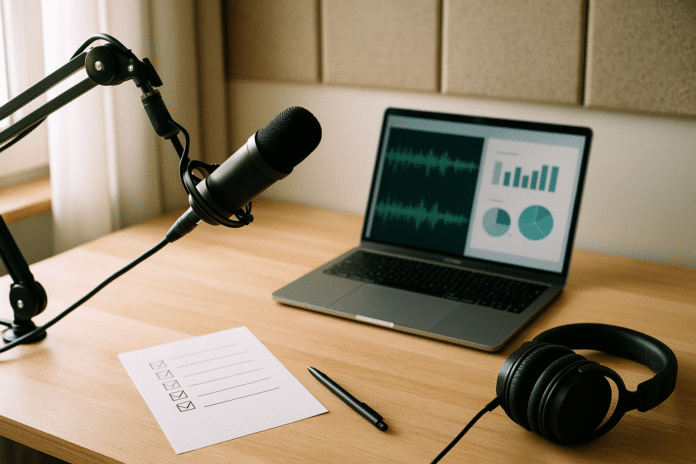
If you want a practical, soup-to-nuts path for creating and monetizing a podcast, you’re in the right place. Below are 12 clear steps that take you from niche selection and gear to distribution, growth, and multiple revenue streams. In plain terms: creating and monetizing a podcast means building a show people love and structuring sustainable income around it—without sacrificing listener trust. Quick roadmap you can skim: pick a niche and promise, validate demand, lock your format and budget, build a recording setup, pilot and plan episodes, edit consistently, host and distribute, grow with repeatable systems, and stack monetization (ads, memberships, products/services, live events), while tracking analytics and staying compliant. This guide is educational, not legal, financial, or tax advice; consult qualified professionals for decisions that affect your business.
1. Nail the niche and listener promise
Your show should solve a specific problem for a specific person in a specific context. Start by articulating a sharp listener promise: “In each episode, you’ll learn X so you can do Y.” This positions your podcast beyond entertainment into usefulness, and it sets expectations you can deliver week after week. A good niche reduces competition, clarifies guest selection, streamlines research, and makes your show more referable. Instead of a broad “marketing podcast,” consider “ethical email marketing for indie SaaS founders,” or swap “fitness” for “pain-free strength training for new parents.” The promise also guides tone (expert, conversational, investigative), average episode length, and whether you go solo, co-hosted, or interview-driven.
How to do it
- Write 3 versions of your listener promise; choose the most concrete.
- Define your “who/what/why”: who it’s for, what they get, why they should care now.
- List 20 episode ideas that directly fulfill the promise; if this is hard, narrow further.
- Identify 5 podcasts your audience already loves; note gaps you can fill.
- Choose a memorable show name that reflects your promise and passes the “spoken aloud” test.
Mini-checklist
- Audience: One primary persona, not three.
- Promise: One sentence, outcome-oriented.
- Name: Spelled as it sounds, available as a domain and social handle.
A tight promise makes downstream choices obvious—format, guests, even monetization—because you’re building for someone specific, not everyone.
2. Validate demand and map positioning
Before you invest in gear or artwork, do lightweight validation. The goal is to confirm there’s enough interest and white space to support your efforts. Study search trends, relevant subreddits, and competitors’ review sections for patterns of questions and frustrations. Look at top episodes in your niche and note topics, episode length, and show structure. For podcasts with public data, estimate typical download bands or YouTube views to gauge interest levels. Create a simple landing page offering a “founding listener” perk (e.g., shoutouts, early access) and collect emails; even 50–200 subscribers can be a green light.
Numbers & guardrails
- A quick sanity check: if similar shows see ~2,000–10,000 downloads per episode after consistent publishing, there’s likely space for another angle. Treat this as directional, not a target.
- If 3–5 competitive shows cluster around the same promise, differentiate with format (e.g., short “lab notes” episodes), audience segment, or POV.
How to do it
- Analyze Apple Podcasts and Spotify top charts for your niche; read reviews to mine language and pain points.
- Search for key phrases with modifiers like “how to,” “best,” “mistakes,” and “vs” to surface actionable topics.
- Run a quick email waitlist and ask one question: “What would make this podcast indispensable for you?”
- Draft a one-page positioning brief: audience, promise, 3 differentiators, and topics to avoid.
Common mistakes
- Mistaking novelty for differentiation; clarity beats cleverness.
- Overweighting “what you want to talk about” vs “what your listener needs next.”
Positioning that reflects real demand prevents you from producing episodes that sound great to you but miss for your audience.
3. Plan format, cadence, and budget
Structure creates momentum. Decide episode length, release frequency, segment structure, and whether you’ll do interviews, solo teaching, narrative storytelling, or a hybrid. Cadence is a contract; choose a schedule you can keep even on busy weeks. Budget is about two buckets—setup (one-time gear) and ongoing (software/hosting, freelance editing, transcripts).
Numbers & guardrails
- Typical show cadence: weekly or biweekly. If weekly, plan a 6–8-week buffer of recorded content.
- Episode length often clusters at 15–25 minutes (short-form) or 35–60 minutes (long-form). Consistency matters more than the exact number.
- Starter budget ranges (USD): $250–$700 one-time gear, $20–$80 monthly software/hosting; pro rigs can climb to $1,200–$2,500.
Sample budget table
| Item | Starter Range | Pro Range |
|---|---|---|
| XLR/USB microphone | $70–$150 | $250–$400 |
| Audio interface (if XLR) | $80–$170 | $200–$500 |
| Closed-back headphones | $50–$120 | $150–$350 |
| Acoustic treatment | $40–$120 | $200–$600 |
| Hosting + tools (monthly) | $20–$80 | $60–$200 |
Mini-checklist
- Format: Solo, interview, co-hosted, narrative, or hybrid.
- Cadence: Weekly or biweekly, with a content buffer.
- Budget: One-time vs monthly, cap your spend before shopping.
A realistic plan avoids feast-or-famine production—and it helps you model monetization targets later.
4. Build a production-ready recording setup
Your audio should be clear, consistent, and comfortable to listen to for long stretches. You don’t need a treated studio; you do need a controlled acoustic space and reliable signal chain. Pick a cardioid microphone (USB for simplicity; XLR for flexibility), mount it on a boom arm, and speak 6–10 inches away with a pop filter. Use closed-back headphones to monitor. If you choose XLR, add an audio interface or recorder. Reduce room reflections with soft furnishings or portable panels; think medium-sized room with rugs and curtains, not a tiled kitchen.
How to do it
- Prioritize room acoustics over pricier mics; a duvet-fort outperforms an echoey office.
- Set mic gain so your peaks sit around −12 dBFS; avoid clipping.
- Record local tracks for remote guests (ask them to record themselves) to protect against internet glitches.
- Capture room tone (10 seconds of silence) for easier noise reduction later.
- Aim for consistent loudness across episodes using a LUFS meter or an automated processor. Many podcasters target around −16 LUFS integrated for stereo (≈ −19 LUFS mono) to match common podcasting expectations.
Tools & examples
- Loudness meters and processors (examples include plugin or app solutions) help you hit stable targets and measure true peak, short-term, and integrated loudness in line with EBU R128 concepts. HoRNet Plugins
Synthesis
Get the room and gain right, then let tools help with loudness and dynamics. Clean input audio is the cheapest production upgrade you can buy.
5. Create a pilot, show structure, and calendar
A pilot episode is your risk-free sandbox. Use it to test your open, segment order, music, and sign-off. Establish a repeatable structure: cold open or teaser, intro theme, main segment(s), actionable takeaways, and clear CTA. Your editorial calendar should cover 8–12 episodes ahead, alternating “hero” topics with lighter lifts to maintain cadence. Draft outlines, not scripts, so your delivery stays natural.
Numbers & guardrails
- Keep your cold open to 15–30 seconds; preview one explicit listener benefit.
- Use 1–2 recurring segments to build familiarity (e.g., “tool of the week,” “myth buster”).
- Map a season as 8–12 episodes if you want natural breaks for learning and promotion.
How to do it
- Record 2–3 pilot variations; share with 5 target listeners for notes.
- Create an episode template (intro copy, segment order, CTA, credits).
- Build a 3-column run-of-show: Segment, Time budget, Notes/links.
- Prewrite show notes and guest bios; you’ll edit faster post-recording.
Mini-checklist
- Hook: One strong promise in the first minute.
- Structure: Repeatable segments; time budgets per segment.
- Calendar: 8–12-episode runway, with backup topics ready.
Synthesis
Pilots prevent scope creep. A templated structure makes every episode feel intentional and listener-friendly.
6. Edit for quality and consistency
Editing is where you earn listener trust. The goal isn’t to sound “studio perfect,” but to produce an experience that’s comfortable on earbuds and car speakers. Focus your workflow on: de-noise, de-ess, gentle compression, EQ for intelligibility, and loudness normalization. Remove filler only where it hurts clarity; keep natural rhythm. Master to a consistent loudness target across episodes.
How to do it
- Build an effects chain (high-pass filter, de-noise, de-ess, compress, EQ touchups, limiter).
- Normalize loudness to a stable target; many podcasters aim around −16 LUFS integrated for stereo and set maximum true peak to −1 dBTP to avoid clipping during transcoding.
- Export to AAC or MP3 using a reputable encoder; Apple recommends AAC (MP4) for efficient streaming and accurate seeking.
- Use chapter markers and episode artwork if your host supports them; it improves navigation.
Common mistakes
- Over-compression that creates ear fatigue.
- Inconsistent levels between host and guest.
- Ignoring room clicks and plosives that distract at normal listening volumes.
Synthesis
Polished editing turns “good content” into “great listening.” A consistent loudness target and tasteful dynamics keep your show feeling professional episode after episode.
7. Host, distribute, and optimize your feed
Your podcast host stores your audio files, generates your RSS feed, and syndicates episodes to listening apps. Choose a host that supports IAB podcast measurement guidelines (for standardized download metrics), reliable analytics, and features like dynamic content insertion and private feeds. Optimize your feed to meet platform requirements: unique <enclosure> per episode with URL, length, and type; valid GUIDs; and cover art at the correct size. Apple specifies show artwork between 1,400×1,400 and 3,000×3,000 pixels (RGB, JPG or PNG, no transparency).
How to do it
- Submit your RSS feed to major directories (Apple Podcasts, Spotify, Google Podcasts alternatives/directories, YouTube Podcasts) once; future episodes then propagate automatically. Apple’s Connect validates feeds for technical compliance.
- Ensure your host supports (or is pursuing) IAB Tech Lab compliance for consistent metrics, ideally aligned with the latest Podcast Measurement Guidelines.
- Write search-friendly show notes with a clear summary, keywords your audience actually uses, and links to resources.
- Use square cover art at 3,000×3,000 pixels to look crisp on all displays; avoid tiny type and busy designs.
Mini-checklist
- RSS: Clean
<enclosure>, GUID per episode. - Art: 3,000×3,000 preferred; JPG/PNG; RGB; no transparency.
- Metrics: IAB-aligned host for apples-to-apples downloads.
Synthesis
Solid hosting and a clean feed make your show easier to find, measure, and grow—without headaches later.
8. Grow your audience with repeatable systems
Audience growth is a system, not a one-off stunt. Focus on findability (SEO-friendly titles and show notes), shareability (memorable takeaways and quotable clips), and consistency (reliable cadence and quality). Pair your podcast with an email newsletter to announce episodes, summarize insights, and solicit feedback. Repurpose episodes into short video clips, carousels, or blog posts to meet listeners where they already are. Cross-promote with complementary shows via swaps or guest interviews, and run small, targeted promos where your audience hangs out.
Numbers & guardrails
- Treat each episode as 3–5 micro-assets (e.g., 2 clips, 1 carousel, 1 text post).
- Track leading indicators: unique listeners, % new listeners, episode completion rate, and email list growth per episode.
- A simple growth target is a steady 5–10% month-over-month increase for the first few months; the real goal is consistency, not virality.
How to do it
- Name episodes with real user language (“How to budget your first studio” beats “Episode 14”).
- Publish at the same day/time to train subscribers.
- Include a single CTA per episode—subscribe, join the newsletter, or share with a friend.
- Create a guest kit (art, links, copy) so guests can easily promote their episode.
Common mistakes
- Chasing every new platform without a content repurposing plan.
- Burying the lede in your titles and intros.
Synthesis
Growth compounds when you keep it boring: consistent cadence, useful episodes, and systematic repurposing.
9. Sell ads and sponsorships the smart way
Advertising can be a meaningful revenue stream if you protect trust and price correctly. There are two primary approaches: host-read ads (you read the ad copy) and producer-inserted/dynamically inserted ads (pre-recorded spots inserted automatically). Host-reads, especially mid-roll, often command higher CPMs (cost per thousand downloads) than programmatic announcer-reads. Typical averages vary by niche, placement, and audience size; you’ll see public averages for 30- and 60-second spots commonly in the high-teens to mid-twenties CPM ranges, with mid-roll host-reads at the upper end. Dynamic ad insertion lets you update or localize ads across your back catalog without re-editing episodes.
How to do it
- Set inventory: pre-roll (15–30s), mid-roll (30–60s), and post-roll (15–30s); cap total ad minutes to keep the listener experience strong.
- Price using a CPM model and maintain a rate card; offer package discounts for multi-episode buys.
- If you use dynamic insertion, segment by geography, device, or episode age to keep ads relevant.
- Keep brand safety: insist on ad approval and advertiser alignment with your audience.
Numbers & guardrails
- Example: 5,000 episode downloads × $25 CPM × 2 mid-rolls ≈ $250 per episode in gross ad revenue.
- Prefer IAB-aligned download counts when you quote performance; it’s the industry standard for buyers and sellers.
Synthesis
Ads work when you balance inventory, pricing discipline, and listener experience. Dynamic insertion adds flexibility without sacrificing your back catalog.
10. Launch memberships and premium feeds
Memberships diversify income and deepen community. You can offer ad-free episodes, bonus segments, early access, extended interviews, or a private feed. Major platforms provide tooling for this: Apple Podcasts Subscriptions (managed within Apple’s ecosystem), Spotify podcast subscriptions, and third-party tools like Supercast or Patreon. Apple, for example, lets you set your own price with monthly or annual options, offers free trials, and increases your net share after a subscriber’s first year. Spotify also supports subscriber-only episodes within its app. Spotify for Creators Tools like Supercast integrate with most players and offer pricing flexibility.
How to do it
- Define 2–3 tiers with clear, escalating benefits (e.g., $5: ad-free + bonus Q&A; $12: monthly deep-dives + private chat; $25: quarterly live workshop).
- Use a private RSS feed to deliver premium audio into members’ favorite apps when possible.
- Promote membership in-episode with one 15–20-second pitch that stresses benefits, not guilt.
Numbers & guardrails
- A common starter target is 1–3% of regular listeners converting to paid membership.
- Example: 3,000 loyal listeners × 2% × $6/month ≈ $360/month gross. Fees and taxes vary by platform, payment processor, and region; always review current terms.
Synthesis
Memberships reward your superfans and smooth revenue variance from ads. Keep benefits simple, deliver reliably, and revisit tiers twice a year.
11. Expand revenue with products, services, and live events
Beyond ads and memberships, your podcast can drive products (courses, digital templates, books, merch), services (coaching, consulting, audits), and experiences (workshops, live recordings). These often produce higher margins per buyer and align naturally with educational or professional niches. Use episodes to seed problems your product solves and stories from customers; avoid turning the show into a constant sales pitch.
How to do it
- Validate with a low-lift digital product (e.g., a 20-page guide or checklist) before investing in a full course.
- Offer a service “starter” (e.g., 45-minute audit) to reduce perceived risk and scope creep.
- Test live recordings with a small venue or virtual format; cap seats to maintain intimacy.
Numbers & guardrails
- Simple digital products can see 60–90% gross margins; services can range widely but often deliver higher absolute dollars per sale.
- Live event planning: budget venue + tech + staffing at $15–$35 per attendee for a small meetup, then add contingency. Keep the experience tight (90–120 minutes) and record it for repurposing.
Common mistakes
- Launching a course before the audience asks for it.
- Pricing only by competitor benchmarks; price to value and delivery effort.
Synthesis
Products, services, and events turn your authority into tangible results for listeners—while creating diversified, stackable income alongside ads and memberships.
12. Track analytics, improve ROI, and stay compliant
Measure what matters: unique listeners, downloads by episode and 7/30-day windows, episode completion rate, subscriber growth, and conversion to email or membership. Use IAB-aligned analytics for standardized downloads and, if available, per-episode retention curves to diagnose drop-off points. For memberships, track active subscribers, churn, and monthly recurring revenue in your platform’s reports. Keep your operation compliant: attribute music correctly (prefer properly licensed music), disclose sponsorships clearly, respect platform artwork and feed requirements, and follow local advertising and consumer-protection rules.
How to do it
- Build a simple dashboard: episodes published, average downloads per episode, completion %, email list size, membership count.
- Use Apple and platform subscription reports to monitor subscriber trends and cohort retention. Apple Podcasts
- Ensure your host supports the latest IAB Podcast Measurement Guidelines; that’s what advertisers expect when they audit your numbers.
- Follow Apple’s technical requirements for feeds and art to avoid distribution hiccups.
Numbers & guardrails
- Aim for >70% episode completion on core audience episodes as a quality signal; diagnose dips with tighter hooks and stronger segment pacing.
- Track conversion rates from podcast → email (often 1–5% when the CTA is specific and repeated) and from email → membership (often 2–8% for warm subscribers, depending on offer and price).
Synthesis
You improve what you measure. A modest analytics stack, clean compliance, and steady iteration keep your show healthy and partner-ready.
FAQs
How long should an episode be?
There’s no universal “right” length; it’s about delivering value without filler. Many successful shows cluster at 15–25 minutes for tactical updates and 35–60 minutes for interviews or deep dives. Pick one target length and structure segments to hit it consistently. Consistency helps listeners plan you into their routines and improves completion rates over time.
What gear do I actually need to start?
Start with a cardioid microphone (USB for simplicity), a boom arm, pop filter, and closed-back headphones. If you use XLR, add an audio interface. Focus on room acoustics—soft furnishings beat bare walls. You can upgrade later to multi-mic setups or hardware recorders once your workflow is stable and your show is publishing consistently.
Do I need a separate website for my podcast?
It’s not mandatory, but it helps. A lightweight site gives you control over SEO, show notes, transcripts, and lead capture for an email list—key for monetization. Many hosts provide a basic site; you can start there and upgrade to a custom domain or CMS once you want richer content, search features, or product pages.
How many downloads do I need before I can monetize?
You can monetize from day one with products or services that match your audience’s needs. For ads and sponsorships, many brands start paying attention around the thousands of downloads per episode range, but niche alignment can trump raw volume. Memberships can convert even with a small, loyal base (think 1–3% of regular listeners).
What’s the difference between host-read and programmatic ads?
Host-read ads are delivered by you in your own voice, often mid-roll, and typically command higher CPMs because they feel native. Programmatic or announcer-read ads are pre-produced and inserted automatically; they scale and can backfill unsold inventory. Both can use dynamic ad insertion to update ads across your back catalog without re-editing episodes.
How do I submit my show to Apple and Spotify?
You publish to a hosting platform that generates an RSS feed. Submit that feed to Apple Podcasts Connect, which validates technical requirements (like <enclosure> tags and artwork). Spotify supports creator tools for submission as well. Once accepted, episodes published via your host propagate automatically.
What are typical podcast ad rates?
Rates vary widely by niche, placement, and audience engagement. Public benchmarks often show averages in the high-teens to mid-twenties CPM for 30–60-second spots, with host-read mid-rolls commonly at the higher end. Treat these as starting points; your fit and outcomes matter most.
How should I set loudness levels?
Aim for consistent listening comfort across episodes. Many podcasters target approximately −16 LUFS integrated for stereo (≈ −19 LUFS mono) with a maximum true peak around −1 dBTP. Use a loudness meter or an automated processor to hit targets reliably.
What artwork specs should I follow?
Use square cover art, preferably 3,000×3,000 pixels, RGB color, JPG or PNG, with no transparency. Keep typography bold and legible at thumbnail sizes, and avoid tiny text or cluttered collages. These specs help your art display crisply across apps and devices.
Which membership platform should I choose?
If your listeners are heavy Apple users, Apple Podcasts Subscriptions offers in-app convenience and a clear revenue share that increases after a subscriber’s first year. Spotify supports subscriber-only episodes in-app. Third-party tools (e.g., Supercast, Patreon) offer cross-platform flexibility, community features, and varied fee structures—compare current terms before deciding.
Conclusion
Creating and monetizing a podcast is a craft and a system. The craft is picking a precise promise, showing up with clean audio, and packaging episodes so listeners get value quickly. The system is everything else: a cadence you can sustain, a distribution pipeline that meets platform requirements, a growth engine rooted in repurposing and guest networks, and a monetization stack that respects your audience’s attention. You don’t need a studio or a staff to start. You need clarity, consistency, and a plan to learn in public. If you follow the 12 steps here—niche, validation, format, setup, pilot, editing, hosting/distribution, growth, and then layered monetization with ads, memberships, and products/services—your show will have the bones of a durable media asset. Ready to take the first step? Outline your listener promise, record a 5-minute pilot this week, and publish your roadmap—then invite your first 10 founding listeners to join you.
CTA: Turn your idea into a real show—pick your niche today, draft 10 episode titles, and record your pilot by the weekend.
References
- Podcast Measurement Technical Guidelines v2.2 — IAB Tech Lab, Feb 20, 2024. https://iabtechlab.com/wp-content/uploads/2024/02/PodcastMeasurement_v2.2_pc.pdf
- Podcast RSS feed requirements — Apple Podcasts for Creators, publication date not listed. https://podcasters.apple.com/support/823-podcast-requirements
- Validate your podcast RSS feed — Apple Podcasts for Creators, publication date not listed. https://podcasters.apple.com/support/829-validate-your-podcast
- Show Cover template (specifications) — Apple Podcasts for Creators, publication date not listed. https://podcasters.apple.com/support/5514-show-cover-template
- Artwork guide — Apple Podcasts for Creators, publication date not listed. https://podcasters.apple.com/artwork-guide
- Audio requirements (AAC recommendation) — Apple Podcasts for Creators, publication date not listed. https://podcasters.apple.com/support/893-audio-requirements
- A Massively Oversimplified Guide to Loudness — Simplecast Blog, Aug 30, 2022. https://blog.simplecast.com/a-massively-oversimplified-guide-to-loudness
- The Benefits of Dynamic Ad Insertion in Podcast Advertising — Acast, Jul 27, 2023. https://advertise.acast.com/news-and-insights/the-benefits-of-dynamic-ad-insertion-in-podcast-advertising
- March Podcast Ad Rates — Libsyn (AdvertiseCast) Blog, Apr 1, 2024. https://libsyn.com/blog/march-2024-podcast-ad-rates/
- Apple Podcasts Subscriptions (overview) — Apple Podcasts for Creators, publication date not listed. https://podcasters.apple.com/878-subscriptions
- Apple Podcasters Program Overview (revenue share details) — Apple Podcasts for Creators, publication date not listed. https://podcasters.apple.com/support/892-apple-podcasters-program-overview
- Pricing — Supercast, publication date not listed. https://www.supercast.com/pricing