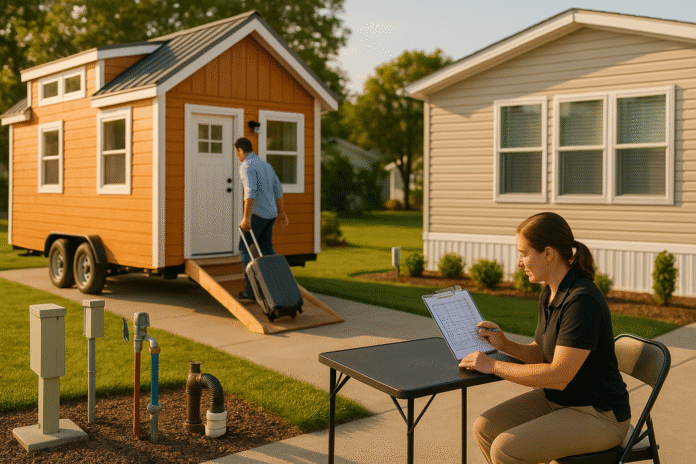
Whether you aim to host weekend travelers or provide mid-term housing, mobile home or tiny house rentals can deliver excellent value—if you build on the right foundations. In plain terms: a manufactured (HUD-code) home or a tiny house (often a small dwelling under ~400 sq ft) can be rented as short-, mid-, or long-term lodging, provided you comply with local zoning, safety standards, and utility requirements. Here’s the quick path: (1) know the housing type you’re renting, (2) confirm local legality and park/HOA rules, (3) meet safety and code basics, (4) size utilities and hookups correctly, (5) plan siting and transport, (6) design guest-friendly interiors, (7) price with data, (8) set clear policies, (9) insure the risk, (10) optimize your listing, (11) run smooth ops, and (12) track performance.
Disclaimer: This guide is informational and not legal, tax, or engineering advice. Consult qualified local professionals for approvals, permits, and safety compliance.
1. Decode the dwelling types before you list (manufactured, “mobile,” tiny, park model)
Start by naming what you’re renting. This isn’t just semantics—your category decides which rules and standards apply. A manufactured home is a factory-built dwelling constructed to the federal HUD code; it’s a home with a permanent chassis and at least 320 sq ft, shipped in one or more sections, and bears a certification label (“HUD tag”). Many people casually say “mobile home,” but in regulatory language “mobile home” typically refers to pre-HUD-code units; post-code units are “manufactured homes.” Tiny houses, by contrast, are a real mixed bag: some are built on permanent foundations and follow local building codes; others are tiny houses on wheels (THOWs) built as RVs; a subset called park model RVs is built to an ANSI RV standard. Knowing your type sets your path for permitting, siting, utilities, and rental policies.
Quick comparison (one-glance table):
| Category | Typical size | Built to | On wheels? | Common rental use |
|---|---|---|---|---|
| Manufactured home (HUD) | ≥ 320 sq ft | 24 CFR Part 3280 | Permanent chassis; installed | Mid-/long-term housing |
| “Mobile” home (pre-HUD) | varies | pre-code factory build | Often chassis | Case-by-case; rules vary |
| Tiny house on wheels (THOW) | ~120–400 sq ft | RV standards (e.g., NFPA 1192) | Yes | Short-term/glamping |
| Park model RV (PMRV) | up to ~400 sq ft | ANSI A119.5 | Yes | Seasonal/short-term |
| Tiny house on foundation | ~200–400+ sq ft | Local building code / IRC (Appendix Q often applies) | No | ADU/longer stays |
Numbers & guardrails
- Manufactured homes: HUD minimum size ≥ 320 sq ft; requires HUD label and compliance with federal standards.
- Tiny homes: Appendix Q provides size-related relief (e.g., lofts, stairs) for small dwellings under 400 sq ft when adopted by a jurisdiction.
- Park models: Built to ANSI A119.5 (not HUD).
Synthesis: Pin down the correct category first; it controls your next decisions on legality, siting, and guest expectations.
2. Match the rental use-case to the right structure and location
Decide who you’ll host and for how long. A manufactured home in a licensed community might excel for 3–12-month tenancies, while a THOW parked on a scenic pad can outperform as a short-term vacation rental. Urban infill with a tiny home as an accessory dwelling unit (ADU) may favor mid-term stays (travel nurses, relocations). Each use-case triggers different permissions (e.g., STR permits), taxes, occupancy limits, and parking rules, plus neighborhood compatibility. Set your target: weekenders seeking design-forward tiny spaces, month-long project crews needing parking and laundry, or long-term residents prioritizing storage and insulation.
Mini checklist
- Define the stay length band: short (1–29 nights), mid (30–179 nights), long (180+ nights).
- Identify platform fit: vacation OTA, furnished medium-term marketplace, or direct corporate.
- Confirm what the parcel/park allows (guest turnover frequency, parking, signage, quiet hours).
- Align structure choice: THOW/park model for experiential stays; manufactured home for residential stability.
- Pre-write policies on pets, smoking, accessibility, and parking to match the audience.
Mini case (pricing angle): A host with a 320-sq-ft THOW in a lakeside area sets weekend ADR at $165 with 65% weekend occupancy and 30% weekdays, averaging $110 nightly. A comparable 2-bed manufactured home in a workforce corridor rents month-to-month at $1,550 including utilities. The THOW delivers seasonal peaks; the manufactured home smooths cash flow. Pick the model that matches your cash-flow goals and what’s lawful on your site.
Synthesis: Fit the dwelling and site to the demand you want, not the other way around.
3. Confirm zoning, land-use, and park/HOA rules before you invest
Legality is local. HUD’s construction standards don’t override zoning or local land-use rules; a HUD-code home still must be placed where it’s allowed. Similarly, tiny houses—especially on wheels—fall under RV or local building ordinances, and short-term rentals can require permits, platform registrations, or be limited by neighborhood rules. Platforms themselves remind hosts to check local laws and taxes and to maintain safety standards. Start here: call planning and building departments, read your parcel’s zoning (use type, setbacks, height, parking), verify if STRs are permitted, and obtain any park or HOA approvals.
How to do it
- Pull parcel zoning map and code chapter; confirm dwelling type allowed (HUD-code MH, ADU, RV).
- Check short-term rental ordinances (caps, minimum stays, taxes, quiet-hours).
- In a manufactured home community, review the community rules and lease terms.
- For THOWs/PMRVs, ask if overnight occupancy is legal outside RV parks.
- Document approvals/permits; save emails and permit numbers in a shared folder.
Numbers & guardrails
- Expect setbacks of a few feet to several yards depending on zone class; verify for each side and frontage.
- Many jurisdictions treat THOWs like RVs—overnight habitation outside designated areas may be limited.
- Some cities require on-site parking (1–2 spaces) for STRs; plan guest parking to prevent complaints.
Synthesis: Paper first, pad later. Clear land-use status reduces enforcement risk and protects your revenue.
4. Meet safety and code basics every guest expects
Safety builds trust and keeps you compliant. Manufactured homes must meet HUD safety requirements; tiny houses on foundations should meet local building codes; THOWs/PMRVs should follow RV safety standards. Regardless of type, equip smoke alarms, carbon monoxide (CO) detectors near sleeping areas, fire extinguishers, and clear egress routes. If using gas appliances or generators nearby, CO protection is non-negotiable. For manufactured homes, proper anchoring/tie-downs and close-up procedures are critical at installation. For THOWs/PMRVs, verify LP systems, venting, and electrical protection devices are to standard.
How to do it
- Install smoke and CO detectors per best-practice locations (near sleeping areas). Keep spares and document test cycles.
- Provide a one-page emergency sheet: address, directions for responders, gas shutoff, breaker map, evacuation route.
- For manufactured homes, confirm anchoring and stabilization per installation standards and wind zone requirements.
- Label propane valves and provide appliance manuals.
- Add GFCI/AFCI protection where required; test before first booking.
Numbers & guardrails
- CO detectors: place near every sleeping area and test regularly; replace per manufacturer guidance.
- Manufactured home anchoring: homes must be secured against wind with approved assemblies or alternative foundations per HUD Model Installation Standards.
Synthesis: A small checklist prevents big problems—document, test, and log safety items between every stay.
5. Plan utilities and hookups that actually match the load
Comfort (and five-star reviews) depends on solid utilities. Manufactured homes connect as fixed dwellings; THOWs/PMRVs typically use RV-style hookups for electricity (commonly 30-amp TT-30 or 50-amp 14-50 service), potable water, and sewer. Size electrical loads to the dwelling’s HVAC and appliances; use a pedestal with breakers and correct receptacles; use potable-rated hoses and backflow protection. For wastewater, verify municipal sewer capacity or design a septic system with a licensed professional based on bedrooms/expected occupancy—local health rules usually size systems by bedrooms and soil percolation.
Tools/Examples
- RV pedestals from major manufacturers often combine 50-amp (14-50R), 30-amp (TT-30R), and 20-amp GFCI outlets with dedicated breakers—ideal for flexible pads serving THOWs or PMRVs.
- EPA provides guidance and manuals on onsite wastewater systems; local health departments commonly size by bedrooms and soil conditions.
Numbers & guardrails
- 30-amp RV service typically supports one air-conditioner and essentials; 50-amp service supports higher loads and multiple major appliances—plan to the higher of seasonal peak or appliance draw. (See pedestal configurations for common outlet types.)
- Septic maintenance: expect inspection every 1–3 years and pumping every 3–5 years, with frequency depending on tank size and usage. EPA
Synthesis: Right-sized power and wastewater capacity prevent outages, odors, and refunds—design for peak days, not average days.
6. Nail siting, transport, and legal road limits
Before you tow or deliver, check roadway limits and site access. On the U.S. National Network of highways, the maximum legal vehicle width is 102 inches (8 ft 6 in.)—a key constraint for THOW moves and for transport sections of manufactured homes. Wider loads typically require permits, escorts, and route planning; access on local roads can be tighter. Clear trees and lines, ensure turning radii, compact the pad, and place the pedestal and sewer where the dwelling’s hookups will reach without unsafe extensions. If a crane is needed for placement, confirm lifting points and rigging with the manufacturer or installer.
Mini checklist
- Confirm approach route and turning radii; measure gate clearances.
- Verify grade and soil bearing for delivery vehicles and pads.
- Plan pedestal/water/sewer within hose/cable reach and protect lines.
- If oversize, obtain permits/escorts per route; schedule daylight moves.
Numbers & guardrails
- Federal width limit 102 in. on the National Network; Hawaii differs. Local roads may impose additional constraints—plan conservatively.
Synthesis: A few tape-measure checks beat a stuck trailer and a reschedule fee—engineer your approach and pad ahead of delivery.
7. Design interiors that rent: comfort, storage, and clarity
Guests love charm, but they book for function. In small footprints, every inch must earn its keep. Prioritize a real bed with breathable bedding, usable counter space, adequate lighting, and smart storage (toe-kick drawers, loft cubbies, wall-mounted fold-downs). In manufactured homes, consider a split-plan for privacy in mid-term stays; in tiny houses, choose multi-functional furniture and easy-stow tables. Provide a compact desk (even a 24-inch wall-mount) and fast Wi-Fi—remote workers often pay a premium. Label switches, include a simple HVAC guide, and provide blackout options. Document what’s included (pots, hair dryer, extra linens) and where to find it.
Mini-checklist (guest comfort)
- Sleep: supportive mattress; two pillow types; blackout window option.
- Work: small desk niche; clear Wi-Fi network; outlet access near seating.
- Kitchen: two-burner or induction hob; mini-oven or combo microwave; real knives; basic spices.
- Bath: good ventilation; hooks/shelves; anti-slip mat; hair dryer.
- Storage: under-bed bins; peg rails; tall cabinets to ceiling.
Numbers & guardrails
- For tiny lofts, aim for at least ~30–36 inches of clear loft height at the crown for comfort (check local code if adopting Appendix Q provisions on lofts and stairs).
Synthesis: Thoughtful layout beats square footage—equip for sleep, cook, work, and store, and you’ll see it in reviews.
8. Price with data: set ADR, occupancy, and RevPAR targets
Treat pricing as a system, not a guess. Start with ADR (average daily rate), occupancy, and RevPAR (ADR × occupancy) to measure performance. Use a base rate for weekdays and a premium for peak weekends; apply minimum-stay rules to protect cleaning margins. For mid-term stays, set monthly rates that reflect utility inclusion and reduced turnover. Track competitor listings with similar dwelling type, capacity, and location. In peak periods, hold rate floors instead of chasing 100% occupancy; in shoulder seasons, add value (early check-in, pet fee waivers) to protect occupancy.
Numbers & guardrails
- ADR formula: room revenue ÷ nights sold; RevPAR: ADR × occupancy (or revenue ÷ nights available). These are standard hospitality KPIs used across hotels and STRs.
- Mini case: If you target ADR $135 and 65% occupancy, RevPAR is $87.75. With 30 nights available, revenue ≈ $2,632 (before fees). Raising ADR to $145 at 60% occupancy yields RevPAR $87; roughly the same. Small ADR moves matter only if occupancy holds—watch both.
How to do it
- Start with a defensible base rate from comp analysis; adjust with a rule set (weekends +15–25%; holidays +30–60%).
- Use dynamic pricing tools, but monitor last-minute discounts to avoid underpricing unique inventory like THOWs.
- For mid-term stays, price per 30 nights with utility caps and a deposit.
Synthesis: Measure like a pro—ADRs, occupancy, and RevPAR are your steering wheel, not just a dashboard ornament.
9. Write operating policies that prevent friction
Clear house rules avert neighbor complaints and protect your property. Align policies to your use-case and local rules: quiet hours, parking locations, visitor limits, pet expectations, smoking/vaping, fires/grills, and how to handle gray/black water if on RV hookups. For THOWs/PMRVs, a water, power, and sewer primer reduces mis-use (e.g., not running electric plus gas heat simultaneously on small circuits). Include an accessibility statement of what is and isn’t provided (ramp vs steps, loft ladder characteristics). Keep a laminated quick-start guide on the counter and a digital guestbook with photos.
Mini-checklist (host ops)
- Arrival: driving approach, parking diagram, smart-lock code, Wi-Fi.
- Systems: heater/AC how-to, breaker reset, water shutoff, septic/sewer use.
- Noise: quiet hours mirroring local ordinance; outdoor music limits.
- Pets: max number, fee, areas allowed, cleaning expectations.
- Waste: trash, recycling, dump station or sewer hookup steps.
Numbers & guardrails
- Platform guidance emphasizes safety, emergency info, and hazard minimization in listings—embed this into house rules and the digital guide. Airbnb
Synthesis: The best policy is the one guests actually read—use diagrams, fewer words, and the same rules in-app and on-site.
10. Insure and allocate risk the right way
Don’t rely solely on platform protections—your risk profile is different for short-term, mid-term, and long-term stays. Speak with an agent about landlord policies for manufactured homes (especially in communities) vs. commercial STR endorsements for vacation rentals. For THOWs/PMRVs, confirm coverage while the unit is in motion and while parked and rented. Use guest agreements that clarify liability, maximum occupancy, pet rules, and prohibited uses (space heaters, candles). Require government ID matching the booking party. If your dwelling is in a community, confirm the park’s insurance expectations, additional insured requirements, and any rider for rental operations.
Common mistakes
- Assuming platform “host guarantees” replace proper insurance.
- Forgetting to cover contents and loss of income.
- Not updating the policy when usage changes (owner-occupied → STR).
- Omitting CO/smoke/fire disclosures despite devices being installed.
- Skipping a security deposit or hold aligned to nightly rate.
Synthesis: Coverage must match how the unit is used and where it sits—tell your agent everything, in writing.
11. Market the space: photos, positioning, and the details that sell
Inventory like this is visual. Shoot wide-angle daylight photos that show context: where the home sits on the pad, the hookups (subtly), alfresco seating, and the sleeping area. For THOWs, a shot that reveals the loft, ladder/stairs, and living area earns trust; for manufactured homes, show the floor plan and storage. Use a crisp title that names the type (“Tiny House on Wheels,” “HUD-Code Manufactured Home in Quiet Park”) and the best hook (waterfront, mountain view, private deck). In the description, explain who it’s perfect for and any constraints (loft ladder not suitable for some guests). Keep amenities lists accurate; over-promise is your enemy.
Numbers & guardrails
- Aim for 20–30 photos with at least 2–3 exterior/context shots, 2 kitchen, 2 bath, 4–6 living/sleeping, and utility/parking callouts.
- Provide a one-page floor plan or schematic for small spaces—guests book faster when they can visualize scale.
How to do it
- Stage with minimal clutter; hide cords; open shades; switch on lights.
- Put first five images in this order: hero exterior, living area, bed, kitchen, view/outdoor seating.
- Caption photos with functional facts (“Full-size 14-50 pedestal, easy back-in parking”).
Synthesis: Sell certainty, not mystery—great visuals and clear captions reduce pre-booking questions and cancellations.
12. Run tight operations and track the numbers that matter
Set up a repeatable cadence for cleaning, inspections, and maintenance. For small footprints, turnovers can be fast—if you standardize. Keep a bin of duplicate linens, a backup water hose and pressure regulator, spare TT-30/14-50 adapters if you host PMRVs/THOWs, and labeled breaker maps. Track costs (utilities, supplies, cleanings, repairs) against revenue to monitor margin per stay. Watch RevPAR monthly trends and note drivers (weather spikes, events). If you’re in a park, maintain relationships: proactive communication with managers and neighbors buys patience when issues arise.
Numbers & guardrails
- KPI starter set: ADR, occupancy, RevPAR, cleaning cost per turn, utility cost per occupied night. Use these to adjust minimum stays and pricing.
- Inventory smalls (filters, bulbs, CO/smoke batteries) on a 45–60-day cycle to cut emergency runs.
Mini-checklist (weekly/monthly)
- Test detectors; log dates.
- Walk the pad: check pedestal, hose seals, sewer cap, skirting/tie-downs.
- Review reviews: tag issues (noise, instructions, bedding) and fix.
- Update pricing blocks 6–8 weeks ahead for events and seasons.
- Reconcile transactions and set aside tax escrows.
Synthesis: Professional habits turn quirky spaces into dependable income—operationalize what you want repeated.
FAQs
Are tiny houses legal to rent on residential lots?
It depends on local zoning and building code adoption. Many jurisdictions treat tiny houses on wheels like RVs, which may limit year-round occupancy outside RV parks. Tiny houses on foundations often follow local building codes (some adopt Appendix Q for small dwellings). Always confirm zoning, occupancy rules, and any short-term rental permit requirements with your planning department before listing.
What’s the difference between a mobile home and a manufactured home?
In regulatory language, “manufactured home” refers to HUD-code homes that meet federal standards and carry a certification label; “mobile home” is commonly used for pre-code factory-built units. Manufactured homes must be at least 320 sq ft, include a permanent chassis, and meet safety, electrical, plumbing, and thermal standards established by HUD. hud.gov
Can I host short-term stays in a manufactured home community?
Sometimes—community rules vary. Many parks allow only owner-occupancy or long-term tenancies; others may permit short-term rentals with written approval and added insurance. Read your lease/CC&Rs and speak with park management. Remember: platform guidance also stresses compliance with local laws and taxes.
What electrical hookup should a tiny house on wheels have?
Most THOWs and park models connect like RVs: 30-amp (TT-30) or 50-amp (14-50) service via a pedestal with dedicated breakers. Choose based on HVAC and appliance loads; larger systems benefit from 50-amp service. Use proper cords, surge/overcurrent protection, and weather-rated gear.
How do I size a septic system for a small rental?
Septic sizing is jurisdiction-specific and typically based on bedrooms and soil percolation. Work with a licensed designer and your health department. EPA resources provide general guidance; plan for routine inspections and pumping on a defined cadence to prevent failures.
Do I need special anchoring for a manufactured home?
Yes. After blocking and leveling, manufactured homes must be secured against wind using approved anchoring systems or alternative foundation designs that meet HUD Model Installation Standards and the home’s design loads. Check wind and roof load zones on the home’s data plate and follow the manufacturer’s installation instructions.
What roadway limits affect moving a tiny house or manufactured home section?
On the U.S. National Network, the maximum legal width is 102 inches (8 ft 6 in.); wider loads require permits and routing. Local roads can be more restrictive, so plan your route and escorts with your transporter.
How many photos should my listing have?
Aim for 20–30 well-lit, accurate images that show context, layout, and key features. Include exterior approach, pad/hookups, sleeping arrangements, kitchen, bath, and outdoor seating. A simple floor plan helps guests visualize compact spaces and reduces pre-booking questions.
What safety devices are essential?
Install and maintain smoke and carbon monoxide detectors (near sleeping areas), provide a fire extinguisher, keep exits clear, and post an emergency info sheet. If you use gas appliances or generators nearby, CO protection is essential.
Conclusion
Mobile home or tiny house rentals succeed when you align structure, site, and stay type—then execute the basics with discipline. Get the category right (HUD-code manufactured, THOW, park model, or foundation tiny), confirm your permissions, and build safety into the space. Right-size power and wastewater, plan access and placement, and furnish for sleep-cook-work-store in small footprints. Then run the business: price with data, codify policies guests actually follow, insure for the real risks, present the listing clearly, and operate to metrics. Follow these 12 keys and you’ll deliver experiences guests return to—and a P&L you can trust.
CTA: Ready to launch? Use these keys as your setup checklist and start your first listing with confidence.
References
- 24 CFR Part 3280 — Manufactured Home Construction and Safety Standards, eCFR (U.S. Government Publishing Office). https://www.ecfr.gov/current/title-24/subtitle-B/chapter-XX/part-3280
- HUD Office of Manufactured Housing Programs — Overview, U.S. Department of Housing and Urban Development. https://www.hud.gov/hud-partners/manufactured-home
- APPENDIX Q: Tiny Houses, International Code Council (ICC). https://codes.iccsafe.org/content/IRC2018/appendix-q-tiny-houses
- Association and ANSI Adopted Standards — ANSI A119.5 Park Model RV Standard, RV Industry Association. https://www.rvia.org/node/association-and-ansi-adopted-standards
- NFPA 1192, Standard on Recreational Vehicles, National Fire Protection Association. https://www.nfpa.org/product/nfpa-1192-standard/p1192code
- Carbon Monoxide Poisoning — About CO & Safety Guidance, Centers for Disease Control and Prevention. https://www.cdc.gov/carbon-monoxide/about/index.html
- ENERGY STAR Manufactured Homes — National Program Requirements, U.S. EPA / ENERGY STAR. https://www.energystar.gov/partner-resources/residential-new/manufactured-national-page
- Responsible Hosting — Local Laws & Taxes, Airbnb Help Center. https://www.airbnb.com/help/article/3029
- 24 CFR Part 3285 — Model Manufactured Home Installation Standards (including §§ 3285.401–.402), eCFR / LII. https://www.ecfr.gov/current/title-24/subtitle-B/chapter-XX/part-3285 ; https://www.law.cornell.edu/cfr/text/24/3285.401 ; https://www.law.cornell.edu/cfr/text/24/3285.402
- 23 CFR § 658.15 — Width, eCFR / FHWA. https://www.ecfr.gov/current/title-23/chapter-I/subchapter-G/part-658/section-658.15
- RV / Temporary Power Pedestals — Receptacle Configurations (14-50R, TT-30R), Eaton (Product Brochure). https://www.eaton.com/content/dam/eaton/products/backup-power-ups-surge-it-power-distribution/temporary-power-panels/power-pedestals-v1-t5-ca08100002e.pdf
- Septic Systems — Reports, Regulations, Guidance & Manuals, U.S. Environmental Protection Agency. https://www.epa.gov/septic/septic-systems-reports-regulations-guidance-and-manuals
- Glossary & KPI Definitions (ADR, Occupancy, RevPAR), STR. https://str.com/data-insights/resources/glossary ; https://str.com/data-insights-blog/what-is-revpar