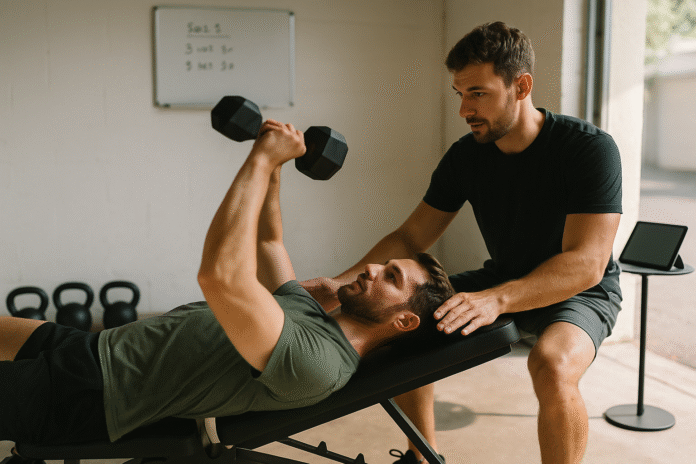
If you’re exploring Fitness Coaching or Personal Training as a Side Gig, you’re looking to earn extra income and impact real people without quitting your day job. In plain terms, this side gig means you deliver paid, structured workouts and coaching—one-to-one or in small groups—either in person, online, or as a hybrid model. Because this touches health and safety, here’s a neutral reminder: this guide is for education, not medical or legal advice. Always follow local laws, scope-of-practice limits, and consult qualified professionals when needed.
Quick answer: you’ll validate the fit, get certified and insured, define a niche, price your offer, register the business, design safe programs, market ethically, lock in operations, retain clients, and scale with boundaries.
Skimmable steps:
- Validate fit, time, and risk
- Earn relevant certifications and CPR/AED; carry liability insurance
- Pick a niche and promise concrete outcomes
- Choose a business model and pricing structure
- Register the business; manage taxes and client data
- Build safe assessments and programs
- Market your offer with proof and clarity
- Set up scheduling, payments, and policies
- Onboard, measure, and retain clients
- Scale sustainably and protect your bandwidth
When you apply these ten steps, you’ll launch with confidence, protect your downside, and give clients a professional experience from day one.
1. Confirm the Side-Gig Fit: Skills, Time, and Risk
Start by deciding whether coaching fits your schedule, personality, and appetite for responsibility. You will be guiding movement and behavior change, which demands reliability, empathy, and conservative safety judgment. A realistic part-time cadence is 2–10 sessions per week, depending on commute time, online vs. in-person delivery, and your main job’s workload. You also need to be comfortable with client variability: missed sessions, fluctuating motivation, and different training ages. Think through where you’ll coach (home gym, client’s home, local park, rented studio, or fully online) and what equipment you have or can access. Finally, accept that even with excellent coaching, people respond differently to training—your job is to set guardrails, not promise instant transformations.
Mini-case: You have 8 “free” hours weekly. Commuting and setup/cleanup average 20 minutes per session. If each session is 60 minutes, count 80 minutes total. You can serve 6 sessions (480 minutes) and keep 40–60 minutes for programming and admin. If you switch two sessions to online with zero commute, capacity rises to 7–8 sessions without extending your week.
Mini-checklist
- Bandwidth: Block recurring windows you won’t sacrifice.
- Environment: Access to safe space, basic equipment, ventilation, and lighting.
- Tech: Video platform, scheduling app, payment solution.
- Risk lens: You’re comfortable saying “not today” when screening flags appear.
Close this step by writing your side-gig boundaries—who you’ll coach, when, and where. You’ll use those boundaries later to avoid overcommitment.
2. Get Certified, Insured, and CPR/AED-Ready
Clients expect a credible certification and current CPR/AED training. Reputable certs teach exercise science fundamentals, coaching skills, and scope-of-practice limits (e.g., you can offer general nutrition guidance but not medical nutrition therapy unless licensed). Combine your cert with CPR/AED training so you know how to respond to cardiac or breathing emergencies. Then protect yourself with professional liability (errors & omissions) and general liability insurance; if you train in a facility, they may require proof of coverage and specific limits. Round out safety by using a pre-exercise screening tool (e.g., PAR-Q+ or equivalent) and informed consent forms. These basics elevate you from “fitness fan” to “fitness professional.”
Numbers & guardrails
- Screening: Use a standard tool (e.g., PAR-Q+). If clients report symptoms or conditions outside your scope, refer out before training. eParmedX
- Scope: Stay within personal trainer boundaries; avoid diagnosing, treating injuries, or prescribing restrictive diets. NASMACE Fitness
- CPR/AED: Complete a recognized course and keep it current; many gyms require it.
- Insurance: Maintain both professional and general liability as appropriate to your setting. Hiscox
Pitfalls to avoid
- Relying on a waiver instead of proper screening and informed consent
- Training beyond your competence to please a client
- Skipping CPR/AED because “sessions are low-risk”
Wrap this step by creating a simple compliance pack: certification proof, CPR/AED card, insurance certificate, PAR-Q+/consent templates, and emergency contacts.
3. Define Your Niche, Signature Offer, and Outcomes
Generalists can succeed, but niches make marketing and programming easier. A niche is the client type + primary goal + constraints you’re best at serving. Examples: new parents seeking efficient strength circuits at home; desk-bound professionals wanting shoulder-friendly lifting; recreational runners adding strength to avoid injury; older adults prioritizing balance and daily function. Your signature offer turns that niche into a clear package: number of sessions, program design, messaging, and extras (habit coaching, form checks, text support). Focus on outcome statements clients actually recognize: “pain-free push-ups,” “first unassisted pull-up,” “walk upstairs without knee pain,” or “consistent 30-minute workouts three times weekly.”
How to shape the offer
- Start with a 12-week arc: assessment → skill acquisition → progression → consolidation.
- Define deliverables: weekly sessions, program updates, check-ins, form reviews, and a recap report.
- Write acceptance criteria: e.g., 10 controlled goblet squats at a set load, 20-minute brisk walk without discomfort, or 2-minute continuous plank with neutral spine.
- List exclusions: no medical nutrition therapy, no return-to-play post-surgery unless cleared and referred by a clinician.
Synthesis: Your niche and outcome-based offer help you communicate value fast, set realistic expectations, and standardize your programming.
4. Choose a Business Model and Set Prices
Pick a delivery and revenue model that matches your time blocks and client goals. Common options include single sessions, packages, subscriptions, and hybrids. Subscriptions stabilize income and reinforce consistency; packages add commitment without monthly billing; single sessions are flexible but volatile. Price should reflect expertise, market, travel, equipment, and session length. Anchor your pricing to time and transformation rather than just “one hour.” Consider value ladders (starter → core → premium) and standardized discounts only when they support adherence (e.g., small group rates).
Compact comparison
| Model | What it looks like | Pros | Cons |
|---|---|---|---|
| Single session | Pay-as-you-go 60-min | Maximum flexibility | Unpredictable income |
| Package | 8–12 sessions | Commitment & momentum | Renewal friction |
| Subscription | 1–3 sessions/week + programming | Predictable revenue, habit-friendly | Requires strict policies |
| Hybrid | Fewer live sessions + app-based program | Scales time, budget-friendly | Needs tech and clear checkpoints |
Numbers & guardrails
- Capacity math: With 6 weekly sessions at an average $70 and two hybrid clients at $120/month, monthly gross is about $2,120 before expenses and taxes.
- No-show policy: Charge 50–100% for cancellations inside 12–24 hours; apply evenly and document it.
- Small-group pricing: Price per person at 40–60% of your 1:1 rate; cap groups to keep coaching quality high.
Synthesis: Choose a model you can deliver consistently, price it to value and capacity, and enforce policies that protect your calendar.
5. Register Your Business, Mind Taxes, and Protect Client Data
Formalize your side gig so you can bank separately, invoice cleanly, and manage risk. In many places, registering a legal structure (such as a sole proprietorship or limited liability company) is straightforward once you choose a business name and structure. You’ll likely need an employer identification number for taxes, and you may need local permits if operating from home or renting space. Keep business and personal finances separate with a dedicated bank account and accounting app. On the data privacy front, you’ll collect names, contact details, health disclosures, and training records; store only what you need, secure it, and share it with no one without consent. If you handle clients in jurisdictions with strong data laws (e.g., the UK), learn the core principles: lawfulness, transparency, minimization, accuracy, storage limits, security, and accountability.
Practical steps
- Register your business per your jurisdiction’s rules and select the structure that fits your risk profile.
- Use written policies: cancellation, payments, refunds, late arrivals, data retention.
- Maintain informed consent and screening records in secure storage; restrict access.
- Learn whether health privacy rules for covered entities apply to you (many independent trainers are not covered entities).
- Apply GDPR-style principles if relevant to your clients.
Synthesis: Clean business setup and sensible data stewardship build trust, reduce headaches, and keep you on the right side of the rules.
6. Build Safe Assessments and Programs You Can Deliver Consistently
Safety starts before the first workout. Combine a health questionnaire, goal interview, a short movement screen, and simple fitness benchmarks that match your niche. Use a conservative progression model: increase volume or intensity gradually, emphasize technique cues, and stop sets well before form breaks. For general clients, blend resistance training, gait or cardio, mobility, and balance. Document each session: exercises, loads, reps, rest notes, and any pain signals. Encourage clients to report unusual symptoms and sleep/stress patterns that can affect training response.
Numbers & guardrails
- Aerobic targets: Aim toward 150–300 minutes of moderate activity weekly or the vigorous-intensity equivalent, scaled to the person.
- Resistance progressions: Many position stands support multi-set programming for trained individuals while novices progress with lower volume; use conservative loading and prioritize multi-joint movements.
- RPE buffer: Keep most sets 2–3 reps in reserve for general population clients, especially early on.
Mini-case: A beginner starts with goblet squats at 10 kg (22 lb) for 3×8. Over four weeks, you progress to 12.5 kg for 3×10, then introduce a second lower-body pattern. Cardio begins as 3×10-minute brisk walks, evolving to 30 minutes continuous.
Synthesis: Thoughtful assessment and graduated programming reduce risk, support adherence, and make your progress tangible.
7. Market Ethically With Proof, Clarity, and Community
Ethical marketing beats hype for side-gig pros. Lead with the specific problems you solve and the constraints you accommodate (time, equipment, joint history). Replace generic promises with client-centered outcomes and show evidence: anonymized progress charts, short testimonials (with written permission), and technique demo clips. Position your intake as a fit call, not a hard sell—your goal is to decide together whether you can help safely. Favor channels you can maintain: a simple website or landing page, a Google Business profile, and one social platform. Be discoverable with niche terms (“strength training for new runners,” “at-home dumbbell workouts for desk workers”) and consistent updates that teach, not tease.
Tips for traction
- Publish before/after habit stories (e.g., “From zero workouts to three per week”).
- Offer free form checks or 10-minute consults at community events.
- Share micro-lessons: one exercise cue, one progress check, one common mistake.
- Ask for warm referrals after month one, not day one.
Synthesis: Concrete proof and community presence attract right-fit clients without overpromising or burning you out.
8. Lock Down Scheduling, Payments, and Day-to-Day Operations
Operations make or break a side gig. Set fixed training blocks, automate scheduling with buffers, and keep confirmations and reminders turned on. Require payment in advance for packages or subscriptions and define cancellation windows. Use a single source of truth for programs and notes (coaching app or shared doc) and a simple naming convention for sessions. For in-person work, standardize a portable kit (timer, bands, wipes, first-aid basics). For online, verify camera angles, lighting, and a clear coaching voice. Build a short pre-session checklist to catch hazards in living rooms, garages, and parks.
Numbers & guardrails
- Capacity plan: With two weeknights (2 sessions each) and one weekend morning (3 sessions), you cap at 7 sessions/week. Add 2 hybrid clients for biweekly program updates in 30 minutes each, and your weekly delivery time remains under 10 hours.
- Cash flow: Subscriptions with auto-billing stabilize revenue; packages create stepwise inflows—track both and set aside a tax reserve from every payment.
- Service levels: Promise response times (e.g., reply to messages within 24 hours on weekdays) and stick to them.
Mini-checklist
- Scheduling app with reminders and card-on-file
- Payment terms and late-cancel fees in writing
- Session templates in your coaching app
- Emergency plan documented and accessible
Synthesis: Simple, automated operations protect your time, reduce no-shows, and keep quality high even on busy weeks.
9. Onboard, Measure, and Retain Clients With Clear Milestones
Onboarding sets tone and expectations. After screening and consent, align on goals, constraints, schedule, and communication norms. Use a welcome packet with policies, a brief FAQ, equipment list, and how to report discomfort. Establish baseline metrics tied to client goals—movement quality notes, strength or endurance benchmarks, daily step count, or balance tests—and revisit them at set intervals. Retention grows when clients see progress, feel heard, and know what’s next. Celebrate small wins and translate numbers into meaningful outcomes (“stairs feel easier,” “shoulders don’t ache at the laptop”). Build a graceful off-ramp and an easy on-ramp so clients can pause and return.
Numbers & guardrails
- Progress cadence: Reassess every 4–6 weeks with 2–5 metrics.
- Retention lens: Track active clients, churn (clients who stop each month), and avg. tenure. If you have 10 active clients and lose 1 this month, churn is 10%—focus on re-engagement and expectation clarity.
- Adherence target: Aim for 80% session completion; adjust load or frequency if adherence drops.
Onboarding essentials
- Clear policies summary
- Review of red-flag symptoms and stop rules
- Equipment and space setup guide (home or gym)
- First-week roadmap and check-in schedule
Synthesis: Structured onboarding and measurement make progress visible, which sustains motivation and referrals.
10. Scale Sustainably With Systems, Referrals, and Boundaries
Scaling a side gig means doing better, not just more. Systematize everything you repeat—consult scripts, assessment flows, warm-ups, and progressions. Maintain a small expert network (physio, dietitian, running coach) and trade referrals; collaborative care boosts results and credibility. Decide your maximum client load and stick to a waitlist when you reach it. Use light content (one useful post weekly, one client highlight monthly) to nurture demand without becoming a full-time marketer. If you expand, consider small-group sessions or hybrid programming to increase impact per hour while preserving safety and coaching quality.
Numbers & guardrails
- Personal cap: If your quality dips above 10 live sessions/week, cap at 8–10 and fill the rest with hybrid clients and program design time.
- Referral loop: Ask for referrals after measurable wins; a 20–30% referral rate from happy clients is common when you remind them how you can help their peers.
- System audit: Once per quarter, remove one low-value task and automate one high-value task.
Synthesis: Sustainable growth keeps your coaching sharp, your schedule sane, and your client outcomes strong.
FAQs
How much can you earn with Fitness Coaching or Personal Training as a side gig?
Income varies with location, model, and consistency. A realistic starting frame is a handful of weekly sessions priced to your market, plus one or two hybrid clients on monthly subscriptions. Track capacity, no-shows, and taxes from the start so you know your true take-home. Many side-giggers find predictable subscriptions plus limited live sessions the easiest to maintain alongside a full-time job.
Do you need a certification to start?
While not always legally required everywhere, a recognized certification signals competence, opens doors at facilities, and helps with insurance. Pair it with CPR/AED training and stay strictly within scope—refer nutrition therapy and injury management to licensed professionals. Certifications don’t replace judgment; conservative progression and screening remain essential.
Is online coaching actually effective for general clients?
Yes—when the program fits the client’s goals and equipment, and when you maintain regular check-ins, form feedback, and progressive overload. Hybrid models (occasional live sessions plus remote programming) often balance accountability with affordability. Set video standards (lighting, camera angle) and demonstrate cues clearly. Online success depends more on clarity and follow-through than on fancy apps.
What paperwork should every client sign?
Use a pre-exercise health questionnaire, informed consent, liability waiver, and a privacy note explaining what data you collect and why. Keep documents secure and only as long as necessary. If you share client information with other providers, get explicit consent first, and follow local privacy rules. Exercise is Medicine
Can personal trainers give nutrition advice?
Within scope, you can provide general nutrition education grounded in public guidelines and behavior change fundamentals. Avoid prescriptive meal plans, supplement protocols, or advice for medical conditions unless appropriately licensed. When in doubt, collaborate with or refer to a registered dietitian. Eace Fitness
What’s a safe way to progress workouts for beginners?
Keep it simple: practice movement patterns, increase volume or load gradually, and stop sets before form breaks. Blend strength, cardio, and mobility. Reassess every few weeks and adjust based on sleep, stress, and reported soreness. Emphasize technique and use multi-joint exercises as a foundation.
Do HIPAA rules apply to independent trainers?
Often not, unless you’re a covered entity or business associate under the rules (for example, if you transmit certain standardized electronic health transactions as a healthcare provider). Even if HIPAA doesn’t apply, treat client information with professional care and follow applicable privacy laws in your region.
What equipment do you actually need to start?
You can begin lean: adjustable dumbbells or kettlebells, a few bands, a timer, and a mat cover most general-fitness needs. Add a bench and door-anchor for more variety at home gyms. For online sessions, prioritize audio quality and camera placement over fancy lighting. Equipment grows with your niche; technique and progression matter more than gadgets.
How do you handle clients with pain or medical conditions?
Screen first, ask about history, and clarify that you don’t diagnose or treat. If red-flag symptoms appear (chest pain, unexplained dizziness, acute joint swelling), stop and refer to a healthcare professional. Require medical clearance when appropriate, and stay in communication with the client’s clinical team when they consent.
Conclusion
A professional, sustainable approach to Fitness Coaching or Personal Training as a Side Gig is less about flashy workouts and more about systems, safety, and clarity. You validated your fit, stacked foundational credentials, and defined a niche with outcome-based offers. You chose a model and price that match your capacity, set up a compliant business, and built conservative programming that moves clients forward without unnecessary risk. On top of that, you dialed in ethical marketing, scheduling, and onboarding so each client experience feels organized and personal. From here, your job is to iterate: refine your session flow, review client data regularly, and protect your boundaries so you can deliver excellent coaching without burning out. When you combine craft, care, and clear guardrails, your side gig becomes a durable, reputation-building part of your life.
Ready to begin? Pick your niche, write your offer, and schedule your first three fit calls today.
References
- Physical activity – Fact sheet. World Health Organization. Published Jun 26, 2024. World Health Organization
- Guidelines on Physical Activity and Sedentary Behaviour – Recommendations. World Health Organization via NCBI Bookshelf. NCBI
- Updating ACSM’s Recommendations for Exercise Preparticipation Health Screening. Medicine & Science in Sports & Exercise. Riebe et al. 2015. Exercise is Medicine
- PAR-Q+ and ePARmed-X+ (official resources). ePARmed-X+. eParmedX
- CSEP Get Active Questionnaire – Pre-screening for Physical Activity. Canadian Society for Exercise Physiology. Published Jan 20, 2021. csep.ca
- CPR/AED for Professional Rescuers – Training overview. American Red Cross. https://www.redcross.org/take-a-class/cpr/cpr-training/cpr-for-healthcare-providers Red Cross
- Choose a business structure / Register your business. U.S. Small Business Administration. Updated Mar 7, 2025. and https://www.sba.gov/business-guide/launch-your-business/register-your-business Small Business Administration
- Covered Entities and Business Associates. U.S. Department of Health & Human Services. Updated Aug 21, 2024. HHS.gov
- A guide to the data protection principles. Information Commissioner’s Office (UK). Updated May 19, 2023. ICO
- American College of Sports Medicine Position Stand: Progression models in resistance training for healthy adults. Medicine & Science in Sports & Exercise. Sportgeneeskunde Nederland